


One of the most promising aspects of Ethereum’s development is its sharding technology, which has the potential to help Ethereum achieve a theoretical 100,000 transactions per second, more than enough to scale to hundreds of millions of users. Let’s dive into what sharding is, how it works, and its roadmap for implementation.
Ethereum’s latest major upgrade, the Merge, was a great success and represented a significant milestone in getting to a fully complete Ethereum protocol. However, much to the frustration of users, high transaction fees and low processing times are still an issue. Layer 2 rollups like Arbitrum and Optimism have helped with these issues, but the fees are still prohibitively high and the user experience of bridging to layer 2 is less than ideal. To mitigate these issues, sharding has been the new main focus of Ethereum developers.
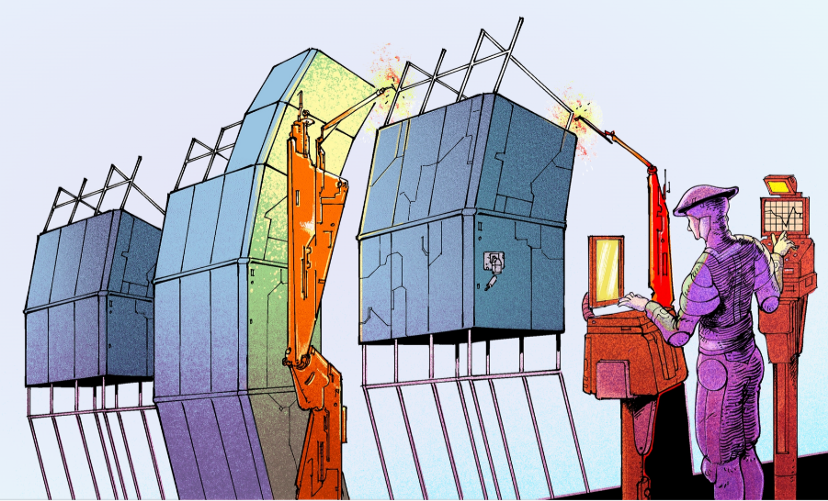
Sharding is a type of database partitioning that breaks up data into smaller pieces so that it can be more efficiently stored and processed. In the context of Ethereum, sharding refers to the division of the Ethereum blockchain into multiple shards, each of which stores a subset of transactions. This would allow each node in the network to only process a small portion of transactions, greatly increasing the scalability of the Ethereum blockchain by utilizing parallel processing. Additionally, since each node would be processing less data, running a client will become far more accessible and it may even be possible to run a node on a mobile phone, making Ethereum incredibly decentralized.
It may be helpful to think of each shard as its own micro-blockchain, and then the main Ethereum chain as a coordinator between all these different chains.
Ethereum will be first implementing the Danksharding design, which has some differences from traditional sharding. Danksharding implements proposer-builder separation, which means that the nodes building blocks are different from the node proposing blocks. The building is intensive and will likely become more centralized while validating is not and will become more decentralized, which many experts agree is the right approach to take. As an analogy, it doesn’t matter who builds a skyscraper if anyone can check its structural integrity.
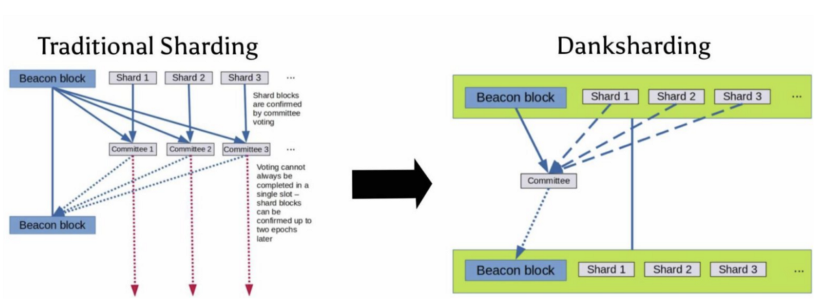
PBS will also help with the miner extracted value, or MEV, problem, which results in users paying higher fees for their transactions due to node frontrunning.
The first step in implementing Danksharding is Proto-Danksharding, also known as EIP-4844. Proto-Danksharding aims to introduce a programming object known as blobs to Ethereum. These blobs will help lower transaction fees on Layer 2s. Developers hope that EIP-4844 will be included as part of the next major Ethereum upgrade (likely in 2023), but whether or not they are able to achieve this goal remains to be seen.
A few blockchains, including Harmony and NEAR, have already implemented sharding on their mainnets. Harmony, another EVM-based chain, has 4 shards, but all the activity and smart contracts are on the first shard and nothing much happens on the other. The main reason for this is because all of the liquidity and dApps are already on the first shard and cannot natively interact with other shards, and Harmony is fast and cheap enough to where it does not make sense to expand to other shards just yet.
Sharding is a sought-after solution for blockchain scalability issues because it has the potential to greatly increase transaction throughput without compromising security or decentralization. However, there are also some challenges that need to be addressed, like data storage and cross-shard communication. Regardless, sharding technology shows great promise and could one day help make blockchain applications mainstream.
(By Lincoln Murr)


All Comments