

Cointime

Download App
iOS & Android

Rise of Ethereum staking came at cost of higher centralization — JPMorgan

Validated Media

The rise of Ethereum staking since major network upgrades, the Merge and Shanghai, has come at the cost of higher centralization and lower staking yields, a new report by JPMorgan said.

JPMorgan analysts, led by senior managing director Nikolaos Panigirtzoglou, issued a new investor note on Oct. 5, warning about the risks stemming from Ethereum’s growing centralization.
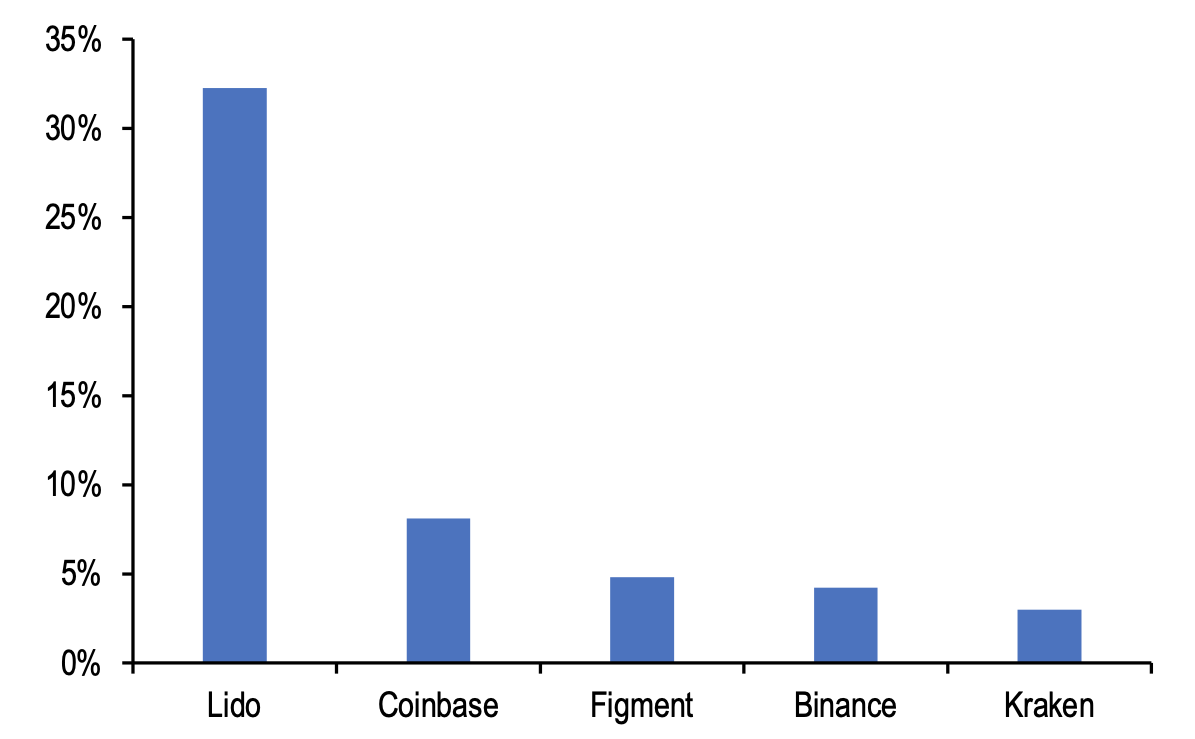
Market share of top five liquid staking providers. Source: JPMorgan

The top five liquid staking providers: Lido, Coinbase, Figment, Binance and Kraken, control over 50% of staking on the Ethereum network, JPMorgan analysts noted in the report, adding that Lido alone accounts for almost one-third.

The analysts mentioned that the crypto community has seen the decentralized liquid staking platform Lido as a better alternative to centralized staking platforms associated with centralized exchanges like Coinbase or Binance. However, in practice, “even decentralized liquid staking platforms involve a high degree of centralization,” JPMorgan’s report said, adding that a single Lido node operator accounts for more than 7,000 validator sets or 230,000 Ether These node operators get selected by Lido’s decentralized autonomous organization (DAO), which is controlled by a few wallet addresses, “making Lido’s platform rather centralized in its decision making,” the analysts wrote. The report mentioned a case when Lido’s DAO rejected a proposal to cap the staking share at 22% of Ethereum’s overall staking to avoid centralization.

“Lido didn’t participate in the initiatives as its DAO rejected the proposal by an overwhelming majority of 99%,” JPMorgan analysts wrote, adding:

“Needless to say that centralization by any entity or protocol creates risks to the Ethereum network as a concentrated number of liquidity providers or node operators could act as a single point of failure or become targets for attacks or collude to create an oligopoly [...]”

Apart from higher centralization, post-Merge Ethereum is also associated with an overall staking yield decline, JPMorgan noted. The standard block rewards declined from 4.3% before the Shanghai upgrade to 3.5% currently, the analysts wrote. The total staking yield has declined from 7.3% before the Shanghai upgrade to around 5.5% currently, the report added.

JPMorgan analysts aren’t the only Ethereum observers who have noticed a significant increase in network centralization following the Merge upgrade. Executed on Sept. 15, 2022, the Merge has been seen as a major impediment to Ethereum’s decentralization and a major reason for dropping yields.

Ethereum co-founder Vitalik Buterin has admitted that node centralization is one of Ethereum’s main challenges. In September 2023, he said that finding a perfect solution to handle this problem may take another 20 years.

Comments

All Comments

Recommended for you

  • BTC Surpasses $82,000

    Market data shows that BTC has surpassed $82,000, currently priced at $82,038.65, with a 24-hour increase of 0.31%. The market is experiencing significant volatility, so please ensure proper risk management.

  • ETH Surpasses $2400

    Market data shows that ETH has surpassed $2400, currently priced at $2400.26, with a 24-hour decline of 1.33%. The market is experiencing significant volatility, so please ensure proper risk management.

  • BTC Surpasses $81,000

    Market data shows that BTC has surpassed $81,000, currently priced at $81,016.34, with a 24-hour decline of 1.53%. The market is experiencing significant volatility, so please ensure proper risk management.

  • BTC Falls Below $80,000

    Market data shows that BTC has fallen below $80,000, currently priced at $79,940.09, with a 24-hour decline of 3.44%. The market is experiencing significant volatility, so please ensure proper risk management.

  • Philadelphia Semiconductor Index Set to Lose Over $2 Trillion in Market Value in Seven Trading Days

    The Philadelphia Semiconductor Index is poised to evaporate over $2 trillion in market value within seven trading days.

  • Philadelphia Semiconductor Index Drops 4% to Lowest Level in Nearly a Month

    The Philadelphia Semiconductor Index fell by 4.01% during the day, currently reported at 11,215.37 points. Nvidia dropped by 3.25%, Broadcom fell by 2.87%, Micron decreased by 5.79%, Intel declined by 5.81%, AMD dropped by 6.28%, Qualcomm rose by 0.66%, TSMC fell by 4.37%, and ASML decreased by 3.34%.

  • Philadelphia Semiconductor Index Falls 4% to Lowest Level in Nearly a Month

    The Philadelphia Semiconductor Index dropped 4.01% during the day, currently reported at 11,215.37 points. Nvidia fell by 3.25%, Broadcom by 2.87%, Micron by 5.79%, Intel by 5.81%, AMD by 6.28%, Qualcomm rose by 0.66%, TSMC fell by 4.37%, and ASML dropped by 3.34%.

  • Ripple Prime Launches Perpetual Contract Trading Services for Institutional Clients

    According to Bloomberg, Ripple's main brokerage division, Ripple Prime, is launching perpetual contracts for real-world assets (RWA) aimed at institutional clients, covering over 100 reference markets including stocks, indices, ETFs, and commodities. This product is offered through Trade.xyz on Hyperliquid, continuing Ripple Prime's previous initiative to provide clients with access to cryptocurrency perpetual contract trading.

  • NYC Comptroller Urges Anthropic to Pause IPO Plans

    On October 15, New York City Comptroller Mark Levine stated in an interview that he has written to Anthropic CEO Dario Amodei, urging the company to suspend its planned initial public offering (IPO). In the letter, he called for Anthropic to pause its IPO plans until it can fully and transparently address concerns related to AI safety, governance, and development that the company itself has raised. Levine wrote that the company should focus on mitigating these risks rather than advancing the IPO. Currently, New York City has an investment exposure of less than $10 million in Anthropic through the private market.

  • US September PPI Rises 6.3% Year-on-Year, Exceeding Market Expectations

    The US Producer Price Index (PPI) for September recorded a year-on-year increase of 6.3%, the highest since May 2026, surpassing market expectations of 5.3%. The month-on-month PPI for September was reported at 1.3%, significantly higher than the market forecast of 0.5%. Additionally, US retail sales for September showed a month-on-month increase of 0.8%, also exceeding market expectations.
