


Web3 is accelerating, and Arweave will be adopted by more developers as an infrastructure, creating a new and more colorful ecosystem. PermaDAO is a community of co-builders built for this purpose. Everyone involved can find a role in contributing to the Arweave ecosystem, and any proposal and mission for Arweave can be posted here and received support and feedback from the entire community. Join PermaDAO and build Web3!
Author: Spike @ Contributor of PermaDAO
Reviewer: Xiaosong Hu @ Contributor of PermaDAO
With the continuous development of the encryption industry, more and more crypto wallet applications have emerged. This chapter will classify and summarize the existing crypto wallet products from three perspectives. As shown in Figure 1.1, each classification method actually reflects the strategic focus adopted by the crypto wallet and the user groups it is oriented to. Many wallet products have carried out in-depth exploration in terms of security, ease of use, and functional integration.
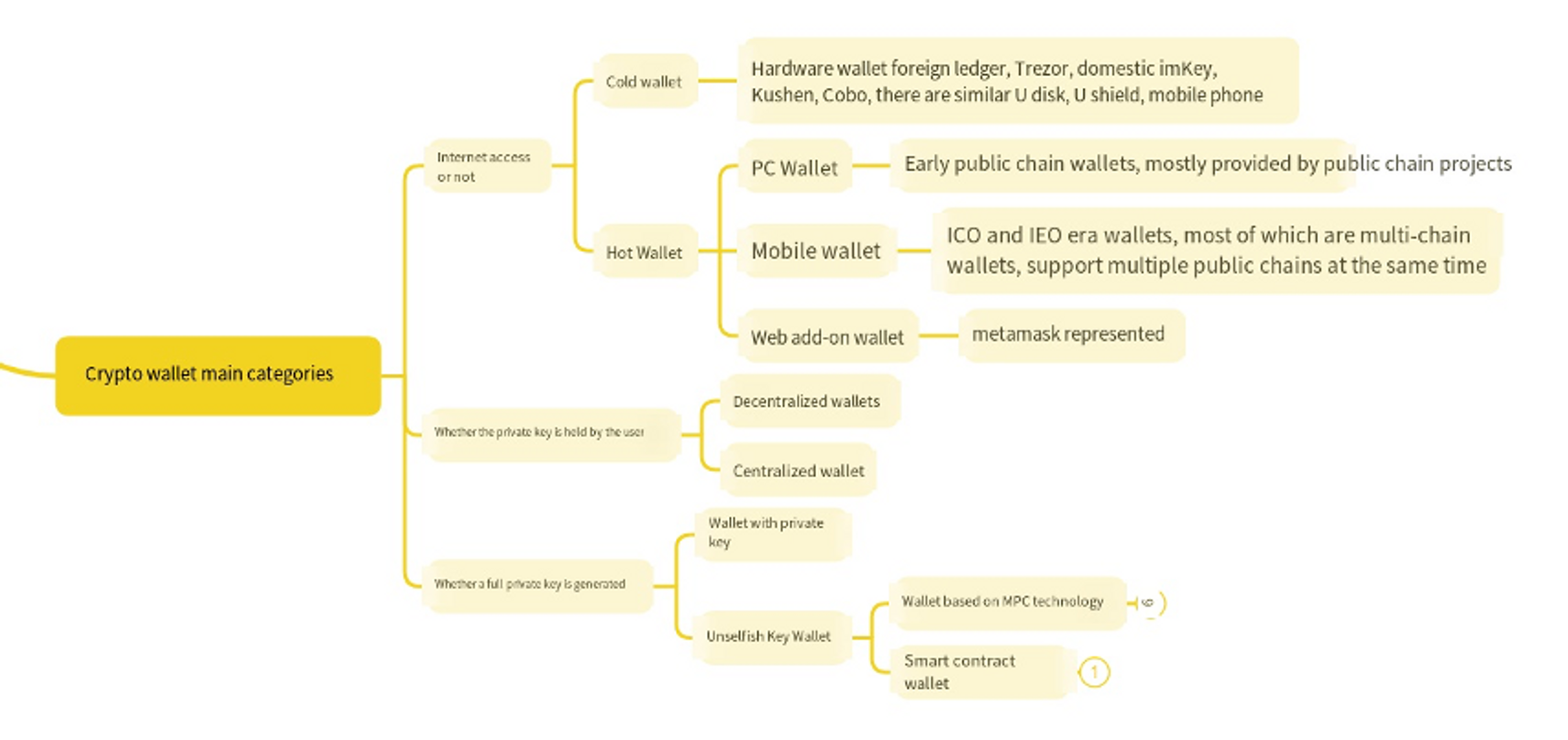
Figure 1.1.Major categories of crypto wallets
- Categorized by whether the private key is stored by the user
Encrypted wallets are essentially tools for storing private keys, and the security of private keys is very important. In order to achieve extreme security, cold wallets that are not connected to the network have emerged.
- Hot wallets
- Features: Wallets that stay online in real time are often called hot wallets.
- Analysis: The hot wallet is more convenient to use than the cold wallet. It can be used on the PC, or in mobile terminals such as mobile phones, and can also operate the assets in the wallet at any time. However, due to its network connection, it also gives hackers the basic conditions for attack, and the security of the wallet will be challenged. However, usually the wallet project side will encrypt the stored private keys and communication packets, which can also avoid hackers from easily invading to a certain extent.
- Cold wallet
- Features: Cold wallets usually refer to wallets that are not connected to the Internet, also known as offline wallets. According to the different implementation methods, they can also be divided into hardware wallets and paper wallets. The hardware wallet is used to generate and store keys, and the device itself does not leak or output the keys, but only displays the storage of the keys after we press a button or enter the passcode of the device. A paper wallet, as the name suggests, is one where you write down the key on a piece of paper and then lock the paper in a safe.
- Analysis: Cold wallets, which store private keys on a completely offline device, are a more secure approach than hot wallets, but are more expensive and less usable. For example, the traditional hardware wallet Armory requires an offline computer dedicated to the offline installation. Although the cold wallet is more secure than the hot wallet, the cold wallet is not absolutely safe. Hardware damage and wallet loss may occur, so it is necessary to make backups.
- It is classified by whether the private key is stored by the user
Private keys are the core of security in the field of digital assets, and the essence of wallets is to help users manage and use private keys conveniently and safely. Therefore, the storage method of private keys is very critical. According to whether the private key is stored on the user's local device, we can divide wallets into two types: centralized wallets and decentralized wallets. At present, decentralized wallet is the mainstream model.
- Centralized wallet
- Features: The private key is not held by the user, but is kept by the wallet project on the off-chain central server, and usually the funds are also escrow by the service party.
- Analysis: Centralized wallets are usually called Offchain wallets, private keys and assets are handed over to the wallet for centralized management. Users register through their mobile phone number or email. Users of wallet products in this way do not have to worry about the loss of funds caused by the loss of private keys, and usually support the function of account password recovery. However, the capital risk will be more concentrated in the wallet project side. Once the centralized server is hacked, the user will suffer unnecessary losses, and the project side cannot be effectively prevented from doing evil.
- Decentralized wallet
- Features: The private key is held by the user, and the assets are stored on the blockchain.
- Analysis: Decentralized wallets are usually called Onchain wallets, and the custody of the private key is handed over to the user. If the private key is lost, the wallet will not be able to help the user recover, and the funds will be lost permanently. However, decentralized wallets are difficult to suffer from centralized attacks by hackers, and users do not have to worry about the situation of wallet service providers.
- They are classified according to whether they need to generate a complete private key
Private key management has always been an obstacle for encryption users. The complicated private key self-hosting mode has blocked a large number of Web2 users from the encryption world. When NFTS break the circle and attract more incremental users to enter the encryption field, digital assets are not only stored once and for all, but also more traded and used. The way of using assets through private keys is neither safe nor friendly, and it is difficult to meet the needs of many application scenarios. How to simplify the operation steps of private key management, improve ease of use, and reduce the difficulty of users to retain private keys and the risk of loss has become an important issue in the development of encrypted wallets.
- There are private key wallets
- Features: Private keys or mnemonics are generated in the process of wallet creation, which need to be safeguarded by users.
- Analysis: At present, the vast majority of wallets on the market belong to private key wallets, which belong to the branch of decentralized wallets, and have all the advantages and disadvantages of decentralized wallets.
- Selfless key wallet
- Features: It is mainly divided into secure multi-party computation MPC technology and smart contract wallet with account abstraction to realize user selfless-key wallet account creation.
- Analysis: The user experience and security of the existing mneminics wallets are far from the level of Web2, and the high threshold for using mneminics wallets prevents a large number of Web2 users from entering the Web3 world. With the selfless key wallet, users do not need to bear the risk of private key self-hosting, and can achieve Seedless, Gasless, and social recovery. This is the focus and development direction of the current wallet field.
Technical Overview of Crypto Wallet
The crypto wallet technology implementation consists of three main parts:
- The design of the wallet itself, how to generate mnemonics, keystores and passwords, etc.
- How to generate private key, public key and address;
- The RPC interface design of wallet remote call to each public chain;
As shown in the following figure, the technical process of the encryption wallet implementation can be summarized in general:
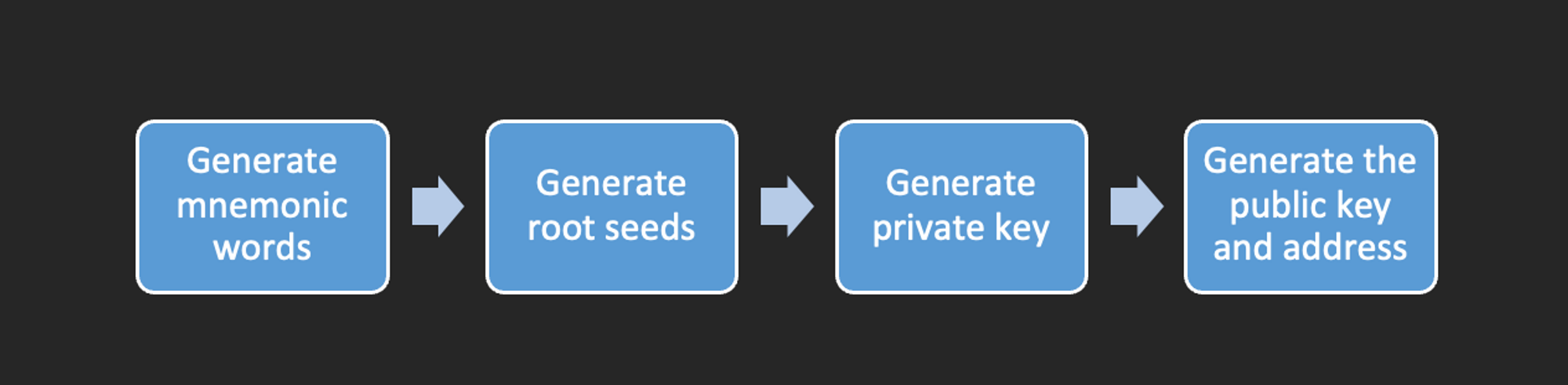
Figure 2.1 Overview of the technical process of the implementation of the encryption wallet
As we all know, the private key is a string of irregular strings, which is very inconvenient to remember and use. Therefore, from the perspective of wallet design, in order to simplify the operation without losing security, a mnemonic word method has appeared. Under normal circumstances, mnemonics consist of some words. As long as you remember these words and input them in the wallet in order, you can open the wallet. The principle and method will be expounded in detail below.
Wallets can be divided into two categories according to whether there is a relationship between keys:
- nondeterministic wallet: each key is generated independently from random numbers, and the Keys are not associated with each other. This kind Of wallet is also known as "Just a Bunch Of Keys", referred to as JBOK wallet.
- deterministic wallet: All keys are derived from a master key, which is the Seed. All keys in this type of wallet are related to each other, and all keys can be found through the original seed. There are many different key derivation methods used in deterministic wallets, but the most common one uses a tree structure called hierarchical deterministic wallets or HD(hierarchical deterministic) wallets.
Bitcoin Core is a nondeterministic wallet that generates key pairs that are not directly related to each other. It is troublesome to backup and import this type of wallet. Users must operate the private key and corresponding address in the wallet one by one. The following figure contains a nondeterministic wallet with a loosely structured random key set:
Deterministic wallet is based on BIP32(Bitcoin Improvement Proposal32)/BIP39/BIP44 standards.
It maintains n private keys through a common seed, and the seed derivation private key uses irreversible hash algorithm. Only this seed can be backed up (in most cases, the seed is generated by BIP44 mnemonic words, which is convenient for transcription). In wallets supporting BIP32, BIP39, and BIP44 standards, only the mnemonic words can be imported to import all the private keys, as shown in the following chapter.
The BIP32, BIP39 and BIP44 standards are mentioned above. To summarize, the BIP32 standard defines that the seed uses HMAC-SHA512 to generate the root private key and export the child private key, which is the main standard for HD wallet; BIP39 standard defines wallet mnemonic words and seed generation rules; BIP44 standard defines node layout for multi-currency and multi-account wallets.
In addition, there is the BIP43 standard for defining multi-purpose HD wallet structures. The concrete can learn to https://github.com/bitcoin/bips.
- Wallet Design Framework
- Generate mnemonic words (BIP39 standard)
There are 2048 words in the mnemonic thesaurus, and 11 bits can be used to locate all the words in the thesaurus (2^11=2048), as the index of the word, so a word is represented by 11 bits, and the number of mnemonic words can be (entropy + checksum)/11, the value is 12,15,18,21,24. It is stipulated that the number of bits of entropy must be an integer multiple of 32, so the length value of entropy is 128 to 256, which is 128,160, 192, 224,256. The length of the checksum is the length of the entropy /32 bits, so the length of the checksum can be 4,5,6,7,8 bits.
The specific steps to generate a mnemonic are shown in Figure 2.4:
1) Generate a random sequence (entropy) with length of 128 to 256 bits (bits), taking 128 bits as an example;
2)Take the first n bits after entropy SHA256 hash as the checksum (n= entropy length /32), the figure is 128/32=4;
3) random sequence (entropy)+ checksum concatenated into a string, the figure is 128+4=132;
4) Cut the result obtained in step 3 every 11 bits, and the figure is 132/11=12 strings;
5) Each string obtained from step 4 matches a word in the predefined 2048 vocabulary;
6) The result of step 5 is a mnemonic string, which is an ordered group of words, what we have been referring to as a mnemonic.
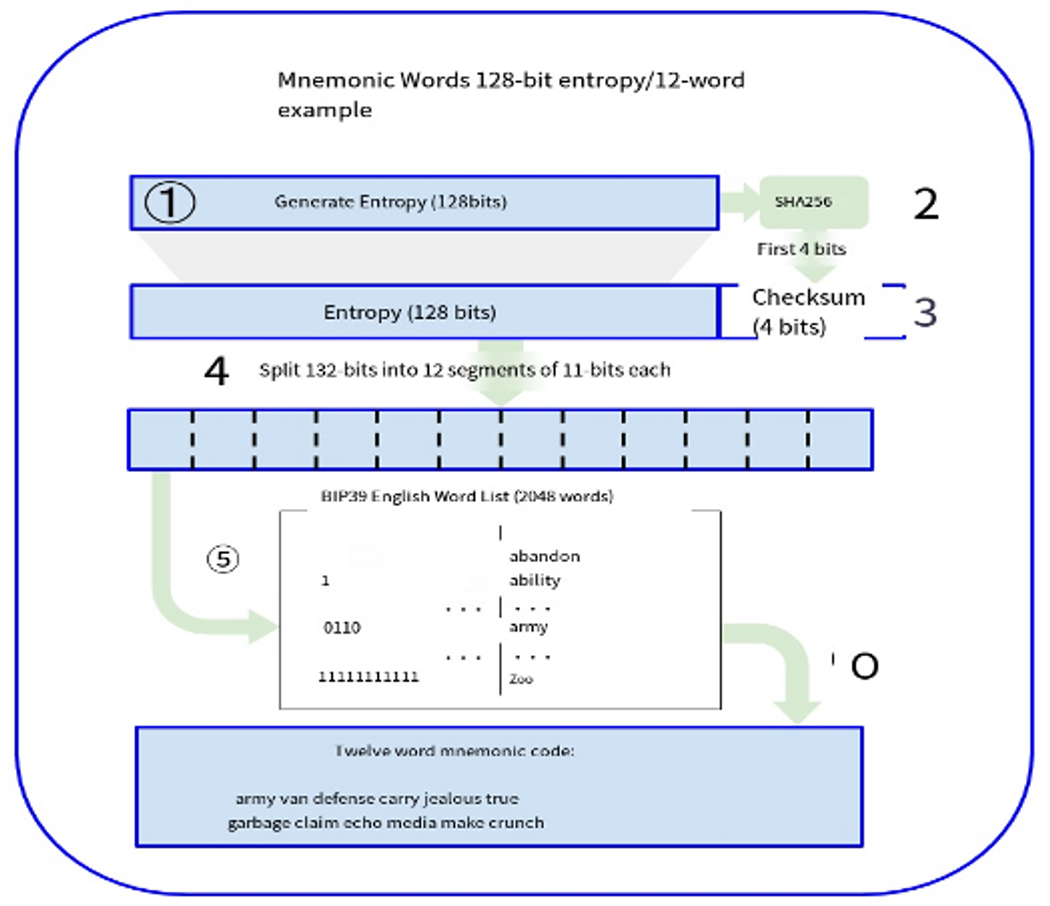
Figure 2.2 Schematic diagram of the algorithm for generating a 12-digit mnemonic
- Seed generation by mnemonic (BIP39 standard)
Mnemonic word from a length of 128 to 256 - bit random sequence (entropy) matching thesaurus, then use PBKDF2 (Password - BasedeyDerivationFunction2) longer seeds (seed) is deduced. The generated seeds are used to generate the deterministic allet and derive the wallet key. In cryptography, Keystretching technique is used to enhance the security of weak keys, increase the Brute-forceattack time for each possible key, and increase the difficulty of the attack. Native libraries for various programming languages provide implementations of key tretching. PBKDF2 is one of the commonly used keystretching algorithms. The basic principle is to take a random function (such as HMAC function), take plaintext and salt as input parameters, and then repeat the operation to finally produce the key.
See theory below:
1) PBKDF2 has two parameters: mnemonic and salt. The purpose of salt is to increase the difficulty of a brute-force attack. See the BIP-39 standard. Salt consists of a string constant "mnemonic" concatenated with an optional user-supplied password string;
2) PBKDF2 uses HMAC-SHA512 as a random algorithm +2048 hash repetitions to finally obtain BIP32 seed, 512 bits (64 bytes) is the expected seed length. Namely DK = PBKDF2 (PRF, Password, Salt, c, dkLen), among them, the PRF is a pseudo-random function, such as HASH_HMAC function, it will output the length of hLen results; Password is the original password used to generate the key; Salt is a salt value for encryption; c is the number of times the calculation is repeated; dkLen is the expected length of the key; DK is the final key produced.
- Creating HD Wallets from Seeds (BIP32 standard)
HD wallets are created from a single Root Seed, which is a random number of 128 to 256 bits. Any root seed compatible with HD wallet can also recreate the entire HD wallet, so owning the root seed of HD wallet is equal to owning all keys for easy storage, import and export.
The generation process of the specific Master Key and the main Chain Code of HD wallet is shown in Figure 2.6. The root seed calculated the 512-bit hash string through the irreversible HMAC-SHA512 algorithm, the left 256 bits are the Master Private Key(m), and the right 256 bits are the Master Chain Code. The Chain Code is used as the entropy of the derivation of the subordinate key.
The above process combined with BIP43, BIP44, HD wallet can also achieve such as multi-currency, multi-account, multi-purpose and other functions.
- Basic functions of keystore and password
Going back to the user experience, mnemonics are still complicated, and the existing password operation is the most familiar way for users. Therefore, wallets also provide a keystore that allows users to export a key file to save. The Keystore is stored on the device in use, so that only the corresponding password is entered each time they login. The Keystore is a file with an encrypted private key that requires a password set by the user to open the file. Even if the keystore file is stolen, as long as the password set by the user is long and random, the private key will not be leaked in a short period of time, and there is enough time to transfer the digital assets in the address to other addresses.
- How the private key, public key, and address are generated
Deriving the public key from the private key and the public key hash from the public key is unidirectional, using an irreversible algorithm commonly known as the elliptic curve algorithm:
The overall public key and address generation process is shown in next:
1) Generate a private key from a random number;
2) the private key is processed by SECP256K1 algorithm to generate a public key;
3) RIPEMD 160 is a Hash algorithm like SHA 256. After one SHA 256+ one RIPEMD 160 hash operation, the public key hash is calculated from the public key.
4) Connect the address version number of a byte to the head of the public key hash, perform two SHA 256 operations, and connect the first 4 bytes of the result as the check value of the public key hash at its tail;
5) Encode the result of step 4 with BASE58, that is, get the wallet address.
The detailed public key generation process is as follows:
1) The private key is 32 bytes (256 bits) of random number;
2) put the version number in the head of the private key;
3) add a compression flag to the end of the private key; . perform SHA256 hash operations on the private key twice, and take the first 4 bytes of the two hash results as the check code, which is added to the compression flag;
5) Encode the random numbers obtained by the 2, 3 and 4 steps with BASE58 to obtain the WIF (Wallet import Format) private key (used for importing and exporting private keys between wallets, which is a common key format for users).
6) The public key can be obtained by elliptic curve multiplication of the private key. The public key is a point on the elliptic curve and has x and y coordinates.
The detailed wallet address generation process is as follows:
1) The public key is processed by SHA256 hash algorithm to obtain a 32-byte hash value;
2) The RIPEMD-160 algorithm was used to obtain the 20-byte public key hash Hash160.
3) Double-SHA256 hash operation is performed on the 21-byte array composed of version number + public key hash Hash160.
4) The first 4 bytes of the hash value are used as the checksum and placed at the end of the 21-byte array;
5) Base58 encoding of the formed 25-bit array, and finally get the wallet address.
- Wallet backup and recovery methods
Backup, as a necessary prerequisite for wallet recovery and preservation, generally requires users to backup immediately after the address is created, and the correctness of backup of mnemonials is verified to avoid asset loss caused by users accidentally forgetting passwords or device loss. No matter what kind of backup method, users need to be careful to avoid direct plaintext screenshots or storage in networking devices or cloud services, to avoid improper storage or malicious hacker attacks to leak relevant information, and lead to the theft of encrypted assets. The altruistic key wallet needs to backup private key fragments, complete biometric verification, cloud backup and other specified operations according to the instructions of the wallet. Please refer to the table below for specific backup and recovery methods.
| Encrypted wallet backup method | Crypto wallet recovery method | Adapting to the situation |
| Backup mnemonics (Mnemoniccode) | Import mnemonics | 1. Multi-chain wallets can back up all generated multi-chain private keys by backing up mnemonics; 2. It is suitable for different devices of the same wallet software, and multi-chain wallet recovery. |
| Backup private key | Backup private key | 1. Backup the private key of a public chain; 2. Suitable for different wallet software, single-chain wallet recovery |
| Backup Keystore+ password (Keystore+Password) | Import Keystore+ Password to unlock the encrypted file | The Keystore file needs to be backed up with the wallet password, otherwise the Keystore file cannot be decrypted. Due to the relative complexity of the operation, this method is rarely used at present |
| Backup the private key shard file | Import the private key shard file, or social recovery | Secure multi-party computation MPC scheme wallet |
| No backup required | Smart contract wallet |
Table 2.9 Ways of wallet backup recovery
It should be noted that most wallets with private keys have mnemonics and private keys that cannot be recovered: the private key + mnemonics is not backed up, and the device imported before is lost or the wallet password is forgotten. It will lead to the user's assets cannot be recovered.
Security analysis of crypto wallet
For the blockchain industry, security will be an eternal topic. Wallets involve the core of users' assets, and their security can not be ignored. The security of crypto wallets should not only be comprehensively considered from the underlying design, but also the security education of users is also very important for most decentralized wallets.
- Users are accustomed to secure guidance
For decentralized wallets, private keys are saved by users. How to help users correctly understand and use keys and mnemonics has become the focus of the wallet project. At present, mainstream wallets use image-text tutorials, answer tests, video explanations and other methods to help users understand the basic concepts of wallets and remind users to properly keep mnemonikers, private keys and local passwords. It is recommended to record manually through relatively primitive methods, stay away from screenshots, copy and other computer operations, develop good Internet habits, and minimize the risk.
- Wallet Security Design
- Network transmission security
- MITM man-in-the-middle attack defense, that is, two-way verification
MITM (Man-in-the-middleattack) : An attacker creates separate connections with two peers and exchanges the data they receive, making both peers think they are talking to each other directly over a private connection, when in fact the attacker is in full control of the conversation. Although most crypto wallet applications use the HTTPS protocol to communicate with the server, the MITM attack method can obtain the content of the HTTPS protocol by installing a digital certificate on the user's terminal. A secure encrypted wallet needs to be able to scan the legitimacy of all digital certificates in the terminal, check the proxy Settings in the process of network transmission, and ensure the security of the basic network communication environment. In the development of encrypted wallet, whether to use two-way verification for communication verification at the network transmission level is an important evaluation standard to measure the security of an encrypted wallet application.
- RPC interface call permission security
The wallet itself is only the interface software of the blockchain world. As introduced in the previous section, many use RPC to call the corresponding interface. The permission control of data transmission in this calling process is the security of data communication. Security policy when Remote Procedure Call (RPC) is used: for example, when remote procedure call access is enabled on the wallet node Geth, do not allow external access to remote procedure calls with unlocking account functions.
- Client-side file management security
File security mainly considers that the files installed on the user side are encrypted and cannot be cracked, and some prohibited operations for the user or increase the inconvenience of some risk operations to reduce the risk caused by the user.
- Installation Package Security
Ensure the security of the software installation package can not be decompiled, cracked to insert illegal operations, etc.
- Resist terminal bad program access to critical files
The core information of the encrypted wallet, the private key/mnemonics, is stored on the terminal device, whether it is a PC or a mobile terminal. If the terminal device is unsafe, there is a very high security risk for the private key/mnemonics.
A secure encrypted wallet should be designed at the beginning to avoid the possibility of stolen private keys/mnemeics caused by the operating environment, such as increasing the function of face recognition or SMS confirmation when users want to access the core files.
- Terminal key file encryption method
Use high security encryption method for terminal key files to prevent ordinary programs from accessing, or even if the key file is copied out, the third party can not easily crack the function. Such as Wallet.dat encryption problem.
- Terminal key file backup process display way
Users inevitably have the demand for backup of key files. When designing a wallet, it is necessary to consider the actual security operation to restrict the direct export of key files, or allow the export of key files, but the decryption method is displayed in a way that no operation can be performed, for users to manually record.
- Generation and management of key information such as mnemonics
The generation and management of the core key information of the wallet, such as mnemonics, private keys, and keystores, should fully consider the security. The design principles and ideas of the three are basically the same, taking mnemonics as an example: in order to ensure that the client generates mnemonics, it cannot go through any cloud or server, which is the core of the decentralized wallet. Any process of accessing mnemonics requires the user to actively confirm, such as the above mentioned face recognition or SMS confirmation function. The mnemonics are displayed in a way that no operation can be carried out for users to record manually.
- Importing private keys and mnemonics generated by other wallets is safe
Related security ideas are: by recreating new core files, reduce the risk of illegal program intrusion; It can also use the function of face recognition or SMS confirmation.
- Develop extended security
Considering the wallet as the interface of the blockchain, it is important for the application to scale, so the design needs to strictly control the permissions of the open port to ensure that the communication is only public key signature. At the same time, the application should be strictly examined whether it has the core technical ability of anti-tampering ability, as well as memory safety and anti-debugging ability during the operation of the application. In addition, considering the risk of forgetting the user's password, we can consider using multi-signature to increase various application scenarios, such as password recovery function.
The disassembly of the functions of encrypted wallet products
From the beginning of its birth, the wallet was used as a tool to assist users in generating and managing. The core function was to realize the creation and transfer operation of encrypted wallets. After active exploration and development, it has successively launched multiple value-added product modules including information, financial management, trading, and so on. On the one hand, in order to increase user viscosity, improve the flow entrance, accumulate users and precipitate funds; On the other hand, it also tries to increase revenue sources.
- Crypto wallet users and scenarios
- Target user profile
- User needs
- Demand scenario
- Crypto wallet basic functionality
- Wallet account creation
- Core functional logic:
After the user opens the application, it will check whether there is a wallet account in the local area. If not, it will enter the wallet account creation boot page. After the user sets the wallet password, it will generate a wallet account. Enter the mnemonics/private key/private key fragment backup process to guide the user to complete the backup.
- Desired type requirements:
- Support creation of multi-chain accounts;
- Support creation of multiple accounts;
- Wallet account avatar and name setting management;
- Support searching and adding (fuzzy query + contract address precise query) and deleting currency display;
- Home token display order adjustment;
- Support NFT asset display;
- Selfless key account creation;
- Social recovery;
- Wallet account backup
- Core functional logic:
After the wallet address is created or the user enters the backup wallet function through wallet management, input the wallet password to unlock the local kestore file, enter the backup bootstrap process page, prompt the backup notes, display the mnemnez/private key/private key fragment, and complete the backup verification (the mnemnez verification sequence and the private key fragment file verification are completed), and the backup is finished.
- Desired type requirements:
- No need to copy backup mnemonic/private key;
- Wallet account import
- Core functional logic:
Users enter the wallet account import function through the import wallet button, input the wallet password, import the mnemonics/private key/private key fragment, enter the verification is correct, and the corresponding address encrypted assets are displayed after parsing.
- Desired type requirements:
- Support scan input;
- Support importing via social accounts
- Money transfers
- Core functional logic:
To carry out cryptocurrency transfer operation, the basic operation process of the user is to select the currency with a balance greater than 0 on the address, fill in the receiver's address, set the commission, and after the basic information is verified, enter the wallet password, decrypt the local encrypted file and complete the signature authorization, and package the signed transfer information and send it to the blockchain network, waiting for the chain, and add the transfer record at the same time. Mark the transfer status.
- Desired type of demand:
- Address book: record the user's common address to facilitate user operation and avoid the loss of asset transfer caused by address input errors;
- Miner fee setting: open the authority of fee setting to users, users can set procedures according to their own needs;
- Address token arrival notification: monitor the change of users' address assets and notify the users in time to help users grasp the address assets in time;
- Service fee gas station: help users solve the problem of transfer fee, and avoid being unable to transfer due to lack of service fee;
- Transaction acceleration: Due to the congestion of the main chain network, the initiated transfer transaction cannot be confirmed on the chain for a long time, and may further affect the user's next transfer. In this case, the previous transaction application can be repackaged through transaction acceleration to be confirmed by miners as soon as possible.
- Batch transfer: it supports users to import multiple transaction information and quickly realize multiple transfer needs.
- Support node configuration: users can select network nodes to receive and send relevant information on the chain.
- Full transfer: ensure that the user meets the fee, all transfer out, to avoid the address retention of small tokens;
Figure
- Collection
- Core functional logic:
By displaying the user address and two-dimensional code, users can view, confirm and share their own token address, so as to ensure normal reception of encrypted assets sent by others.
- Expectation type demand:
- Set the collection amount: the collection amount information and the address are displayed in the two-dimensional code, which is suitable for the collection scene;
- Copy address information: it is convenient for users to forward to others and avoid errors when users copy their own address;
- Share: support users to share to other applications with one click;
Receiving pictures
- Crypto wallet multi-chain support
One wallet account manages multiple public chain assets. Through the continuous investment of the technical team, docking support for different public chains, enhance the ease of use of wallets, and build a one-stop multi-chain asset management platform
- Resource requirements: the technical team needs docking support and continuous maintenance, and the server resource occupation will be relatively prominent.
- User growth: It can radiate all users of the public chain and obtain more user traffic. Especially, once the new public chain is launched, it can be quickly supported, which will bring a wave of user growth. We need to combine the situation of target users and improve the relevant capabilities in the long term.
- Exploration of value-added services of crypto wallets 1. Market information
Wallet built-in rich news information, market express, project introduction, K chart, large funds flow monitoring, code activity and other digital asset market information. The information and market information of the blockchain project is the demand of token holders to keep pace with the market, and it is also the big entrance to gather user traffic. If the wallet product can integrate the information and market service well, it can not only generate enough viscosity for existing users, but also bring in more incremental users. However, the information market service needs to invest a certain amount of human and financial resources, which will greatly increase the operating cost of the product. It is generally used to connect media information websites, such as non-small or Tokeninsight, golden finance, Babbit, odaily, coinmaket, etc., mainly used to improve user activity and improve user convenient experience.
Infographic
- Deals
Wallets have built-in digital asset trading capabilities, and there are wallets that access centralized exchange platforms, such as BitPie; There are also wallets connected to decentralized exchange platforms, such as Imtoken; And automated trading platforms such as Tokenpocket that tap into Bancor's mechanisms.
At present, the built-in transaction of the wallet is mainly based on the "flash" (or Swap) function, which creates revenue through transaction fees. That is, different currencies are swapped according to a certain "exchange rate", and its background usually connects to multiple flash exchange service providers or decentralized exchanges. Flash exchange does not need to recharge the Token to the trading platform in advance, and the exchange can be completed directly in the wallet. We can think of flash cash as a 24-hour unattended ATM machine, where users can exchange different tokens with simple operations. Different from the order matching mode of the trading platform, it is an over-the-counter quotation mode, which can complete the user's token exchange needs in almost real time.
Wallet users naturally have transaction needs. If coins can be traded without raising wallets, it not only reduces the operation steps of users to withdraw coins and transfer coins, reduces the probability of mistakes, but also enhances user viscosity, which provides a good development direction and capital precipitation for the subsequent transformation of wallet projects. However, the built-in exchange greatly increases the complexity of the system, and introduces greater risks for wallet products with higher security requirements, and the security of users' funds will be challenged to a certain extent.
Image of transaction
- Managing your money
The wallet has a built-in financial management module. The financial management types include long-term fixed income type, Yubibao short-term flexible type, token lock position pledge, and mortgage loan type. At present, some of these financial management modules are access to third-party services, and they do not participate in financial services themselves. Some are financial products developed to provide cheap funds for the development of their own platform, and the user interest is paid by the revenue of the platform. Some are to build their own quantitative team, and put the digital assets raised by the platform into the primary or secondary market trading, so as to obtain excess returns and pay user interest; Others provide P2P digital asset lending and trading services, providing matching services for asset demanders and providers.
For users who hold coins for a long time, digital asset financial management services are just needed, and they can also obtain benefits. At present, the annual yield of financial products provided by various wallets is ranging from 4% to 10%. However, with the rapid development of the blockchain industry, the volatility of the digital asset market is high, and financial products with poor liquidity will face greater risks. At present, the digital asset financial management market has made some great progress after the development of the first two years, but it has been affected by the stormy waves of quantitative funds since last year. The scale of lending, financing and quantitative business has fallen rapidly, and the market and users need time to recover and adjust.
- Advertising traffic monetization
Compared with the web2 application advertising monetization model, the traffic monetization in the encryption field is more inclined to deep cooperation, and the traffic is open to the project parties that the wallet team is familiar with or even deeply cooperate with, so as to avoid the user assets falling into the leeping plate project and Rug Pull. Most advertisers in the encryption field need users to transfer assets to participate in the project. Once the wallet is exposed to the wallet user on the premise of commercial cooperation, the wallet platform will inevitably bear the corresponding risk. Once the user's assets are damaged, it will bring immeasurable negative impact to the wallet platform.
Image of advertisement
Appendix 1: Common nouns
- Key: A piece of secret information that is used to perform encryption, decryption, integrity verification, and other cryptographic applications. In symmetric cryptography, the same key is used for encryption and decryption. In asymmetric cryptography, different keys are used for encryption and decryption, and they can be divided into public keys and private keys according to whether they are public or not.
- Private key: In asymmetric cryptography, different keys are used for encryption and decryption. According to whether it is public, it can be divided into public key and private key. The public and private keys are generated and used in pairs. The one that is kept by the user himself and not made public is called the private key.
- Public key: In asymmetric cryptography, the key that can be made public and passed around is called the public key.
- Address: Usually generated from a public key. The public key is generated by various encryption algorithms, hashing algorithms, etc
- It becomes the user's wallet address, similar to the bank card number in traditional finance.
- Digital signature: Similar to the ordinary physical signature written on paper, it requires the user's signature to be activated when transferring assets. Multi-signature, the address allows multiple users to use a public key to send part of the address separately, and jointly manage the asset.
- Mnemonic words: the private key that is difficult to remember is converted into a set of common words through the encryption algorithm. The private key and the mnemonic can be converted to each other.
- Keystore: A private key encrypted by an encryption algorithm, usually stored in a file format.
- Cold wallet: Offline wallet, used in the absence of network environment, collectively referred to as cold wallet.
- Brain wallet: The main principle of brain wallet is to use a predictable algorithm to convert a password into a pair of public and private keys. By inputting a string written by the user, it can generate a one-to-one mapping with a certain key, which is a key generation method.
- Hardware wallet: using professional hardware to store digital assets, the private key of digital assets is stored in a chip alone, isolated from the Internet, and plug-and-play.
- Paper wallet: A method of storing and using private keys or mnemics recorded on paper in the form of strings or QR codes.
- Hot wallet: It is also called online wallet, which is connected to the Internet and the private key is stored in the wallet that can be directly accessed by the network.
- Heavy wallet: full node wallet, which needs to synchronize the number of all blockchains while saving the private key.
- Light wallet: A wallet that does not store all the data of the block, but only the data related to itself.
- Decentralized wallet: it uses other full nodes on the blockchain network to save and synchronize their own related data without saving all block data. There is no need for a third party to manage and store your private key, and the private key is controlled by me.
- Centralized wallet: the user selflessly keys and data are completely dependent on the centralized third party that runs the wallet product.
- Secure multi-party computation MPC: In the absence of a trusted third party, multiple parties collaborate to compute a given function, and each party is guaranteed to obtain only its own computation results, and cannot infer the input and output data of any other party from the interactive data during the computation (unless the function itself can infer the input and output data of other parties from its own input and output).
- Secret Sharing (SS) : splitting the data into multiple meaningless numbers, each party gets a part of the original data, and one or a few parties cannot recover the original data. Only when they put their data together can the real data be recovered.
- Oblivious Transfer (OT) : The data sender has n data, the data receiver receives one of the data, and the data receiver cannot get the other data, the data sender does not know which data the receiver chooses to receive.
- Garbled Circuit (GC) : The calculation logic of a participant's secure multi-party computation protocol is compiled into a Boolean circuit, and then each gate in the Boolean circuit is encrypted and the encryption order is scrambled to complete the confusion operation.
- Homomorphic Encryption (HE) : The result of decryption after computing the ciphertext is the same as the result of directly computing the plaintext. According to the types of operations it satisfies, homomorphic encryption can be divided into addition homomorphism (Paillier homomorphic encryption), multiplication homomorphic encryption (RSA homomorphic encryption), and full homomorphic encryption (Gentry homomorphic encryption).
- Trusted Execution Environment (TEE) : A secure region is constructed in the central processing unit (CPU) by using software and hardware methods to protect the confidentiality and integrity of the programs and data loaded in it.
- Account abstraction
- Smart contract wallet
🔗 关于 PermaDAO:Website | Twitter | Telegram | Discord | Medium | Youtube



All Comments