



Web3 is booming, and Arweave is becoming a popular infrastructure choice for developers. PermaDAO is a community where everyone can contribute to the Arweave ecosystem. It's a place to propose and tackle tasks related to Arweave, with the support and feedback of the entire community. Join PermaDAO and help shape Web3!
Author: Azriel @ Contributor of PermaDAO
Reviewer: Xiaosong HU @ Contributor of PermaDAO
Recent events involving Meta, the parent company of Facebook, have again spotlighted the profound influence and power centralized social media giants wield over global information dissemination. The removal of the largest Palestinian news page, Quds News Network (QNN), from Facebook at a time of heightened geopolitical tension emphasizes this alarming reality.
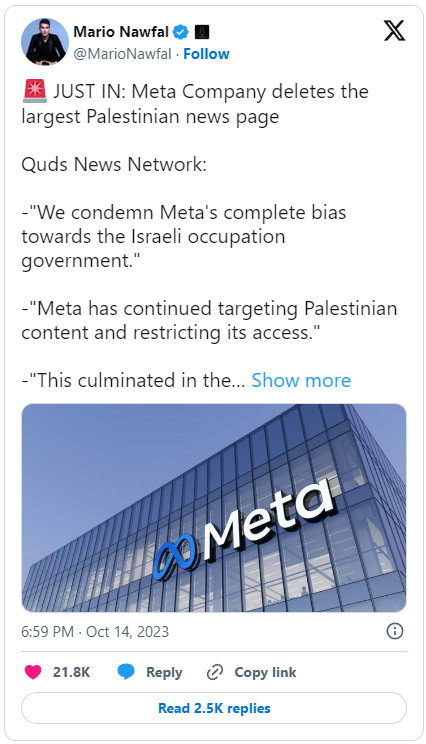
This incident is not isolated. Over the years, various entities, from independent news outlets to individual activists, have faced the whims of platform policies. The platforms, which are private entities, can enforce their guidelines in ways that can sometimes seem arbitrary or even biased. QNN's removal, especially during the ongoing conflict, deprives a significant audience of a perspective that might differ from mainstream narratives. Whether one agrees or disagrees with QNN’s content, its erasure from a major platform diminishes the tapestry of discourse.
Such actions beg the question: Should a handful of companies have the authority to shape global narratives and decide what historical records future generations access?
Decentralization: The Path Forward?
Centralized platforms, by design, are prone to exerting control, whether influenced by governments, advertisers, or public opinion. This structure not only compromises the richness of public discourse but also the historical record. If significant events, perspectives, or voices are removed, future generations might be handed a skewed or incomplete view of history.
In this context, decentralized platforms emerge as a potential solution.
Unlike traditional systems, where decisions and control emanate from a single entity, decentralized systems distribute power among their users. In the realm of social media, this could mean a platform where content moderation and governance are community-driven, making arbitrary deletions less likely.
Arweave: Preserving Deleted Data
Enter Arweave, a decentralized storage solution.
While it's primarily designed to offer permanent data storage on the blockchain, its implications for preserving deleted data are significant. If platforms like Facebook decide to remove content, decentralized storage solutions could archive this data for posterity. Essentially, Arweave can serve as a "time capsule," ensuring that the content — be it news articles, videos, or images — remains accessible to future generations, irrespective of the prevailing narratives or biases of the time.
While this doesn't directly prevent centralized platforms from removing content, it does ensure that data, once on the internet, can always be retrieved. It offers a layer of historical preservation, especially crucial in volatile times.
The removal of QNN from Facebook is a stark reminder of the perils of centralized control over global information streams. As the world grows increasingly digital, safeguarding diverse perspectives and preserving history becomes paramount. Decentralized social media and solutions like Arweave might be the key to ensuring a more balanced and historically accurate digital legacy.
🔗 More about PermaDAO :Website | Twitter | Telegram | Discord | Medium | Youtube


All Comments