


TL;DR
1. NFT lending is a financial product that occurs during the holding phase of NFTs. Its core mechanism allows holders to borrow short-term funds against their idle NFTs without selling them. By leveraging their NFTs as collateral, holders can obtain liquidity in the form of cryptocurrencies or fiat currencies. This allows them to earn profits while enjoying the benefits of holding onto their NFTs, thus improving the efficiency of their funds utilization.
2. There are primarily two categories of NFT lending protocols: collateralized lending and uncollateralized lending.
1) Collateralized lending:
- Peer-to-peer (P2P): Suitable for bear markets with limited liquidity, as the platform is not likely affected by extreme market conditions.
- Peer-to-Pool: Suitable for bull markets with abundant liquidity.
- Hybrid: Based on the standard peer-to-pool mode, it offers greater operational convenience.
- Collateralized Debt Position (CDP): A good choice for those seeking liquidity from blue-chip NFTs but avoiding to pay high interest rates.
2) Uncollateralized lending:
- Buy Now Pay Later (BNPL)
- Flash loan
Allow users in the NFT market who have the intention to purchase but temporarily lack full payment capabilities.
3. The revenue model of NFT lending primarily relies on the loan interest paid by users for collateralized lending. If additional features such as flash loans are available, they can generate corresponding functional fees.
4. The main risks associated with NFT lending are:
- Fluctuation risk in the valuation of NFT collateral (default risk).
- High concentration of target users.
- Limited growth potential of overall sector volume due to limited incremental supply of high-quality asset targets.
5. It is estimated that within three years, assuming a moderate scenario, the overall market capitalization of NFTs could reach approximately $60 billion, with NFT lending’s total value locked (TVL) reaching around $18 billion, catering to approximately $9 billion in lending demand. The projected annual revenue for the NFT lending sector is expected to reach $1.3 billion.
1. Industry Landscape
In the past few years, two areas in the cryptocurrency industry have experienced rapid development. One is decentralized finance (DeFi), which had its “DeFi Summer” in 2020. The other is the NFT boom in 2021.
The overall market size of NFTs on Ethereum has grown from around $61 million in early 2021 to a peak of around $32 billion in just over two years. Although the market has experienced a significant downturn, the market size is still around $7.5 billion, representing a growth of over 120 times.
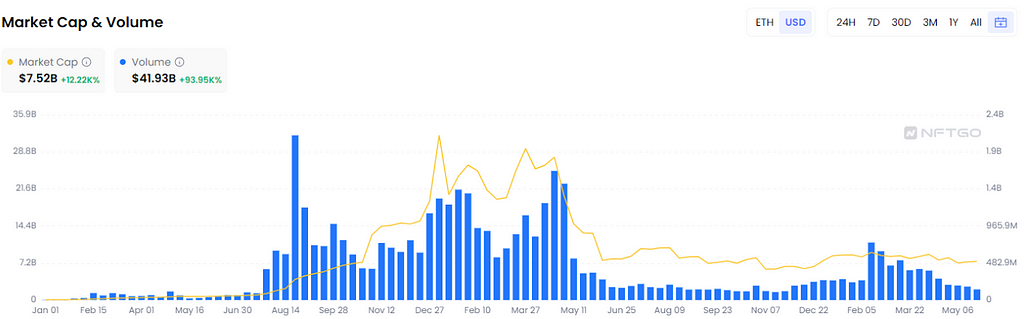
Ethereum NFT Market Size and Trading Volume, Source: NFTGo.io (May 31, 2023)
Nowadays, NFT-Fi, which combines NFTs with DeFi, has rapidly evolved from a niche field to an essential component of the crypto world.
The financialization of NFTs helps expand and enhance consensus and demand for NFTs through financial means. The industry structure can be vertically divided into three layers:
1) Direct Trading: This involves exchange markets, aggregators, and automated market makers (AMMs) for cryptocurrency-based value exchange transactions. Representative projects include Opensea and Blur.
2) Indirect Trading: This includes NFT collateralized lending, financing custody, and other related services. Representative projects include BendDAO and ParaSpace.
3) Financial Derivatives: This includes options, futures, indices and other high-leverage trading products with associated risks. Representative project includes Openland.
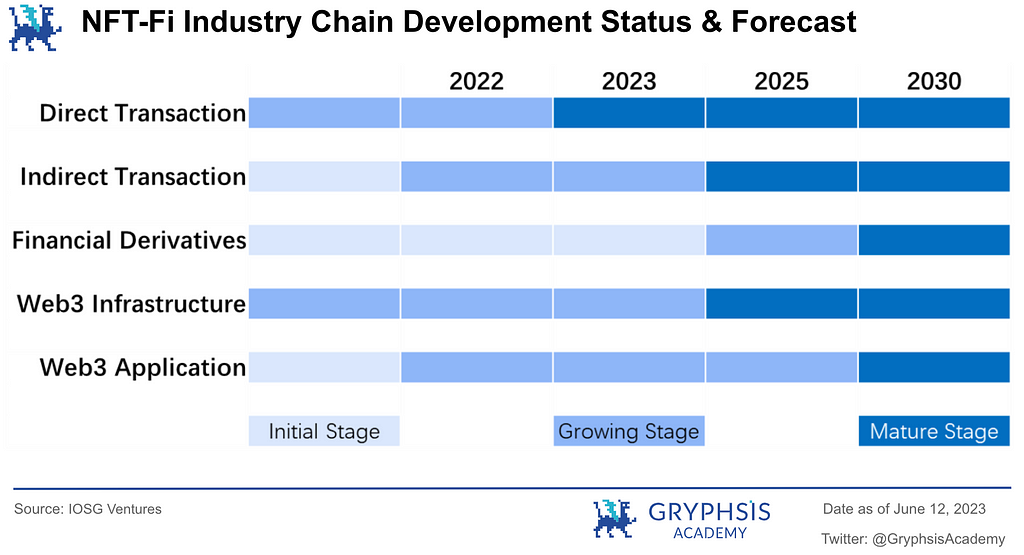
As direct trading has matured relatively, and financial derivatives are still in the early stages, the intermediate layer of indirect trading, which involves deposits, loans, and lending, possesses the basic attributes of a financial system and is currently under rapid development. Therefore, this article will primarily focus on the current emphasis of indirect NFT trading direction — NFT lending.
2. Industry Market Value
First, let’s address the question: Why is there a market demand for NFT lending?
As we know, NFT stands for Non-Fungible Token, which refers to unique cryptographic assets that cannot be replicated or substituted. NFTs possess characteristics of uniqueness, indivisibility, and non-replaceability. The pricing of NFTs is primarily based on personal subjective judgment or collective consensus.
However, due to these characteristics, although NFTs have inherent aesthetic and collectible value (along with potential project utility), they often face a limited audience compared to regular fungible cryptocurrencies. This lack of a standardized benchmark for valuing NFTs often results in relatively poor liquidity for NFTs within the overall crypto market.
Typically, NFT investors aim to profit from NFTs by selling them when their prices rise. However, this approach is heavily influenced by the current market environment. In a bear market scenario within the Web3 ecosystem, where market confidence is low and trading activity is sluggish, liquidity further contracts. Consequently, in most cases, these NFT assets remain idle, resulting in highly inefficient utilization of funds. Without lending services, users may be forced to sell their unique NFTs to obtain much-needed liquidity.
NFT lending, as a financialization product that occurs during the holding phase of NFTs, whose core mechanism is to allow holders to borrow short-term funds against their idle NFTs without selling them. By leveraging their NFTs as collateral, they can obtain liquidity in the form of cryptocurrencies or fiat currencies, earning profits while enjoying the benefits of holding onto their NFTs, thus improving the efficiency of funds utilization.
NFT lending serves as a solution to address the liquidity issue of NFTs, and the demand for this innovative market is growing bigger. NFT liquidity solutions with smooth user experiences and sustainable transaction models will be quickly emerging in the whole NFT-Fi space.
3. Industry Barriers
The industry barriers of NFT lending business revolve around achieving the feasibility of the core business model, which mainly include:
1) Effective matchmaking system for NFT lending demand users
Since NFTs are inherently unique, users typically need specialized knowledge of specific assets and relevant financial knowledge to connect NFT assets with lending services. Designing an attractive business model that appeals to both lenders and borrowers is essential to effectively match user demands.
2) Rational pricing mechanism for NFT assets
Pricing is one of the crucial components in NFT lending business. While estimating the value of NFT assets, calculating the Loan-to-Value (LTV) ratio and liquidation, systems which can effectively provide rapid and reasonable quotes are vital to NFT lending operations. As the number of users within the protocol increases, along with a growing demand for services, the system’s quoting mechanism, data tracing, and update efficiency will directly impact the overall customer experience.
4. Competition Landscape
In the current NFT lending business, there are two main categories: collateralized lending & uncollateralized lending.
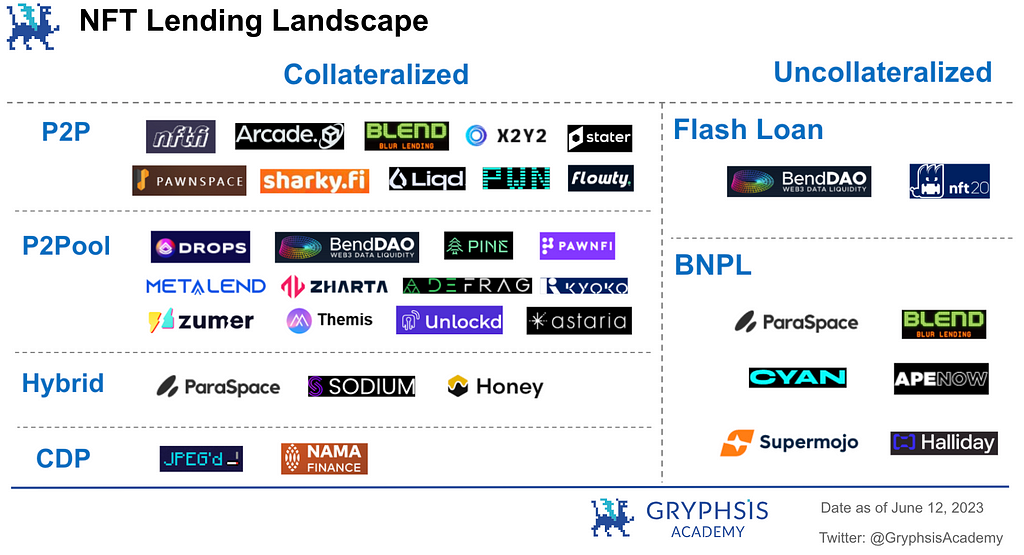
Collateralized lending can be primarily classified based on its protocol type:
1) Peer-to-Peer (P2P)
This model involves direct lending between users, where lenders and borrowers match in terms of interest rates, loan terms, types of NFT collateral, etc. Once the demand is matched, the lending transaction is executed. Representative projects: NFTfi, Arcade, Blur (Blend).
2) Peer-to-Pool
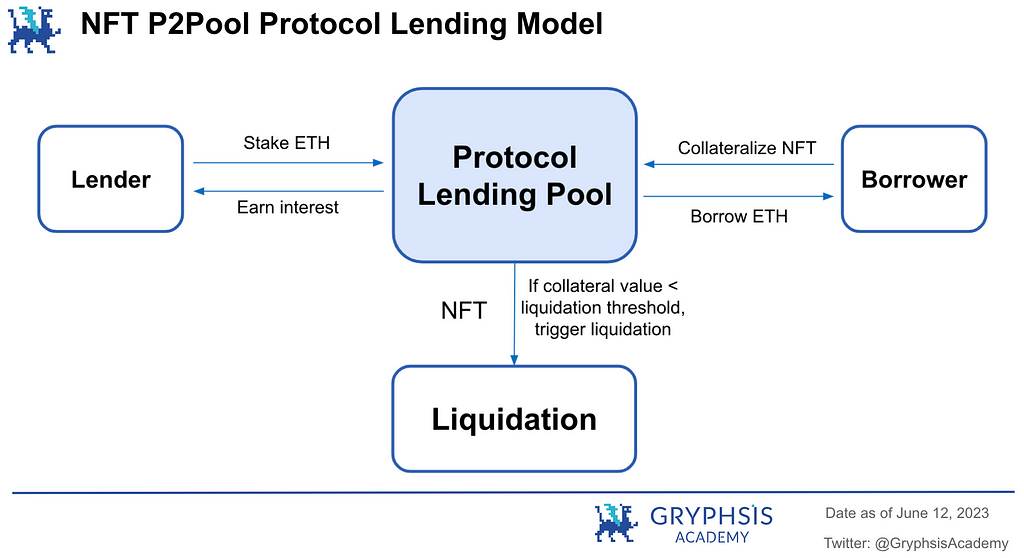
This model involves lending between users and the protocol pool. Lenders collateralize NFTs to the protocol pool to quickly obtain loans, while depositors provide funds to the protocol pool and earn interest. Representative projects: BendDAO, DROPS.
3) Hybrid
This model combines elements of both P2P and Peer-to-pool protocols. In this model, lenders set parameters such as interest rates, loan terms, loan amounts, etc. When requesting a loan on the platform, it is equivalent to creating a separate protocol pool. Multiple borrowers can deposit funds into the protocol pool to earn interest income. Representative project: ParaSpace.
4) Collateralized Debt Position (CDP)
Introduced by MakerDAO, this is considered the ultimate model for NFT collateralized lending. Representative project: JPEG’d.
Uncollateralized lending can be further divided into:
1) Buy Now Pay Later (BNPL)
Representative projects: CYAN, ParaSpace, Blur (Blend)
2) Flash loan
Representative project: BendDAO
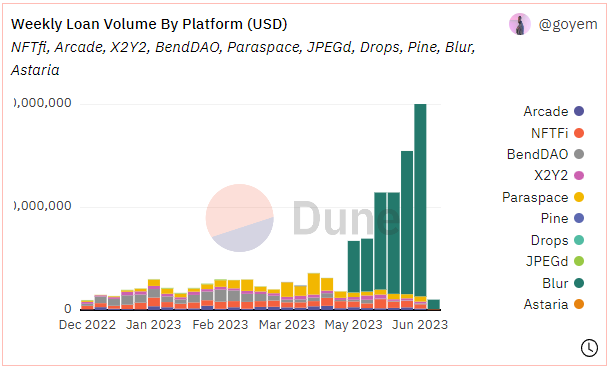
Source: Dune Analytics (@goyem) as of Jun 12, 2023
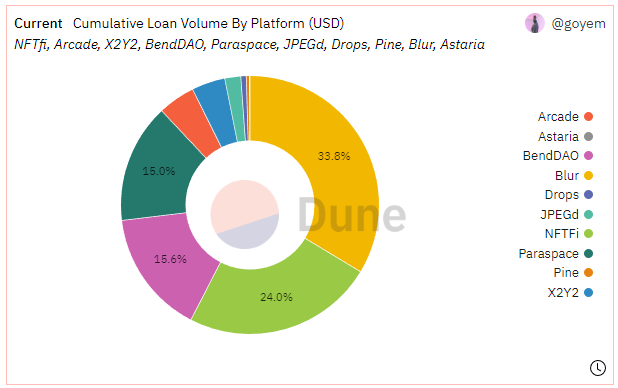
Source: Dune Analytics (@goyem) as of Jun 12, 2023
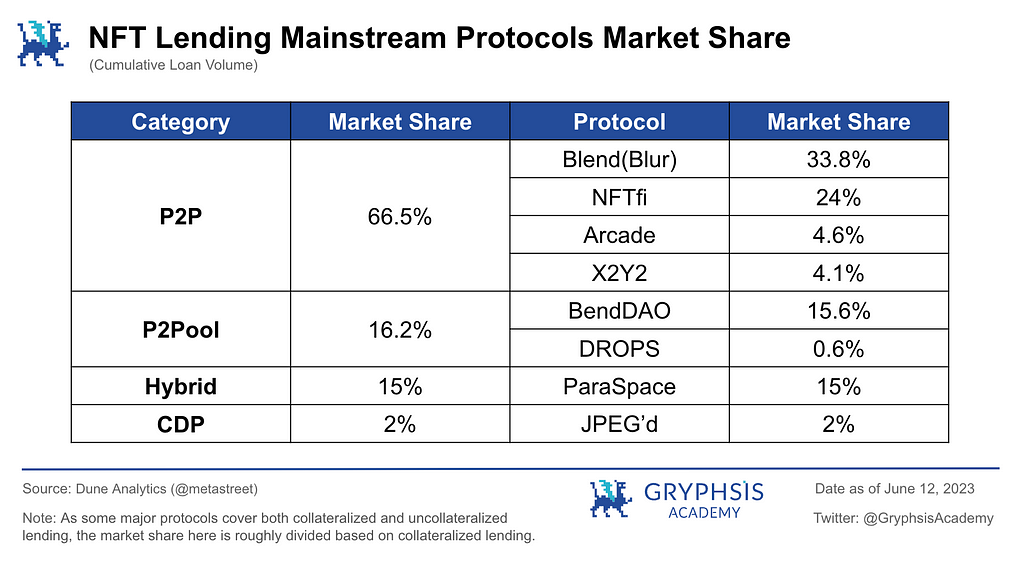
From the two charts above, it can be seen that P2P and peer-to-pool protocols dominate the overall NFT lending market in terms of lending volume.
It is worth awareness that since the launch of Blend by Blur in May, it has rapidly gained a leading position in the mainstream lending protocols. Benefiting from Blur’s position as a leading NFT trading market and its user base, Blend has consistently had significantly higher trading volume than the other protocols combined. Currently, its cumulative lending volume ranks first in the industry.
5. Technical Implementation Paths and Pros & Cons
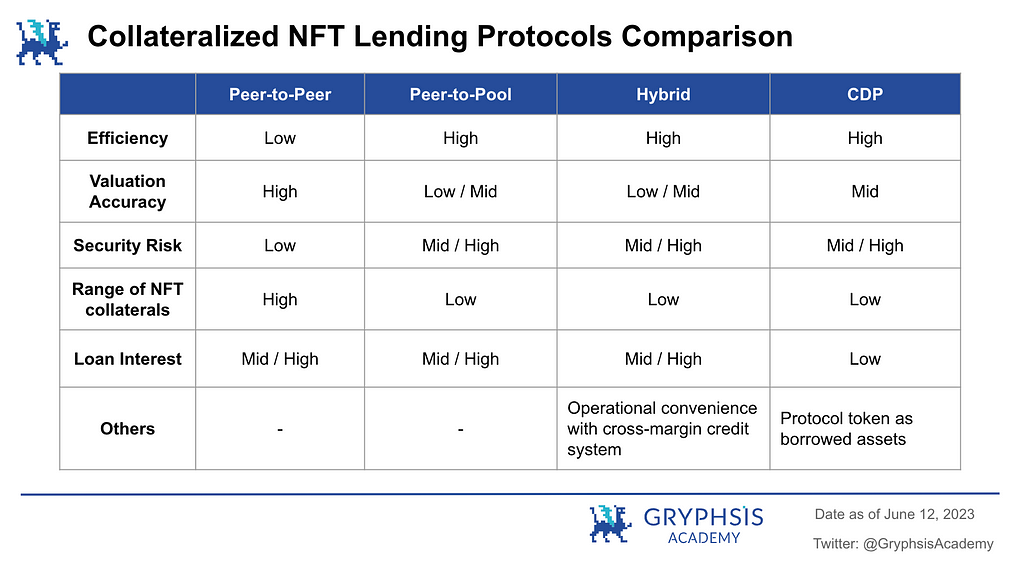
Based on the different protocol types of NFT lending business mentioned in the previous section, each has its own characteristics.
5.1 Collateralized Lending
5.1.1 Peer-to-Peer (P2P)
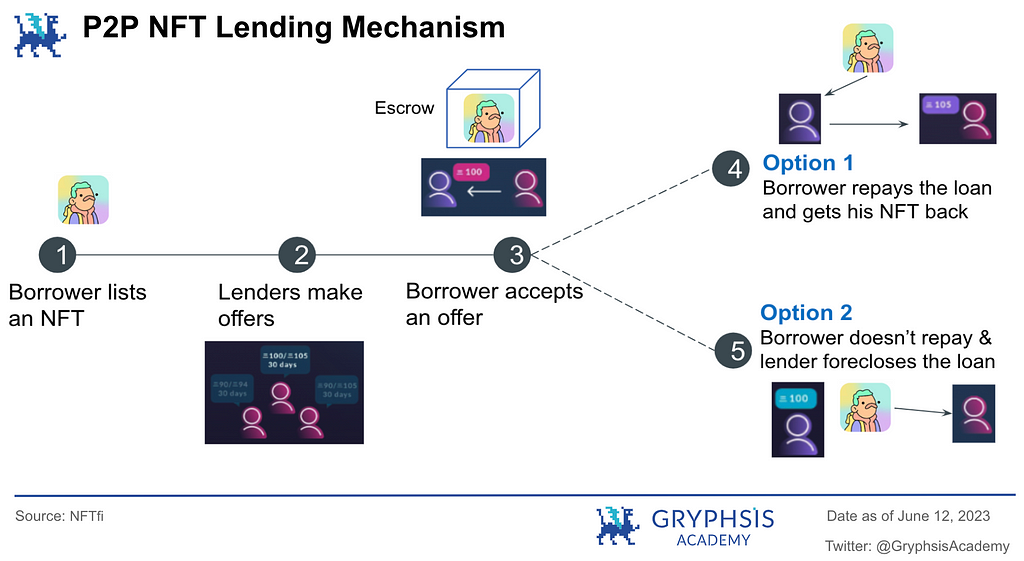
In P2P lending, the user valuation method is primarily used, where the pricing of NFTs is based on the price estimation provided by users. Users give specific quotes based on the uniqueness of each individual NFT. It has the following characteristics:
- Low efficiency: The matching process between lenders and borrowers may take a long time.
- Relatively reasonable valuation: NFTs within the same series may have different values based on their attributes. Lenders and borrowers can negotiate and determine the valuation based on the attributes of individual NFTs, rather than using a uniform floor price for the entire NFT series.
- High security: In the event of default by an individual, it only affects the lenders and borrowers involved in that particular loan, without spreading the risk to other users on the platform.
- Support for a wide range of NFT collateral: Since it involves direct quoting between users, theoretically any NFT series can serve as collateral for lending.
Summary: The P2P model is more suitable for bear markets with low liquidity, as it is not susceptible to extreme market conditions which may affects platform security.
5.1.2 Peer-to-Pool
Time-Weighted Average Price (TWAPs) is widely used in peer-to-pool lending protocols. Oracle solutions like Chainlink can obtain and publish time-weighted average prices for sales and floor prices, creating a hybrid price to assess the value of NFTs. This model reduces the impact of anomalies on prices by taking the average of multiple prices over a predetermined time period, making it more difficult for malicious manipulation of prices.
It has the following characteristics:
- High efficiency: Users can interact with the lending pool directly, enabling borrowing and lending at any time.
- Less accurate valuation: The platform cannot conduct detailed collateral valuations based on the attributes of each NFT. The valuation is determined based on the floor price of the NFT series, and the loan amount remains the same for any NFT with the same series, regardless of its specific attributes.
- Potential security risks: Each loan on the platform affects the interests of all depositors on the platform. In extreme cases, mass liquidation of NFTs may pose systemic risks.
- Support for a limited range of NFT collateral: For security reasons, only blue-chip NFTs with high trading volume, good liquidity, and relatively stable prices are supported as collateral.
Summary: The peer-to-pool model is more suitable for bull markets with sufficient liquidity.
5.1.3 Hybrid
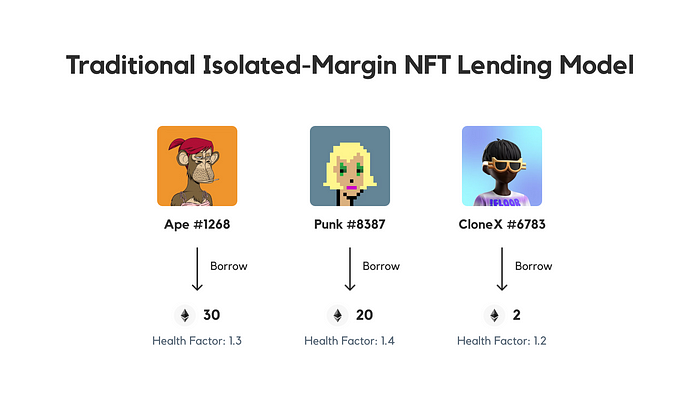
The underlying lending mechanism in hybrid protocols also adopts the peer-to-pool model. Users can get liquidity by collateralizing NFT in real-time as borrowers and also provide liquidity to earn interest as lenders. The innovation lies in the introduction of a cross-margin credit system instead of the isolated margin pool design used by existing platforms, allowing users to use one credit limit to provide loans against all collateral.
Let’s illustrate with an example:
Suppose you own 61 Bored Ape Yacht Club (BAYC) NFTs, and you decide to collateralize 5 of them to borrow and then buy another one. Using existing lending protocols and their isolated margin model, you would need to borrow ETH separately using each of the 5 BAYC NFTs and then purchase the new BAYC NFT in the market.
This process has at least two drawbacks:
1. User experience: Users would need to execute 5 separate on-chain transactions and manage 5 individual lending positions.
2. If any of your lending positions is at risk of liquidation, you would need to repay the loan immediately to avoid being liquidated.
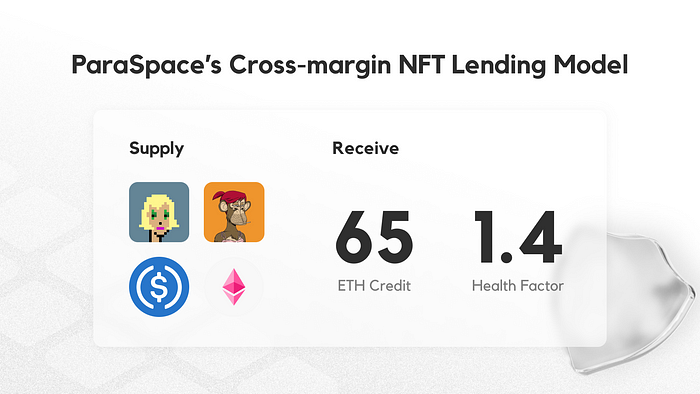
However, by collateralizing your NFT assets, you generate a credit limit and a health factor for your entire collateralized asset portfolio in hybrid protocols. As long as the health factor of your entire collateralized asset portfolio remains above 1, none of your NFTs will ever trigger liquidation auctions. To mitigate risks, you can always choose to deposit more collateral (NFTs or ERC-20 tokens) to maintain a high health factor.
This credit system is similar to a valuation system that assesses the value of all your collateral and automatically approves loans based on that evaluation. As long as your collateral falls within the supported collateral types of the credit system, you can borrow based on their total value. This is known as a cross-margin full-portfolio leverage model.
Easy to understand, this model provides higher operational convenience on top of the standard peer-to-pool model.
5.1.4 CDP (Collateralized Debt Position)
After users deposit their NFTs as collateral in the vault, they can mint corresponding protocol tokens. The CDP project protocol allows the debt position of the protocol tokens to reach a certain proportion of the collateral value, and charges an annual interest rate on it.
When the user’s debt/collateral ratio exceeds the liquidation threshold, the DAO executes liquidation. The DAO repays the debt and retains or auctions off the NFTs to build its vault.
Users can purchase insurance against liquidation at the time of borrowing, paying a one-time fee proportional to the loan amount, which is non-refundable. With insurance, users have the option to repay the debt themselves within a specified timeframe after liquidation (with a penalty).
CDP loans are a good option for those seeking liquidity from their blue-chip NFTs but avoiding to pay high interest rates.
5.2 Non-Collateralized Loans
5.2.1 Flash Loan (Down payment purchase)
Flash loans (Down payment purchase) are a variation of traditional lending. Users can purchase an NFT listed on a trading market by paying a certain down payment on the protocol. The remaining funds are provided by a third-party DeFi protocol offering flash loan services (such as Aave). After the buyer purchases the NFT with the down payment and the remaining funds obtained through the flash loan, they own the NFT and have engaged in collateralized lending on the NFT lending protocol. The protocol’s funding pool returns the borrowed funds to the flash loan, and the remaining interest calculations, repayment mechanisms, and liquidation mechanisms are based on the lending protocol’s specifications. The down payment percentage increases when the listing price exceeds the floor price on the protocol. The fees typically include a down payment fee and a flash loan fee.
The workflow is illustrated in the diagram below:
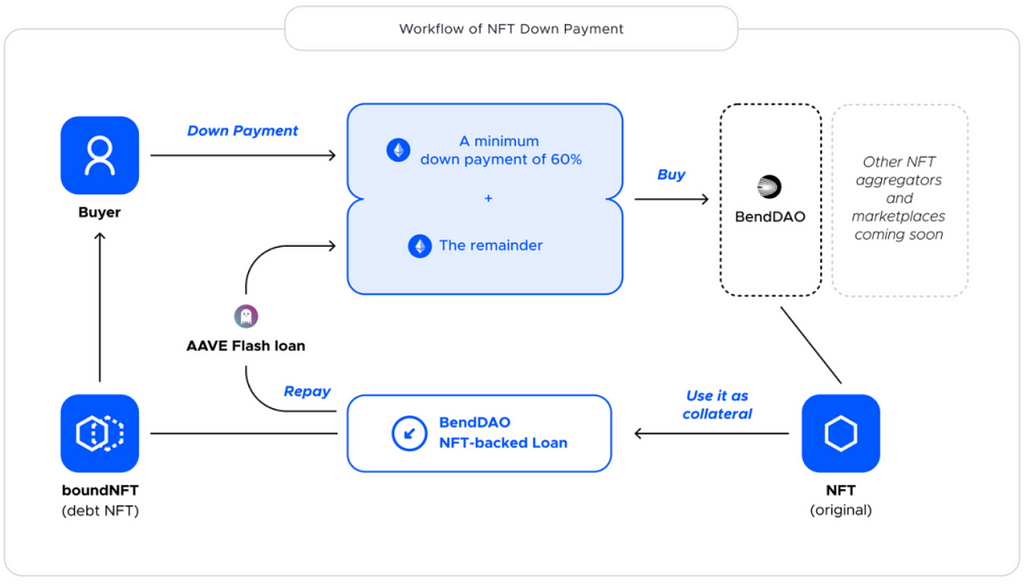
Source: BendDAO
5.2.2 BNPL (Buy Now Pay Later)
Here is a brief explanation of how it operates from the buyer’s perspective:
1. Bob wants to purchase a Pudgy Penguin. He initiates a BNPL plan on the platform to buy any Penguin currently listed on Opensea, LooksRare, or X2Y2.
2. The platform provides Bob with an installment plan that includes a pre-quoted interest rate that he needs to repay within a three-month period. Regardless of fluctuations in the NFT price, the installment payments remain unchanged and fixed for the three-month duration.
3. If Bob accepts the plan, he receives ETH from the platform’s funding pool to purchase the NFT and it is held in custody by the platform’s smart contract.
4. When Bob completes all his installment payments, the NFT transfers to his wallet, and he gains full ownership. (Note: If the NFT appreciates in value during this period, Bob has the option to pay off the BNPL plan early and sell the NFT.)
5. Overdue payments will result in default, and the NFT will be held in the corresponding platform Vault for liquidation.
The BNPL feature offers a “pawning” service, allowing users to temporarily collateralize their NFTs in exchange for a loan. The loan, along with interest, is then repaid, and the interest flows directly into the funding pool. To mitigate plan defaults, the platform implements various risk management measures such as higher interest rates to regulate loans and prevent holding high-risk NFT products.
We can see, the business model of non-collateralized lending, whether it’s Flash Loans (Down Payment) or BNPL, actually involves collateralizing after the purchase. Users can acquire NFTs with a smaller upfront investment by paying a partial down payment, and then repay the corresponding loan within a specified timeframe. This model is suitable for NFT market users who have a purchasing intent but temporarily lack full payment capabilities.
Therefore, the characteristics of such lending models include:
- Reasonable capital utilization, allowing users to make early purchases with a smaller upfront investment, reducing financial pressure
- A reliable credit assessment system is required to assess the risk of each transaction through credit evaluation
- Risk control models need to be validated, especially as the product is in its early stages. It is crucial to effectively manage risks and maintain business health as user adoption increases.
6. Profit Model
Generally speaking, the revenue sources of NFT lending protocols mainly include: (1) interest payments from users for collateralized loans, (2) loan fees generated from features such as flash loans, (3) transaction fees from the marketplace.
The profit model of NFT lending business primarily relies on loan interest and loan feature fees, while transaction fees from the marketplace are unrelated to the lending business.
The allocation of project revenue may vary depending on the protocol’s design. It could involve different proportions of distribution between the project treasury and token holders/users.
7. Sector Valuation
We can estimate the valuation by using a top-down valuation approach and drawing an analogy with the DeFi lending market. The growth logic is primarily based on the expectation that the NFT market size will continue to increase along with the overall development of the Web3 industry. As NFT lending is still in its early stages, there is significant room for overall sector growth.
7.1 Valuation Assumptions
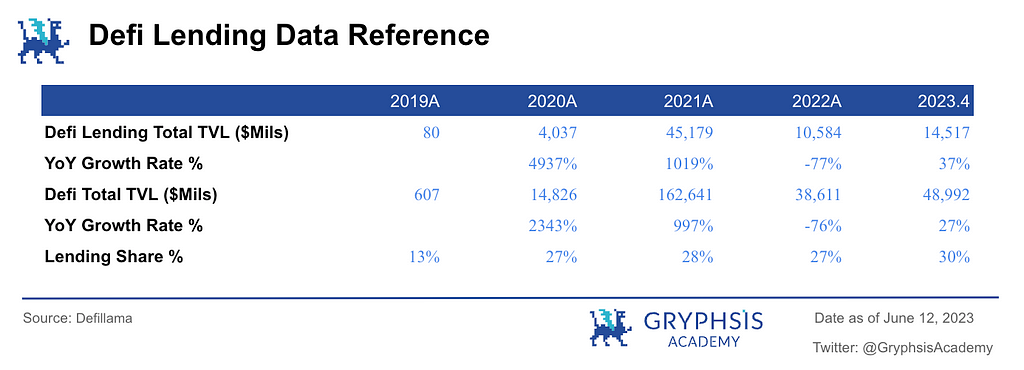
The cryptocurrency market is cyclical, currently experiencing a phase of bear market, and the overall NFT industry size will fluctuate with the market cycles. However, the penetration rate (Total Value Locked, TVL) of NFT lending is expected to increase relatively quickly.
(a) Market Cap YoY Growth
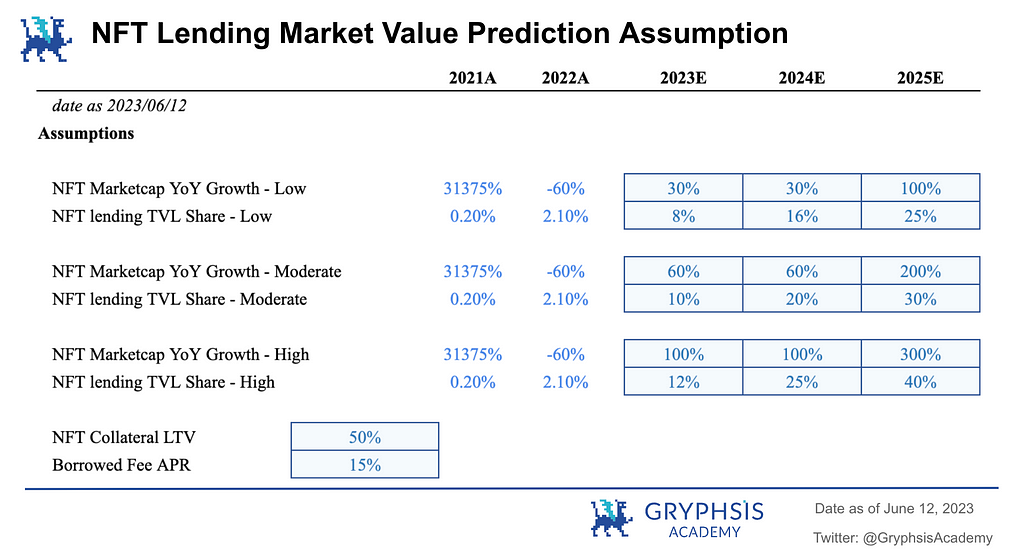
Looking back on the evolution of the DeFi lending market from 2019 to now, we see a rapid industry expansion in the initial two years, with relatively stable market conditions. This allowed the total market size to undergo substantial growth, multiplying several times due to the small initial market size. However, 2022 marked a period of pronounced contraction in total market capitalization because of a sluggish market. A similar trajectory was followed by the NFT market in the past two years. As we entered this year, the overall DeFi market capitalization has shown signs of revival from its 2022 base. If this recovery continues at a steady pace, we anticipate that it could make up for last year’s downturn over the current year.
Thus, we postulate a 60% overall industry growth for the NFT market this year. Bearing in mind the cyclical nature of bull and bear markets, we predict 2024 to be a period of stability, matching the growth rate of 2023, while 2025 is projected as a period of bull market surge, with a growth rate tripling that of the stable period.
We regard these assumptions as the moderate scenario. The pessimistic scenario assumes 50% of the growth rate from the moderate scenario, while the optimistic scenario presents a more ambitious expectation, based on the moderate scenario.
(b) NFT Lending TVL Share
Considering the historical penetration rate of lending business within the overall DeFi market, which has been around 25% to 30% in the past three years, we can estimate that the NFT lending TVL will reach a similar lock-up ratio by 2025, taking it as 30% for moderate scenario. And 25% as low scenario while 40% as high scenario.
(c) NFT Collateral LTV
Based on the LTV (Loan-to-Value) data from several mainstream NFT lending protocols, assume a 50% LTV for the valuation.
(d) Borrowed Fee APR
Referring to the DeFi lending and the current NFT lending interest rates, assume a 15% APR (Annual Percentage Rate) for NFT loans.
7.2 Market Value Prediction
Based on the moderate assumption in our valuation prediction model, we assume a steady growth of the overall NFT industry market cap in 2023/2024 (60% annual growth) and a significant increase in 2025 due to a potential bullish market cycle (200% annual growth). NFT lending TVL assumed 30% of the overall industry market cap. The Loan-to-Value (LTV) ratio is set at 50%, and the Annual Percentage Rate (APR) for loans is assumed to be 15%.
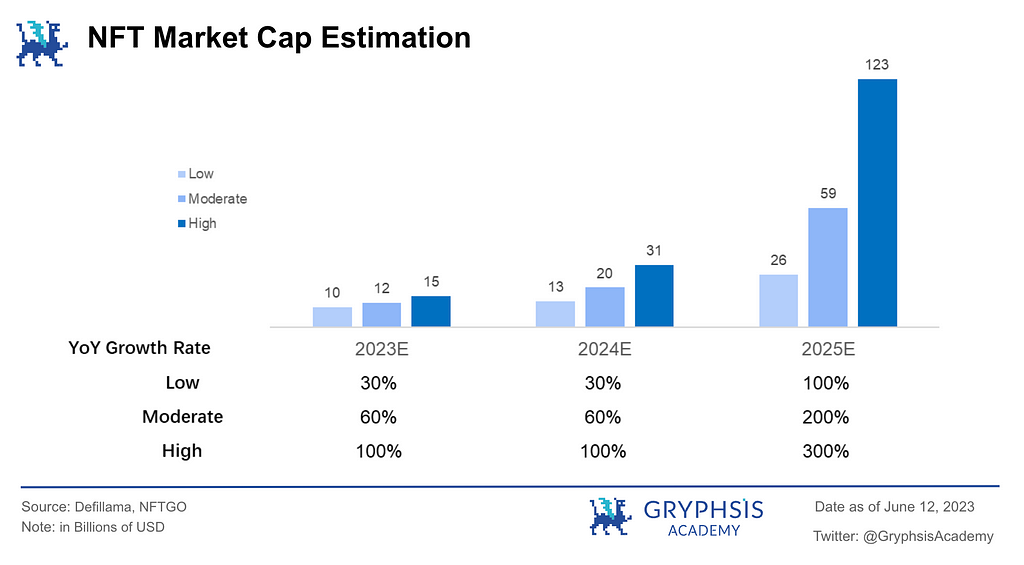
Based on above assumptions, expected in 3 years, the estimated overall market cap of the NFT industry would be around $60 billion with the TVL of NFT lending reaching approximately $18 billion. This can meet lending demands of approximately $9 billion (assuming an average Loan-to-Value ratio of 50%). The projected revenue of the overall NFT lending sector is estimated to reach $1.3 billion, i.e. nearly 10 billion Chinese Yuan (based on an average annualized interest rate of 15%).
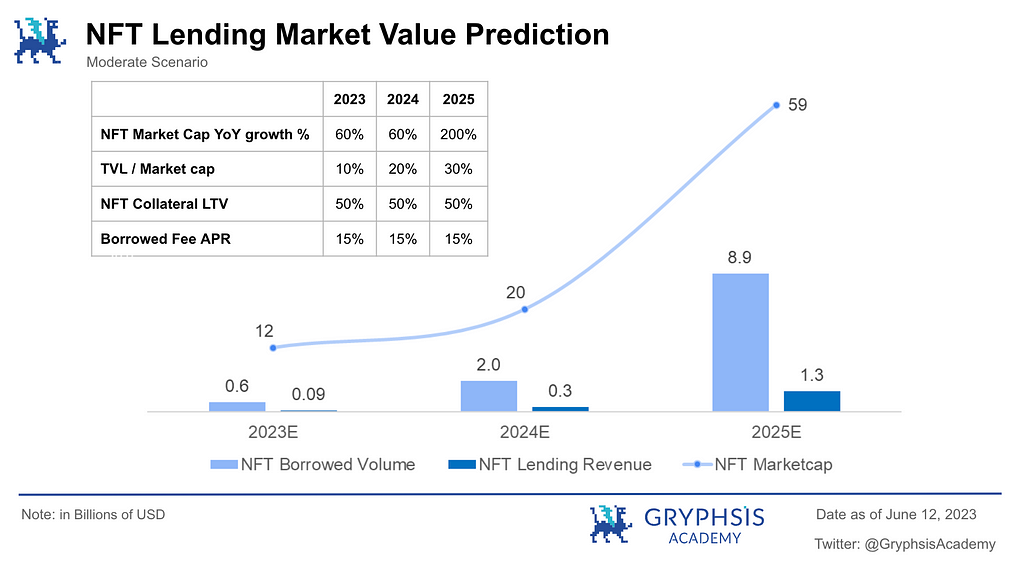
Note: The revenue mentioned here only considers loan interest as majority income. Based on historical lending data from major NFT lending platforms (interest rates mostly concentrated in the range of 15% to 30%), and considering the evolving trend of DeFi lending rates, an average annualized interest rate of 15% is used as the assumption for NFT lending.
8. Main Companies / Protocol Products
8.1 Peer-to-Peer
8.1.1 NFTfi
NFTfi.com is a mature P2P NFT lending platform that operates in an auction-style format. The bidding, interest rate calculation, and duration are determined jointly by the lenders and NFT collateral providers. It is one of the leading platforms in the P2P lending business.
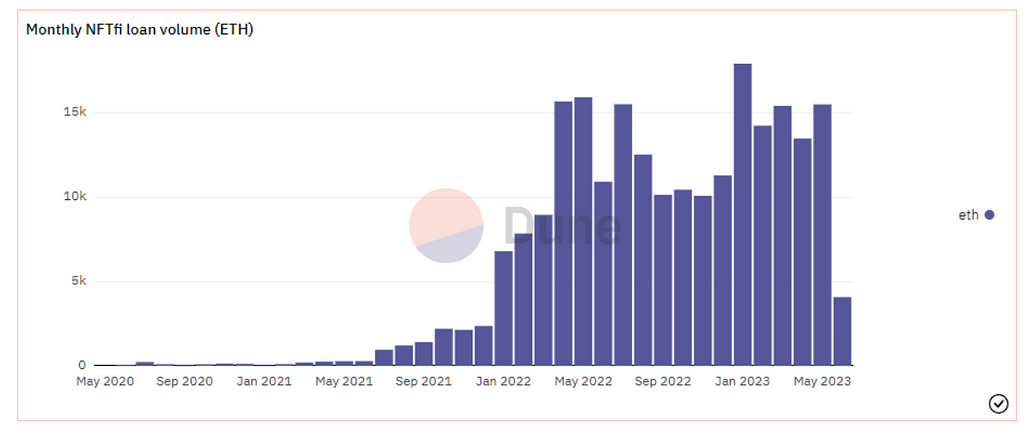
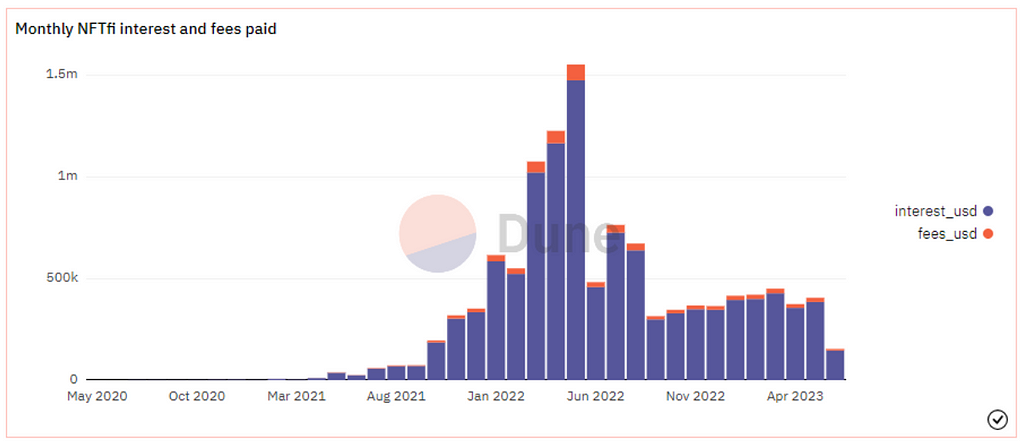
Since its launch in 2020, it has facilitated over 45,000 loans with a total loan value of approximately $450 million (as of the end of May 2023). Since April 2022, the monthly ETH loan volume has consistently remained above 10,000 ETH, reaching a peak of nearly 18,000 ETH in January 2023. From March to May 2022, monthly revenue exceeded $1 million, with a peak in May surpassing $1.5 million.
Source: Dune Analytics (@rchen8) as of Jun 12, 2023
Source: Dune Analytics (@rchen8) as of Jun 12, 2023
8.1.2 Arcade
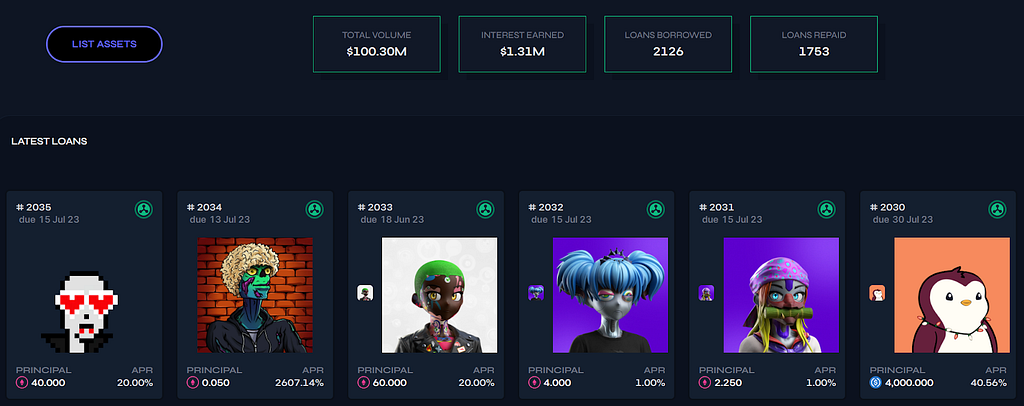
Arcade is another P2P platform that provides liquidity lending for NFTs. It is the successor of Pawn.fi. The project is built on top of the Pawn protocol, which is an infrastructure layer for NFT liquidity. It consists of a set of smart contracts deployed on the Ethereum blockchain that enable the financialization of non-fungible assets. NFT holders can use their assets as collateral to apply for loans through the Arcade application, which enforces specified loan terms.
Source: Arcade (Jun 12, 2023)
The platform creates a wrapped NFT (wNFT) using smart contracts, which represents the borrower’s collateral for the loan application. The wNFT is locked in a custodial smart contract that records when the principal funds are sent to the borrower and repaid to the lender.
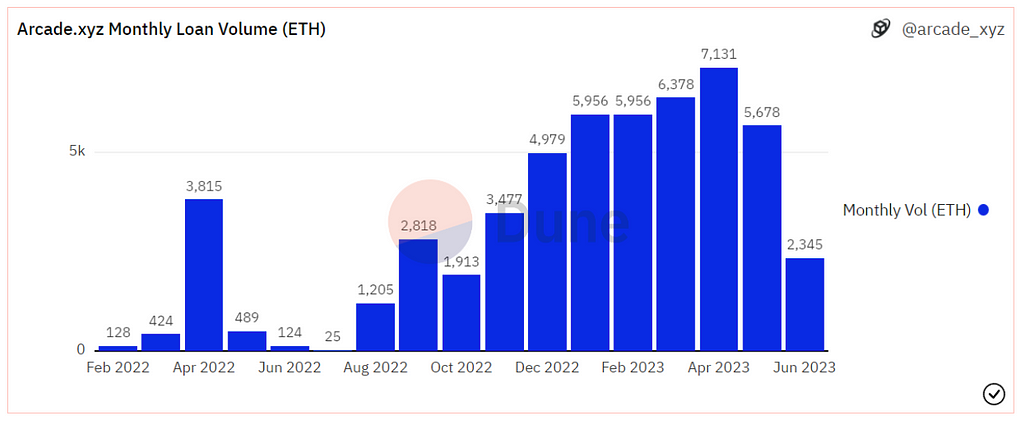
As of June 12th, Arcade has facilitated over 2,000 loans with a lending value of around $100 million. The monthly loan volume has consistently exceeded 5,000 ETH in the past six months. The cumulative interest income from loans has surpassed $1.3 million.
Source: Dune Analytics (@arcade_xyz) as of Jun 12, 2023
8.1.3 Blur (Blend)
Blur, a leading NFT trading platform, launched Blend in May in collaboration with Paradigm. Blend is a P2P NFT lending protocol that includes the functionality of purchasing NFTs with loans.
The core features of Blend include:
- P2P perpetual lending with no expiration date or need for oracles.
- Lenders define loan amounts and publish offers with specified annual percentage yield (APY), while borrowers choose the offers.
- If a lender exits, the borrower must repay the loan within 30 hours or borrow again, or else liquidation occurs.
- Borrowers can repay the loan at any time.
- Supports Buy Now Pay Later (BNPL) model, where borrowers make a down payment and take out a loan to purchase NFTs.
Source: Blur
Blend’s core advantage lies in unifying non-essential elements, reducing system complexity, and allowing flexible migration of lending relationships within the system. Pricing risks and returns are determined through market dynamics, maximizing user satisfaction.
Compared to traditional P2P models, Blend improves the liquidity issue for lenders by unifying the loan duration as a flexible perpetual mode.
Blend unifies lender exits and liquidation, with oracles determining the timing of liquidation. The choice to exit is given to the lenders, allowing for flexible handling.
Blend has achieved significant improvements by unifying non-essential elements in the traditional P2P lending model and integrating them extensively with the Blur trading module. Shortly since its launch, Blend has gained market recognition, rapidly increasing its lending volume which has been surpassing NFTfi in early May.
Since its launch in early May, Blend has achieved nearly 50,000 transactions in just over one month. The total lending amount has exceeded $700 million, with a cumulative user count of nearly 20,000. In June, the business has continued to grow compared to May, with a daily average of around 2,000 lending transactions and a daily lending amount consistently surpassing $20 million. The peak was reached on June 6th, with a single-day lending amount of $34 million. (Data as of Jun 12)
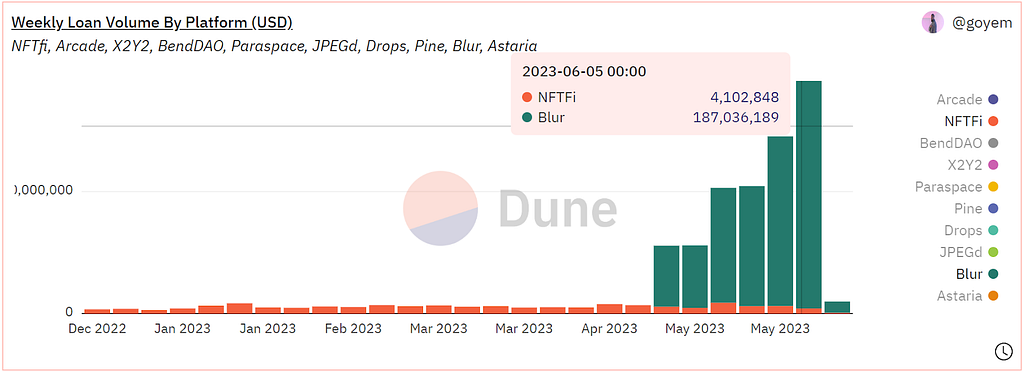
Source: Dune Analytics (@goyem) as of June 12, 2023
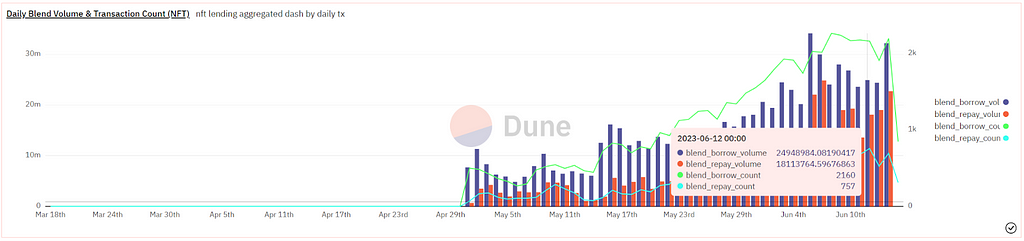
Source: Dune Analytics (@impossiblefinance) as of June 12, 2023
8.2 Peer-to-Pool
8.2.1 BendDAO
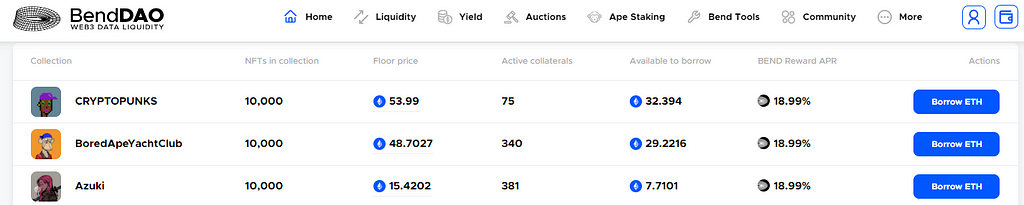
BendDAO is a leading protocol which pioneered the “Peer-to-Pool” model of NFT lending in the sector. It primarily serves blue-chip NFT holders. Lenders (Peer) can quickly borrow funds from the funding pool(Pool) by collateralizing blue-chip NFTs, while depositors (Peer) provide Ethereum to the funding pool(Pool) and earn interest denominated in ETH. Both lenders and borrowers are rewarded with BEND tokens. When the price of the collateralized NFTs falls to a certain level, liquidation is triggered. Currently, BendDAO supports the collateralization of 10 types of mainstream blue-chip NFTs.

Source: BendDAO
BendDAO UI:
Number Of BendDAO Bluechip NFT Collaterals:
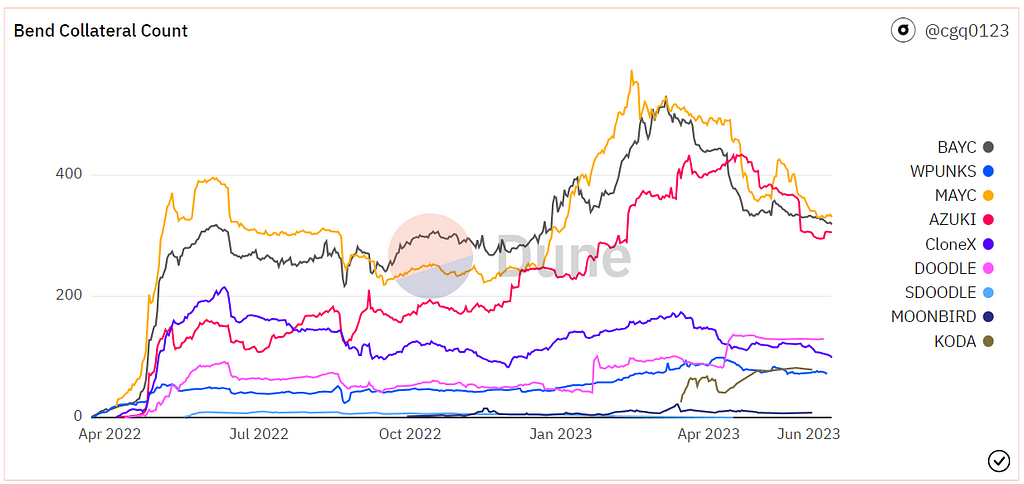
Source: Dune Analytics (@cgq0123) as of June 12, 2023
The floor price data for NFTs is obtained through the Bend Oracle, developed in collaboration between BendDAO and Chainlink. The Oracle retrieves floor price raw data from Opensea, X2Y2, and LooksRare, filters the data based on trading volume to calculate a low price, and employs a TWAP (Time-Weighted Average Price) to ensure the data is not manipulated.
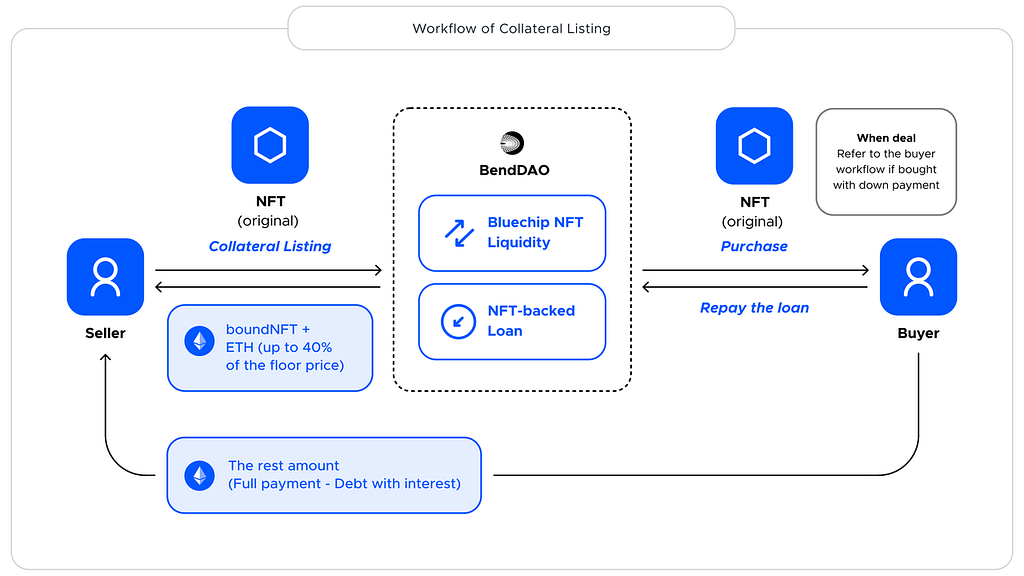
Source: BendDAO
Since its launch in March 2022, the protocol has continuously updated and iterated its features to meet market demands. In addition to the main lending business, BendDAO has also launched a built-in marketplace, supporting new features such as “Flash Loans” and “Collateral Listing,” as well as “Peer-to-Peer” lending functionality and “Bend Ape Staking,” an asset pairing feature specifically designed for Yuga Labs’ staking.
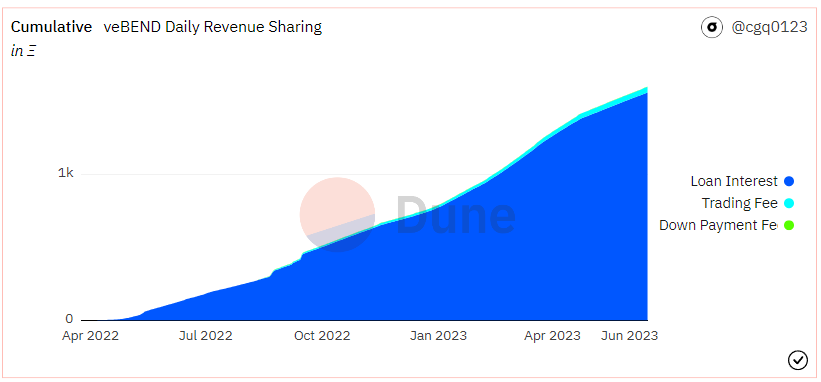
Source: Dune Analytics (@cgq0123) as of June 12, 2023
In terms of revenue sources, BendDAO derives income from (1) lending interest; (2) flash loan fees (paid by buyers, at a rate of 1%) which are relevant to lending business. Income also includes transaction fees from the marketplace (paid by sellers, at a rate of 2%), but it is unrelated to the lending business. Revenue allocated to the protocol treasury are: (1) 30% of the interest paid by borrowers; (2) 50% of the flash loan fees.

Source: Dune Analytics (@cgq0123) as of June 12, 2023
As of June 12th, BendDAO has lent out over 170,000 ETH, with a peak daily lending volume of 4,340 ETH in May 2022. The project has achieved a total revenue of 1,669 ETH, in which lending interest income is 1,563 ETH as of approximately 94% from total. The primary collateral assets in this point-to-pool model are BAYC / MAYC / Cryptopunks, which occupy more than 70% of the collateralized assets counts. The lending APR has remained in the range of 25–30% since the beginning of this year, with daily interest income ranging from approximately 3 to 6 ETH.
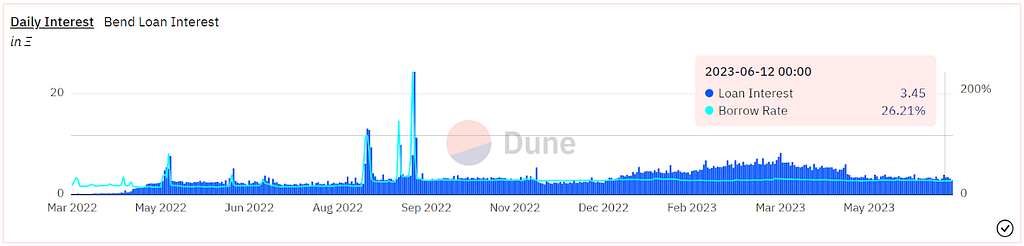
Source: Dune Analytics (@cgq0123) as of June 12, 2023
8.2.2 DROPS
DROPS operates a currency market similar to Compound, where users can collateralize their NFT portfolios to obtain loans in USDC and ETH. The pricing of NFTs is determined by the Chainlink oracle, which adjusts the prices based on outliers and average values over a certain period of time.
Similar to Compound and Aave, DROPS uses a segmented interest rate function that targets specific utilization rates. When there is insufficient funds available for withdrawals, borrowers will pay significantly higher interest rates.
To limit the risk for liquidity providers, DROPS separates the protocol into isolated pools, each with its own collection of NFTs. This approach is similar to how Fuse operates on Rari Capital, ensuring that borrowers can select the collections they are satisfied with.
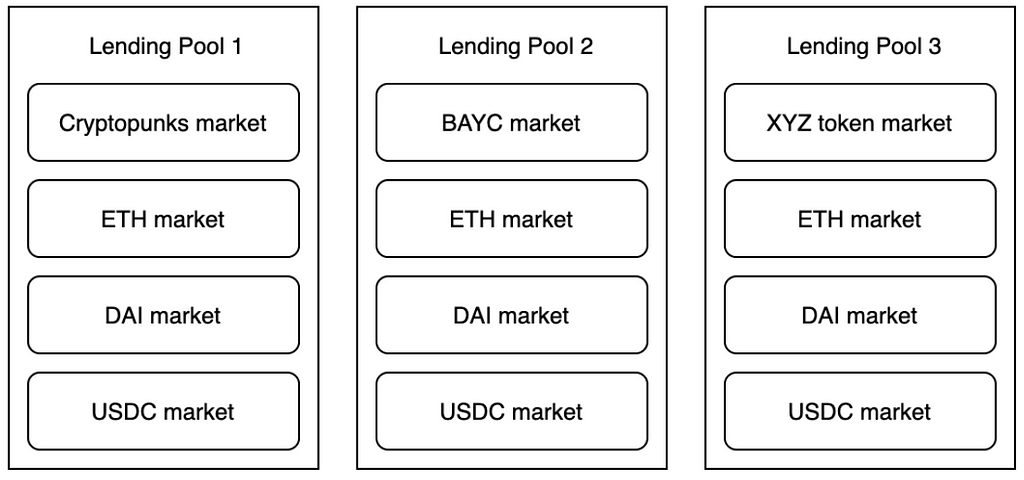
Source: DROPS
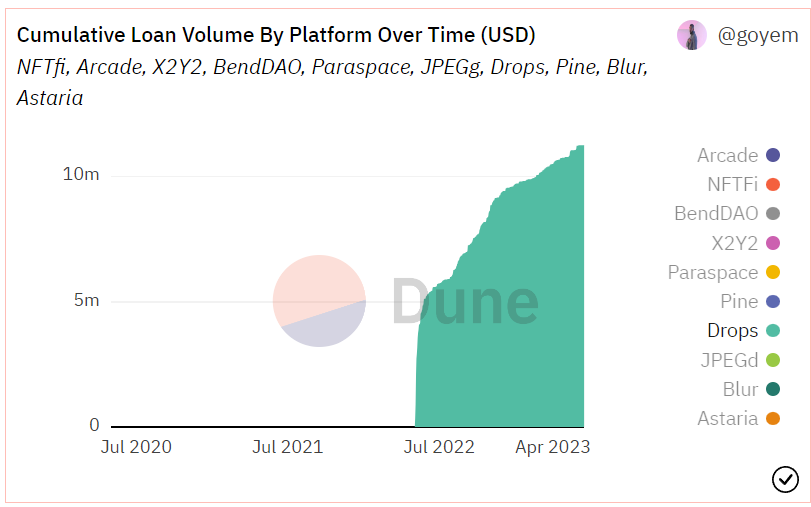
As of June 12th, DROPS has accumulated over $11 million in loaned funds.
Source: Dune Analytics (@goyem) as of June 12, 2023
8.3 Hybrid
8.3.1 ParaSpace
ParaSpace is an NFT lending protocol that utilizes a Peer-to-Pool model as underlying layer, allowing users to collateralize and borrow NFTs and fungible tokens. It enables users to wrap their ERC-721 or ERC-20 token assets, collateralize them, and borrow funds, leveraging underutilized capital to improve the efficiency of their on-chain assets and earn returns.
Source: ParaSpace
ParaSpace’s innovative collateralized lending model pioneered the first cross-margin credit system, which is a departure from the isolated margin pool design used by existing platforms. This allows users to provide loans against their entire collateralized portfolio using one credit line.
Source: ParaSpace
By collateralizing your NFT assets with ParaSpace, you generate a credit line and a health factor for your entire collateralized portfolio. As long as the health factor of your entire collateralized portfolio remains above 1, none of your NFTs will trigger liquidation auctions.
This credit system functions similar to a valuation system that evaluates the value of all your collateral and automatically approves loans based on that assessment. As long as they are supported collateral types in ParaSpace, you can borrow based on their total value.
This is achieved through the cross-margin full leverage mode.
In addition, ParaSpace has designed features such as a “Hybrid Dutch Auction” liquidation mechanism, “Buy Now, Pay Later” within the credit system, high rarity NFT lending with higher limits, and borrowing to short-sell, catering to the needs of the current NFT market users.
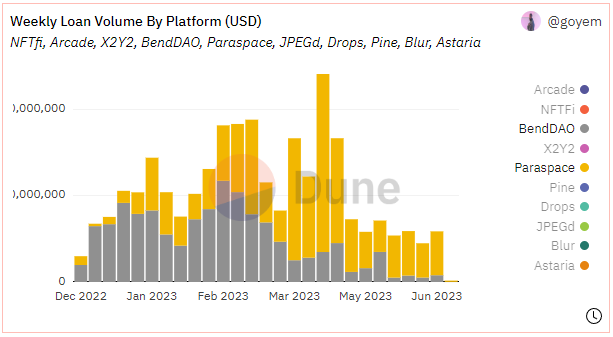
Since its launch in December 2022, ParaSpace business has experienced rapid growth, whose rate is significantly higher than the overall NFT lending market and has outpaced BendDAO in lending volume over the past six months. As of June 12th, the protocol has accumulated nearly $300 million loan volume, with over 13,000 users. It reached a peak weekly lending volume of over $20 million in April, and recently the weekly lending volume has remained around $5 million in the past one month.
Source: Dune Analytics (@goyem) as of June 12, 2023
8.4 Collateralized Debt Position (CDP)
8.4.1 JPEG’d
JPEG’d is an improved NFT P2Pool lending protocol that adopts the CDP (Collateralized Debt Position) model from MakerDAO. Users of the protocol collateralize NFTs and borrow stablecoin PUSd against the collateralized NFTs, with a maximum borrowing limit of 32% of the floor price of the NFT. The first NFT allowed as collateral in JPEG’d is CryptoPunks, with an initial annual interest rate of 2% and a one-time borrowing fee of 0.5%. JPEG’d sets the Loan-to-Value (LTV) ratio at 32%, triggering liquidation when the LTV reaches 33%.
Source: JPEG’d
Due to the significant volatility of NFT floor prices, JPEG’d uses Chainlink as its data source, core is the Time-Weighted Average Price (TWAP). Notably, JPEG’d has designed a novel insurance mechanism where users can choose to pay a 5% insurance fee for their loans. In the event of liquidation, they have the option to repurchase their NFT after repaying the debt, accrued interest, and a 25% liquidation penalty within 72 hours. Otherwise, the NFT will be owned by JPEG’d DAO.
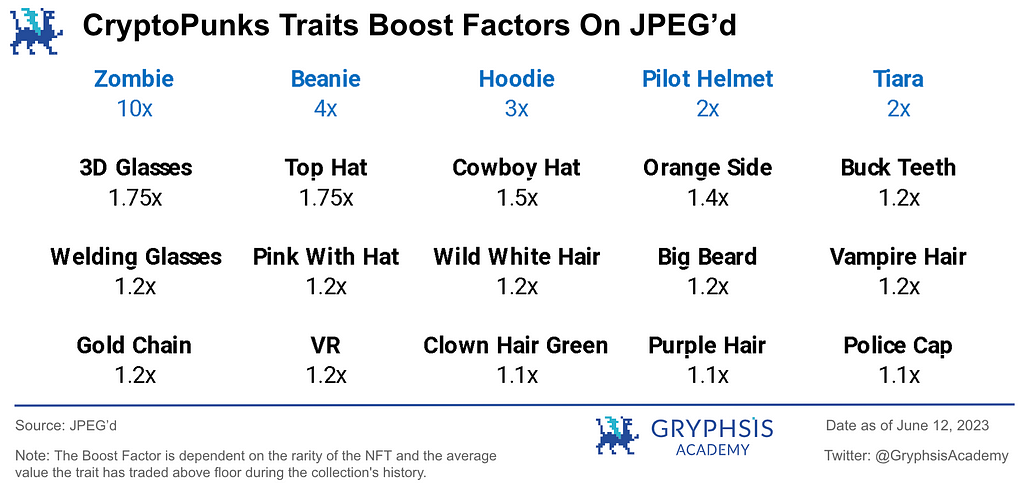
JPEG’d has another innovation, which provides platform-defined weighted valuations for specific blue-chip NFTs like CryptoPunks, Bored Ape Yacht Club (BAYC), and Azuki. For each rarity trait gaining different weightings, the valuation will get corresponding rewards in the form of increased traits boost factors. Currently, there are relatively few platforms in the market that provide valuations based on rarity traits.
In addition, pETH generated from JPEG’d can be staked on Convex with relatively good returns. The ETH-pETH asset pair has seen yields reaching around 30–45% in early 2023.
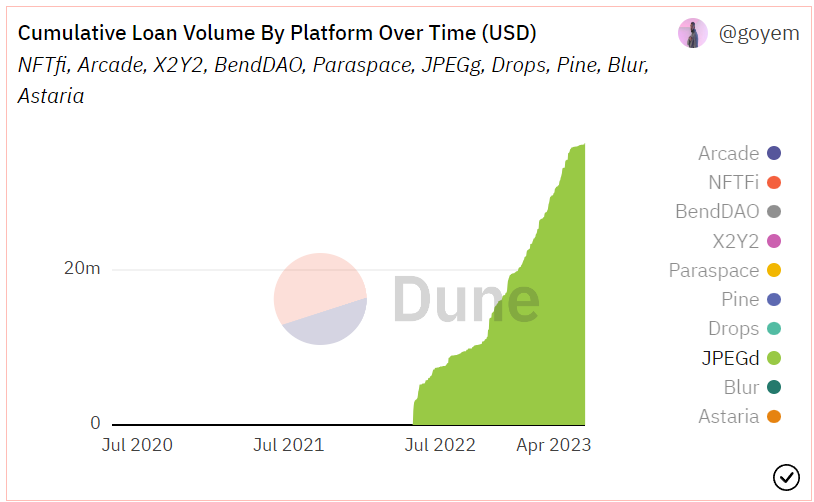
As of June 12, 2023, the protocol has accumulated over $36 million loan volume. The peak weekly borrowing volume was around $770,000 in January~February of this year. CDP-based NFT lending protocols still hold a relatively small market share.
Source: Dune Analytics (@goyem) as of June 12, 2023
9. Risk and Outlook
Currently, while the NFT lending sector is developing very fast, there are also some key risks that cannot be ignored:
1) NFT collateral valuation volatility risk (credit risk)
For lending projects, the worst-case scenario is when the liquidity of the funding pool dries up, and borrowers are unable to repay their loans due to insolvency.
For NFT lending protocols, it is crucial to determine high-quality NFT collateral assets. When the floor prices of the collateralized NFT series sharply decline, many borrowers may choose to default on their loans and abandon the NFT assets. In such cases, the NFTs with collapsed prices may have no bidders in auctions.
(Historical Event Recap — BendDAO Liquidity Crisis: In August to September 2022, the floor prices of blue-chip NFTs collectively declined, triggering the liquidation of several collateral assets with no bidders. This led to panic in the market, resulting in a depletion of liquidity in the funding pool. Loan and deposit interest rates skyrocketed, posing a potential collapse crisis for the BendDAO protocol. To address the crisis, the team proposed modifications to certain parameters, and over the next few days, funds gradually returned to the protocol’s pool, market sentiment stabilized, and utilization rates and lending rates returned to normal levels.)
2) Concentration of target user base
Although the industry is developing rapidly, the current NFT lending business does not have a wide user base. Data from some projects indicates a significant reliance on a small number of key users for business volume.
Example:
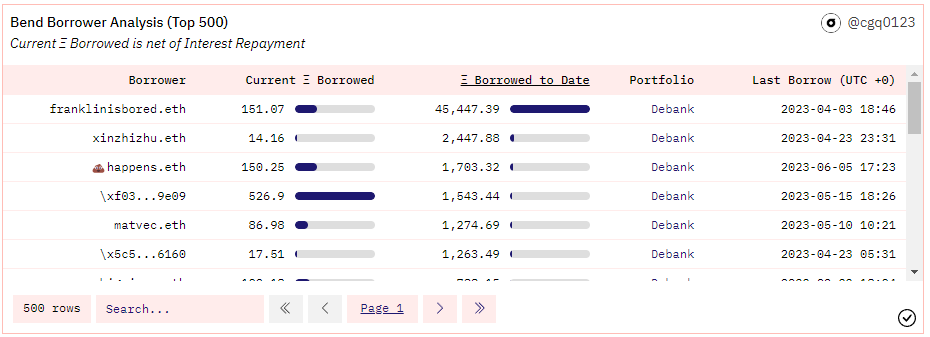
BendDAO Protocol: As of June 12, 2023, the total loan amount reached 178,820 ETH, and the user named Franklinisbored.eth, who borrowed the most, accounted for over 25% of the total business volume, with a loan amount of 45,447 ETH.
Source: Dune Analytics (@cgq0123) as of June 12, 2023
3) Growth potential of the market size may be limited
To ensure healthy business growth, NFT lending projects often focus on high-quality blue-chip NFTs as eligible collateral assets, as they have price consensus and strong risk resistance. However, the number of blue-chip NFT types that meet these criteria is limited, and each project has a fixed NFT supply. In the current market environment, recognizing additional high-quality NFT collateral assets requires time for market validation, and it is challenging to predict and assess in advance. This poses a potential risk and may impose limitations on the overall market size and business growth potential of the NFT lending sector.
Regarding the overall development of the NFT market, it is expected that specific categories including blue-chip PFP (Profile Picture) NFTs, high-quality GameFi assets, and NFT assets empowered by unique projects will be important components of the industry’s future development. Along with the industry maturing, more users will embrace and invest in the realm of NFTs. The link between NFTs and real-life will become increasingly diverse, and the influence of NFTs will continue to expand through various derivatives. As the overall market size of NFTs grows, opportunities in various specific areas within the NFT space will also increase. For NFT lending, a diversity of protocols can meet the needs of different users. When lending protocols achieve high activity and wide adoption, they will be able to provide better liquidity solutions that benefit both NFT and DeFi users.
10. Epilogue
In the current NFT market, the majority of users still concentrate in the areas with lowest entry barriers, such as marketplaces and aggregators. However, these areas have not fully demonstrated the maximum efficiency of capital utilization. As more users join the NFT space, how to effectively improve market efficiency through NFT financialization and attract user attention may be a continuous breakthrough for Web3 business growth.
NFT lending, as an important component of NFT financialization, has gradually shown its efficiency advantages of P2Pool models in competition with P2P models, due to the improvement of oracles and liquidation mechanisms. The continuous updates and iterations of different products are shaping the maturity of the market’s product landscape. Key issues including how to independently rate and accurately price different NFTs, as well as establishing liquidity are crucial to improve customer experience.
It is believed that NFT liquidity solutions with reasonable pricing mechanisms, seamless user experience, sustainable trading models and profit models, along with comprehensive risk control mechanisms, will become the cornerstone for the advancement of the NFT-Fi industry.
Declaration
The present report is an original work of @enginezyq, a @GryphsisAcademy trainee, under the mentorship of @CryptoScott_ETH and @Zou_Block. The author(s) alone bear the responsibility for all content, which does not essentially mirror Gryphsis Academy’s views or that of the organization commissioning the report. The editorial content and decisions remain uninfluenced by the readers. Be informed that the author(s) may own the cryptocurrencies mentioned in this report.
This document is exclusively informational and should not be used as a basis for investment decisions. It is highly recommended that you undertake your own research and consult a neutral financial, tax, or legal advisor before making investment decisions. Keep in mind, the past performance of any asset does not guarantee future returns.


All Comments