


With the rapid development of the internet over the past 30 years, tech giants such as Facebook, Google, and Twitter have gradually gained control over many crucial domains, including social media, search engines, and media.
However, in recent years, their abuse of power has become increasingly rampant, posing a serious threat to individual freedoms. One significant manifestation is the insecurity of user personal accounts and data. Examples include the permanent suspension of former US President Trump's personal account by Twitter and the temporary suspension of over 70,000 Trump supporters' accounts on January 6, 2021.
Moreover, these companies restrict freedom of speech by deleting content that opposes their political viewpoints. They also manipulate information dissemination channels through recommendation algorithms to suppress opposition.
Furthermore, they continuously suppress small companies. For instance, Parler was banned from the App Store and Google Play, and Amazon ceased providing it with cloud services. As social media and search engines become the gateways for internet users, new small platforms or services must purchase traffic from a few monopolistic tech giants to develop their own platforms or services. This makes it difficult for innovative startups to grow, while imitators may rely on capital advantages to prevail. Large monopolistic companies possess a vast amount of user behavior data to analyze and obtain user preference information, making it more likely for them to dominate market share.
The internet was originally designed as an open, decentralized network for interconnected information. But today, can we regain the intentions of its designers and achieve decentralized services in fields such as social networks, media, communities, search engines, and e-commerce? Can we make users willing to use them and break the monopoly of big corporations? The Mises Network aims to develop decentralized services to address these issues.
Mises: Towards a Decentralized Internet
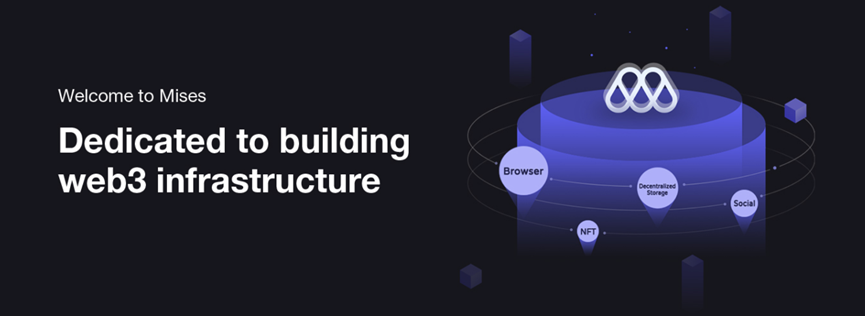
Mises is a Web3 infrastructure project built on blockchain technology, aiming to achieve a decentralized internet. To accomplish this, Mises offers a range of products and services, including the distributed ledger Mises Chain, the identity verification system Mises ID, the mobile Web3 browser Mises Browser, decentralized storage services, and NFTs (non-fungible tokens).
Mises Chain is a high-performance distributed ledger built on the Cosmos SDK and Tendermint consensus mechanism, supporting the development of Web3 applications. Mises ID is a unique, secure, and privacy-oriented identity verification system based on Mises Chain, compatible with Ethereum addresses. Mises Browser is the world's first fast, secure, and extensible mobile Web3 browser, allowing users to access DApps and browse Web3 content. Decentralized storage services aim to ensure secure data storage and fast retrieval. Users can store their data on nodes spread across the Mises network globally, ensuring data integrity and confidentiality. NFTs are non-fungible tokens that users can showcase through wallet addresses, enhancing their social value.
Mises also plans to leverage its decentralized network to break the existing monopolies and become the gateway to the Web3 world on mobile devices. Once Mises accumulates over 10 million users, the accumulated user base and social connections will start attracting other communities, helping to promote other ecosystems and ultimately realizing the vision of building a decentralized internet.
Introduction to Core Product - Mises Browser
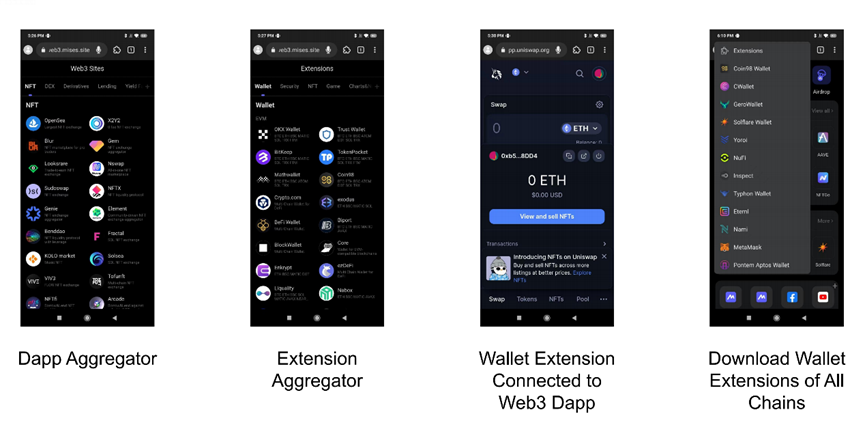
Mises Browser is the world's first Web3 browser that supports Chrome extensions on mobile phones. It aims to provide users with the same seamless Web3 experience on their mobile devices as they would have on a PC. The product offers four main features:
1. Web3 DApp Aggregator:
The browser comes with a built-in Web3 DApp aggregator, including nearly 400 popular Web3 websites, allowing users to access Web3 services quickly and securely.
2. Extension Support:
Users can directly download and use Chrome extensions on the Mises mobile browser. The browser also features a built-in extension aggregator with over 200 wallet extensions.
3. Decentralized Domain Name Resolution:
Mises Browser supports decentralized domain name resolution and IPFS (InterPlanetary File System).
4. Secure Whitelisting:
We have implemented several security mechanisms to protect our users from phishing websites and scammers. DApps, extensions, and websites from our trusted partners are added to the secure whitelist.
Compared to other browsers, Mises Browser offers several advantages, including:
1. Best Mobile Browser Extension Support:
Most Chrome extensions are supported on Mises Browser and have been optimized for mobile devices.
2. Convenient Access to Web3 Websites:
The browser includes a Web3 aggregator featuring the most commonly used Web3 websites.
3. DID (Decentralized Identifier) Domain Name Resolution:
Mises Browser can resolve DID domain names across different chains, allowing users to directly access Web3.
4. 100% Open-Source:
Mises Browser is based on the latest Chromium core and is developed entirely by its own development team.
5. Decentralized Account System:
User accounts are based on the decentralized Mises ID and do not collect any personal information.
6. Faster Performance:
Mises Browser removes redundant features to improve speed and performance.
7. Robust Privacy Protection:
Incognito mode and private search help users protect their privacy.
Economic Model and Token Economy
Mises is a decentralized social networking protocol designed for user social relationships and decentralized storage. Its native token is called MIS, and there are three methods of token generation:
A. A one-time initial generation at the launch of the mainnet.
B. Ongoing generation with the creation of each block.
In addition to the above issuance methods, there is one more method for the Mises token. When the active user count of Mises ID exceeds 4 million, 8 million, ... 400*2^n, the community can propose and approve additional issuance. 10% of the funds raised will be donated to the development team, while the rest will be allocated to the Market Making Fund.
Now, let's delve into the systematic introduction of its economic model.
1. Token Issuance and Distribution
The initial total supply of MIS tokens is 100 million. The allocation is as follows: 12% for angel investments, 18% for the team, 10% for private placements, 20% for public issuance, 15% for the community, 10% for ecosystem development, and 15% for the MIS Foundation.
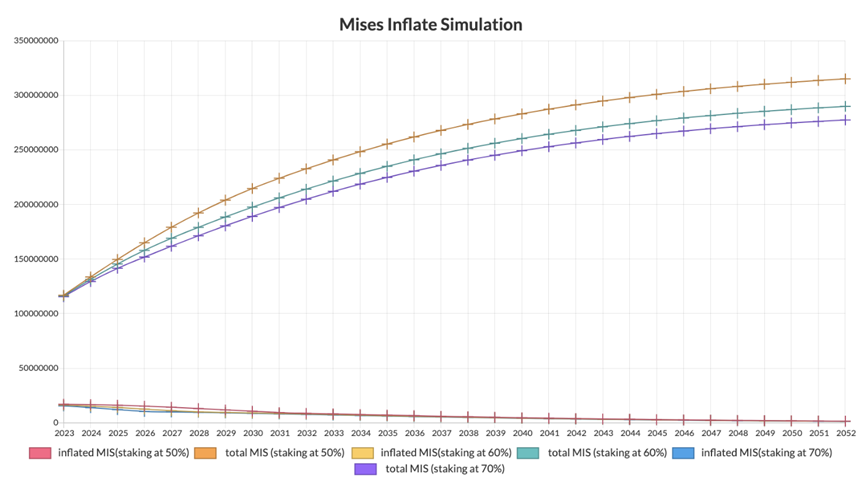
Once Mises starts operating, nodes will receive block rewards. The specific reward value is related to the staking rate of MIS. If the staking rate exceeds the target rate, the reward will decrease proportionally, and if it falls below the target rate, the reward will increase proportionally. Based on calculations, the total supply of MIS tokens is projected to be between 250 million and 320 million in subsequent issuance.
2. Inflation and Token Issuance
Every time a block is produced, all participating validating nodes receive additional rewards, and the issuance reward pool is distributed based on the voting power held by each node.
The initial inflation rate is set at 18% for the genesis block. Afterward, the annual inflation rate is continuously adjusted based on the block height, with a limited adjustment range. The default annual adjustment range is [-13% - 13%], and the annual inflation rate is capped and floored. In the first year, it is limited to [10%-20%]. The system's annualized inflation rate is dynamically adjusted based on the current staking rate and time.
Specifically, the overall staking rate is influenced by the following factors:
1) When the staking rate is low, increasing staking rewards encourages staking, while a high staking rate ensures system stability and resistance to attacks. When the staking rate is too high, the rewards decrease, improving liquidity.
2) The suggested target staking rate is 34%. If the staking rate is below the target, the annualized inflation rate increases, and if it is above the target, it decreases. Once the target is reached, the inflation rate stabilizes.
3) The formula for adjusting the inflation rate at each block height is the number of blocks produced per year divided by the annual adjustment range limit multiplied by (1 - current staking rate / target staking rate).
4) The influence of time:
A) To ensure the interests of early investors, there will be minimal additional issuance in the coming years, resulting in a decreasing overall inflation rate.
B) With lower inflation in the future, validators will earn more income through gas fees.
C) At each block height, the upper and lower limits of the inflation rate will undergo an adjustment, aiming for a 10% decrease per year.
3. Participants in the Economic Model
1) Users: Users who utilize the Mises network.
l In DApps, users need to pay gas fees in MIS to cover their basic actions, such as accessing personal data and social relationships within the DApps.
l Users need to pay gas fees when conducting MIS token transfers.
l Users utilizing decentralized storage:
l Storing content incurs fees based on content size and storage duration.
l Accessing paid content from other users requires payment based on the price calculated by the Mises network, with the user's specified portion distributed proportionally to the Foundation, nodes, and the content publisher, with distribution ratios of 10%, 30%, and 60% respectively.
2) DApps: Decentralized applications built on the Mises network.
l DApps pay gas fees in MIS on behalf of their users for their basic actions within the Mises network.
l DApps need to stake MIS as collateral for utilizing network services on the Mises network, with a minimum stake requirement of 10,000 MIS.
l Early-stage DApps can apply for funding from the Foundation, and all funded MIS must be staked. Later DApps are required to purchase MIS on their own.
l DApps utilizing decentralized advertising services on the Mises network will receive 40% of the revenue.
l Additionally, the Foundation will receive 10%, nodes will receive 20%, and users who view ads will receive 30%.
3) Nodes: Service providers running the Mises decentralized software to serve users.
l Running a node requires staking MIS as an incentive. Each node must stake a minimum of 1 million MIS, with a maximum stake of 5 million MIS. The stake amount is positively correlated with the probability of a node producing blocks.
l Nodes that produce blocks will receive transaction gas fees and additional block production rewards.
l Nodes providing decentralized storage services:
l They receive storage fees paid by content owners.
l They receive 30% of the payment based on the price calculated by the Mises network from viewing users and the user-specified price.
l Nodes providing decentralized advertising services will receive 20% of the advertising revenue.
4) Foundation: The team responsible for developing, operating, and expanding the Mises network.
l The Foundation receives 10% of the revenue from decentralized storage and advertising.
l The Foundation will fund the development of third-party communities, games, and other DApps based on the Mises network.
4. Development and Roadmap
In the second phase of Mises network development, decentralized storage services will be developed. Users will be able to pay to store their most important documents or posts published in Mises Discover on the Mises network.
Content stored on the Mises network can be accessed with payment, with the price set by users in Mises tokens, but it cannot be lower than the minimum network bandwidth cost. 10% of the revenue will go to the Foundation, 30% will go to the nodes providing storage and bandwidth services for the content, and 60% will reward the users who publish the content.
Mises network will also develop decentralized online advertising services. Merchants can purchase Mises tokens and advertise within the community. 10% of the advertising revenue will be allocated to the development team, 20% to DSN-V nodes, 40% to the advertising community, and 30% to users who view the ads.
Additionally, there will be many disruptive decentralized services on the Mises network, such as hotel bookings, flight bookings, e-commerce, and food delivery services. Many current internet services can be decentralized in various ways. Breaking monopolies in more areas will allow service providers and creators to earn more income.
Conclusion
As a Web3 infrastructure project built on blockchain technology, Mises aims to achieve a decentralized internet. Its range of products and services will help break the monopoly of current internet giants and become the gateway to the Web3 world on mobile devices. With the growing demand for internet freedom and security, Mises' development should be able to meet users' pursuit of a more open, decentralized, and interconnected network, gradually ushering in a more decentralized era for the entire internet.


All Comments