


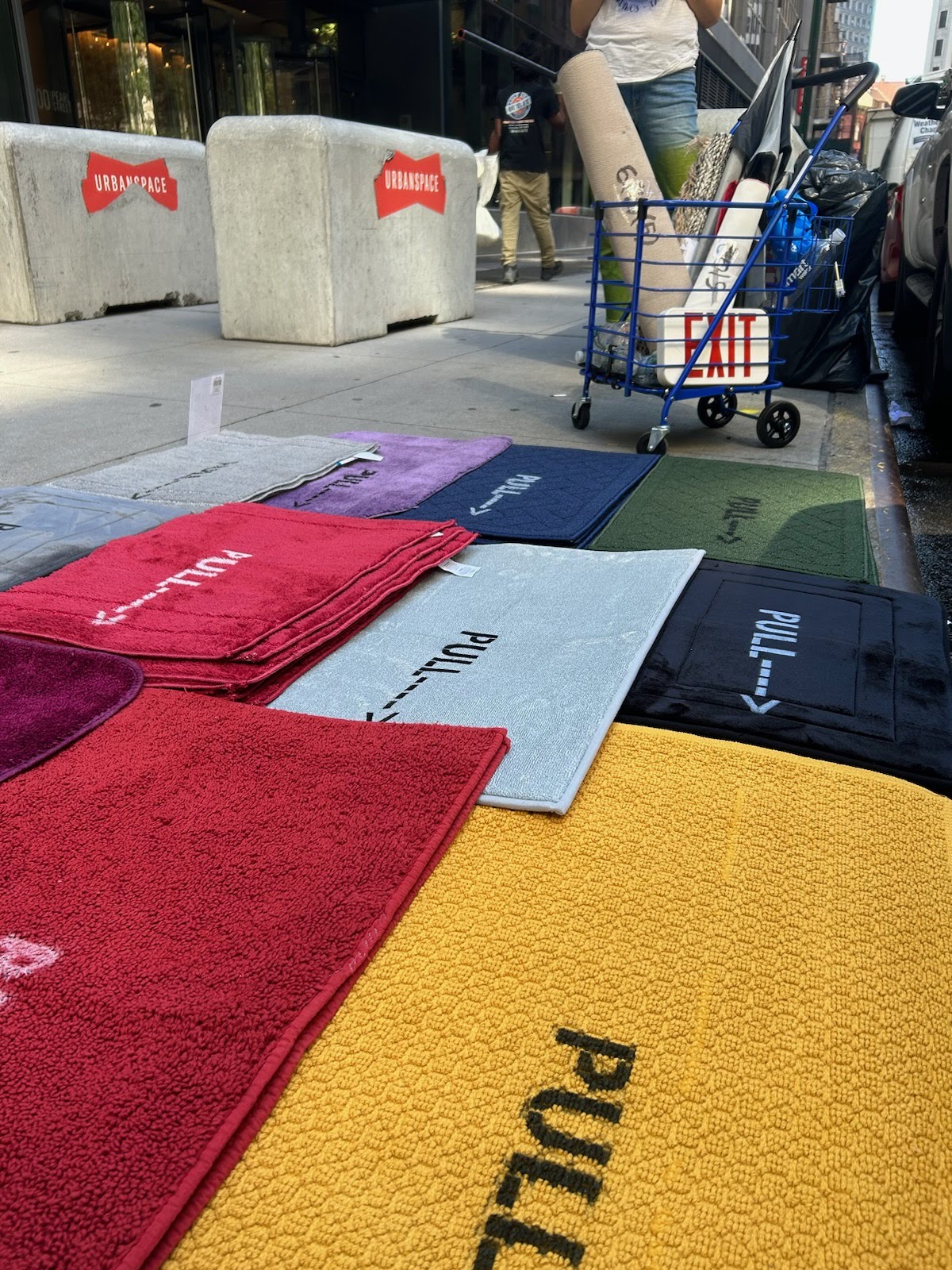
Street vendors abound in downtown Manhattan’s Financial District. But weeks ago, on Sept. 14, an especially unconventional seller set up shop in front of the United States Securities and Exchange Commission (SEC), transforming a patch of Maiden Lane into a colorful quilt of doormats, each spray painted with the straightforward instruction to “pull.”
People enquired, but they were fake and not really for sale. The wares were part of “Rug Pull,” the latest guerilla installation by Nelson Saiers, a New York-based hedge fund manager turned artist who some consider “The Warhol of Wall Street” or crypto’s most creative activist. As an artwork, “Rug Pull” highlights the many victims affected by the type of scam it’s named after.
Over the past year, crypto has been forced to overcome its resistance to centralized regulations. At the same time, victims of rug pulls and other scams have yet to enjoy the protection that centralized bodies supposedly provide.
“The SEC’s shortcomings extended beyond merely failing to safeguard investors from clear scams,” Saiers told Cointelegraph, adding: “While they have a very difficult job, it seems they were too lax in some ways but also too aggressive in others. I feel their rejection of certain investments may have unfortunately led some investors into more fraudulent products.”
Saiers only works on-site when it makes sense. His art practice transcends crypto, too. He takes on other topics like unjust incarceration or the profound union of art and math.
The artist’s family moved from Ethiopia to the Washington, D.C. area when he was five. He earned his bachelor’s and Ph.D. in mathematics from the University of Virginia by age 23.
Saiers chose to work in finance after reading the travails of the Wall Street bond salesmen in the book Liar’s Poker by Michael Lewis. He served as a managing director at Deutsche Bank and as the chief investment officer at his own fund, Saiers Capital, which won the 2011 HFMWeek Award for top Relative Value hedge fund.
In 2014, though, he took the leap to become an artist.
“Art was just way more interesting than finance at that point,” Saiers said. He’d seen significant shifts during his finance career — like the 2008 crisis, to say the least. By comparison, the field was calming down.
“When you’re regularly daydreaming about art, or you wake up in the middle of the night and start thinking about your next art piece instead of the Nikkei and S&P, it’s time to become an artist.”
He taught himself to paint with videos and books, building on childhood museum visits.
At the end of 2014, Saiers presented his first full-scale exhibition titled “Blindfolded in Gravity’s Shadow” at Studio Vendome in New York.
In 2016, he unveiled three more, including “Shortening: Making Irrational Rational,” which was a show criticizing unnecessarily long prison sentences for low-level offenders in America’s prison industrial complex through the lens of jerseys — since inmates often call those sentences “football numbers.” The show took place, appropriately, at the infamous prison on Alcatraz Island in San Francisco.
Saiers caused a buzz with his first guerilla installation in 2018, where he inflated a towering “crypto rat” in Manhattan’s Financial District, staring down the Federal Reserve.
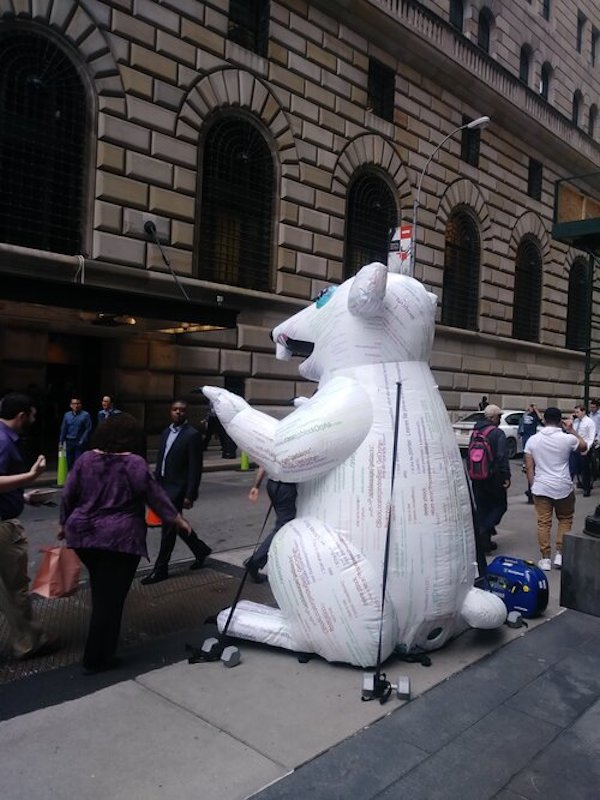
Its design was directly inspired by iconic New York City blowup rats, which often anchor protests against landlords. In this instance, Saiers added crypto code across the rodent’s body and Bitcoin signs in its eyes.
The rat also alluded to Warren Buffet, who called crypto “rat poison squared” at the time. That was the first crypto winter, where Bitcoin famously fell from $20,000 to $6,000 at the hands of SEC uncertainty and waning faith in the tech.
That was the year Saiers, who’s only ever held Bitcoin, got involved in crypto. “I did want to inject some support back into the crypto community,” he said.
Even at the height of the madness, he never got caught up in a rug pull. Despite disagreeing with Buffet’s crypto critiques, Saiers cited Buffet’s advice “to be fearful when others are greedy and to be greedy only when others are fearful” as his strategy for avoiding most scams.
However, Saiers still sympathizes with those who’ve lost savings in the crypto sector, from obscure projects to FTX. Rather than protecting these taxpayers, he sees the SEC approving bailouts for big banks, even while America’s national debt climbs.
“Rug Pull” speaks to that everyman mentality with its simplicity. Saiers sourced the rugs from Instacart, though his orders got canceled several times due to their size. He chose to spray paint the “pull” accents for pragmatism and to honor the guerilla artist aesthetic.
A cart stationed near the sales display lent further, subtle nuance. The cart itself is another fixture for your typical New York street vendor, but Saiers’s had locks on it to represent locked liquidity, an exit sign to represent exit scams and an empty water bottle for a lack of liquidity.
The artist has another New York gallery show in store during the next year, but just because the “Rug Pull” debut is complete doesn’t mean the project is done. Saiers might perform it again. It wouldn’t be the first time he’d repeated a guerilla installation — he even brought the Bitcoin rat down to Washington, D.C., but while he only has to give the New York Police Department a day’s notice to set up in the city, the Secret Service in D.C. warned him that a bomb squad would need to check out the generator he uses to keep the rodent inflated. Saiers went home instead.
“Rug Pull,” however, doesn’t require machinery. So, who knows where it could go on view next.


All Comments