

Cointime

Download App
iOS & Android

Major Web3 Security Incidents in 2022

Validated Individual Expert

In early January, a major study “Global Web3 Security Report 2022 & Crypto Regulatory Compliance Research” was published. It was jointly created by the companies Beosin, Buidler DAO, Legal DAO and Footprint Analytics. The study consisted of an overview of the ten largest security incidents of 2022 in Web3, global statistics on crypto crimes and regulatory policies of different countries in relation to crypto. Also, this document contains instructions that will help protect yourself in Web3 and the authors’ forecasts for 2023.

According to the study, in 2022 there were more than 167 major attacks in Web3. The total losses from attacks of all types were about $3.6 billion, which is 47.4% higher than in 2021 (approximately $2.44 billion). Most of the losses were caused by attacks on cross-chain bridges — 12 incidents with losses totalling $1.89 billion. And most other attacks (113) were directed at the DeFi sector.
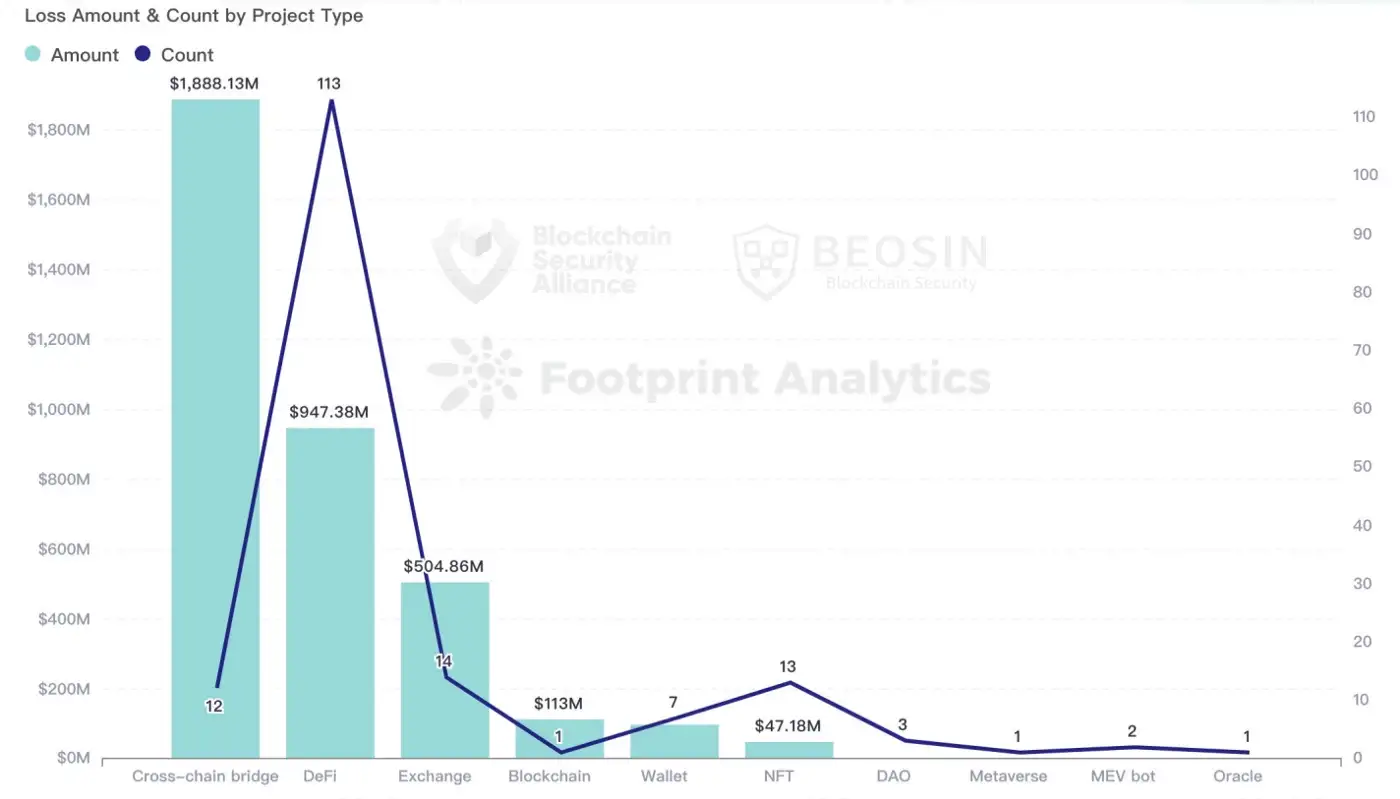
Loss Amount & Count by Project Type. Source: “Global Web3 Security Report 2022 & Crypto Regulatory Compliance Research”

If we take into account all crimes related to crypto, including pyramid schemes, scams, money laundering, attacks/exploits and others (without financial crimes), the losses for 2022 amount to more than $13.7 billion.
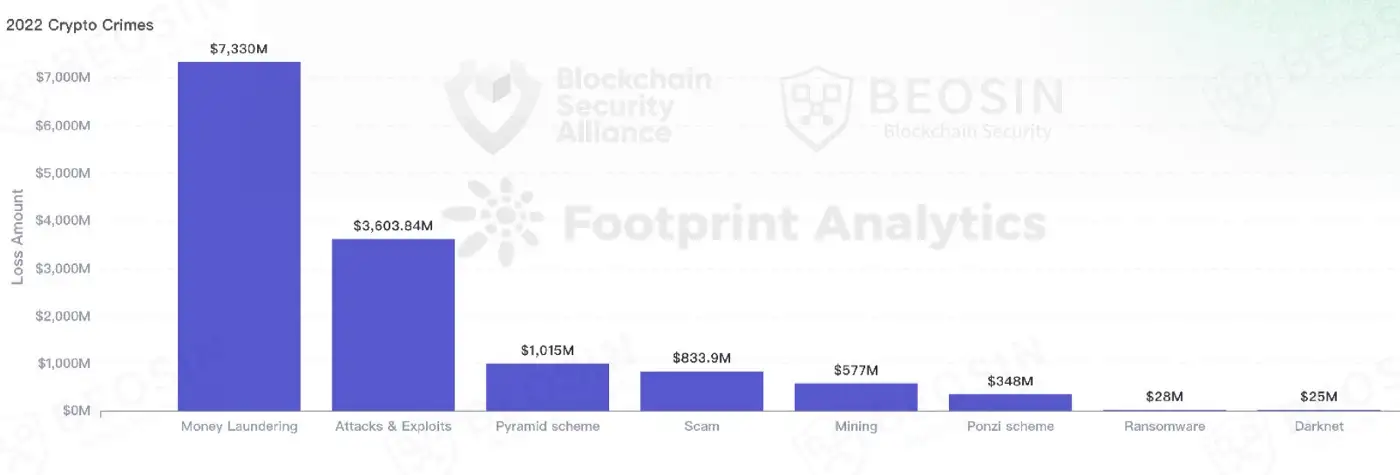
2022 Crypto Crimes. Source: “Global Web3 Security Report 2022 & Crypto Regulatory Compliance Research”

The report linked the decrease of global TVL in 2022 to these events. As we can see from the graph below, the events such as Beanstalk, Luna Crash, Harmony, Nomad, Tornado Cash Sanction, The Merge, Wintermute, BNB Chain, Mango Markets, FTX collapse were all followed by withdrawal of capital from the crypto markets.
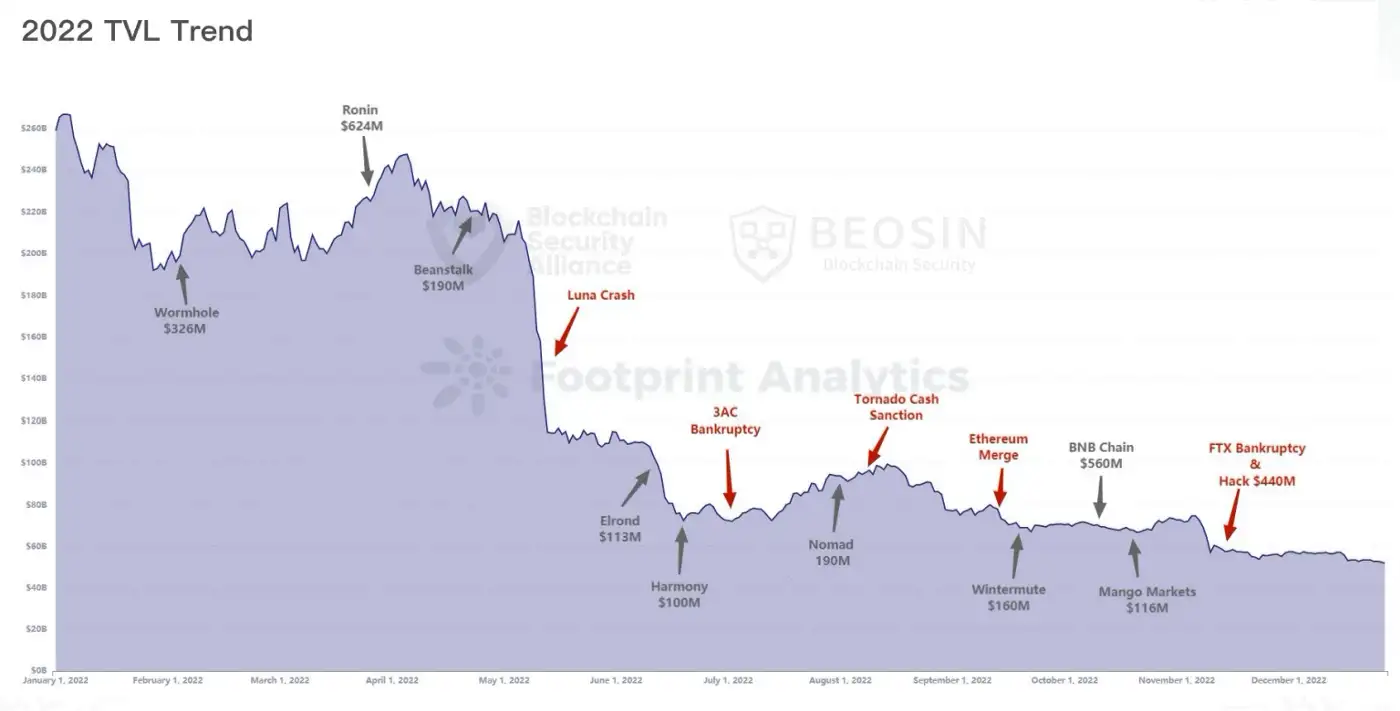
2022 TVL Trend. Source: “Global Web3 Security Report 2022 & Crypto Regulatory Compliance Research”

Furthermore, the study presents a list of the ten largest security incidents for 2022. We have summarised this list, highlighting data about the type of attack and the amount of losses incurred:

  1. Ronin Network (Loss: $624 Million; Attack Type: Social engineering)
  2. BSC Token Hub (BNB Chain) (Loss: $560 Million; Attack Type: Blockchain vulnerability)
  3. FTX hack (Loss: $440 Million; Attack Type: Suspected rugpull)
  4. Wormhole (Loss: $326 Million; Attack Type: Contract vulnerability — validation issue)
  5. Nomad bridge (Loss: $190 Million; Attack Type: Contract vulnerability — validation issue)
  6. Beanstalk (Loss: $182 Million; Attack Type: Flashloan)
  7. Wintermute (Loss: $160 Million; Attack Type: Private key compromise)
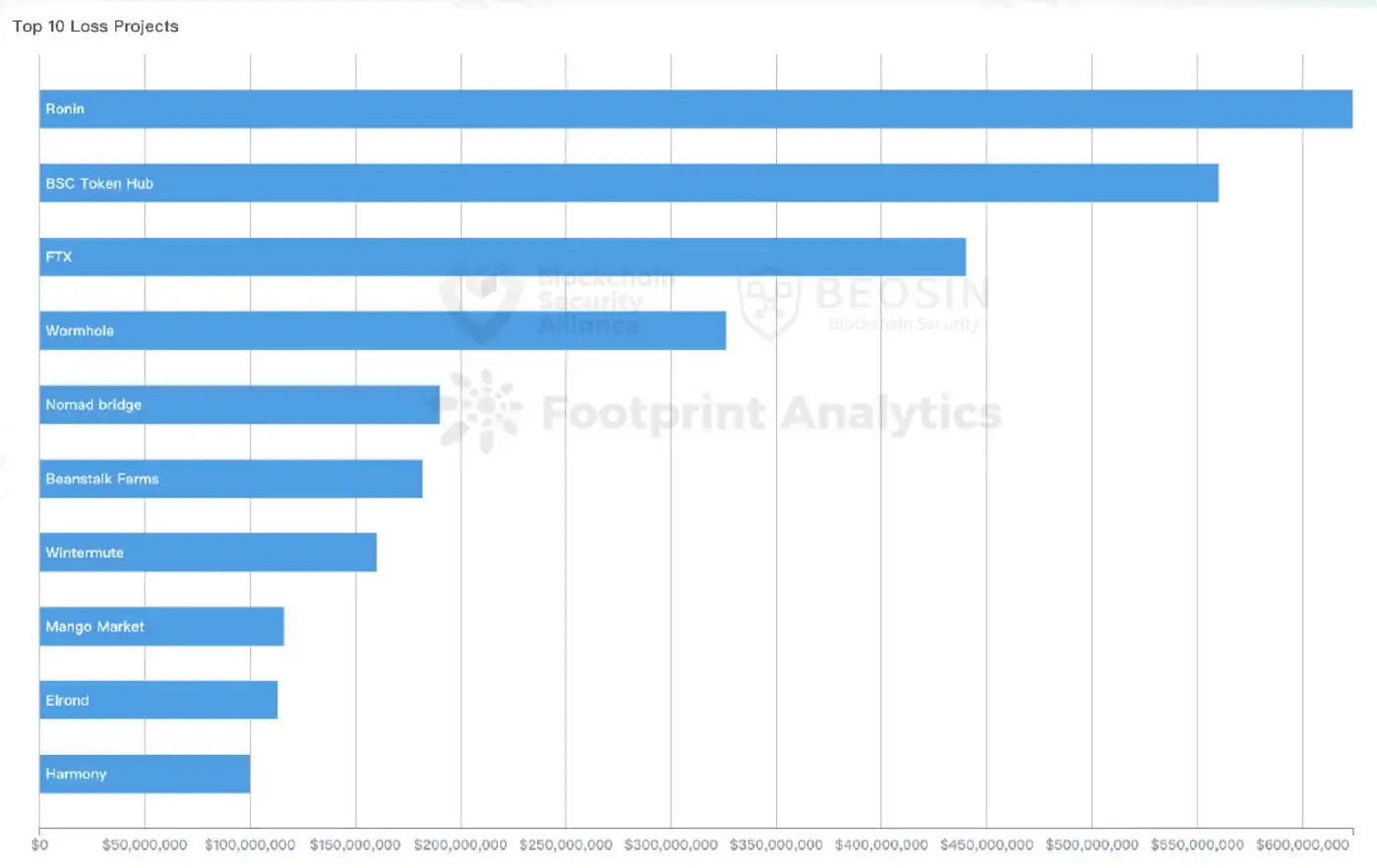
  8. Mango markets (Loss: $116 Million; Attack Type: Price manipulation)
  9. Elrond (Loss: $113 Million; Attack Type: VM issue)
  10. Harmony (Loss: $100 Million; Attack Type: Private key compromise)
Top 10 Loss Projects. Source: “Global Web3 Security Report 2022 & Crypto Regulatory Compliance Research”

As for the chains that were victims of the attacks, number one for losses went to the Ethereum blockchain with losses mounting to more than $2.01 billion and 59 incidents. The second place was taken by the BNB Chain, which lost about $0.8 billion, but was ahead in the number of incidents — 72. The third place was held by the Solana blockchain with losses of about $0.51 billion and 7 incidents.
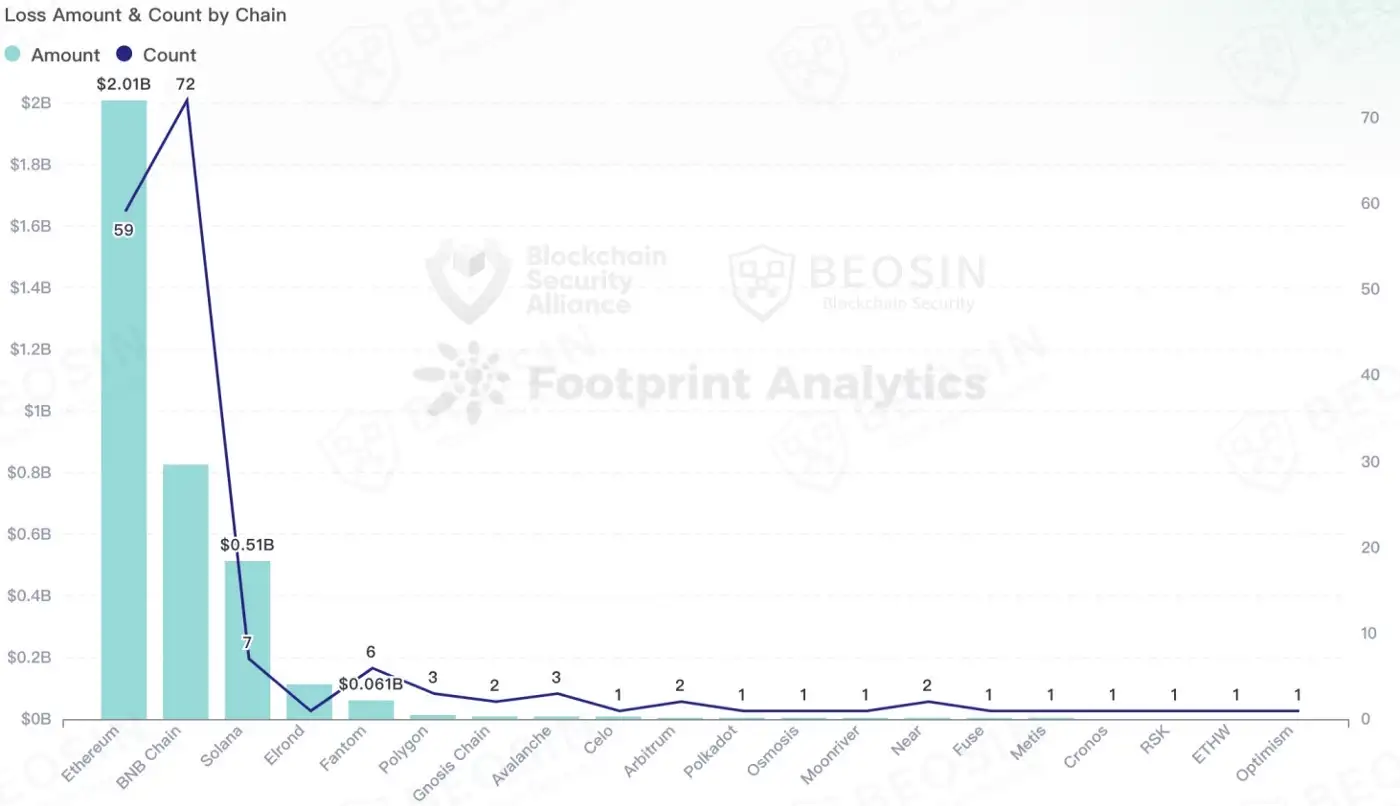
Loss Amount & Count by Chain. Source: “Global Web3 Security Report 2022 & Crypto Regulatory Compliance Research”

In 2022, according to the study, 243 rug pulls were carried out. The total amount of damage to the industry from rug pulls was about $425 million (excluding $440 million FTX incident)
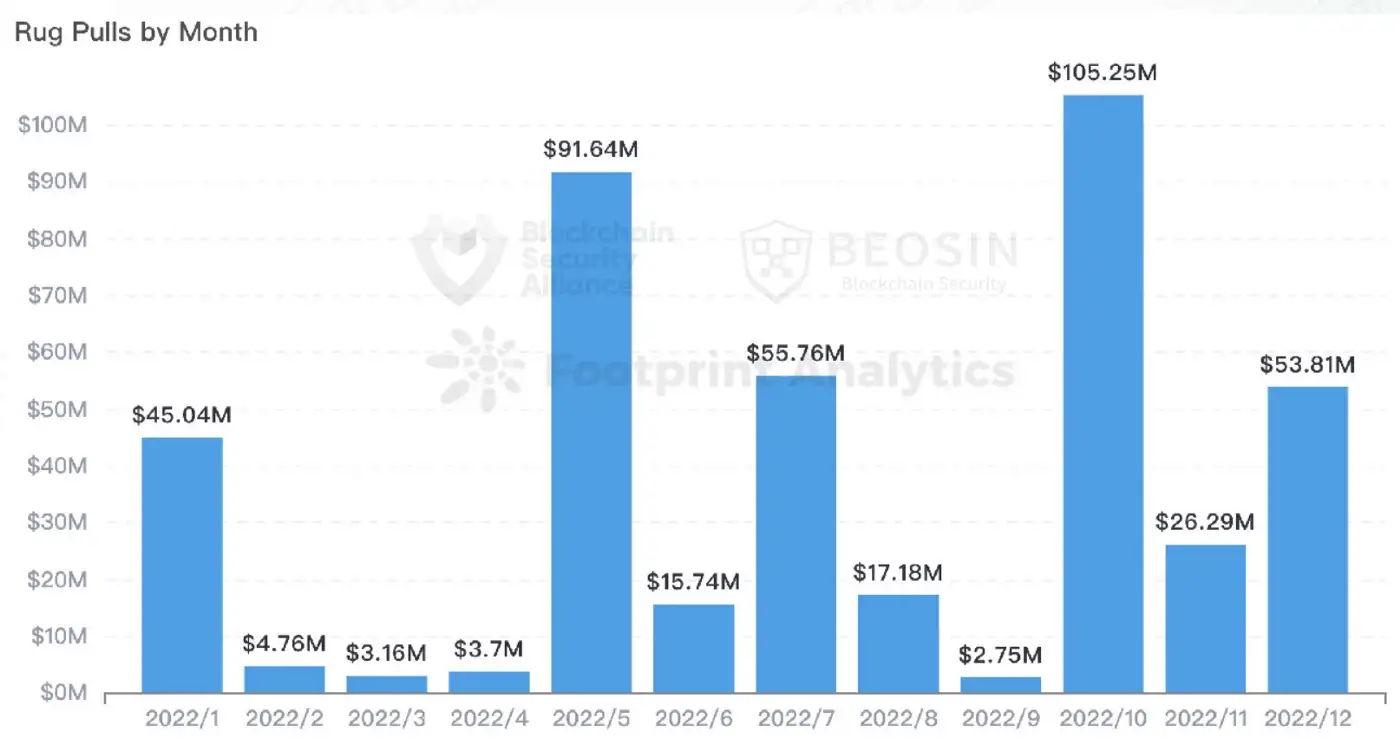
Rug Pulls by Month. Source: “Global Web3 Security Report 2022 & Crypto Regulatory Compliance Research”

As for the regulation of cryptocurrencies, in 2022, countries like the United States, EU member countries, Hong Kong SAR, Singapore, Japan, South Korea, Malaysia and the United Arab Emirates actively participated in this legislative sphere. The authors of the study note that in 2023 the main trend in regulatory policy will be “systematization”.

“In 2022, crypto ‘bombshells’ exploded frequently, accompanied by a dramatic market downturn that caused severe turmoil in the industry. 2023 will certainly see a response from global regulators. A number of regulatory trends are already emerging in 2022. In our view, one of the overarching themes of global crypto regulatory developments in 2023 is likely to be the “systematisation of the regulatory framework”. A large number of jurisdictions with rapidly growing crypto industries (e.g. the US, UK, Canada, etc.) have not yet developed a systematic regulatory framework. In these jurisdictions, there have been a large number of regulations issued by various regulatory or enforcement bodies, but the fragmentation has left many of the underlying legal concepts poorly answered and has made practice difficult. The good news is that we are seeing a clear trend towards ‘systematisation’ in 2022.”

The authors of the study also talked about what can be expected in the security sector in 2023. They wrote that the global regulatory system will develop, the entire infrastructure will be strengthened, stolen funds will be returned more often, more attacks will be blocked before they begin, and users will be more aware of basic security rules.

In conclusion, we recommend you familiarize yourself with the third chapter of this study, which describes security guidelines for Web3 users. And we continue to observe.


Comments

All Comments

Recommended for you

  • Global Bond Market Faces Sell-off, Panda Bond Issuance Reaches Record High

    According to CCTV Finance, the long-term government bond yields of major global economies have continued to rise recently, intensifying sell-off pressure in the bond market. However, China's bond market and exchange rate have remained relatively stable, with the issuance of Panda bonds reaching a historical high for the same period. Data shows that as of August 21, the cumulative issuance of 2026 Panda bonds has reached 209.975 billion yuan, an increase of over 73% year-on-year. Against the backdrop of significant fluctuations in the global bond market, the increased interest from international institutions in domestic RMB financing has drawn attention. Industry insiders noted, 'We are in completely different economic and monetary cycles compared to overseas. Foreign capital accounts for only about 5%-8% of our bond market, while domestic capital holds absolute pricing power. Coupled with our monetary policy that prioritizes domestic considerations, overseas shocks cannot reverse the overall trend of the domestic bond market.' Looking ahead, industry experts believe that overseas bond yields are likely to remain highly volatile, highlighting the value of RMB bond allocations, and foreign capital may continue to increase its allocation in the medium to long term. However, it is also important to note that rising U.S. bond yields have raised the return threshold for global allocation funds, which may disrupt the willingness of foreign institutions to increase their holdings of RMB bonds. Additionally, the rapid rise in bond yields in developed countries overseas may also constrain the valuation of domestic risk assets.

  • Global Bond Market Faces Sell-Off, Panda Bond Issuance Reaches Record High

    According to CCTV Finance, recent long-term government bond yields in major global economies have been rising, increasing sell-off pressure in the bond market. In contrast, China's bond market and exchange rate have remained relatively stable, with Panda bond issuance reaching a historical high for the same period. Data shows that as of August 21, the cumulative issuance of 2026 Panda bonds has reached 209.975 billion yuan, a year-on-year increase of over 73%. Amidst significant fluctuations in the global bond market, international institutions are increasingly focusing on domestic RMB financing. Industry insiders noted, 'We are in completely different economic and monetary cycles compared to overseas. Foreign capital accounts for only about 5%-8% of our bond market, while domestic capital holds absolute pricing power. Coupled with our monetary policy that prioritizes domestic conditions, overseas shocks cannot reverse the overall trend of the domestic bond market.' Looking ahead, industry experts believe that overseas bond yields are likely to remain highly volatile, highlighting the value of RMB bond allocation, which may attract continued foreign investment in the medium to long term. However, it is also important to note that rising U.S. bond yields have raised the return threshold for global allocation funds, which may disturb the willingness of foreign institutions to increase their holdings of RMB bonds. Additionally, the rapid rise in yields of bonds from developed countries overseas may also constrain the valuation of domestic risk assets.

  • Whale Transfers 1,727 Bitcoins Worth $133 Million to Binance

    According to monitoring by Bitcoin News, a whale has transferred 1,727 bitcoins, valued at $133 million, to Binance.

  • A Whale Transfers 1,727 Bitcoins Worth $133 Million to Binance

    According to monitoring by Bitcoin News, a whale has transferred 1,727 bitcoins to Binance, valued at $133 million.

  • Canadian Prime Minister: Tariff Measures Against the U.S. to Take Effect on September 8

    On August 22, Canadian Prime Minister Carney announced that Canada's tariff measures against the United States will take effect on September 8. (Jin Ten)

  • Canadian Prime Minister: Tariff Measures Against the U.S. to Take Effect on September 8

    On August 22, Canadian Prime Minister Carney announced that Canada’s tariff measures against the United States will take effect on September 8. (Jin Shi)

  • Over $1.244 Billion Liquidated in 24 Hours, Majority in Long Positions

    On August 22, according to CoinGlass data, the total liquidation amount in the cryptocurrency market reached $1.244 billion in the past 24 hours, with long positions accounting for $744 million and short positions for $500 million. A total of 246,203 individuals were liquidated. Among them, the liquidation amount for BTC was approximately $194 million, for ETH about $277 million, for SOL around $104 million, for XRP about $123 million, for ZEC approximately $66.77 million, and other assets totaled about $479 million in liquidations. The largest single liquidation in the past 24 hours occurred on the BTC-USD trading pair on Hyperliquid, valued at approximately $24.96 million.

  • Over $1.244 Billion Liquidated in the Last 24 Hours, Primarily Long Positions

    On August 22, according to CoinGlass data, the total liquidation amount in the cryptocurrency market over the past 24 hours reached $1.244 billion, with long positions accounting for $744 million and short positions for $500 million. A total of 246,203 individuals were liquidated. Among them, the liquidation amounts were approximately $194 million for BTC, $277 million for ETH, $104 million for SOL, $123 million for XRP, and about $66.77 million for ZEC, with other assets totaling approximately $479 million in liquidations. The largest single liquidation occurred on the Hyperliquid BTC-USD trading pair, valued at approximately $24.96 million.

  • Grayscale: Bitcoin May Have Hit Bottom, This Week's Rise Signals Key Cycle Reversal

    On August 22, Grayscale published an article indicating that this week could mark a turning point for Bitcoin. Historical data shows that Bitcoin typically bottoms out after falling about 80% from its cycle peak. In the recent bear market, Bitcoin has dropped about 50% from its cycle high, which is less than in all previous cycles up to this point. There has been ongoing market speculation about whether Bitcoin will experience a new round of declines in the fourth quarter of 2026. Although risks remain in the market, this week's rise may suggest that Bitcoin has formed a more solid bottom.

  • Web3 data and AI company Validation Cloud completes $10 million in new round of financing

     Web3 data and AI company Validation Cloud announced a $10 million financing round from True Global Ventures. The company plans to use the funds to expand its AI products and achieve seamless access to Web3 data.