


Web3 is booming, and Arweave is becoming a popular infrastructure choice for developers. PermaDAO is a community where everyone can contribute to the Arweave ecosystem. It's a place to propose and tackle tasks related to Arweave, with the support and feedback of the entire community. Join PermaDAO and help shape Web3!
Author: Kyle @ Contributor of PermaDAO
Translator: Kyle @ Contributor of PermaDAO
Reviewer: Evelyn Zhu @ Contributor of PermaDAO
Introduction
In order to maintain information transparency and protect the right to know of the public, the U.S. government has established a set of decryption mechanisms. According to the "National Archive Act," government agencies need to create a decryption schedule based on the nature and level of confidentiality of documents to ensure that certain documents are made available to the public at the appropriate time. However, in reality, for security or political reasons, sometimes certain documents cannot be decrypted as planned, such as the files related to the assassination of Kennedy.
In the Web3 space, the Sarcophagus project adopts a similar operating mechanism - the dead man's switch. The concept of the dead man's switch originated from the 1918 New York subway derailment accident, which resulted from the tragic consequences of inexperienced drivers' mishandling. To prevent similar incidents from happening again, the dead man's switch was introduced as an emergency system. For example, the "driver's unconsciousness braking device" in the railway system is a dead man's switch used to ensure emergency braking when the driver is negligent or falls asleep to ensure safety.
So, how does the dead man's switch work in Sarcophagus? What possibilities does it bring? Let's delve into the Sarcophagus project.
What is Sarcophagus?
Project Overview
Sarcophagus is a decentralized dead man's switch application, built on Ethereum and Arweave, which provides data recovery or transfer services for users in cases of incapacity, death, or the inability to access their data.
Specifically, Sarcophagus provides users with a comprehensive digital dead man's switch system. Users can upload important files to Sarcophagus, encrypt them, and store them permanently on the Arweave network. At the same time, users need to set a file decryption time and point a recipient. Before the decryption time arrives, users can choose to extend the file's storage time or terminate the service; otherwise, the file will be automatically decrypted for the recipient.
SarcophagusDAO
The Sarcophagus project is run and managed through SarcophagusDAO, which utilizes the Aragon platform for all decision-making and financial management.
The Aragon platform seamlessly integrates proposals, voting, and financial management, automatically triggering a vote once a proposal is initiated. The voting token is SARCO-VR (voting rights) token, and community members need to stake SARCO tokens in the governance contract to obtain them. Proposals require compliance with two conditions to pass: first, governance tokens participating in the vote must reach 10% of the total supply, and second, the proposal must receive 60% approval.
As the project grows and the community expands, SarcophagusDAO has branched into four sub-DAOs, each with its responsibilities, and financial independence from the main treasury.
- Payroll subDAO: Used for regular payroll payments and supports on-chain voting, facilitating more efficient collaboration among multiple parties. Additionally, Payroll subDAO allows for the delegation of voting rights to others for representing and making future organizational structure adjustments.
- Liquidity subDAO: Responsible for providing permanent liquidity for $SARCO tokens to ensure users can acquire tokens and use Sarcophagus services.
- Growth subDAO: Conducts use case research and market analysis by mobilizing community contributors and seeks partners to expand the influence of Sarcophagus, thereby achieving growth both within and outside the DAO.
- Ambassadors subDAO: Aimed at supporting community development and project promotion. In recent proposals, the Growth subDAO will be merged into it.
Team and Funding Status
The Sarcophagus team is anonymous. According to the official website information, it is a global team composed of software developers, crypto enthusiasts, and security experts.
Additionally, Sarcophagus was incubated by Decent Labs and has completed three rounds of funding to date:
- In November 2021, it received $1.8 million in funding, led by Placeholder Ventures.
- In December 2021, it received $3.67 million in funding with participation from Inflection, Infinite, and others.
- In January 2022, it secured $5.47 million in funding with contributions from institutions such as Greenfield One, LD Capital, and several angel investors, with official participation from Arweave.
Why Do We Need Sarcophagus?
In tranquil environments, people often lack preparedness and crisis awareness, whether in the digital world or real life, potential risks persist.
According to Chainalysis' research, approximately 20% of the circulating bitcoins are lost, with a significant portion due to the loss of private keys. Additionally, many internet users, unfortunate in their passing, leave behind digital assets or crucial data that can no longer be accessed, as they did not protect their digital assets during their lifetime. Google's "Inactive Account Manager" service is a form of dead man's switch specifically developed for this situation. When a user passes away or can no longer access or use their Google account for other reasons, the system, based on the user's pre-defined settings, either automatically sends the data to friends and family or permanently deletes all data.
Although many people are unfamiliar with the concept of a dead man's switch, it is actually widely present in various aspects of our lives and important. Sarcophagus, as a decentralized dead man's switch application, has its unique advantages, offering a broader range of use cases.
Sarcophagus: A Robust and Persistent Dead Man's Switch
As digitalization becomes increasingly prevalent in our lives, the demand for managing data assets grows. Sarcophagus aims to help people more easily recover and share secret or sensitive data and deliver it to designated recipients. At the same time, users retain ownership of their data without the need for intermediaries. Overall, Sarcophagus, as a decentralized dead man's switch project, possesses the following key features: determinism, stability, flexibility, and persistence.
- Certainty: Due to the mechanism of the dead man's switch, it automatically triggers execution when conditions are met. When using Sarcophagus, users place their trust in this mechanism, derived from the certainty it offers.
- Stability: The data saved by users using Sarcophagus is double-encrypted and stored by multiple nodes, ensuring the reliability and stability of data in the face of exceptional circumstances.
- Flexibility: Sarcophagus also offers a degree of flexibility. Creating a dead man's switch does not mean it's a one-way street. Users can choose to extend or retract at any time, putting an end to this data decryption game.
- Permanence: Sarcophagus employs Arweave for permanent data storage, ensuring data remains safe and stable in the long term, a crucial aspect for a dead man's switch project.
Sarcophagus Use Cases
The dead man's switch ensures the secure recovery and transfer of users' sensitive information and digital assets. Sarcophagus' application scenarios include (but are not limited to): digital living wills, emergency communication, protecting high-risk individuals, password and credential recovery, and time capsules.
- Digital Will: Allows users to create encrypted and on-chain stored digital wills, one of Sarcophagus' most common use cases. Digital wills typically include account passwords, email accounts, private keys, and other sensitive data. Sarcophagus can provide a secure and trustless dead man's switch solution for users to preserve their digital inheritance.
- Emergency Communication: Users can use Sarcophagus to store emergency contact information and specify contacts to notify in times of distress. This is particularly useful in emergency situations like natural disasters, where communication networks may fail.
- Protection of Special High-Risk Individuals: It's not an exaggeration that politicians and journalists often face higher risks than the general population, and they usually hold crucial and sensitive information. Political activists and journalists can use Sarcophagus to store sensitive information, ensuring that important data remains unaffected in case of an accident. From another perspective, it also helps in backing up sensitive data to prevent loss.
- Password and Credential Recovery: Sarcophagus is used not only for storing passwords and security question credentials but also for utilizing these credentials to recover lost or forgotten information in the future. This is a reliable method for account security recovery, without relying on traditional recovery methods that are vulnerable to hacking or social engineering attacks.
- Time Capsules: Sarcophagus can act as a time capsule, preserving important files and data for future generations to unlock. From a broader perspective, it has the potential to preserve valuable cultural heritage for all of humanity, and from a smaller perspective, it can help every family preserve its own historical records.
Exploring Sarcophagus: Three Roles, Four Steps
Three Roles
The inspiration for the Sarcophagus concept comes from ancient Egyptian burial traditions, so there are many obscure terms in the application. With the launch of Sarcophagus v2 on the Ethereum mainnet, SarcophagusDAO has interpreted and simplified these unique terms, and some terms are no longer in use, becoming "history."
Throughout the entire operation of the Sarcophagus dead man's switch mechanism, there are three key roles.
- Embalmer: Users, the creators of the sarcophagus (dead man's switch).
- Archaeologist: Node operators.
- Recipient: The person (ETH address) who can access secret files after the dead man's switch is triggered.
Four Steps
From the beginning of a user using the Sarcophagus application to the final triggering of the dead man's switch, there are four steps:
- Create the Dead Man's Switch
Users use the Sarcophagus client to upload files and store them on the Arweave network after encrypting them with the recipient's public key, completing the creation of the sarcophagus.
- Attestation and Ongoing Operation
In order to prove that they are still alive, users extend the decryption time by setting a new resurrection time in the contract.
- Bury the Sarcophagus
If a user no longer wishes to use the Sarcophagus dead man's switch service one day and also does not want the files to be decrypted eventually, they can choose to bury the sarcophagus they created and terminate the contract with the nodes.
- Playload Release/Resurrection
The sarcophagus has two layers of encryption. If the user does not set a new resurrection time and triggers the dead man's switch, the nodes can decrypt the outer layer of the file and receive a reward, and finally, the recipient can use their public key to decrypt the file.
Mechanism Detailed Explanation
Phase One: Creating a Digital Dead Man's Switch
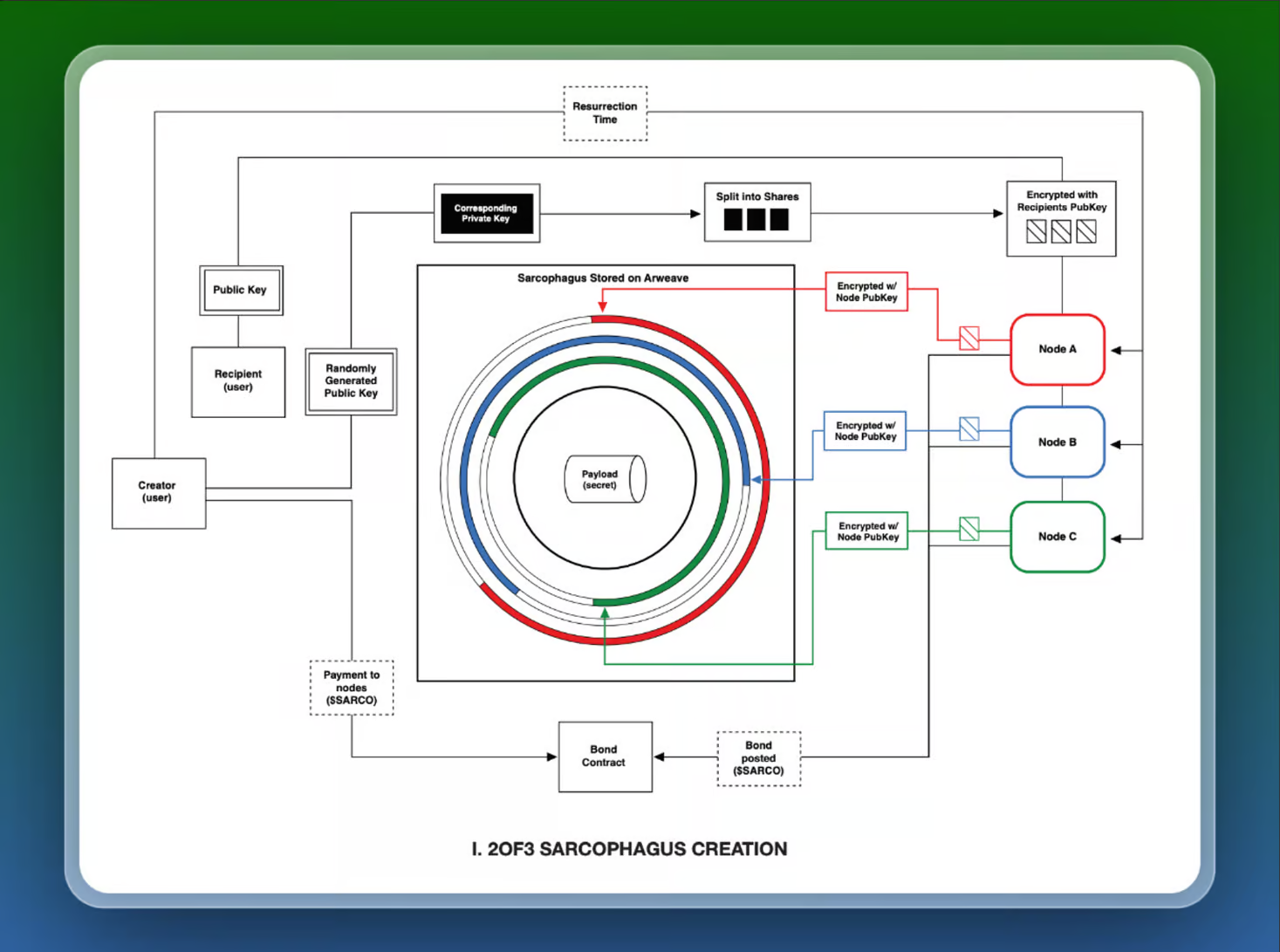
To create a digital dead man's switch, also known as a "Sarcophagus," users must complete the following steps:
- Choose the Resurrection Time: Users can update this resurrection time at any point before the switch is activated. Failure to confirm the contract will result in the secret file being released.
- Store Secret Files (Payload): This is called the payload, and it can be of any file type.
- Specify the Recipient's Public Key: Only users with the private key for this address can download the secret file when the dead man's switch is triggered. Additionally, Sarcophagus allows users to generate a new Ethereum key pair within the application and download it as a wallet PDF for easy sharing. Furthermore, if users wish for the secret file to be made public upon release, they can simply disclose the recipient's private key.
- Number of Nodes to Employ: Each node will receive a key share required to trigger the dead man's switch.
- Number of Nodes Needed to Release the Secret File: If a user selects, for example, 3 nodes to be employed and requires 2 of them to release the file, the dead man's switch will still work flawlessly even if one node is offline when it's triggered. Opting for all nodes to be required for releasing the secret file increases security but reduces resilience.
- Payment for File Storage (in Ethereum) and Payment to Employed Nodes (in SARCO Tokens): When users choose specific nodes, SARCO tokens are deducted from the user, and an amount is held as collateral from the nodes. These tokens are locked into a bond contract until the dead man's switch is triggered, incentivizing nodes to operate in a stable manner and in compliance with the network's rules.
If a node behaves maliciously, such as prematurely resurrecting the Sarcophagus, forgetting to resurrect it, or opening the Sarcophagus after the grace period, the node faces penalties. Penalties include the destruction of the fees paid to the node by the user and the node's staked bond.
Phase Two: Attestation and Ongoing Operation
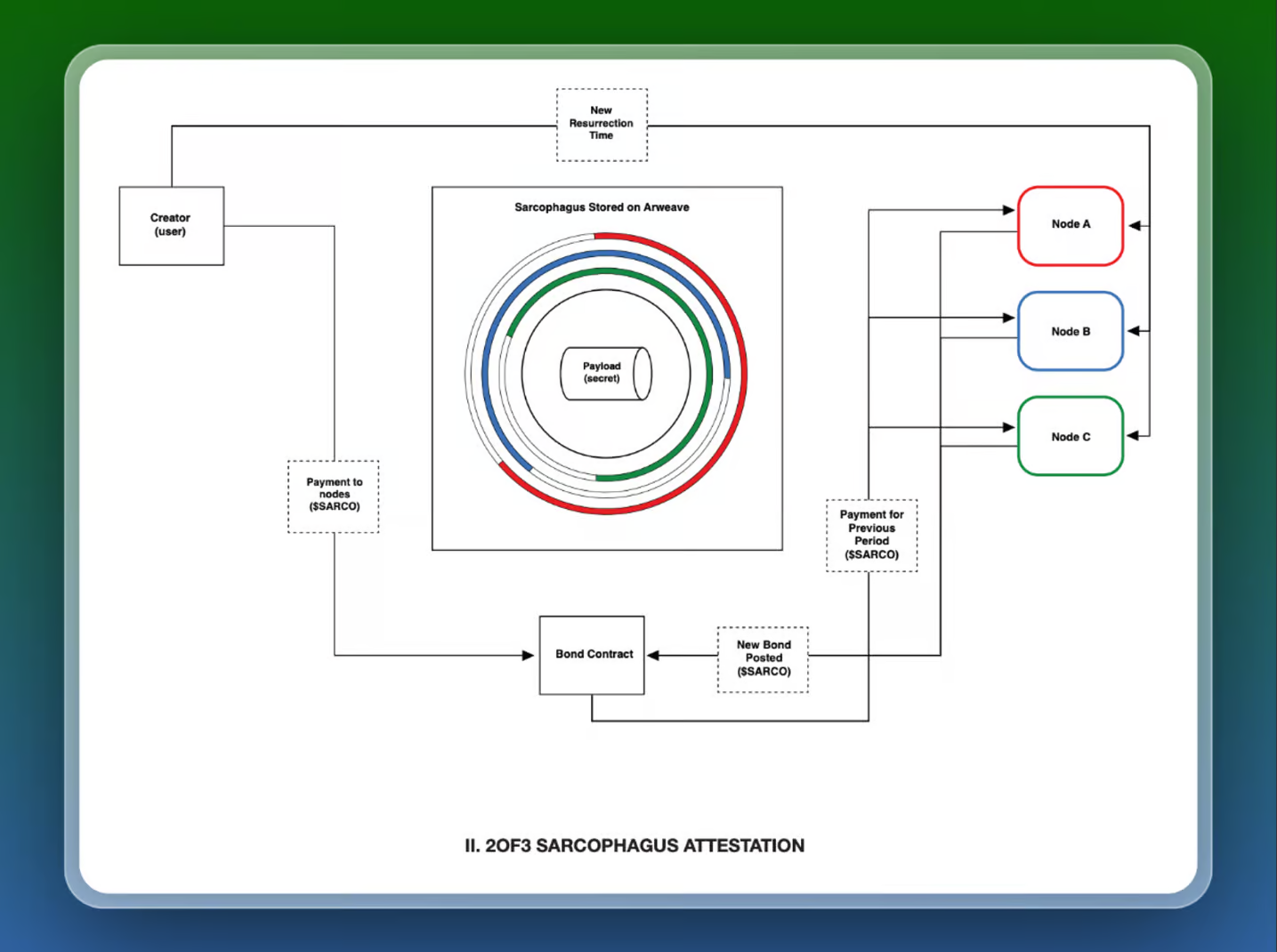
Once a Sarcophagus is created, users must perform a "attestation" action towards the contract before the resurrection time arrives. This proof action specifically involves sending a transaction to the contract, and the contract also informs the nodes (Payment to nodes). It's like telling everyone, "I'm still alive, don't trigger the dead man's switch."
During this process, users must:
- Set a New Resurrection Date: If users fail to confirm the contract again before the new resurrection time, the secret file will be released.
- Pay Fees to Nodes: Paid with SARCO tokens as the service fee for the upcoming period.
When users confirm the contract and select a new resurrection date, the initial SARCO tokens locked in the Sarcophagus during its creation are transferred to the nodes as their compensation for providing the service. Then, a new round of fees is placed into the contract. This process continues until users fail to confirm (i.e., lose control) and release the secret file or choose to bury the Sarcophagus, ending their collaboration with the employed nodes. It's worth noting that node services are billed based on storage time, meaning users pay more for longer resurrection dates. Furthermore, even if users confirm the contract before the resurrection date, they won't receive any refunds.
Phase Three: Burying the Sarcophagus
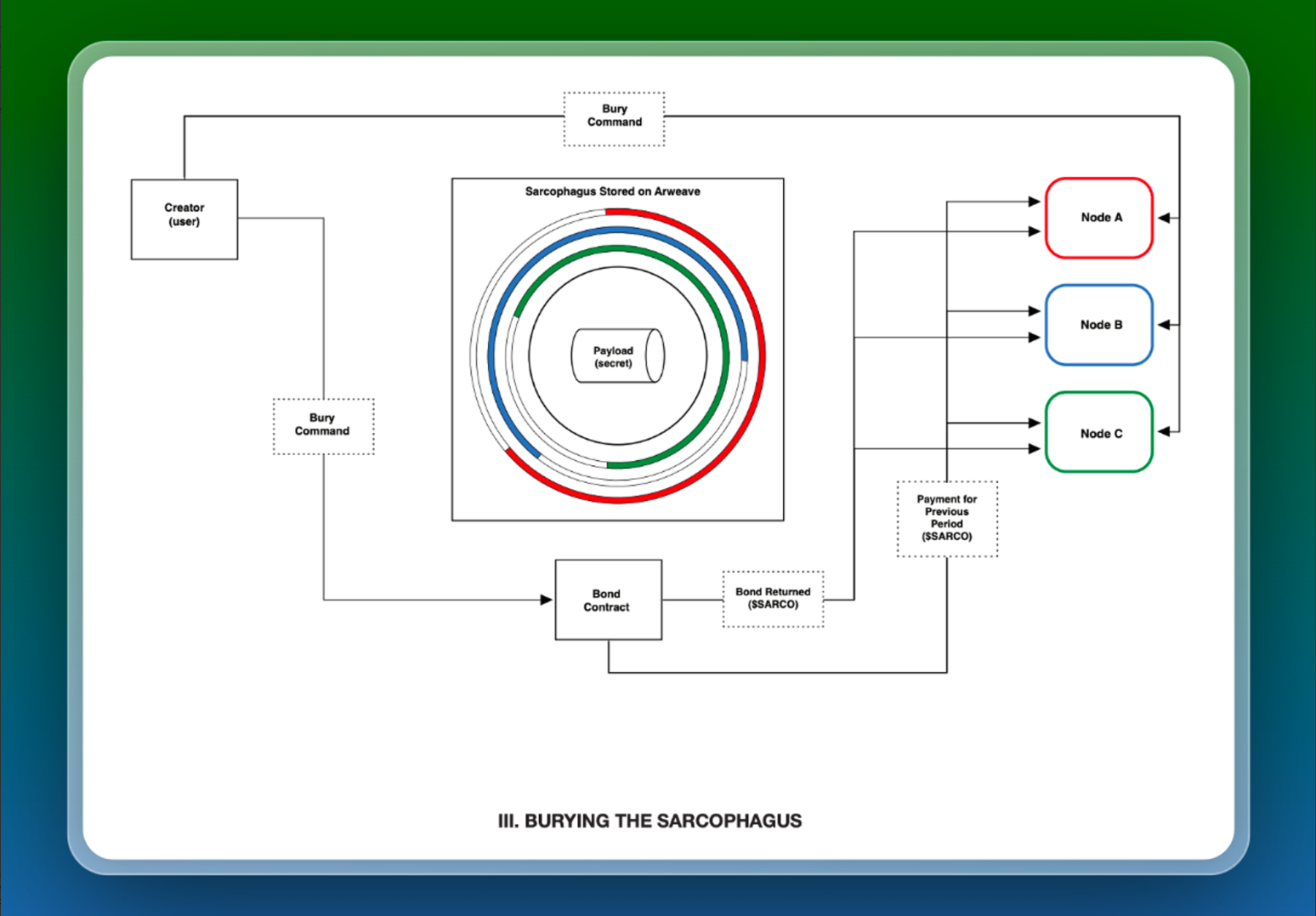
For situations where users no longer want to use the Sarcophagus application and wish to prevent the secret file from being released, they have the option to bury the Sarcophagus they created and terminate the contract with the nodes.
When users choose to bury the Sarcophagus, the fees previously paid will be distributed from the contract to the nodes, and the bond previously locked by the nodes in the contract will be released. From this point on, the secret file will remain permanently encrypted on the Arweave network, and the nodes will no longer be bound by the contract, which means the keys will be removed from their systems.
Phase Four: Playload Release / Resurrection
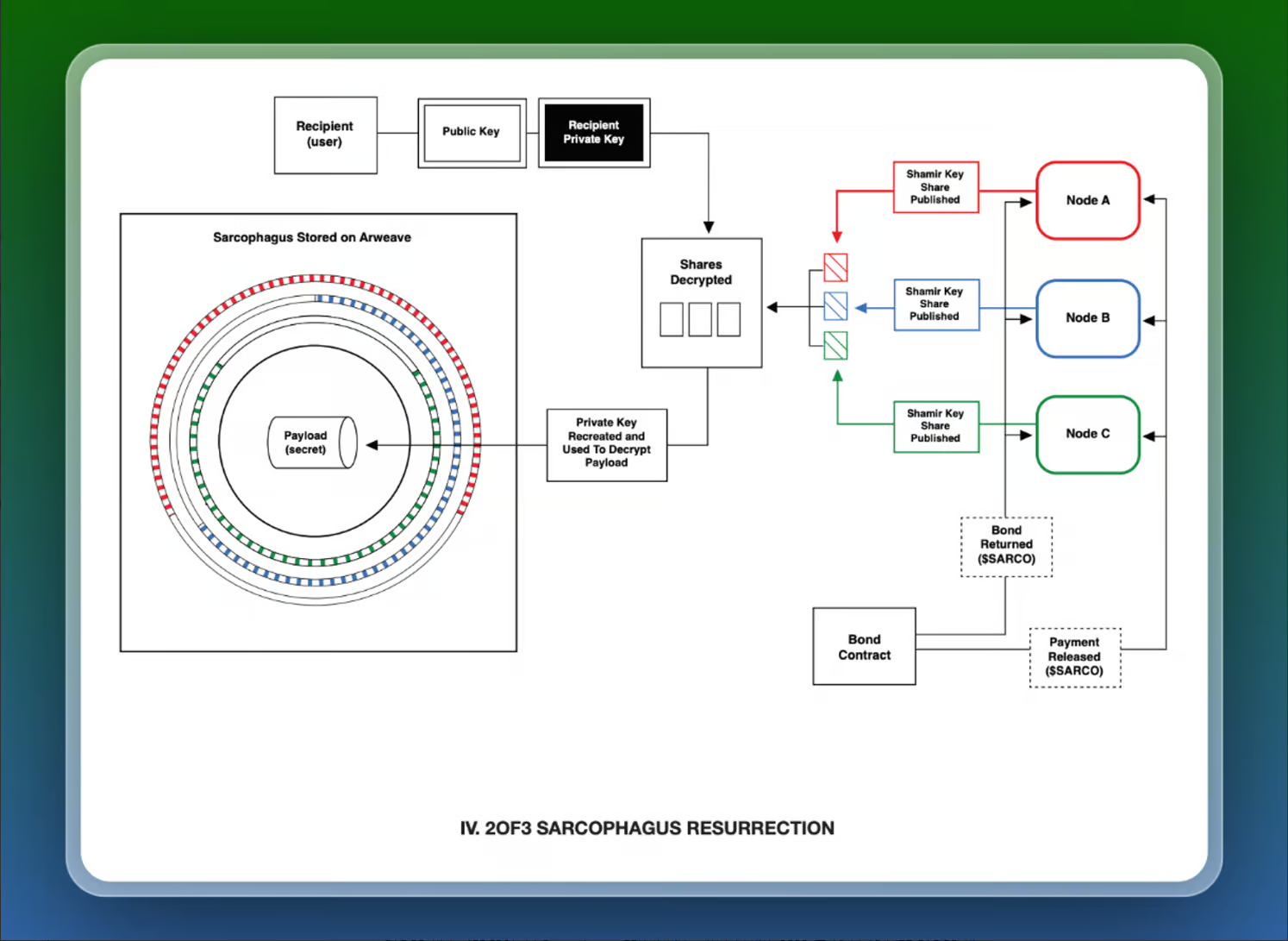
If users fail to confirm the contract within their set resurrection time, the dead man's switch is triggered. Nodes will release their keys to decrypt the Sarcophagus. After the nodes successfully decrypt the Sarcophagus, the recipient of the Sarcophagus can download the secret file from the Sarcophagus application. The secret file remains stored in an encrypted form on the Arweave network but can only be decrypted by the specified recipient without any additional charges. Once the nodes provide the keys for decryption, their task is completed, and they can claim their fees and the bond they staked.
Economic Model
SARCO Token
The SARCO token (ERC20) is the native token of Sarcophagus. The basic information about SARCO tokens is as follows(last update 2023/10/15):
- Contract: 0x7697b462a7c4ff5f8b55bdbc2f4076c2af9cf51a
- Total Supply: 100,000,000 SARCO
- Circulating Supply: 4,840,383 SARCO
- Holders: 1,182
- Current Price: $0.05 (All-time high: $8.52, All-time low: $0.046)
Currently, SARCO tokens serve three main purposes:
- SARCO tokens are used to pay for creating Sarcophagi, monitoring storage, and resurrection services.
- SARCO tokens are staked by nodes (archaeologists) as collateral in contracts.
- Staking SARCO tokens in governance contracts (uncirculated portion) grants voting rights and provides a share of the fees for Sarcophagus creation and attestation services.
Additionally, Sarcophagus has two governance tokens: SARCO-VR and SARCO-PAY. SARCO-VR is the voting rights token for SarcophagusDAO, and SARCO-PAY is the voting rights token for the Payroll subDAO. Both are ERC20 tokens.
Distribution Mechanism
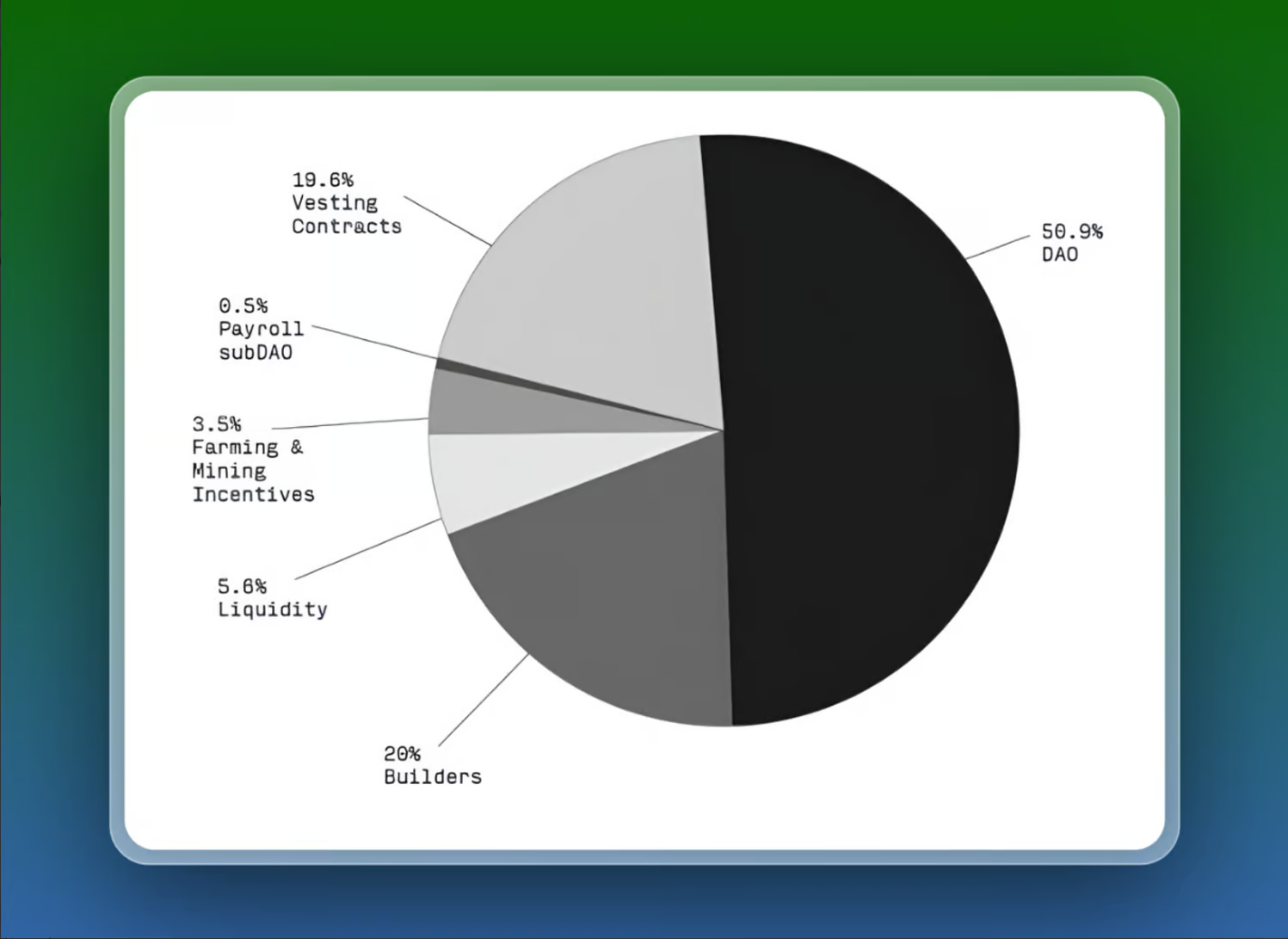
The allocation of SARCO tokens is collectively determined by the SarcophagusDAO community, with the specific allocation as follows:
- DAO: 50.9%;
- Builders: 20%;
- Vesting Contracts: 19.6%;
- Liquidity: 5.6%;
- Liquidity Mining Incentives: 3.5%;
- Payroll subDAO: 0.5%.
Acquiring SARCO Tokens
Currently, SARCO tokens can only be obtained through Uniswap:
- Trading Pair: SARCO/ETH;
- Contract Address: 0x8d3c9f4d0a8dbb6d5e2068ac36719290f7988cc1.
The good news is that SARCO tokens were officially launched on the Arweave ecosystem's real-time financial payment protocol, everPay, on September 28, 2023. If the decentralized exchange Permaswap can adds the liquidity of SARCO in the future, users will be able to easily swap SARCO tokens on Arweave.
Additionally, SARCO tokens are expected to be listed on the mainnets of public chains such as Polygon, Arbitrum, Optimism, BSC, Solana, Terra, etc., although this is currently in the testing phase. Stay tuned!
Market Analysis
Market Potential
The dead man's switch mechanism is a clever feature that gives Sarcophagus multiple use cases, including digital inheritance, password recovery, and time capsules.
Take the time capsule, for example. In the Web2 space, there's a giant company called Ancestry. Ancestry is the world's largest genealogy website and an online community for family history, with a massive family tree database. The company also operates several business websites, including RootsWeb.com, a free family community website where users can upload photos and share videos.
As of October 2023, Ancestry has a total market value of $13.9 billion, and its subsidiary company, RootsWeb.com, generates annual revenues of $1-2 million. These numbers clearly demonstrate the significant growth potential of Sarcophagus in the time capsule industry.
Furthermore, Sarcophagus is a decentralized Web3 project that uses Arweave for permanent data storage. This means data is no longer reliant on centralized servers but is stored in a distributed manner on the blockchain, ensuring long-term stability and security. Unlike traditional Web2 models, Sarcophagus offers users greater control and privacy, allowing them to securely store, transmit, and manage important information.
Arweave Ecosystem and Sarcophagus in the Storage Sector
Apart from Sarcophagus, the Arweave ecosystem storage race also features two excellent projects: Ardrive and Akord. All three are built on Arweave and focus on data storage services, providing secure, stable permanent data storage and supporting data encryption for privacy protection.
However, they differ in some key aspects.
- Ardrive is similar to traditional services like Dropbox or Baidu Cloud, where users can easily upload and manage files without worrying too much about the sensitivity of their data.
- Akord, on the other hand, is a secure vault for digital assets, providing a safe storage place. Akord also supports features like file authorization, private messaging, and collaboration, offering users more application scenarios.
In some scenarios, such as digital inheritance, password recovery, and time capsules, all three projects can provide the respective storage services. However, when it comes to passing on digital assets to heirs, Sarcophagus is the clear choice.
This is because Sarcophagus offers a unique dead man's switch mechanism, combining stability and permanence similar to Ardrive and Akord with user control, determinism, and flexibility. When it comes to digital asset inheritance, a well-implemented dead man's switch mechanism can prevent uncontrollable human errors, and Sarcophagus also gives users the freedom to choose to extend or terminate, offering greater flexibility in managing digital assets.
Challenges for Sarcophagus
Sarcophagus undoubtedly has great potential in the digital inheritance services space, but it comes with a set of challenges, with a relatively small user base and regulatory uncertainty being prominent.
Limited Target User Base
The growth of the crypto world has been relatively slow, and for traditional wealthier individuals, entering the unfamiliar Web3 space and using digital asset inheritance services may present barriers and hesitations. Therefore, while the potential is immense, the promotion process may take time, especially in attracting traditional asset holders.
Regulatory Uncertainty
Both traditional and crypto assets are still evolving in terms of their legal status and regulatory frameworks. Sarcophagus' inheritance services may lack legal support in most regions, and legal uncertainty could lead to disputes and litigation, posing a risk to wealth inheritance. This legal ambiguity may discourage some potential users.
Future Outlook
Recently, certain regions of the world have experienced turmoil and unrest again, such as the attack on Japanese Prime Minister Abe and the recent Israel-Palestine conflict. These events have sparked discussions about a potential third world war. People who have been accustomed to relatively peaceful times may start to feel a sense of crisis. Although no one wishes for a crisis, from another perspective, it may mark the beginning of the world embracing the trend of decentralization. The dead man's switch in a world full of changes is a form of certainty to embrace.
Sarcophagus was founded in 2019 and has grown alongside the development of Web3 for four years, making it a resilient and focused team. They have been continuously improving and developing the project, achieving significant progress in 2023. In early 2023, Sarcophagus officially launched the Sarcophagus v2 version of its dApp, introducing a series of product enhancements, including the allocation mechanism for protocol fees, simplification of terms, and the establishment of new sub-DAOs. As of my writing, Sarcophagus has just released the latest version of its whitepaper. In the future, Sarcophagus will gradually support more L1 and L2 networks to reduce transaction costs, making it more accessible to a wider audience.
While traditional online will and trust companies in the traditional world, such as Ancestry and inherit.com, still dominate, these traditional companies cannot provide the decentralization and anonymity that Sarcophagus offers, nor can they achieve permanent data storage. Decentralized technology is breaking traditional limits and is rapidly evolving, and Sarcophagus will continue to explore broader use cases.
As time goes on, the world will gradually recognize the allure of decentralization, and Sarcophagus has already brought a gift from the future.
Summary
Sarcophagus is a resilient decentralized dead man's switch project, incubated by the Ethereum project accelerator Decent Labs, and it has been in operation for four years. The project is operated and managed in the form of a DAO (SarcophagusDAO) and is divided into four sub-DAOs, each with different responsibilities.
Sarcophagus have several key features, such as certainty, stability, flexibility, and permanence, which collectively address the challenges of securely storing and managing digital assets and sensitive information. The project has a wide range of applications, including digital inheritance, emergency communication, data protection for high-risk individuals, password and credential recovery, and time capsules.
The operation of Sarcophagus' dead man's switch mechanism involves three key roles: users (Anti-Corrosionists), node operators (Archaeologists), and recipients. The entire mechanism includes four steps: creating a dead man's switch, attestation and ongoing operation, burying the sarcophagus, and releasing secret files. Sarcophagus provides a secure and trustless way for users to retain control over their important data, passing it to heirs or protecting and recovering it when needed. Additionally, Sarcophagus has its native token SARCO, used for service fees, bond, and community governance.
Sarcophagus is a promising Web3 project, especially in the sector of digital asset inheritance. While it faces challenges like a limited target user and regulatory uncertainty, with the rise of decentralization, Sarcophagus has a bright future.
Clearly, Sarcophagus has a long way to go, and winning over users requires a commitment to doing what you believe is right. In the future world, unique projects will stand out. When users consider creating digital wills or making time capsules, they will think of Sarcophagus first, making it the key to Sarcophagus's success.
References
- https://en.wikipedia.org/wiki/Sarcophagus
- https://en.wikipedia.org/wiki/Dead_man's_switch
- https://sarcophagus.notion.site/Sarcophagus-Documentation-9d9044719669401a8738a1b9059333cf
- https://www.odaily.news/newsflash/271108
- https://jxhccygl.com/a/shehuixinwen/1117.html
- https://www.notion.so/permadao/Sarcophagus-V2-dApp-ad2c420b36d14e03bbcea4abb048880f
🔗 More about PermaDAO :Website | Twitter | Telegram | Discord | Medium | Youtube


All Comments