

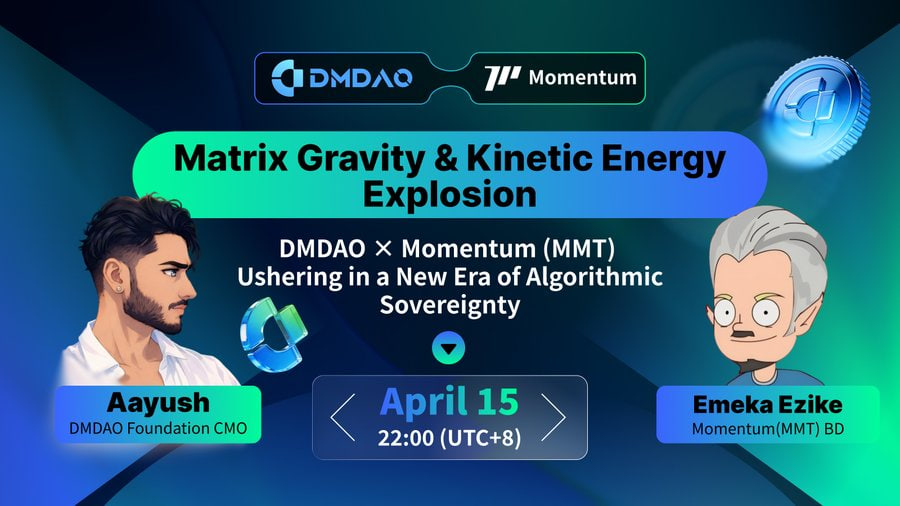
Amid the structural adjustments of the global crypto market and the deepening evolution of decentralized finance (DeFi), a paradigm revolution around “algorithmic sovereignty” and “market-making efficiency” is quietly unfolding. Recently, the world’s first distributed matrix market-making protocol, DMDAO, together with the central liquidity engine Momentum (MMT), successfully held a joint AMA event titled “Gravitational and Kinetic Explosion.” The event featured a high-level dialogue between Momentum BD Head Emeka Ezike and DMDAO Foundation CMO Aayush.
The discussion spanned distributed market-making, non-directional yield, and the qualitative transformation of human investors’ roles in the Web 4.0 era. Over several hours, the participants conducted an in-depth deconstruction aimed at illustrating a blueprint for a fully autonomous, intelligence-driven financial ecosystem to global participants.
1. Paradigm Shift: From “Liquidity Leasing” to “Ownership Reclamation”
When addressing the core topic of identity reconstruction, DMDAO Foundation CMO Aayush first raised a thought-provoking point: in the traditional DeFi space, LPs (liquidity providers) are essentially “liquidity mercenaries.” He explained that, in past DeFi protocols, ordinary users’ participation in liquidity mining resembled a form of “asset leasing”—you lend your assets to the protocol, and ideally, it pays you interest. However, this model is extremely fragile; in the event of a major market drawdown, the minimal interest earned by users is often completely eroded by severe impermanent loss.
Based on this, Aayush explicitly proposed a brand vision shift: from “liquidity mercenary” to “DAO initiator.” He emphasized that being a “DAO initiator” is more than a title—it represents the “reclamation of ownership” over financial sovereignty. Within the DMDAO framework, the initiator’s returns no longer passively rely on unilateral price appreciation. Instead, they originate from the precise capture of bid-ask spreads. This means that as long as market volatility exists—whether panic selling or retaliatory rebounds—the spread profits captured by the matrix engine continuously flow back into the base pool.
This non-directional yield logic completely overturns the traditional LP’s passive dependency on token price movements. Even more defensively, initiators secure long-term system governance by locking $DMD. Momentum BD Aayush vividly illustrated: “In DMDAO, you’re not just doing short-term labor for the market; you hold the ‘risk controller’ in your hands.” Once the system detects volatility exceeding thresholds, initiators can collectively adjust the hedging frequency of Matrix Prime. This level of control over certainty establishes a robust safety buffer far beyond the reach of ordinary LPs.
2. Kinetic Core: Millisecond-Scale Engine Driving “Strategy Equality”
Regarding the technical implementation of the protocol’s core “Kinetic Engine,” Momentum BD Emeka Ezike provided a detailed breakdown of how MMT maintains exceptional profit capture capabilities in a high-frequency on-chain environment. He stated that Momentum is positioned as the ecosystem’s “central liquidity engine,” and its core competitive advantage lies in its independently developed Flash-Path path-prediction algorithm.
In the extremely complex on-chain environment, every transaction faces the dual challenges of Gas costs and slippage. Emeka Ezike revealed that the MMT engine possesses millisecond-level spread-capturing capability, allowing it to calculate the “net profit and loss threshold” at the very moment an instruction is issued. Only when the algorithm determines that: Potential Premium – Dynamic Gas Cost – Slippage Loss>Target Profit Margin will the atomic contract trigger execution. This ensures that every profit captured by the protocol, the instant it is written into a block, is pure profit after deducting all costs.
The profound significance of this technology lies in its realization of true “strategy equality.” In traditional finance, high-frequency quantitative hedging is the exclusive domain of top-tier institutions, with ordinary users excluded due to lack of computational power and capital thresholds. By combining the MMT engine with DMDAO Matrix Prime scheduling capabilities, these complex, institution-grade strategies are encapsulated into algorithmic rewards that ordinary users can access with a single click.
For long-term holders of MMT, this means that MMT assets have evolved from mere tokens into “profit-sharing certificates” and “fuel” for the distributed market-making network, with their value rigidly supported by real-time market-making profits across the globe.
To ensure absolute transparency in profit distribution, the system employs “synchronous execution contracts.” Every captured premium is immediately distributed across the network according to pre-set contract ratios. The entire process eliminates temporary addresses, operational wallets, or manual settlement steps, reducing system loss to the physical minimum of Gas fees and achieving a 100% conversion from captured profit to accumulated value.
3. Safety Closed-Loop: Matrix Shield and Real-Time Hedging “Defense Fusion”
In the DeFi space, “security” is always a non-negotiable core concern. During the event, DMDAO Foundation CMO Aayush and Momentum BD Emeka Ezike jointly presented a dual closed-loop firewall composed of “dynamic hedging + risk-premium coverage.”
Emeka Ezike explained that the first line of defense for security lies in “real-time sensing capability.” When the market exhibits anomalies, the MMT algorithm triggers millisecond-level hedging operations, offsetting risk via inverse positions before it spreads to the principal pool. This ensures that the baseline of the yield pool remains healthy, filtering out the majority of volatility risk from the source.
The Matrix Shield risk mechanism of DMDAO, developed by CMO Aayush, serves as the second safety margin. He emphasized that Matrix Shield is not an empty promise—every penny in its compensation pool originates from actual matrix business premiums. It functions like a 24/7 automatically triggered “vault” specifically designed to handle extreme tail risks in the market. The fusion logic of the two mechanisms is straightforward: Momentum filters volatility risk on the front end via algorithms, while Matrix Shield absorbs extreme risk on the back end through capital reserves. This dual-layer constraint liberates community members’ principal from speculative exposure, enabling exponential “snowball” growth on a highly secure cushion.
4. Genesis Entry: DMDAO Foundation CMO Aayush’s “Efficiency-First” Practical Guide
With the full launch of the DMDAO 2026 Global Expedition Plan, competition for the top 200 Genesis Airdrop allocations is receiving intense attention. To ensure participants can smoothly complete technical interactions, CMO Aayush shared three highly practical “efficiency strategies” during the event, aimed at optimizing technical details to improve subscription success rates:
- Configure an “Ultra-Fast” Gas Strategy: During network congestion, using the wallet’s default “recommended Gas” may lead to excessive transaction queuing. Aayush recommends manually increasing the Gas Price by at least 20% in the wallet’s advanced settings. This small cost premium secures faster block confirmations, avoiding opportunity loss due to timing delays.
- Pre-Approve Full Allowance: Regarding USDC allowance, Aayush advises users to monitor authorization limits. He suggests setting the maximum allowance at first authorization, eliminating the need for a second contract call during critical subscription moments, ensuring a smooth, uninterrupted interaction flow.
- Optimize RPC Node Connections: If wallet response delays are observed, manually switching to a higher-frequency public or private RPC node is an effective way to enhance interaction efficiency. This ensures that, during high-concurrency subscriptions, commands reach the blockchain layer faster and more reliably, giving participants an advantage in seat allocation.
5. Expedition Vision: Defining the Financial Order of Web 4.0
In the final segment of the AMA, both parties reached a high degree of consensus regarding industry standards for the next two years. Momentum BD Emeka Ezike noted that traditional financial intermediaries survive essentially by exploiting information asymmetry and high “toll fees,” but under the order established by DMDAO and Momentum, intermediaries are replaced by code, and profits are returned directly to the community—a trend that is irreversible.
DMDAO Foundation CMO Aayush summarized from the perspective of the evolution of the human role. He believes that we are at a significant “power transition” threshold. In the past, human investors had to act as “operators,” calculating parameters and monitoring markets day and night—a role akin to being a short-term laborer for the market. Under this fully automated, “unattended” system, humans are liberated from mundane operations.
The identity of investors will undergo a qualitative transformation: evolving from “manual laborers” into “DAO Initiators”, leaders of algorithmic civilization. You no longer need to learn how to code or adjust parameters; you only need to decide the flow of assets, while all execution is handled entirely by DMDAO and MMT. Simply put, you transform from a “trader/operator” into a “rule-maker” and “ultimate beneficiary.” This qualitative leap—from manual labor to algorithmic decision-making—is the era dividend Web 4.0 offers to every ordinary participant.
Currently, DMDAO is accelerating toward the extreme scarcity goal of 1,000,000 DMD. With the global series of workshops and roadmap initiatives underway, this expedition into algorithmic sovereignty is only just beginning.
About DMDAO:
DMDAO is a globally leading decentralized matrix market-making protocol, dedicated to building long-term sustainable intelligent financial infrastructure. Through core modules such as Matrix Prime and Matrix Shield, the protocol empowers participants worldwide to share in algorithmic yields and collectively define the future benchmark for decentralized market-making. For updates on meeting schedules and DMD scarcity progress, please continue to follow official announcements.


All Comments