
Cointime

Download App
iOS & Android

Galoy Launches Bitcoin-Backed Loan Software, Sets Groundwork For Open-Source Banking

Cointime Official

From bitcoinmagazine by Frank Corva

Last week, Galoy launched Lana, software that enables banks to accept bitcoin as collateral for loans.

Lana helps community and challenger banks (the banks with which Galoy is looking to work) to offer bitcoin-backed loans to various types of customers.

“Some banks might want to use it to sell to retail, and some might want to use it to sell commercial customers or high-net-worth individuals,” Burtey told Bitcoin Magazine.

In offering such loans to a wide array of customers, Burtey believes that the high cost of borrowing currently associated with such products will come down.

“Today's interest rates are 12% to 15% if you want to get a loan using your bitcoin as collateral,” said Burtey.

“The rates are high because there are so few financial institutions offering this type of product. We see an opportunity now that the regulations are allowing banks to do things with bitcoin,” he added.

“We think a lot of banks will want to enter this market.”

If Burtey is correct in his prediction that banks are keen to offer bitcoin-backed loans, this will not only lower rates for such loans, but it will also introduce open-source Bitcoin software into the world of banking, which could initiate a new trend in the industry.

But more on that in just a minute. First, some background on Galoy.

Galoy’s History: From Blink Wallet To Lana

Founded in September 2019, Galoy had intentions to enable banks to use bitcoin from the start, but it had to hold off on doing so due to an unfriendly regulatory environment.

So, instead, it focused its efforts on creating and supporting Blink wallet (which was originally called the Bitcoin Beach wallet and which Galoy recently sold), a custodial Bitcoin and Lightning wallet predominantly used at first in El Salvador and then in Bitcoin circular economies globally.

“Galoy’s mission was to onboard banks to Bitcoin five years ago,” said Burtey.

“But the regulatory environment was so bad during the last five years that we decided to create Blink. The reason we are now focusing on our original mission is because with the end of Choke Point 2.0 and the repeal of SAB 121, we think now is the perfect time to help banks adopt Bitcoin.”

Burtey spoke about his work in creating and growing Blink fondly and shared that he had to stop working on the project only because it would be too difficult to continue managing it while also aiming to serve a new type of clientele.

“Blink is a B2C (Business-To-Customer) play, and it’s hard as an early-stage startup to focus on too many things,” explained Burtey.

“Galoy is a B2B (Business-To-Business)-driven business, and we want to work with banks and financial institutions,” he added.

“It’s good to be focused on just one thing.”

And, as mentioned, that one thing will now be Lana.

How Lana Works

Lana is software that Galoy helps banks integrate and manage for a subscription fee. With this software, banks can issue bitcoin-backed loans under the terms they create.

“We’re not the ones deciding how much interest will be charged or anything like that,” explained Burtey.

“We give banks the platform to do this, and then they can figure out their cost of capital, the duration of the loan, the liquidation price for the bitcoin in the loan and the rate at which they want to lend,” he added.

“We’re giving you software, and helping you run and automate that software.”

Something else that Galoy doesn’t do for banks is custody the bitcoin provided as collateral for the loans they issue. Each of the banks with whom the company works is responsible for selecting their own custodian.

“You can go to BitGo or Fireblocks or each loan can have its own multisig,” said Burtey. “We’re agnostic on custody.”

With that said, Lana helps banks monitor the bitcoin in custody so that banks can be aware of whether or not collateral is nearing liquidation levels.

“A key piece of this product is risk management,” said Burtey.

“Bitcoin is volatile, and the bank will need a tool to show that it’s taking calculated risk. So, we’ll provide banks with a dashboard to monitor this risk,” he added.
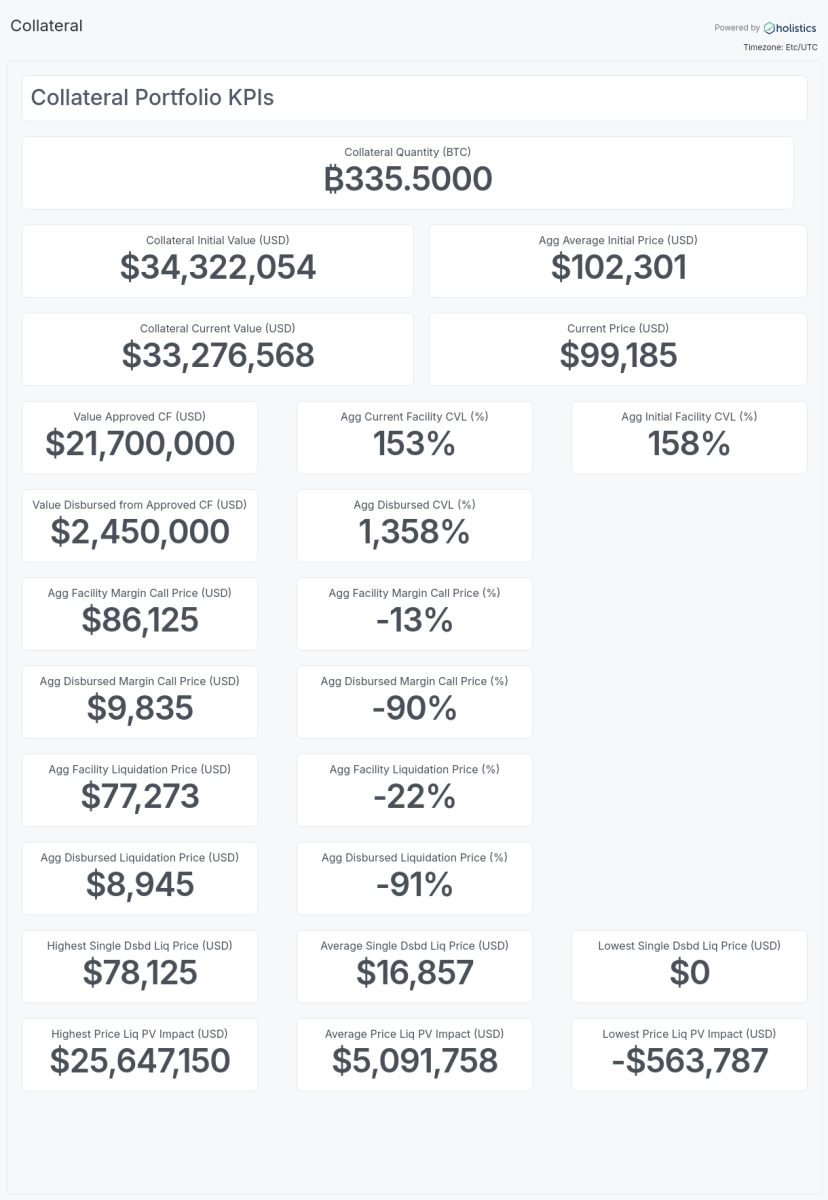
An example of the risk-monitoring dashboard for bitcoin-backed loans that Galoy has created

Who Will Use Lana?

Galoy is targeting community banks and other smaller financial institutions with this new product mostly because they think these smaller players will benefit most from it — and because the big banks likely won’t need such a product.

“We don't think JP Morgan will really want to work with us,” said Burtey. “They’re probably building something like this themselves, whereas a smaller bank, a credit union or small company probably isn’t.”

Burtey also understands that smaller lenders’ incorporating Lana as opposed to building something comparable themselves can save these financial institutions a significant amount of time and effort.

“Our goal is to say, ‘Look, you can develop this internally, and it will take you six months, a year or longer depending on how much you know about Bitcoin,’” said Burtey. “‘Or we have a lending product as a service for you, and you can launch it much more quickly.’”

And as Burtey and his team onboard their first round of smaller banks, they’ll not only be making history in enabling more banks to accept bitcoin as collateral for loans, but they’ll potentially be altering the trajectory of banking in general by introducing open-source software to it.

Open-Source Bitcoin Banking

Burtey’s long-term vision for Galoy is to do much more than just help banks issue bitcoin-backed loans. He’s looking to introduce open-source software into banking as more banks begin to embrace Bitcoin.

However, it’s important to note that Lana isn’t open-source just yet. It’s fair-source software, and, under such a license, code becomes open-source after two years.

“It's a delayed open-source system, but it's all available on GitHub,” said Burtey. “You can go and try it, test it, and play with it on your own.

Under the fair-source license, no company other than Galoy can sell the product to a bank right now, allowing Galoy to profit while still building with auditable code.

“We sell the deployment, and we help banks to plug in to their custodian,” explained Burtey. “We’re building in the open — but we also want to generate revenue.”

Beyond helping banks implement Lana, Burtey’s wants to develop open-source “core banking software,” as he’s looking to disrupt the “core ledger” oligopoly.

“The core ledger is where banks store the account data, customer information and transaction details,” said Burtey. “It’s the source of truth for banks.”

And only three companies — FIS, Fiserv and Jack Henry — have the core ledger market cornered.

“These are all like hundred billion dollar companies that you’ve probably never heard about because all they do is focus on selling software to banks,” said Burtey.

“Our long-term goal is to disrupt this industry by making something that is open source,” said Burtey. “Today, there is no company that does core banking with the idea of open source, and so we're working towards this.”

Burtey envisions a world in which open-source software can make it much easier for someone to start a Bitcoin bank. (For those who wince at the words “Bitcoin” and “bank” being used in tandem, might I remind you that it was the legendary Hal Finney himself who wrote that bitcoin-backed banks would serve as a scaling solution.)

“To start a bank today is a very expensive and complicated process,” said Burtey. “You have to pay $100,000 plus just to purchase the core ledger technology.”

Burtey then referenced his own experience in starting Blink wallet, essentially a bitcoin bank run on open-source code, before continuing.

“I just went to El Salvador and started what was effectively my own bank because I wanted to,” said Burtey.

“We need to reinvent how core banking software is being made in the world of Bitcoin, and I think this is where open-source becomes relevant,” he added.

“This is really why I think the world of banking and Bitcoin will be very different from the world of banking with fiat, and I think we’re one of the companies at the forefront of this.”


Comments

All Comments

Recommended for you

  • Iran-Pakistan Border Reopens

    On October 25, according to Fars News Agency, Pakistan has reopened the Gabd-Rimdan border crossing in the Gwadar region, allowing trucks carrying liquefied gas and essential goods to resume passage. The crossing had been closed for less than a week due to security concerns and efforts to combat smuggling. Meanwhile, natural gas prices in Pakistan have reached a historic high.

  • South Korea Delays Cryptocurrency Tax Policy Originally Set for January

    On October 25, the South Korean presidential office decided to postpone the cryptocurrency income tax policy that was scheduled to take effect in January next year. An official from the presidential office stated on the 25th, "The discussions are leaning towards delaying the implementation of the cryptocurrency tax." The South Korean government had established a tax on virtual asset gains as early as 2020 when it revised the Income Tax Act, but the policy has been delayed three times. Initially set to take effect on January 1, the presidential office has now decided to postpone it again, citing incomplete tax administration preparations and public opinion among the youth. According to the revised Income Tax Act, annual gains from the transfer or lending of virtual assets are subject to a combined tax rate of 22% (including other income taxes and local income taxes) after a basic tax exemption of 2.5 million won.

  • Trump: Possible Military Action Against Iran or Reaching an Agreement

    On October 25, U.S. President Trump delivered a recent speech stating, "I may have to completely resolve the Iran issue, or I may reach an agreement with Iran. Either way, we will win. I could launch an attack on Iran, or I could reach a significant and beneficial agreement with Iran. The Iranian side wants to reach an agreement."

  • Over $200 Million Liquidated in the Last Hour, Primarily Long Positions

    On October 24, according to Coinglass data, the total liquidation amount across the cryptocurrency market reached $200 million in the past hour, with long positions accounting for $191 million and short positions for $8.76 million, indicating a strong dominance of bulls. By cryptocurrency, Bitcoin saw liquidations of $59.74 million, while Ethereum experienced liquidations of $53.03 million.

  • Trump Prepares for Escalated Military Action Against Iran Post-Midterms, Increases Troops in Gulf

    U.S. President Trump is preparing to resume strikes against Iran following the November 3 midterm elections, having deployed a third aircraft carrier strike group and 10,000 sailors and Marines to the Persian Gulf. U.S. Secretary of Defense Mark Esper visited Israel to meet with Netanyahu, while the State Department ordered the evacuation of some diplomatic personnel and their families from Saudi Arabia. Iran is planning retaliatory actions in the Middle East, with Foreign Minister Zarif stating that diplomatic progress is currently limited. The conflict is disrupting energy transport in the Gulf, driving Brent crude oil prices up over 80% this year, and impacting the Republican Party's midterm election prospects. (Bloomberg)

  • BTC Falls Below $80,000

    Market data shows that BTC has fallen below $80,000, currently priced at $79,990.04, with a 24-hour decline of 1.76%. The market is experiencing significant volatility, so please ensure proper risk management.

  • Iranian Armed Forces: U.S. Navy Ships Not Allowed in the Persian Gulf Under Any Circumstances

    On October 24, according to CCTV News, Major General Ali Abdollahi, Chief of Staff of the Iranian Armed Forces, stated that the Iranian military has successfully deterred the U.S. Navy, preventing it from approaching the waters near the Persian Gulf or Iranian territorial waters. Under no circumstances will Iran allow U.S. military ships to enter the Persian Gulf; the idea of the U.S. wanting to return its military forces to the Persian Gulf is merely a fantasy. Abdollahi also pointed out that the U.S. and Israel, along with their military forces, will increasingly find themselves deeper in the quagmire they have created, and the longer the confrontation lasts, the more entrenched they will become.

  • CMCC Global Plans to Issue Tokenized Bitcoin Fund in El Salvador in Partnership with Tether and Bitfinex Securities

    On October 24, investment management company CMCC Global announced plans to represent its two digital asset funds—Crest and the Liberty Bitcoin Accumulation Fund (LBAF)—in token form. These tokens will be issued and managed through Tether's Hadron infrastructure and distributed by Bitfinex Securities under El Salvador's digital asset framework. Both funds operate as fund-of-funds structures. Crest is priced in USD and aims to outperform U.S. Treasury yields, while LBAF is priced in Bitcoin with a target annual net return of 8% to 12% (BTC), which is an investment target rather than a guaranteed payment. The tokens represent economic rights to the underlying fund shares, minted according to corresponding shares and destroyed upon redemption, still subject to legal and operational conditions, and are not unlicensed tokens. Issuance requires identity verification, anti-money laundering checks, and whitelist addresses; Bitfinex Securities will provide issuance, distribution, and secondary trading. The institution BTCS S.A. has tentatively agreed to provide a three-digit Bitcoin anchor configuration (specifics not disclosed). The issuance price is set at $10 per Crest token and 0.0001 BTC per LBAF token.

  • Chinese Ministry of Commerce Responds to U.S. Proposed Investment Restrictions

    On October 24, a reporter asked: On October 23, the U.S. Department of the Treasury released a new proposed rule on foreign investment restrictions and is seeking public comments. What is China's comment on this? The response: China has noted the relevant situation. The proposed rule discriminatively expands the scope of investment restrictions against China and intensifies the restrictions, which is a typical practice of generalizing national security. This goes against the important consensus reached by the leaders of both countries, interferes with normal economic and trade cooperation between Chinese and American enterprises, and undermines the international economic and trade order. China expresses serious concern and strong opposition to this and will closely monitor the subsequent developments, reserving the right to take corresponding measures. China has a vast market with enormous consumption and investment potential; investing in China is investing in the future. The U.S. restrictions on investment in China are not conducive to Sino-U.S. economic and trade cooperation and will also harm the interests of American enterprises. China urges the U.S. to respect the laws of the market economy, stop generalizing the concept of national security, and cease politicizing and weaponizing economic and trade issues, in order to create a favorable environment for Sino-U.S. economic and trade cooperation.

  • IRS Plans to Reform Voluntary Disclosure Program, Lower Crypto Penalties and Expedite Cases

    According to Forbes, the Internal Revenue Service (IRS) is preparing to reform its voluntary disclosure program, aiming to reduce penalties and expedite the handling of tax violations, including those related to cryptocurrency. Jarod Koopman, the head of IRS Criminal Investigation, stated at the UCLA Extension Tax Controversy Conference that the goal is to launch the revised program by December, allowing taxpayers to resolve their cases within 120 days after completing the required filings; the current process often takes over a year. The reform will not create a separate disclosure process for digital assets, which will still be handled under the existing voluntary disclosure procedures. Koopman mentioned that the revised penalties will be 'significantly lower' than current levels, although he did not provide specific figures, and he is considering allowing taxpayers to settle their debts through installment payments or offers in compromise. Meanwhile, lawmakers are pushing for an independent voluntary disclosure program for taxpayers who unintentionally report crypto errors, as proposed in Section 502 of the Digital Asset Taxation Certainty Act, which passed the House Ways and Means Committee in September.