

Cointime

Download App
iOS & Android

Galaxy Digital scoops $306M in Solana after deal for crypto treasury

Digital assets investment firm Galaxy Digital has bought $306 million worth of Solana in a single day after teaming up with investment firm Multicoin Capital and trading firm Jump Crypto to create a so-called crypto treasury company.

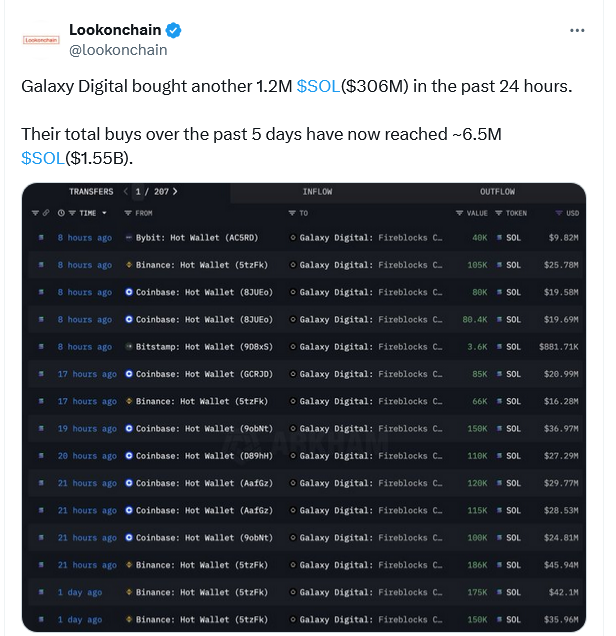
Galaxy scooped up 1.2 million Solana on Sunday from multiple exchanges and sent them to the crypto custody firm Fireblocks, according to blockchain datareportedby Lookonchain.

It extends a Solana buying spree from Galaxy since Wednesday, which has seen it buy up over $1.5 billion worth of the token.

On Thursday, Galaxy said that it’s linking up with Multicoin Capital and Jump Crypto to join in a $1.65 billion private placement round in Forward Industries, a medical device company that recently pivoted to wanting to have the largest Solana holdings among public firms, joining a trend of similar so-called crypto treasury companies.
  Source: Lookonchain


Galaxy buys up over 6.5 million SOL

Lookonchain said in the past five days, Galaxy has scooped up 6.5 million SOL, worth approximately $1.55 billion.

On-chain data shows the firm is buying tens to hundreds of thousands of SOL tokens at a time in rapid succession, each costing millions of dollars.

It’s unclear if Galaxy’s SOL purchases are linked to its involvement with Forward Industries. Galaxy Digital did not immediately respond to a request for comment.

Forward Industries stock rallies

Shares of Forward Industries (FORD) rallied last week on its Solana pivot announcement, with its stock up 16% over the last five trading days to Friday.

The firm’s stock price is up 620% year-to-date after closing trading on Friday at $36.10, which has reversed a multi-year slide.

As of the June quarter, the firm reported its revenue had declined 50% from the same period last year, while its net profit margin was down 329% during the same period.

Solana adoption on the rise

On Sept. 3, Galaxy Digital became the first Nasdaq-listed firm to be tokenized on the Solana blockchain.

Meanwhile, Solana treasury company DeFi Development Corp stated that its Solana treasury hit the 2 million milestone after buying $117M worth of SOL in eight days.

Mert Mumtaz, co-founder and CEO of Helius, has said that Solana treasury companies have cumulatively raised $3-$4 billion with more to follow.

The total value locked on Solana hit a record high of $12 billion earlier this month, and is second only to Ethereum when measured by TVL locked across its DeFi projects.

Solana is up 17.3% in the past seven days and has gained nearly 30% in the past 30 days, according to CoinGecko.

Comments

All Comments

Recommended for you

  • Whale Transfers 1,133 BTC to Coinbase Prime, Valued at $71.48 Million

    According to Onchain Lens monitoring, a whale transferred 1,133 BTC from Coinbase to Coinbase Prime through an intermediary wallet, valued at $71.48 million.

  • U.S. AI Chip Stocks Decline Before Market Open, Intel Falls Over 3%

    On July 7, U.S. AI chip stocks experienced widespread declines before the market opened. Intel dropped over 3%, while AMD, Qualcomm, and NXP fell more than 2%. TSMC, Broadcom, and Tesla decreased by over 1%, and NVIDIA declined by 0.7%.

  • China's Central Bank Increases Gold Reserves for the 20th Consecutive Month

    As of the end of June, China's gold reserves stood at 75.44 million ounces (approximately 2,346.446 tons), an increase of 480,000 ounces (about 14.93 tons) from the end of May, which reported 74.96 million ounces (approximately 2,331.52 tons). This marks the 20th consecutive month of gold accumulation.

  • China's Foreign Exchange Reserves in June at $341.6262 Billion

    On July 7, China's foreign exchange reserves for June stood at $341.6262 billion, a decrease of $26 billion from the end of May, representing a decline of 0.75%, with expectations set at $343.2 billion.

  • U.S. Storage Stocks Drop Pre-Market, SanDisk and Micron Down Over 4%

    On July 7, U.S. storage concept stocks collectively fell in pre-market trading. Western Digital dropped over 5%, SanDisk and Micron Technology fell over 4%, Seagate Technology declined over 3%, Rambus fell over 2%, and SMI fell over 1%.

  • U.S. Stocks in Optical Communication Sector Drop Pre-Market

    On July 7, stocks in the optical communication sector of the U.S. market collectively fell pre-market. Astera Labs dropped over 4%, while Marvell Technology, Credo Technology, and AXT Inc. fell more than 3%. Tower Semiconductor, MaxLinear, Corning, Applied Optoelectronics, GlobalFoundries, Lumentum, and Qorvo all declined by more than 2%. Coherent, Nokia, Amphenol, and Broadcom dropped over 1%.

  • Pre-market Decline in U.S. Storage Stocks

    In pre-market trading, U.S. storage concept stocks experienced a widespread decline, with Micron Technology falling by 4.8%, SanDisk dropping over 4%, Corning down more than 2%, and Intel decreasing by over 3%.

  • Two Departments: Support for Reinsurance Institutions to Increase Capital and Issue Supplementary Capital Tools

    On July 7, the National Financial Supervision and Administration Bureau and the Shanghai Municipal Government released several measures to accelerate the construction of the Shanghai International Reinsurance Center. Among these measures, they proposed to enhance the quality and efficiency of the reinsurance industry, support reinsurance institutions in increasing capital and expanding shares, and issuing supplementary capital tools to improve the capacity for internal capital accumulation and external capital supplementation, thereby strengthening the reinsurance industry's capabilities. The initiative aims to guide the insurance industry to focus on major national projects, strategic emerging industries, and livelihood security, consolidating insurance and reinsurance underwriting capabilities to enhance risk protection levels. It also supports reinsurance institutions in leveraging their professional technical advantages to assist the insurance industry in reducing risk.

  • Sources: Saudi Arabia Plans to Expand Oil Pipeline to Red Sea, Increasing Capacity by 2 Million Barrels Daily to Bypass Strait of Hormuz

    On July 7, five informed sources revealed that Saudi Arabia is considering expanding the crude oil pipeline capacity to its western coast on the Red Sea, allowing Saudi Arabia and its neighbors to transport more oil without passing through the Strait of Hormuz. This east-west pipeline, built in the early 1980s, has gained strategic importance since the outbreak of the Iran war in February and the disruption of shipping in the Strait of Hormuz. The pipeline can deliver up to 7 million barrels of crude oil per day to the Red Sea port. The CEO of Saudi Aramco stated in May that approximately 2 million barrels are supplied to west coast refineries, while about 5 million barrels are for export. Sources indicate that Saudi Arabia is in preliminary discussions with some neighboring countries regarding the pipeline expansion, aiming to add about 2 million barrels of pipeline capacity per day. It remains unclear whether Aramco's planned expansion involves upgrading existing infrastructure or constructing new pipelines. One source mentioned that the expansion plan also includes a smaller refined oil pipeline. Two sources indicated that the expansion scale could range from 1 million to 2 million barrels per day, with refined oil also being considered. Another source stated that the project would take several years and cost billions of dollars, requiring adjustments to Saudi crude pricing mechanisms.
