


Original Author: Bloomberg Crypto Michael P. Regan & Anna Irrera

As the case of Sam Bankman-Fried enters the trial phase, many cryptocurrency players are still in survival mode.
Sara Feenan ventured out of the finance industry in 2017 and entered the brave new world of cryptocurrency.
Feenan has worked at a blockchain technology company and Binance exchange in the past few years, and she is excited about participating in a movement that promises to transform and improve almost everything. She even named her dog after the inventor of Bitcoin. Then, in the turmoil of 2022, FTX exchange went bankrupt in November. With the chain reaction in the following months, Feenan (whose most recent job was at a startup) found herself out of work and left the cryptocurrency industry.
"I'm a bit disappointed," said Feenan, who now works at a non-cryptocurrency fintech startup in London. "Things like FTX can be frustrating. If you tell people you work in the cryptocurrency industry and something like this just happened, it's hard to say that everyone here isn't in it to scam people."
Although suspicion and doubt have been hanging over this emerging asset class from the beginning, the cloud of suspicion may never have been as heavy as it has been in recent months since the collapse of FTX and its mysterious leader, Sam Bankman-Fried. With SBF being charged next week as the main suspect in one of the largest financial frauds in US history, this cloud of suspicion and doubt is unlikely to dissipate soon - despite his plea of not guilty to a series of charges against him.

Of course, nothing affects market sentiment more than price. Despite Bitcoin's rebound of about 60% this year, with a trading price of around $27,000, it is still far below the record of $69,000 set in November 2021, and has been stuck in a trading range for most of the time. The market, which was once worth nearly $3 trillion, now has only about $1 trillion left. The dream of Bitcoin or any other cryptocurrency token becoming a true alternative currency is still just a dream.
The transaction has dried up, and once hot market corners, such as NFT, now look like digital tulips as critics have long said. According to researchers at dappGambl, more than 95% of the over 73,000 NFT collections are basically worthless. The researchers cited data from The Block, stating that the weekly trading value of NFTs in July was about $80 million, only 3% of the peak value in August 2021. Do you remember the hyped NFT project NBA Top Shot by Dapper Labs? It turned basketball highlights into tradable tokens, some of which sold for over $200,000 in 2021. Now there are hundreds of such tokens idle for sale, priced at only $1.
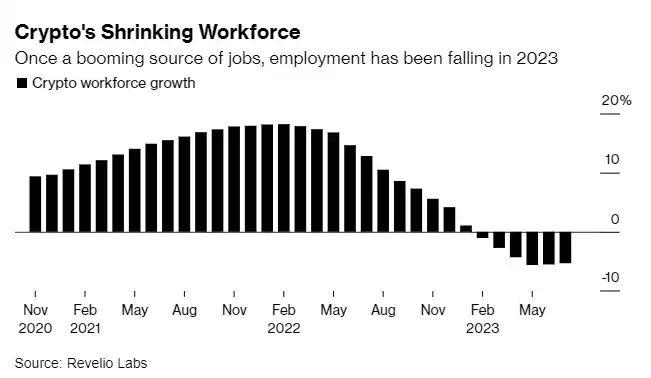
It is crucial to note that the previously loose wallets of the venture capital industry have significantly tightened. According to Pitchbook's data, as of September 19th of this year, the total amount of venture capital transactions for cryptocurrency and blockchain projects is approximately $7.3 billion, equivalent to one-fourth of the total amount for the entire years of 2021 and 2022. Moreover, employment opportunities in this industry are decreasing. According to Revelio Labs' data, based on the data of 35 large companies, although the labor force growth rate in the cryptocurrency industry exceeded 18% at the beginning of 2022, employment opportunities have been declining throughout the year, with the recent decline rate exceeding 5%.
"To be honest, it's really painful," said Nico Cordeiro, Chief Investment Officer of the crypto hedge fund Strix Leviathan. "Due to market conditions, the income is negligible. You can't attract new investors because no one is investing in this field. Participants in this industry are in survival mode: trying to keep operations going as long as possible until funds start flowing back into this field."
Strix Leviathan previously used FTX's offshore exchange to trade perpetual cryptocurrency futures that were not available on US exchanges, but now funds are still locked in a bankrupt exchange through a major brokerage. Due to concerns about the lack of secure trading venues, the company has stopped trading perpetual futures because Binance, FTX's main competitor, is also facing increasing regulatory scrutiny.
For those who have successfully launched cryptocurrency-related businesses in the post-FTX era, it has been a difficult road. Hilal Diab founded his company, Market Mapper, in Tel Aviv, Israel in January. It is a platform that provides blockchain analysis for traders. However, he quickly ran into trouble finding a major online advertising platform willing to accept his business. He said that when he tried to register on Mailchimp to publish Market Mapper's newsletter, the company told him to find another service provider because it did not want to be associated with the cryptocurrency industry. Even his friends and family were cautious about it.
Once I tell people that my startup company is related to cryptocurrency, they become nervous. That's the first reaction I get," he said. "There are also some investors who are very skeptical about giving us money, especially after the FTX debacle. They are afraid of being sued.
After the bankruptcy of FTX and last year's cryptocurrency crash, these lawsuits and various other cases have been increasing. In addition to FTX's own bankruptcy and Bankman-Fried's impending criminal case, cryptocurrency companies Genesis Global, Celsius Network, Voyager Digital, Three Arrows Capital, and BlockFi Inc. have all been involved in bankruptcy and related legal proceedings. Last Friday, Su Zhu, co-founder of Three Arrows, was detained in Singapore and potentially faced imprisonment along with co-founder Kyle Davies for refusing to cooperate with liquidators investigating the bankrupt hedge fund.
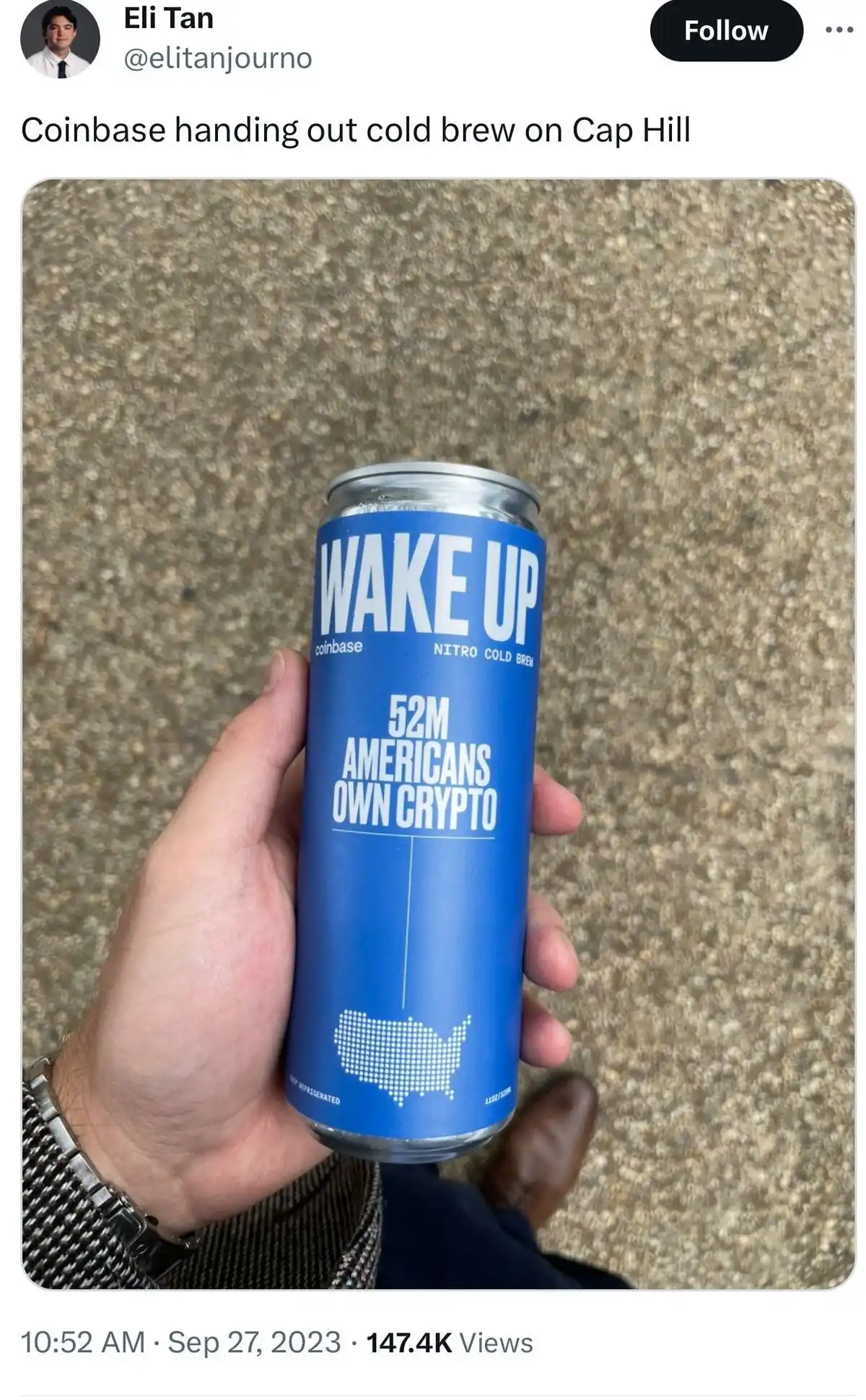
Meanwhile, Coinbase Global Inc. is fighting with the U.S. Securities and Exchange Commission (SEC) over allegations of unregistered securities for many cryptocurrencies traded on its exchange, while also lobbying Congress and making progress overseas.
Meanwhile, Binance has been caught up in enforcement actions by the Commodity Futures Trading Commission (CFTC) and SEC. Even Bankman-Fried's parents have been dragged into a lawsuit aimed at recovering funds they received from FTX.
However, surprisingly, according to Reena Aggarwal, a finance professor at Georgetown University, the court is also a rare optimistic source, which is likely to help cryptocurrency prices find a bottom. She cited a court ruling last month that overturned the SEC's decision to block Grayscale Investment LLC's proposal for a spot bitcoin exchange-traded fund, as well as another judge's ruling that Ripple Labs' XRP token is not a security when sold to the general public.
"SEC has always tried to enforce and stated that cryptocurrency is the Wild West and we need regulation, but the court has fought back," she said. "In a sense, this has given the industry new vitality."
In fact, as BlackRock Inc., Fidelity, Franklin Templeton, and other companies hope to eventually approve their spot Bitcoin ETFs, and traditional Wall Street firms are busy with blockchain projects aimed at transforming traditional assets into digital tokens, the future of crypto innovation can be said to have never been closer to compliance.
As for Feenan, a cryptocurrency exile in London, her dog Toshi is named after the mysterious inventor of Bitcoin, Satoshi Nakamoto, and she herself is not ready to give up the digital asset industry forever.
She said: "Cryptocurrencies can go from being very complex to very foolish in a short amount of time."
"If there is an interesting project, and if I believe that this project will help drive progress, I will come back again."


All Comments