


BY JEX EXMUNDO
The company formerly known as Facebook has had its eyes on the next stage of the internet for a long time. In 2014, the tech conglomerate acquired Oculus — then a Kickstarter-funded project — with aims to throw its endless resources and the Oculus team’s expertise into launching the first entry-level VR headsets flooding the mass market. We’re not quite there yet, but Facebook has nonetheless continued its pivot into uncharted waters since then. Now it’s known as Meta, and it’s diving into Web3.
Besides Meta’s highly-publicized Horizon Worlds metaverse game, the firm is also bringing Instagram and Facebook — two of the most defining platforms of Web2 — into full Web3 functionality. But that shift won’t happen overnight, with intervals of introduction in store. This is why NFTs are taking center stage on Facebook and Instagram’s Web3 transition, and we’re here to explain everything you need to know about where NFTs fit into the future of these social media titans.
Instagram: From image-sharing platform to NFT marketplace
When Instagram launched in October 2010, it was marketed as a free smartphone app wherein users could freely share photos with their social circles. But, given the comparatively primitive camera hardware of most smartphones back then, most results weren’t pretty. However, amid the sea of grainy iPhone 4 selfies was actual photography. Sometimes art, too.
Twelve years and a Facebook acquisition later, for millions of people, Instagram is social media. It’s since expanded its suite of services from simple image-sharing to include carousels, videos, and — since May 2022 — NFTs. Following a January 2022 announcement regarding the site’s future NFT-ready feature set, Instagram looked primed for a year of massive changes. So what type of NFT functionalities can Instagram’s userbase enjoy today?
A rundown of Instagram NFTs
Although a recent update allowed several high-profile NFT creators to sell their works as NFTs on Instagram, this won’t be an exclusive feature forever. Much like how it launched features that enabled NFT creators and collectors to display and share their NFTs on Instagram free of charge in May 2022, that initial crop of creators was merely Meta’s test group.

Instagram expanded support for its NFT sharing features, to include more than 100 countries in August 2022, just three months after the feature first went into testing, it’s only a matter of time before regular users gain the ability to sell NFTs on the platform on its upcoming Creator Marketplace. At that point, Instagram could seize the top spot among currently existing NFT marketplaces on the internet.
How Instagram NFTs work
And the reason for that extends beyond the obvious brand recognition of Instagram. To further facilitate Instagram’s potential status as a massive Web3 onboarding platform, Meta has placed considerable focus on ensuring that availing of Instagram’s brand-new NFT features is as easy and accessible as possible. Creators, collectors, and whoever else hopes to use these features have them available in a few simple taps.
So what’s the appeal of Instagram’s NFT implementations? To start, Meta has emphasized several key features, like sharing NFTs as posts, which will be entirely free of charge. Additionally, once its NFT marketplace services get up and rolling, it’s promised to be completely free of gas fees, at least for the time being. Fees on the iOS and Android app stores may also still apply.
Meta also aims to ensure its list of compatible blockchains and crypto wallets is as inclusive as possible. According to a November blog post, among its growing list of compatible blockchains are Ethereum, Polygon, Flow, and Solana. As for crypto wallets, compatible wallets listed include MetaMask, Trust Wallet, Rainbow, Dapper, Phantom, and the Coinbase Wallet.
So what kinds of NFTs could you put up for display on Instagram? In theory, anything. So long as there’s a visual component of some kind. Also mentioned in Meta’s November blog post is a recent expansion to the types of NFTs users can share, and eventually trade, on the platform. Namely, video and animated NFTs.
Facebook: the everything social network. That includes NFTs.
A decade ago, Facebook was a simpler place. People poked each other and “became a fan” of pages with names that amused them. Now, Meta’s flagship product is essentially a microcosm of the internet. You can do almost anything on the platform, so it only makes sense that eventually, Facebook will offer its billions of users the ability to buy and sell NFTs on the platform.
But it won’t happen in one shot.
How NFTs work on Facebook
For now, Facebook’s implementation of NFTs is limited to sharing them as posts. Provided a creator has a large enough audience on the platform, this feature can be used to easily promote new NFT drops directly on the biggest social media platform in the world. Instagram already does this, and creators on the platform see it as a game-changer for marketing and promotion.
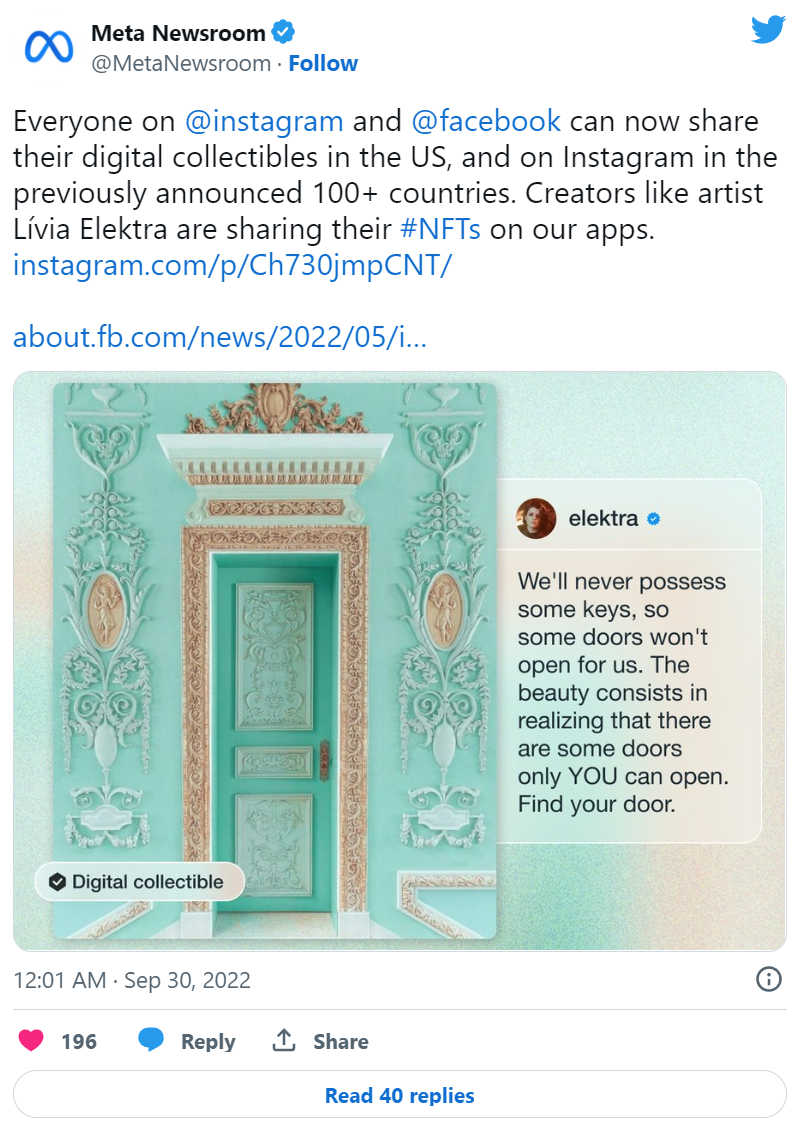
Although Facebook users received these NFT sharing features at the same time Instagram’s denizens did, there hasn’t been word on when exactly NFT trading will become available on the social media platform. Right now, the focus seems to be largely on expanding support for this feature across more markets. As of a September update, all U.S. users of the platform are privy to NFT sharing functionality, with the option to cross-post their NFTs across both Facebook and Instagram, akin to stories and regular photo posts today.
Facebook’s road to turning into an NFT marketplace
Although there’s no solid news on when and how Facebook intends to approach the subject of trading NFTs on-site, its recent efforts to streamline how creators on the platform get compensated for their work indicates that Meta wants to get everything in order before it truly opens the NFT floodgates on Facebook.
Like how “bits” work on Twitch, Facebook has offered fans a way to directly donate to their favorite creators via its Stars feature, which is a form of digital currency users can purchase with fiat currency and use as a way to engage with their creators of choice financially. As of a June 2022 update, the feature is now available to all eligible creators in select markets and can be implemented on live streams, videos, reels, and even photo and text posts.
However, unlike how Twitch has implemented digital currency, there’s good reason to assume that this is part of Facebook’s process of getting its users accustomed to the idea of spending real money on digital goods. In Web3 terms, Stars would be crypto. But what about NFTs? Those would be the virtual gifts Meta has included in Facebook’s November update to the Stars service. Fans can now use their Stars to purchase digital gifts to virtually hand to their most-loved creators. It might still be several steps away from NFTs, but it’s definitely beyond the first step toward that reality.


All Comments