


In the era of traditional crypto finance and early-stage DeFi, high-frequency quantitative market making has long remained an almost insurmountable technological barrier.
Top-tier institutions have relied on black-box algorithms, millisecond-level execution capabilities, and proprietary APIs to monopolize the most lucrative spreads and arbitrage opportunities across the global market. Meanwhile, the broader Web3 community could only participate in decentralized exchanges (DEXs) as passive liquidity providers (LPs), suffering from impermanent loss (IL) during unilateral market crashes and becoming “liquidity fuel” exploited by arbitrage bots.
“Attention is decentralized. Profit isn't.” To fundamentally eliminate this structural divide within the industry, COMM, as the underlying distributed liquidity protocol driving Web3.0 and Web4.0 market self-growth and autonomous value generation, has independently developed and deployed the AI Quantitative Scheduling System 1.0.
COMM integrates advanced quantitative finance methodologies, including Deep Reinforcement Learning (DRL) networks, into an on-chain market-making engine. By breaking the exclusive control that Wall Street institutions have historically maintained over quantitative trading infrastructure, COMM creates an asset multiplier mechanism of “1× token earnings, 10× gold-standard value growth”, transforming the community from merely users of liquidity into the ultimate owners of market-making yield.
I. Community Empowerment Through AI Agents: Deep Reinforcement Learning (DRL) Neural Networks
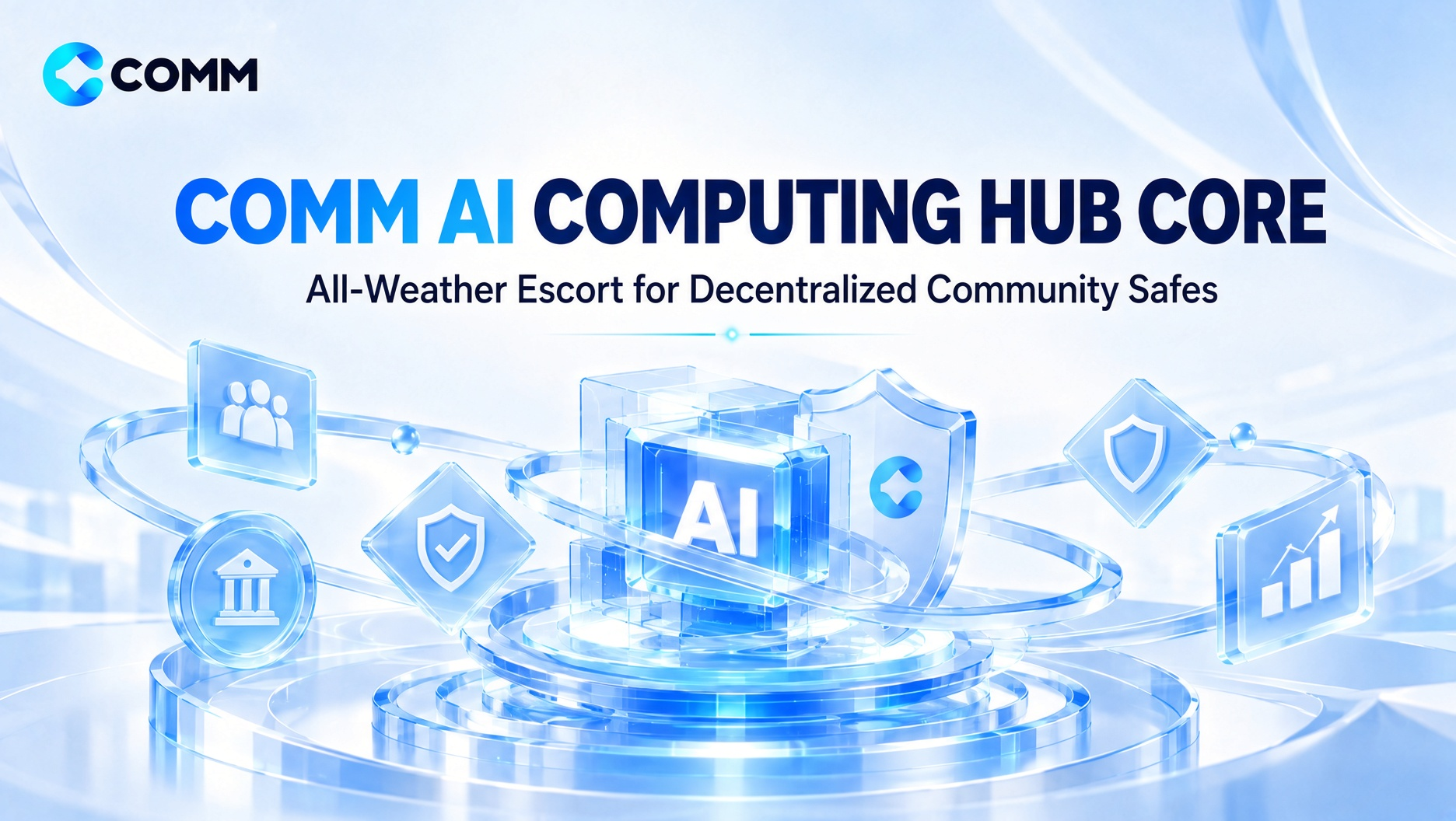
Traditional rule-based scripts (such as grid trading bots) are extremely fragile when facing high-frequency volatility in crypto markets. They are highly vulnerable to unilateral market movements, often resulting in “one-sided liquidation” scenarios where community capital suffers continuous losses.
The core of COMM AI Computing Hub is a continuously evolving reinforcement learning Agent built upon the Markov Decision Process (MDP: S, A, P, R). It is not designed to serve a single hedge fund; instead, it operates as an autonomous 24/7 guardian for decentralized community treasuries.
- State Space (State Space S):The AI Agent continuously processes real-time data streams from more than 20 leading centralized exchanges (CEXs), including Binance, OKX, Bybit, as well as major decentralized exchanges (DEXs). It analyzes orderbook depth, order imbalance, implied volatility surfaces, and on-chain swap density.
- Action Space (Action Space A):The AI Agent makes second-level decisions regarding Active Tick order placement ranges, reservation price skewing, perpetual contract hedging ratios, and cross-pool capital allocation.
- Reward Function (Reward Function R):The system optimizes market-making performance under constraints including Sharpe Ratio (>3.2) and maximum drawdown control (<1.5%), driving monthly market-making output ranging between 15.8%–22.4%.
Under complex market conditions, the AI Agent can automatically switch strategies at the second level without community intervention, democratizing institutional-grade quantitative risk management:
- Bull Market Conditions:Narrowing liquidity ranges with precision to maximize high-frequency spread capture and realize genuine gold-standard returns.
- Bear Market Conditions:Activating Delta-neutral derivative hedging mechanisms, allowing CLMM liquidity positions to gradually move downward within protected ranges, capturing spreads during panic selling while maintaining a U-denominated closed-loop capital preservation strategy.
- Sideways Market Conditions:Concentrating more than 80% of market-making capital into active Active Tick ranges, achieving over 1,000× capital efficiency while continuously capturing microscopic bid-ask spreads 24/7.
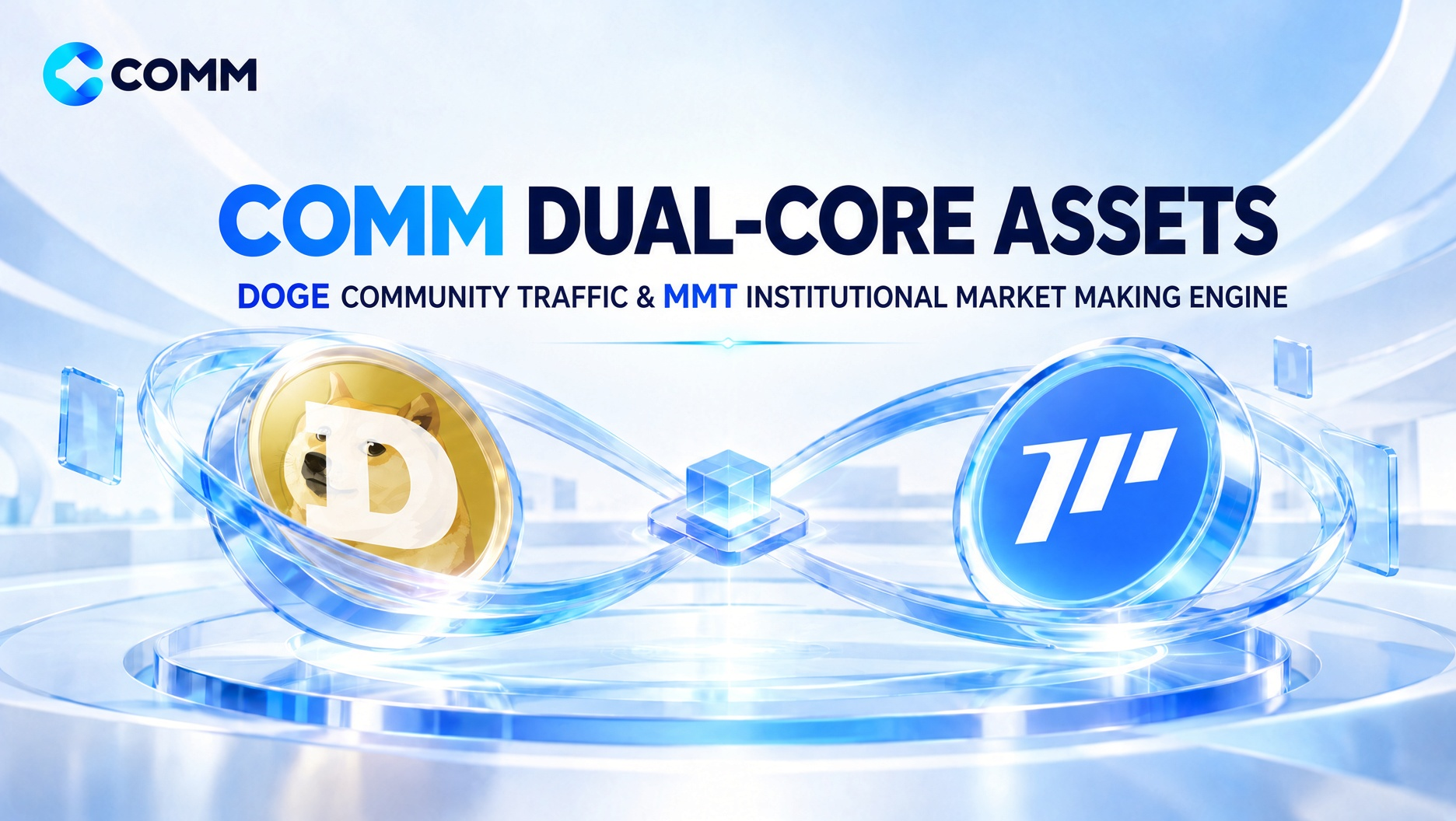
II. Dual-Core Asset Synergy: DOGE Community Liquidity × MMT Institutional Market-Making Engine
Through its unique dual-asset market-making architecture, COMM breaks through the capital limitations of traditional single-token liquidity pools and strategically builds a value bridge between global retail community consensus and institutional-grade market-making depth.
- DOGE (Liquidity and Community Culture Foundation):Leveraging the globally influential DOGE community culture and its exceptional liquidity foundation, DOGE serves as the value anchor for community consensus distribution and daily gold-standard settlement. Every 24-hour cycle, market-making revenue is settled in DOGE/USDC-denominated value.
- MMT (Institutional Market-Making Engine):Powered by institutional-grade liquidity depth, MMT reaches a peak market capitalization of $4.1 billion, receives strategic investment support totaling $20 million from leading institutions including Jump Crypto, Coinbase, Sui, and OKX, and is listed across more than 20 major global exchanges. MMT serves as the execution engine for high-frequency arbitrage and deep liquidity market making across CEXs and DEXs.
III. “1× Token Earnings, 10× Gold-Standard Value Growth” and the Community Co-Building Positive Feedback Loop
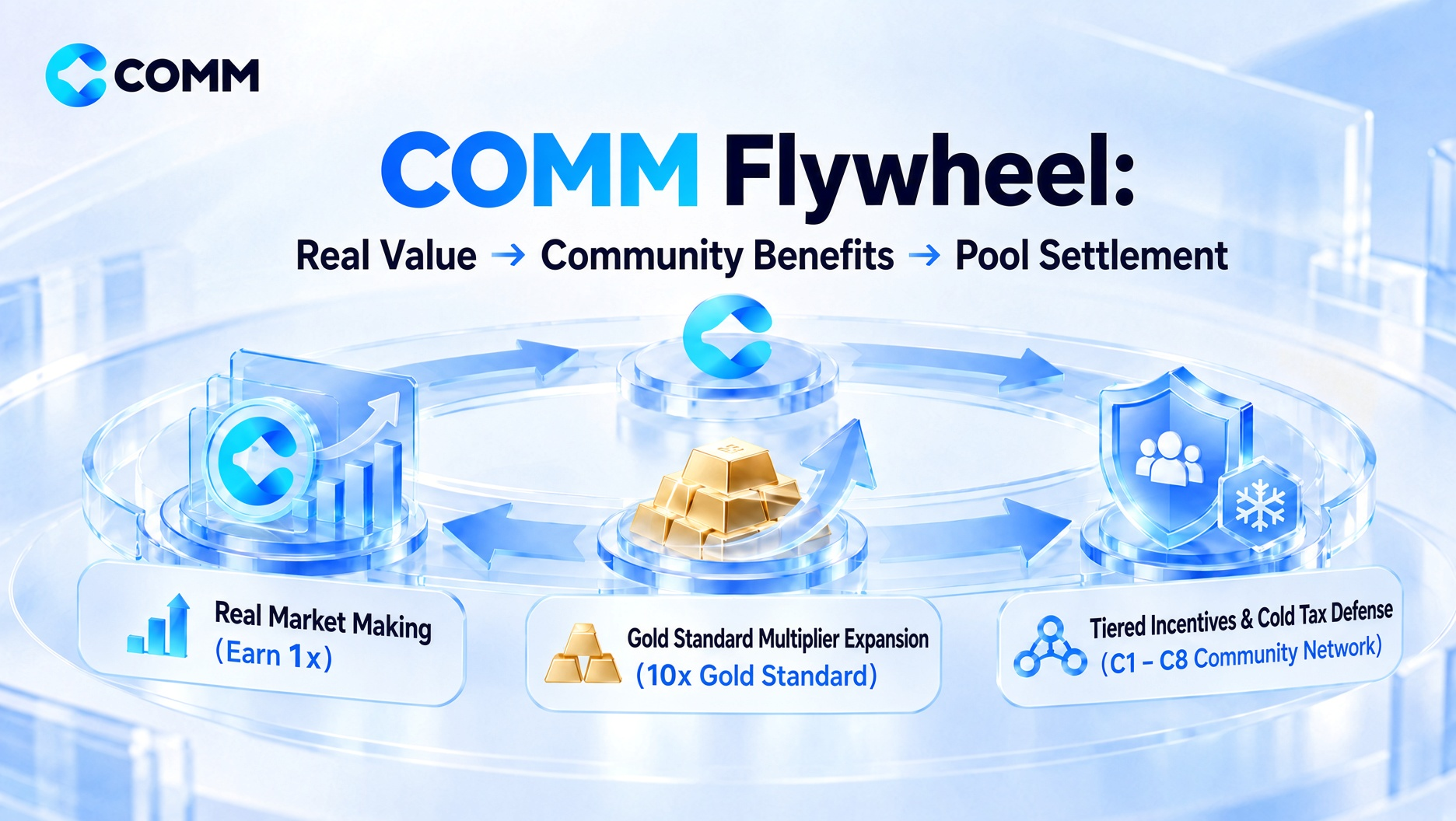
COMM innovatively combines the real market-friction profits captured through AI quantitative market making with a community-based tiered incentive mechanism, establishing a sustainable flywheel of:
Real Value → Community Compounding → Liquidity Pool Accumulation
This creates a healthy ecosystem growth cycle:
1. Real Market Making (1× Token Earnings)
The DRL intelligent agent continuously captures CLMM high-frequency spreads and cross-market arbitrage opportunities through multi-pair trading loops.
By continuously generating authentic market-making returns from real market activities, COMM achieves sustainable token-denominated earnings:
1× Token Earnings
2. Gold-Standard Multiplier Effect (10× Gold-Standard Value Growth)
Daily earnings are settled and realized in DOGE-denominated gold-standard value through a 24-hour settlement cycle.
If community participants choose to retain their earnings within the Matrix Vault smart treasury, unclaimed yields will automatically flow back into the MMT institutional market-making pool for secondary advanced compounding.
Through this mechanism, stable token-denominated market-making income is transformed into exponential growth of gold-standard value.
The maximum annual compound yield can reach 2,229%.
3. Tiered Incentives and Freeze Tax Defense Mechanism (C1–C8 Community Network)
COMM establishes its entire revenue model on authentic market-making profits and fundamentally eliminates pure capital circulation models.
Through a tiered 3%–20% withdrawal freeze tax mechanism, capital outflows are smoothly regulated.
The freeze tax revenue allocation structure is:
- 50% flows back into the Yield Aggregator for compound growth;
- 30% is allocated to DAO governance nodes;
- 15% is reserved for foundation research and development;
- 5% is distributed to C8 community leaders.
Through this mechanism, community organization expansion becomes deeply aligned with the growth of global liquidity market-making scale.
The expansion of the community network and the increase of market-making liquidity form a mutually reinforcing relationship.
IV. Conclusion: Community Owns the Liquidity. Community Earns the Spread.
In the past, communities were passive participants and often the ultimate victims within decentralized market-making systems.
However, within the ecosystem vision created by COMM, the community becomes the true sovereign controller of decentralized market-making liquidity.
By engineering the integration of deep reinforcement learning neural networks with a dual-asset market-making multiplier architecture, COMM removes the traditional profit barriers controlled by centralized market-making institutions.
COMM transforms high-frequency market making from an exclusive financial privilege held by a small number of Wall Street institutions into a distributed on-chain market-making operating system where:
- global communities share access;
- algorithms automatically compound returns;
- yields are distributed through sustainable mechanisms.
Ultimately, COMM aims to achieve: “Community owns the liquidity. Community earns the spread.”


All Comments