

Cointime

Download App
iOS & Android

Ethereum needs simple explanation to see true trustlessness: Buterin

The Ethereum blockchain needs to better explain its features to users in order to achieve true trustlessness, a challenge common across blockchain protocols, says its co-founder Vitalik Buterin.

Trustlessness would see a protocol work without the oversight of developers, as it enforces rules automatically with code. However, if a protocol is so complex that only a small group can work on it, then in practice, others still have to trust that group. 

Ethereum is already trustless as transactions and smart contracts are enforced by open-source code and a decentralized network of validators, but Buterin said in a X post on Wednesday that the network still needs to improve user understanding.

“An important and underrated form of trustlessness is increasing the number of people who can actually understand the whole protocol from top to bottom. Ethereum needs to get better at this by making the protocol simpler.”

Asked how realistic the notion is, given the tradeoff between technological features and user understanding, Buterin said, “we should be willing to have fewer features sometimes.”
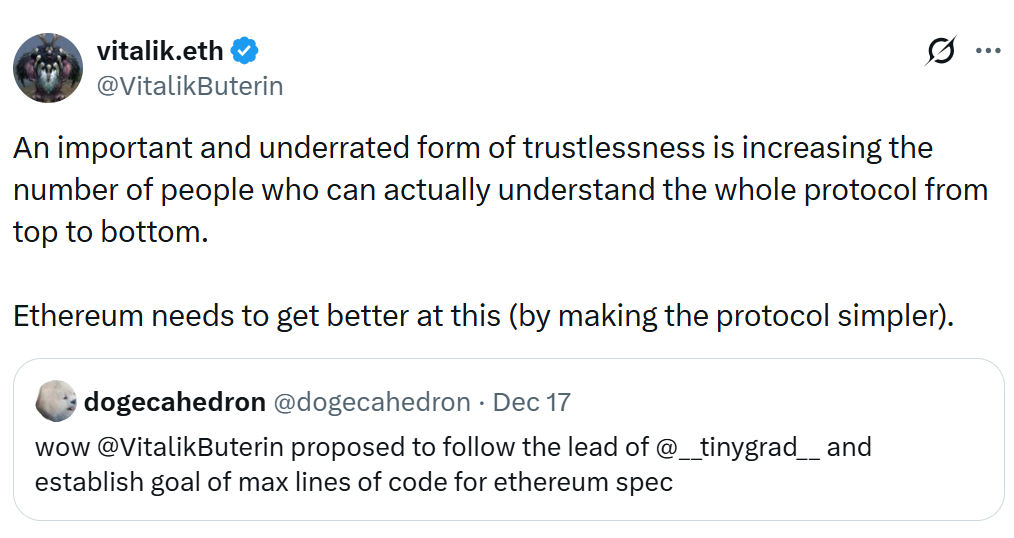
  Source: Vitalik Buterin 


Last year, crypto executives told Cointelegraph that confusion around crypto storage, regulations, and other factors tech-savvy people take for granted could be keeping average users on the sidelines and away from the technology.

Better understanding needed across all protocols

INTMAX, a privacy layer 2 built on Ethereum, agreed with Buterin, and said the same principle applies to privacy infrastructure.

“If only five people can understand how your privacy protocol works, you haven’t achieved trustlessness, you’ve just changed who you trust. Simple, auditable privacy architecture > complex black boxes,” INTMAX said.

Other remarked that deciphering tech-heavy jargon used by some protocols can feel like a full-time job, or outright repel users from an otherwise promising project.
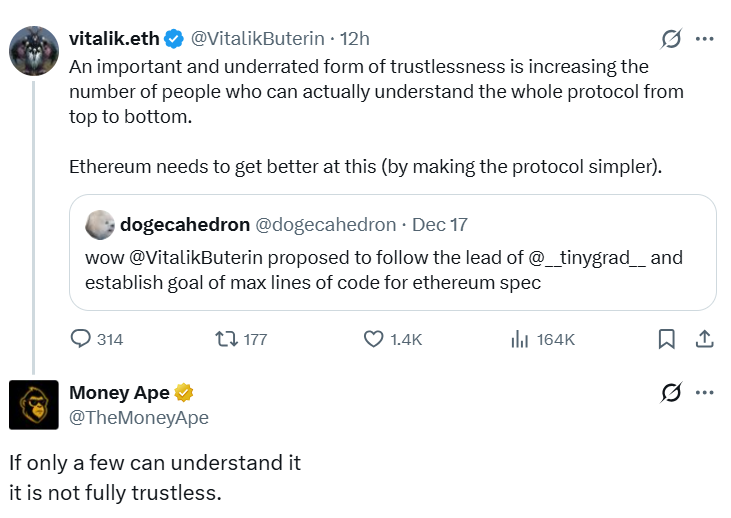
  Source: Money Ape


Ethereum aiming for better user experience

Ethereum’s roadmap acknowledges it can still be “too complex to use Ethereum for most people,” and outlines plans to “drastically lower its barriers to entry,” and become “as frictionless as using a traditional Web2 app.”

Some of the flagged upgrades aimed at creating a better user experience include smart contract wallets, which streamline complex blockchain details such as gas fees and key management and reducing the barriers to running a node by making them accessible on devices like a phone or browser apps.

The Ethereum Foundation also funds a wide range of educational courses and programs to help people learn more about blockchain development and related technologies. 

Comments

All Comments

Recommended for you

  • Putin Reportedly Plans Escalation on Ukraine Issue, Believing Negotiations Are Ineffective

    On August 27, Putin reportedly plans to take escalatory actions regarding the Ukraine issue, as he believes negotiations have been ineffective.

  • Putin Reportedly Plans Escalation on Ukraine Issue, Believing Negotiations Ineffective

    On August 27, Putin reportedly plans to take escalatory actions regarding the Ukraine issue, as he believes negotiations have been ineffective.

  • Zhipu Launches and Open Sources GLM-5.3-Flash

    On August 26, Zhipu launched and open-sourced GLM-5.3-Flash (320B-A18B), the first native multimodal model in the GLM-5 series. It features a total of 320 billion parameters and surpasses GLM-5.2, achieving a score of 57 on the globally recognized Artificial Analysis Intelligence Index (AA Comprehensive Intelligence Index), placing it among the leading models worldwide, on par with Anthropic's popular model Claude Opus 4.8. In the self-developed Z.ai Code Bench evaluation, its programming performance is comparable to that of Claude Opus 4.8. Additionally, GLM-5.3-Flash is priced at 1/10 of GLM-5.3, and during a limited-time discount, it is priced at 1/20 of GLM-5.3, which is 1/40 of Opus 4.8. The same intelligence at 1/40 the price, cutting-edge capabilities without the need to hold back.

  • Zhipu Launches and Open Sources GLM-5.3-Flash

    On August 26, Zhipu launched and open-sourced GLM-5.3-Flash (320B-A18B), the first native multimodal model in the GLM-5 series. It has a total of 320 billion parameters and surpasses GLM-5.2, achieving a score of 57 in the globally recognized Artificial Analysis Intelligence Index (AA Comprehensive Intelligence Index), placing it among the leading models worldwide, on par with Anthropic's popular model Claude Opus 4.8. In the self-developed Z.ai Code Bench evaluation, its programming performance is comparable to that of Claude Opus 4.8. Meanwhile, GLM-5.3-Flash is priced at 1/10 of GLM-5.3, and during a limited-time discount, it is available for 1/20 of GLM-5.3's price, which is 1/40 of Opus 4.8's price. The same intelligence, at 1/40 the cost, provides cutting-edge capabilities without the need to hold back.

  • Ethereum Developers Propose Restructuring Validator Staking Contract to Prepare for Quantum Attacks

    On August 26, Ethereum researchers proposed a draft to rebuild the validator deposit contract in preparation for the future introduction of quantum-resistant signature mechanisms, allowing for a gradual phase-out of the existing BLS signature format. This proposal enables the deposit contract to support keys of different sizes and public key types, assigning labels for each cryptographic scheme, with the current BLS signature labeled as 0 and potential future quantum-resistant schemes receiving new labels. Currently, approximately 42.4 million ETH, worth around $10.4 billion, are staked in Ethereum, all relying on BLS validator keys. This draft is still in its early stages and must be implemented alongside subsequent consensus layer upgrades, with the Ethereum Foundation's overall quantum resistance roadmap targeting around 2029.

  • Ethereum Developers Propose Restructuring Validator Staking Contract to Prepare for Quantum Attacks

    On August 26, Ethereum researchers proposed a draft to rebuild the validator deposit contract in preparation for the future introduction of quantum-resistant signature mechanisms, allowing for a gradual phase-out of the existing BLS signature format. This proposal enables the deposit contract to support keys of different sizes and public key types, assigning labels for each cryptographic scheme, with the current BLS signature labeled as 0, and future quantum-resistant schemes to be assigned additional labels. Currently, approximately 42.4 million ETH, valued at around $10.4 billion, are staked in Ethereum, all relying on BLS validator keys. The draft remains in its early stages and must be implemented alongside subsequent consensus layer upgrades, with the Ethereum Foundation's overall quantum resistance roadmap targeting around 2029.

  • Spot Gold Falls Below $4600/Ounce

    On August 26, spot gold fell below $4600 per ounce, declining by 1.30% during the day.

  • Spot Gold Falls Below $4600/Ounce

    On August 26, spot gold fell below $4600 per ounce, declining by 1.30% during the day.

  • SEC Submits New Crypto Custody Regulations Proposal to White House

    On August 26, Bloomberg reported that the U.S. Securities and Exchange Commission (SEC) has submitted a proposal to the Office of Management and Budget (OMB) regarding new regulations for investment advisors holding client digital assets. The rule aims to 'clarify the framework for investment advisors and investment companies to custody crypto assets,' addressing inquiries from institutions on how to comply with the custody of digital assets. It plans to eliminate certain existing custody requirements that are considered 'outdated' due to market evolution and current trading and custody practices. This proposal is seen as a step by financial regulators to advance the current administration's crypto agenda while relevant legislation remains stalled in the Senate. It will take effect after review by the OMB, a vote by SEC commissioners, and a public comment period.

  • BTC Falls Below $78,000

    Market data shows that BTC has fallen below $78,000, currently priced at $77,983.75, with a 24-hour decline of 1.03%. The market is experiencing significant volatility, so please ensure proper risk management.
