


Whether we are willing to admit it or not, the regulatory landscape of the cryptocurrency market is undeniably becoming more stringent. Especially after incidents like Luna and FTX, the financial consequences of cryptocurrency market fluctuations have forced regulatory bodies to be on high alert.
Currently, the SEC has introduced new regulations, which could result in legal action against improper investments by institutional investors. The Financial Accounting Standards Board in the United States has also released a draft of accounting standards for cryptocurrency assets in early 2023. Additionally, the Organization for Economic Cooperation and Development (OECD) has published a framework for cryptocurrency asset reporting and intends to enhance existing standards gradually.
All of these actions are pointing towards this new frontier of the cryptocurrency market, and as a result, there is a sense that a storm is brewing within the market itself.
However, despite the tightening grip of regulation, the financial and accounting management within the cryptocurrency market remains in a state of considerable disorder. The cross-chain, real-time, and intricately complex nature of cryptocurrency transactions on the blockchain makes it challenging for existing financial accounting systems to be compatible. Moreover, traditional accounting methods do not align with the current generally accepted accounting principles, such as the cryptocurrency accounting standards published by the FASB. Additionally, most transactions involving blockchain assets are encapsulated within complex nested smart contracts, making it difficult for most accounting professionals to understand the underlying business and conduct proper bookkeeping.
Given the various issues and circumstances mentioned above, it is only natural for numerous stakeholders to experience fear and skepticism. Consequently, the need for financial transparency becomes incredibly urgent.
Therefore, our protagonist today—Elven, a cryptocurrency asset reporting and compliance platform—has emerged to address these challenges.
Elven: Cryptocurrency Asset Reporting and Compliance Platform
Elven is a platform dedicated to cryptocurrency asset reporting and compliance. It provides transparent, compliant, and auditable financial reporting services, and leverages its unique financial compliance engine to update the fair value of cryptocurrency assets on a daily basis.
Elven aims to enhance financial transparency and trust within the community ecosystem, and its main business offerings are as follows:
1. Strengthening cryptocurrency treasury management by updating the company's financial status daily.
2. Calculating consolidated financial statements for cryptocurrency funds to evaluate and report fund performance.
3. Assisting investors in conducting pre-investment financial due diligence on projects and enhancing post-investment financial monitoring.
4. Automating the accounting and bookkeeping process to optimize tax compliance.
Regarding the selection of target users, Elven adopts a phased strategy. In the early stages of the project, it will primarily focus on top financial institutions and cryptocurrency projects. However, as regulatory bodies become more involved, Elven will shift its focus towards serving small and medium-sized enterprises.
Next, we will delve into the specific solutions provided by Elven.
An All-in-One Financial Reporting and Compliance Solution
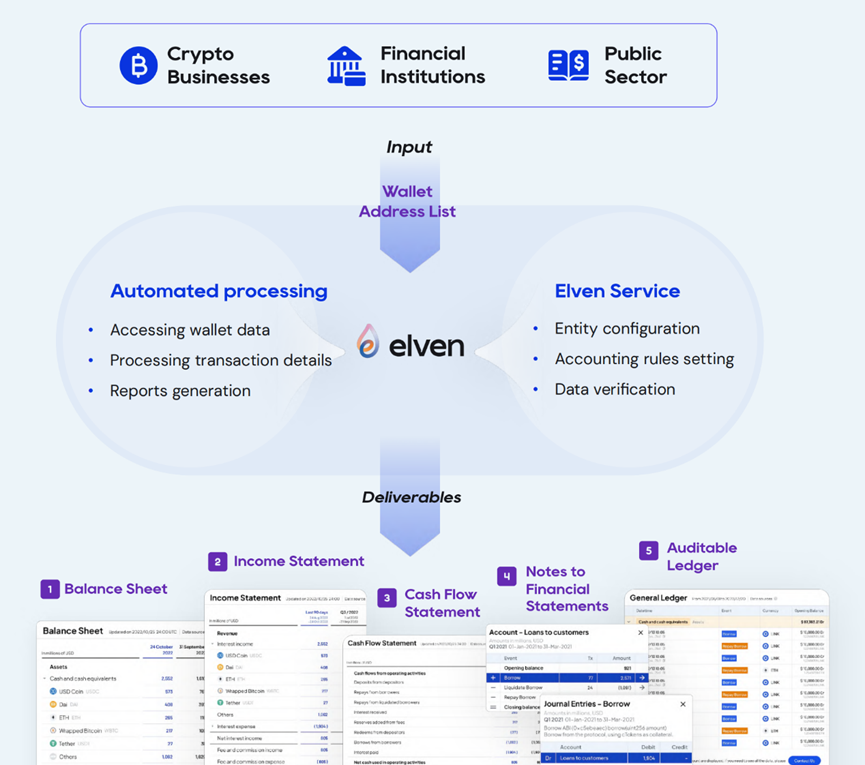
In response to the challenges in the cryptocurrency accounting field, Elven introduces a financial compliance engine and an automated accounting system. Its goal is to bridge the gap between on-chain transactions and financial systems, align with the Generally Accepted Accounting Principles (GAAP), and automate accounting processes and report generation activities.
Users only need to provide the on-chain addresses they are interested in, and Elven will process the transaction information associated with these addresses based on recognized accounting principles and procedures. This entire process is fully automated, eliminating the need for cumbersome manual processing and long waiting times, and removes concerns about the impact of cryptocurrency price fluctuations on accounting results.
Currently, Elven supports the provision of financial statements tied to fair value changes based on GAAP/IFRS guidelines on a daily basis. In addition to the standard financial statements, users can interactively view financial statement footnotes for corresponding accounts, allowing analysis of the impact of business activities, accounting treatments, and other factors on account balances. Furthermore, users can access accounting ledgers and on-chain logs for business intelligence analysis and financial audits whenever needed.
Core Product Introduction
1. Balance Sheet
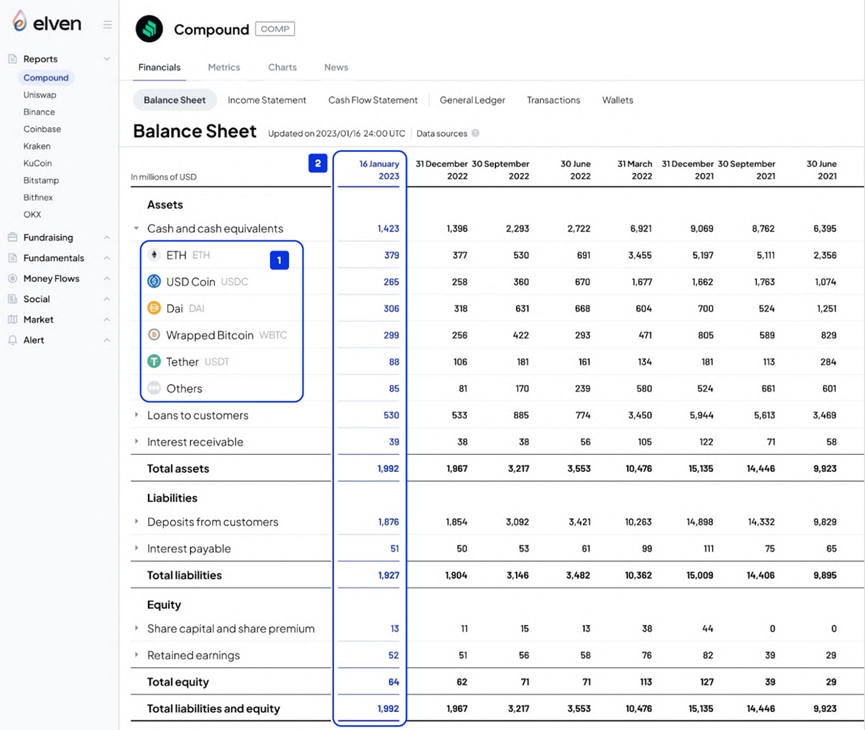
The Balance Sheet allows users to get a clear overview of the current market value and distribution of their cryptocurrency assets. It has the following features:
1) It is prepared based on recognized accounting principles (GAAP/IFRS), with a strong focus on financial compliance.
2) By clicking on each accounting item, users can expand to see the detailed holdings in different cryptocurrencies.
3) Users don't need to worry about complex handling of cryptocurrency price fluctuations as Elven updates the valuations based on fair value on a daily basis.
4) Users can generate financial reports for any selected period, from the first day of the project to the most recent day.
2. Income Statement
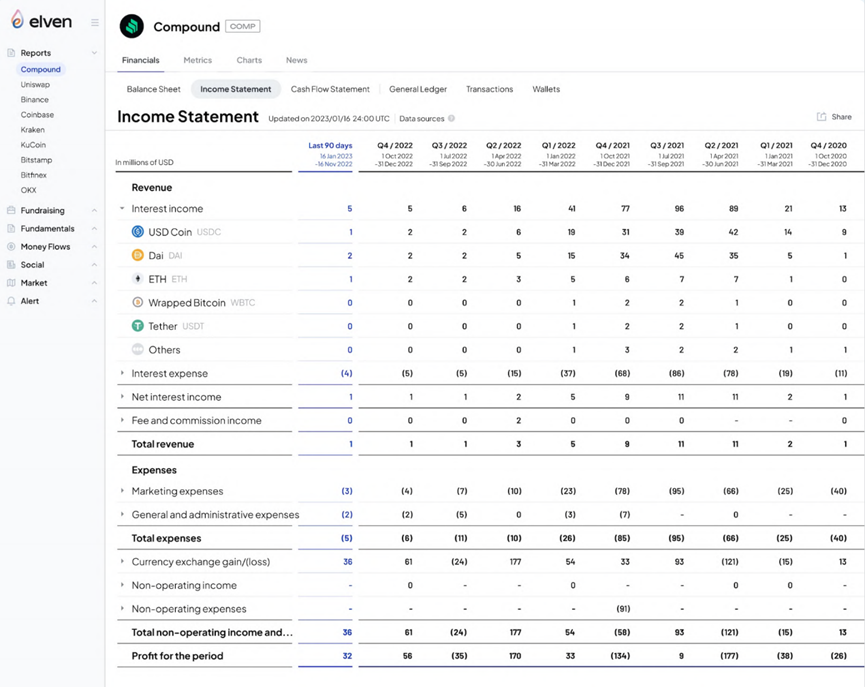
The Income Statement tracks project revenue and profitability in real-time, linked to fair value changes. It offers the following features:
1) It has the capacity to process millions of transactions daily, ensuring real-time recognition of revenue and cost allocation.
2) It effortlessly handles the impact of cryptocurrency price fluctuations on profit and loss, with separate reporting for such effects.
3) Users can define different cost valuation methods (FIFO, LIFO, weighted average, specific identification) to optimize cost allocation and tax planning.
4) With pre-set accounting rules and compliance engines, it automates the financial treatment of income and expenses related to complex businesses such as DeFi and NFTs.
3. Cash Flow Statement
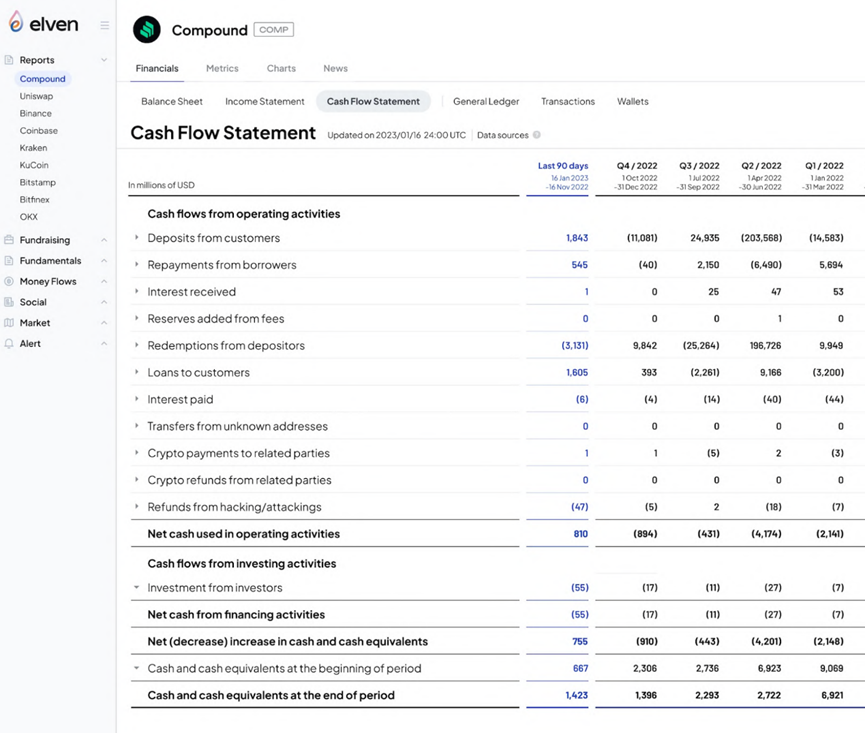
The Cash Flow Statement allows users to assess the liquidity and solvency of their projects and showcases the inflows and outflows of funds categorized by operating activities. It offers the following features:
1) Elven records the inflows and outflows of all tokens based on different types of business activities, analyzing the project's ability to generate sustainable free cash flow.
2) Following the principle of "cash is king," Elven evaluates the project's debt repayment capacity and default risks.
4. Financial Statement Footnotes
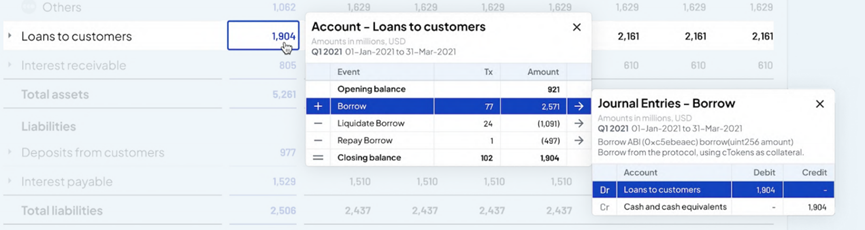
The data for Elven's financial statement footnotes is sourced from multiple transparent and publicly available on-chain data sources. It traces the impact of business activities and accounting rules on changes in account balances.
5. Auditable Ledger
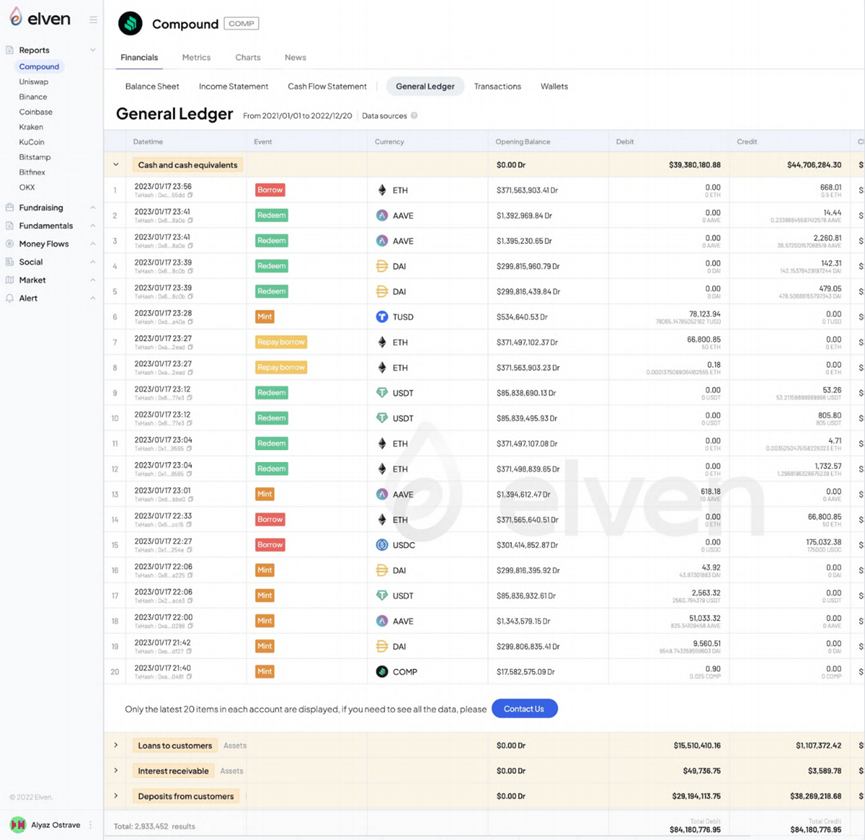
Elven's auditable ledger is generated by the financial compliance engine. It possesses the following features:
1) Revenue recognition rules.
2) Cryptocurrency payment rules (expense recognition).
3) Fair value measurement and impairment rules.
4) Cost valuation rules (FIFO, LIFO, weighted average, specific identification).
5) Accounting treatment rules for DeFi business (deposits, loans, liquidity mining, staking, yields, etc.).
6) Accounting treatment rules for NFT business (NFT minting, buying and selling, commissions, etc.).
6. On-Chain Addresses and Transaction Details
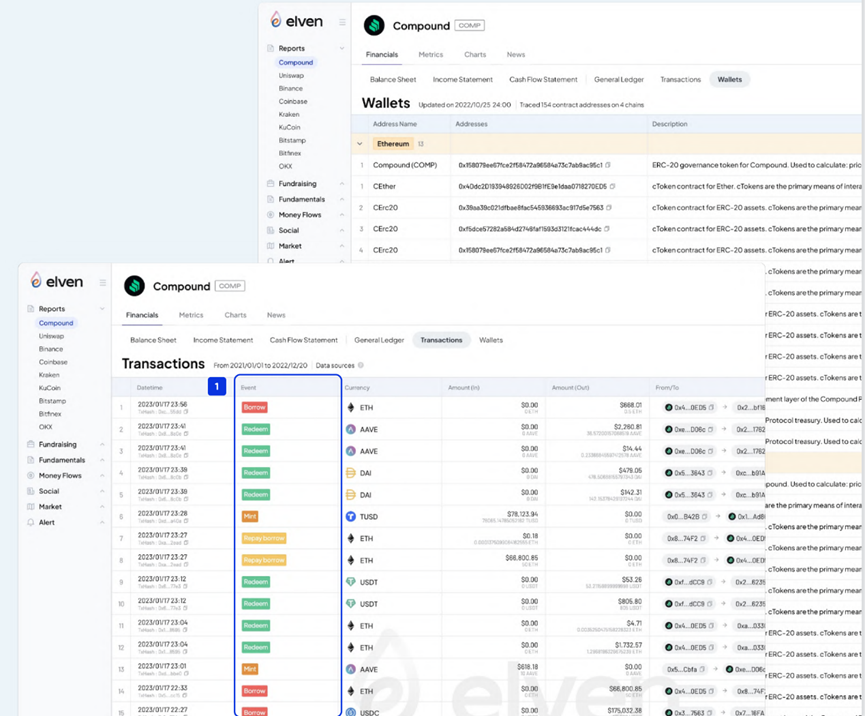
Users can flexibly configure their desired accounting entity based on on-chain addresses. Transaction details provide a clear view of the raw data.
7. Financial Reports in Compliance with GAAP and Tax Requirements
Elven provides financial reports that comply with GAAP standards and tax requirements, including:
1) Financial Statements: Balance Sheet, Income Statement, Cash Flow Statement.
2) Fund Performance Reports: Fund Holdings Report, Fund Income Report, Fund Cash Flow Statement.
3) Tax Reports: Income Reports, Tax Filing Forms.
8. On-Demand Financial Enhancements: Internal Controls, Audit, BI and ERP Integration
1) Internal Controls: Role-Based Access Control (RBAC) for customizable accounting items and rules.
2) Audit: Audit privileges to provide accounting working papers and raw data.
3) Business Intelligence (BI): Access to proprietary databases and customized report generation.
4) ERP Integration: Supports offline financial data consolidation, import-export capabilities, and integration with mainstream ERP systems.
Technological Highlights
1. Integration of On-Chain Transactions and Financial Systems
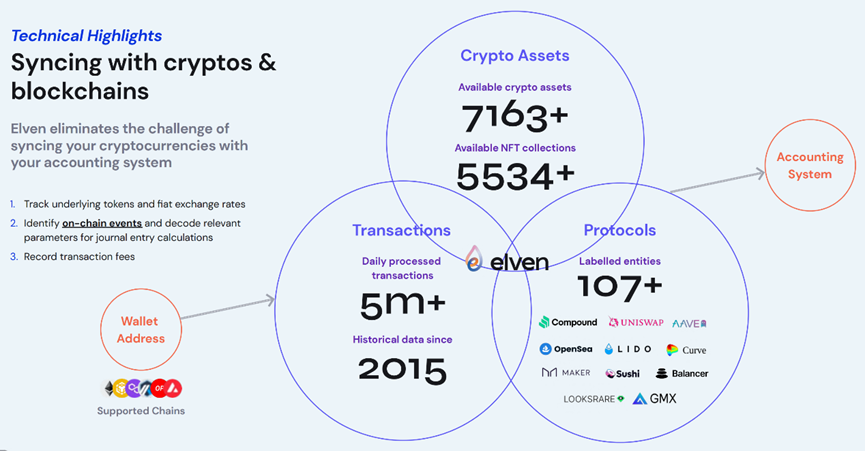
Elven adopts a native Crypto data tracking and synchronization solution to overcome the challenges in processing data within existing accounting systems. This solution offers the following features:
1) Real-time tracking of cryptocurrency price fluctuations.
2) Identification of on-chain events and parsing of relevant parameters for financial recording and processing based on predefined rules.
3) Recording of related transaction fees.
2. Alignment with the Generally Accepted Accounting Principles (GAAP)
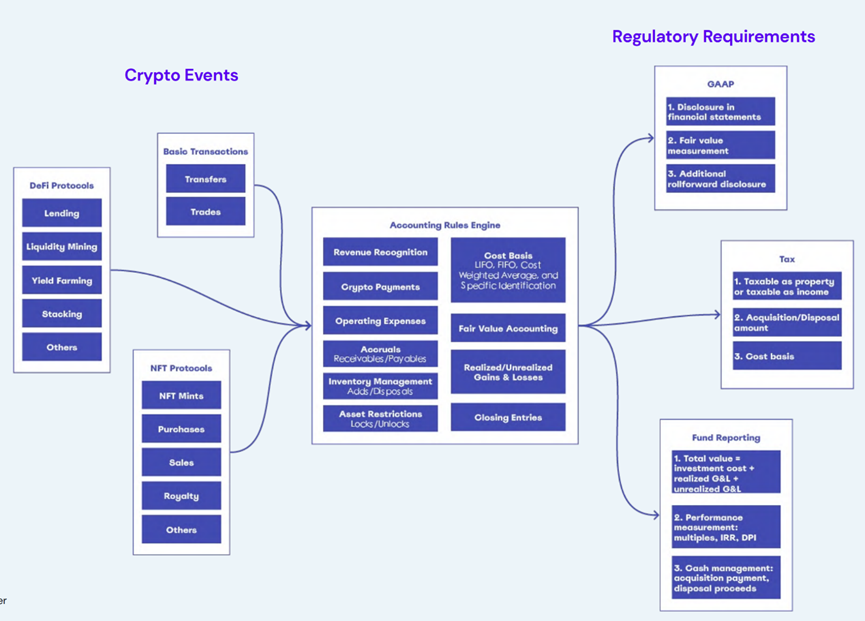
Elven's compliance engine is designed to stay in line with evolving policies. It incorporates the following features:
1) Revenue recognition rules.
2) Cryptocurrency payment rules (expense recognition).
3) Fair value measurement and impairment rules.
4) Cost valuation rules (FIFO, LIFO, weighted average, specific identification).
5) Accounting treatment rules for DeFi business (deposits, loans, liquidity mining, staking, yields, etc.).
6) Accounting treatment rules for NFT business (NFT minting, buying and selling, commissions, etc.).
3. Automated Accounting Processing and Report Generation
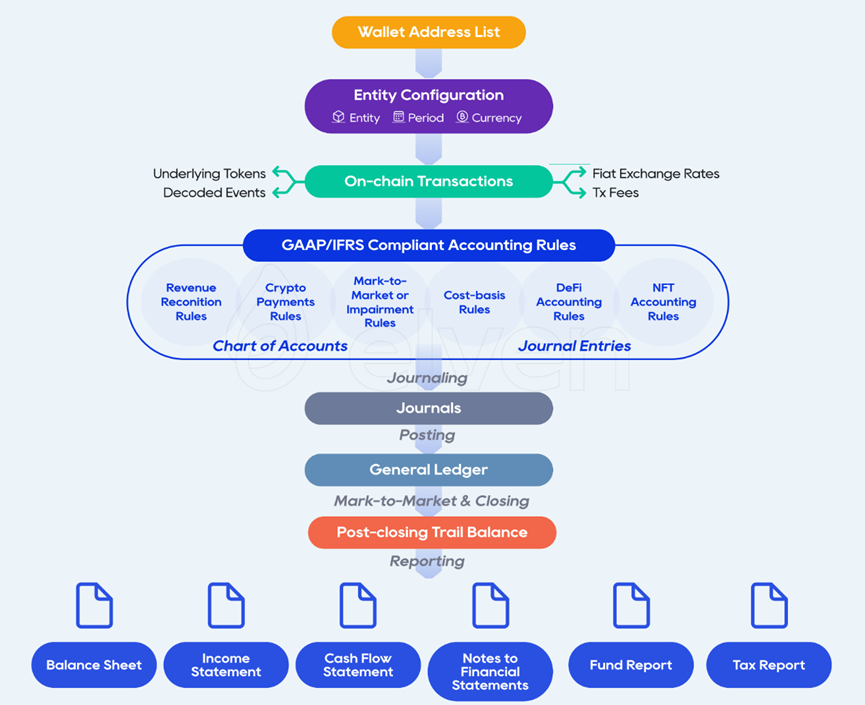
Automating the accounting process saves time and reduces manual data entry, allowing users to access up-to-date reports on a daily basis. It offers the following features:
1) Parsing: Automatic parsing of daily transactions and events, generating corresponding accounting entries based on predefined compliance engines.
2) Journal Entries: Generation of journal entries for each on-chain address.
3) General Ledger: Daily posting and summarization of financial transactions by accounting item, including fair value adjustments.
4) Trial Balance: Profit allocation and offsetting based on defined reporting periods and currencies, resulting in a trial balance.
5) Report Generation: Generation of financial statements, fund reports, and tax reports based on trial balance and specific reporting requirements.
Conclusion
As we approach the era of increasing regulation, it is natural to feel uncertain about the unknown in the world of cryptocurrencies. However, since it is inevitable, being fully prepared is a wise move. Elven is designed precisely for this purpose.
From another perspective, regulation is not necessarily a bad thing. After all, the process of transitioning from unruly growth to a well-regulated industry is natural. Therefore, we need to be prepared and embrace the new phase of the cryptocurrency market.


All Comments