


Web3 is a collection of libraries that allow developers to interact with decentralized applications (dApps) and the Ethereum blockchain. Web3 use cases allow businesses to take advantage of a robust and decentralized system of technologies, such as blockchain, cryptography, NFTs, and DeFi.
What are the Security Challenges in the Web3 Era?
The lack of security in Web 3 can have a significant impact on users. Without proper security measures, users are vulnerable to malicious actors who can access their data, steal their funds, and even manipulate the network. This can result in financial losses, data breaches, and other serious consequences. Furthermore, the absence of security can also result in a lack of trust in the network, which can lead to decreased adoption and usage.
The Web3 stack can be seen as comprised of several layers, each of which serves a different purpose and has its own set of characteristics. Each of these layers is designed to work together to create a secure, decentralized, and highly scalable Web3 system. However, some of these properties also bring new security challenges and expose some specific attack surfaces.
The rapid development of Web3 security is accompanied by frequent hacking incidents due to the transparent and open nature of the blockchain. Due to the financial nature of Web3, attacks usually result in great financial losses for users.
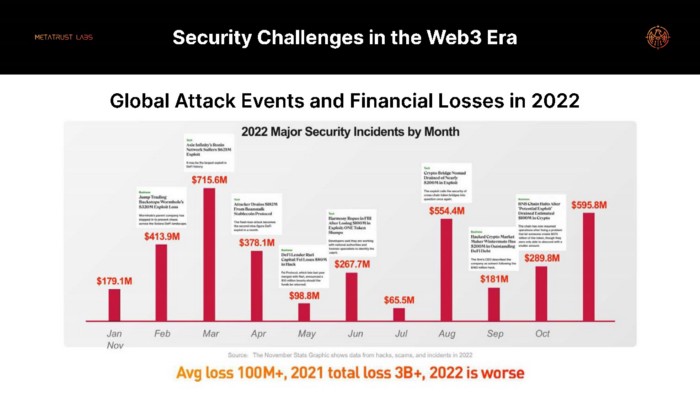
As we can see in this chart, there are already over 3.7 billion USD losses up until November last year. In 2021, we have also seen a total loss of over 3 billion USD. On average, each attack could lead to a loss of over 100 million USD.
Web3 applications are complex because they involve multiple layers of technology, including the distributed ledger layer, cryptography, and smart contracts. The current practice in the Web3 community is to build first and then rely on a one-time security auditing service with the hope of complete protection. However, security auditing services are often slow, expensive, and cannot guarantee results.
A more effective way to ensure web3 security is to incorporate security analysis into the development process, which is to move security to the earlier stages of the SDLC. With the help of automated tools, the left-shift of security can reduce costs and improve the quality and security of the software. Therefore, we believe that shift-left security and full-lifecycle security services will be the future of web3 security.
What is DevSecOps?
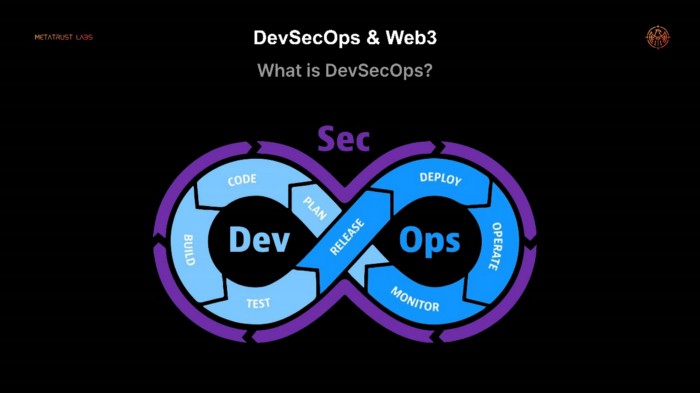
DevSecOps (short for Development Security Operations) is an approach to software delivery that integrates security into the development process from the ground up. The goal of DevSecOps is to ensure that applications are developed with security in mind from day one, helping organizations reduce risk and create more secure products faster.
The importance of software security and DevSecOps is growing in web3 because of the increased complexity of web applications and the need to protect user data. With the rise of distributed ledger technology, blockchain, and other decentralized technologies, the need for secure software development and deployment is becoming increasingly important. DevSecOps is a set of practices that help ensure that software is secure from the start and that security is maintained throughout the development and deployment process. This helps to protect user data and ensure that applications are secure and reliable.
When we explore the security challenges in the Web3 era, we need to figure out how the DevSecOps approach could be adopted, and the tools or services we use to improve the security of the Web3 ecosystem.
How to Develop Secure Web3 Applications?
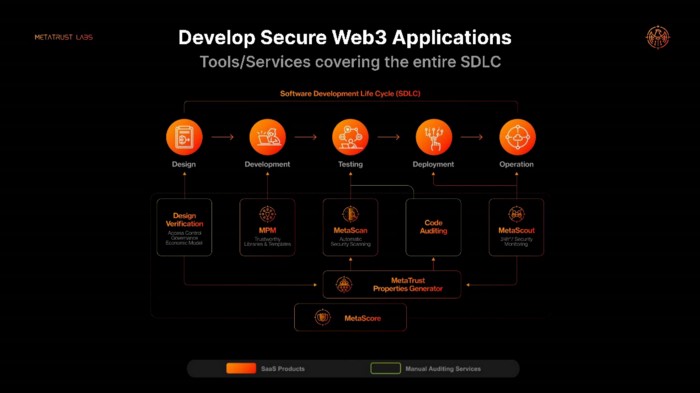
We start with the software design phase and perform a deep security analysis using formal verification techniques for critical systems and contracts like DEX, Bridges, and Wallets, especially in layer 1 and layer 2.
Next, for secure software development, MetaTrust offers the world’s first secure package manager for secure open-source development for Web3 builders, together with the best security development practices and libraries.
The second key product is MetaScan, which is an automatic security auditing tool for smart contracts via a SaaS service. It integrates all state-of-the-art research in the static analysis, formal methods, fuzzing, and code clone analysis to identify all possible risks in users’ contracts. Metatrust also defines the most comprehensive smart contract vulnerability standard and conducts comprehensive experiments to guarantee the results are equivalent or better compared to the best auditing services available.
The third product is MetaScout, which performs 24/7 runtime security monitoring to detect and prevent on-chain attacks, such as price manipulation attacks and rug pulls. MetaScout incorporates the most comprehensive security patterns to detect malicious behavior in the runtime, which may be missed in auditing services. Moreover, MetaScout provides an open framework where developers can easily customize their monitoring requirements with our APIs.
The final capability is MetaScore, which provides a comprehensive security and risk score and ranking for a project via security analysis, security investment, transaction analysis, and development analysis. MetaScore helps end-users, developers, hackathon organizers, and even investors to understand the potential security risks of web3 projects.
With these capabilities and offerings, MetaTrust brings developers the complete and best security development SaaS tools to build a secure and prosperous web3 ecosystem.


All Comments