

Cointime

Download App
iOS & Android

Decoding the EVM inscription decline: Has the party ended?

After gaining popularity on the Bitcoin [BTC] network, inscriptions became popular on Ethereum Virtual Machines (EVM).

The number of inscriptions on these networks reached a record high, affecting the transaction volume significantly. However, the inscription trend has decreased.

How EVM inscriptions have trended in the last three months

An analysis of EVM inscriptions on Dune Analytics over the past three months revealed a notable rise in volume in December. The data showed that at least three networks experienced daily inscription counts of over 1 million on certain days in December.

For instance, on 6th December, the BNB chain recorded over 28 million transactions, while Polygon saw nearly 8 million. The cumulative inscriptions for that day were over 6 million.
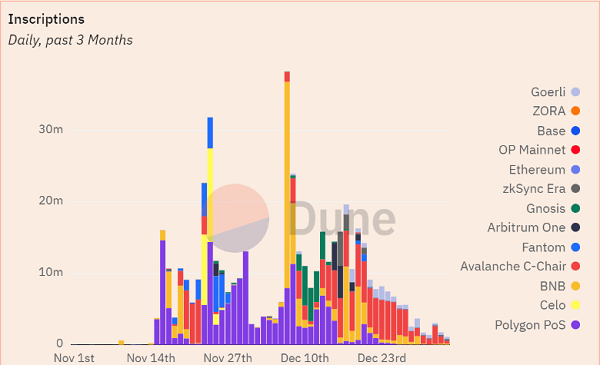
Furthermore, the charts showed that inscription transactions made up over 50% of the total transactions at the peak.

However, a current examination of the charts shows a significant reduction in these transactions. As of the latest data, the highest observed inscription count was around 370,000 on the Avalanche network.

Inscriptions’ contribution to EVM gas declines

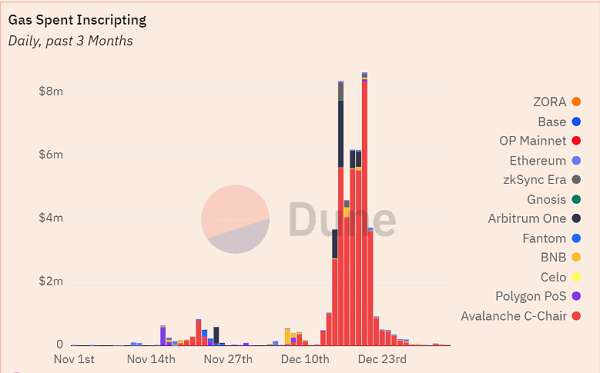
During the height of the inscription craze in December, certain networks experienced gas fees of over $1 million.

Notably, on 16th December, Avalanche and Arbitrum recorded gas fees of over $5 million and $2 million, respectively. While some networks started witnessing gas fees below $1 million, Avalanche continued this trend until 21st December.

Subsequently, gas fees significantly decreased, and at the time of this writing, the highest observed gas fee was about $16,000.
Source: Dune Analytics

As the year concluded, this substantial reduction implied a drastic decrease in the contribution to network fees. It remains uncertain whether this marks the end of the popularity of inscriptions on EVMs or if it signifies a temporary pause.

Bitcoin retains a decent inscription volume

An examination of the inscription volume on Bitcoin on Dune Analytics showed a total of over 53.4 million. Currently, the daily inscriptions on the Bitcoin network stand at over 100,000.

In the same timeframe, the total inscriptions on Ethereum Virtual Machines (EVM) were less than 50,000. This highlights that, despite the apparent decrease, the Bitcoin network continues to witness a substantial volume of transactions compared to EVM networks.

Furthermore, despite the evident decline in inscription fees on Bitcoin, they were still higher than the fees observed on EVM networks. This suggests that, even with the decline, Bitcoin inscription transactions command higher fees than those on EVM networks.


Comments

All Comments

Recommended for you

  • A Total of 37,212.18 DMD Permanently Burned Over the Past 7 Days

    July 9, 2026 — According to the latest on-chain data released by DMDAO, a total of 37,212.18 DMD has been permanently burned over the past seven calendar days through the protocol's predefined trading and wealth management burn mechanisms.

  • Whale Transfers 1,133 BTC to Coinbase Prime, Valued at $71.48 Million

    According to Onchain Lens monitoring, a whale transferred 1,133 BTC from Coinbase to Coinbase Prime through an intermediary wallet, valued at $71.48 million.

  • U.S. AI Chip Stocks Decline Before Market Open, Intel Falls Over 3%

    On July 7, U.S. AI chip stocks experienced widespread declines before the market opened. Intel dropped over 3%, while AMD, Qualcomm, and NXP fell more than 2%. TSMC, Broadcom, and Tesla decreased by over 1%, and NVIDIA declined by 0.7%.

  • China's Central Bank Increases Gold Reserves for the 20th Consecutive Month

    As of the end of June, China's gold reserves stood at 75.44 million ounces (approximately 2,346.446 tons), an increase of 480,000 ounces (about 14.93 tons) from the end of May, which reported 74.96 million ounces (approximately 2,331.52 tons). This marks the 20th consecutive month of gold accumulation.

  • China's Foreign Exchange Reserves in June at $341.6262 Billion

    On July 7, China's foreign exchange reserves for June stood at $341.6262 billion, a decrease of $26 billion from the end of May, representing a decline of 0.75%, with expectations set at $343.2 billion.

  • U.S. Storage Stocks Drop Pre-Market, SanDisk and Micron Down Over 4%

    On July 7, U.S. storage concept stocks collectively fell in pre-market trading. Western Digital dropped over 5%, SanDisk and Micron Technology fell over 4%, Seagate Technology declined over 3%, Rambus fell over 2%, and SMI fell over 1%.

  • U.S. Stocks in Optical Communication Sector Drop Pre-Market

    On July 7, stocks in the optical communication sector of the U.S. market collectively fell pre-market. Astera Labs dropped over 4%, while Marvell Technology, Credo Technology, and AXT Inc. fell more than 3%. Tower Semiconductor, MaxLinear, Corning, Applied Optoelectronics, GlobalFoundries, Lumentum, and Qorvo all declined by more than 2%. Coherent, Nokia, Amphenol, and Broadcom dropped over 1%.

  • Pre-market Decline in U.S. Storage Stocks

    In pre-market trading, U.S. storage concept stocks experienced a widespread decline, with Micron Technology falling by 4.8%, SanDisk dropping over 4%, Corning down more than 2%, and Intel decreasing by over 3%.

  • Two Departments: Support for Reinsurance Institutions to Increase Capital and Issue Supplementary Capital Tools

    On July 7, the National Financial Supervision and Administration Bureau and the Shanghai Municipal Government released several measures to accelerate the construction of the Shanghai International Reinsurance Center. Among these measures, they proposed to enhance the quality and efficiency of the reinsurance industry, support reinsurance institutions in increasing capital and expanding shares, and issuing supplementary capital tools to improve the capacity for internal capital accumulation and external capital supplementation, thereby strengthening the reinsurance industry's capabilities. The initiative aims to guide the insurance industry to focus on major national projects, strategic emerging industries, and livelihood security, consolidating insurance and reinsurance underwriting capabilities to enhance risk protection levels. It also supports reinsurance institutions in leveraging their professional technical advantages to assist the insurance industry in reducing risk.