


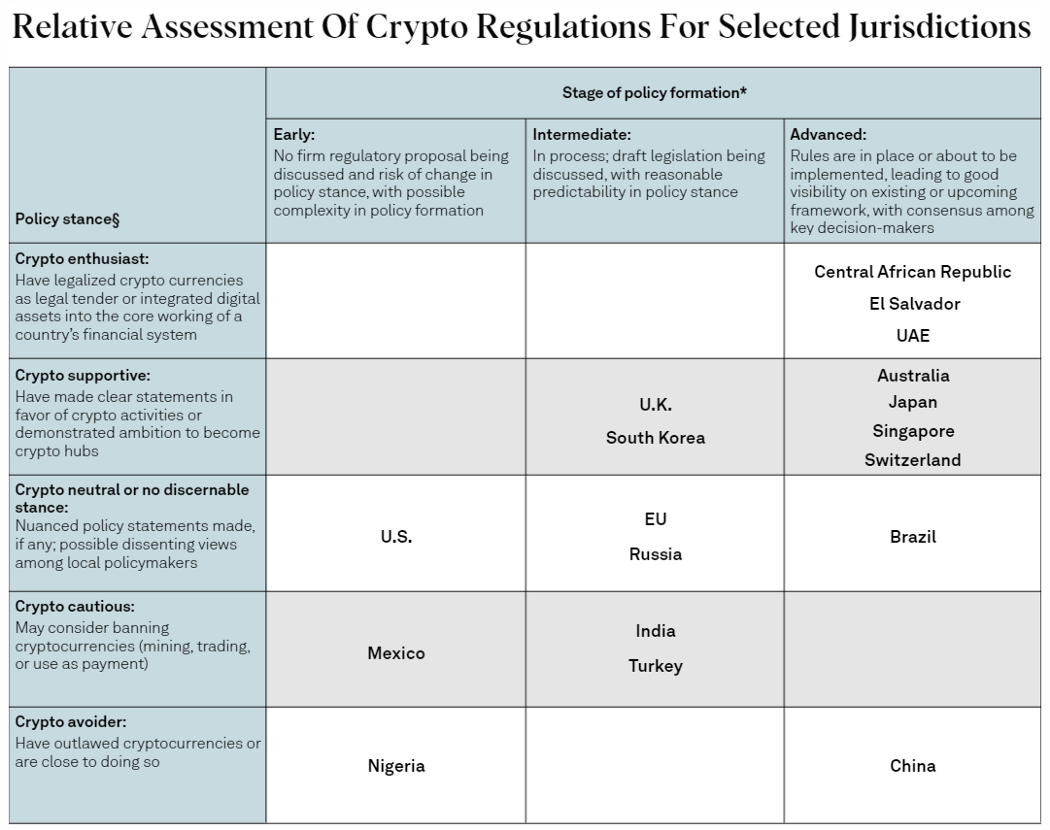
Crypto regulations are gaining more traction. The crash of FTX has brought this issue to the forefront and has caused governments to push even harder. Here is what you should expect from crypto regulations in the coming months and years.
Crypto Regulations Already Under Way Will Be Sped Up
The EU’s Markets in Crypto Assets (MiCA) bill is in the final stages of being approved by the European Parliament. It will bring crypto assets and markets under the supervision of the European Securities and Markets Authority (ESMA). It will also introduce guidelines for crypto projects and platforms. These include:
- Marketing guidelines.
- Requires miners to publish their energy consumption.
- Requires crypto services to disclose information on the people involved in a transaction.
- Introduces transaction caps for stable coin issuers.
There are also many regulatory initiatives in the USA, some of which are not coordinated with one another. What is certain is that the Securities and Exchange Commission (SEC) wants to put cryptocurrencies under the supervision of the Commodity Futures Trading Commission (CFTC). It is also envisaged that stablecoins will fall under the supervision of the Federal Reserve in the future.
⚠️What this means for you: The days of the Wild West in Crypto are over. Expect regulations that will be consolidated across various countries. As a result, users and their assets will be better protected. At the same time, however, surveillance by the state will increase massively — with all the associated disadvantages.
Strong Focus On Custody And Protection Of User Assets
Custody and protection of user assets will be the main points of future crypto regulations. In the future, crypto platforms will have to prove exactly how they ensure the security of users’ assets. This includes detailed information about their operations, such as their risk management strategies and procedures and technologies used for safeguarding user funds.
⚠️What this means for you: For users, regulation in this area will bring the greatest benefit. Stricter rules for crypto platforms mean assets are more secure. Nevertheless, the following applies: Not Your Keys, Not Your Coins.
Also, due to regulations, it is likely that large and established platforms will have an advantage over smaller and newer providers.
Unbundling Of Crypto Exchange Activities
Crypto exchanges and other platforms are providing a range of services, including broker, trading, lending, and custody activities, without any real regulation. The problem with this is that it opens the door to manipulation and poses a risk to users’ assets. In addition, conflicts of interest can arise.
Coming regulations will try to unbundle these activities by introducing rules similar to what we are seeing in traditional finance. This will provide regulators and users with greater oversight of platform activities and ultimately improve the protection of user assets.
⚠️What this means for you: Regulations in this area are also an advantage for users. Because in the future it will (at least in theory) be clearer how and for which services platforms use their users’ funds. This allows a better overview so that users can better decide who to trust their coins with.
More Transparency
The new regulations will also introduce more transparency in the cryptocurrency industry. This will include more reporting requirements for exchanges and other entities, as well as more information sharing between (retail) crypto market participants and regulators.
For example, KYC (know your customer) processes and other AML (anti-money laundering) measures will become mandatory in the future.
In addition, exchanges and other platforms could be forced to disclose money flows and other financial data for regulators and make them easier to understand. In some cases, limits for crypto transactions also seem to be considered.
⚠️What this means for you: Here I see the biggest problem. Because what it will boil down to is that the authorities can track all transactions precisely and assign them to individual people. What ostensibly serves to protect citizens is actually used to monitor them.
Crypto Regulations: Are Decentralized Providers a Protection?
Another consequence I see is that more people will move from centralized to decentralized crypto providers in order to circumvent crypto regulation by the authorities. Here are a few examples of what this might look like in practice:
- Decentralized crypto services can be used to bypass regulatory restrictions on the sale and purchase of cryptocurrencies.
- In the case of transaction limits imposed by the authorities, decentralized providers can offer a way out.
- Some decentralized crypto services allow users to store their own digital assets without the need for third-party custodians. This reduces the risk of regulatory intervention.
- Some decentralized crypto services can be used to facilitate peer-to-peer transactions without the need for a middleman or third-party service. This eliminates the need for intermediary financial institutions, allowing users to transact directly with each other, bypassing potential regulatory restrictions.
However, the devil is in the details. Some believe that decentralized crypto services will be further marginalized by upcoming regulations and will remain a niche product unless they implement some of the regulatory requirements.
Disclaimer: This article is only for informational and educational purposes only. It should NOT be treated as financial and investment advice.


All Comments