


Every retail investor has experienced this.
An ICO happens. Early investors rush in to scoop up coins for cheap. The moment it starts trading publicly, the price dumps.
In many cases, it never recovers.
Here is a fact: one year after its public listing, a cryptocurrency loses about 80% of its value on average.
So it’s reasonable to conclude that the ICO model is overdue for change.
Enter fair launches.
What is a fair launch?
Put simply, a crypto fair launch is designed to enable all participants to purchase a cryptocurrency or token at the same price. Various methods are used to achieve this goal.
Messari defines fair launch tokens as having a publicly announced launch without any form of pre-mine and pre-investors. On top of that, additional mechanisms have been developed by various businesses and projects in the crypto space to ensure a fairer distribution of tokens.
How does a crypto fair launch work?
Every fair launch is different. But here is a simple description of the most important stages.
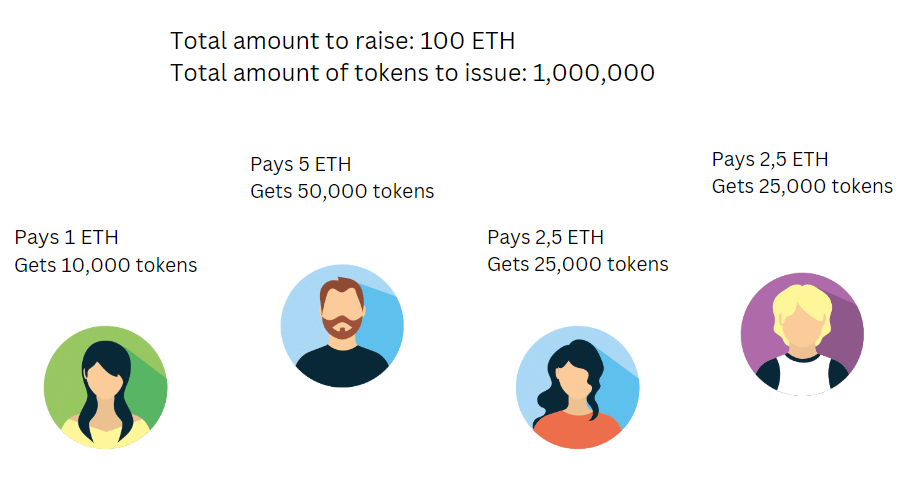
- The first stage is the liquidity generation event (LGE). As a participant, you use a gas token or stable coin (for example, ETH or USDC) to buy coin/token allocations from the crypto project you invest in. At the end of this stage, you receive a share of the total amount raised equal to your deposit as a percentage.
- For example, if the total amount raised is 100 ETH and you invested 1 ETH, then you will get 1% out of the total project tokens. An illustration is shown below.
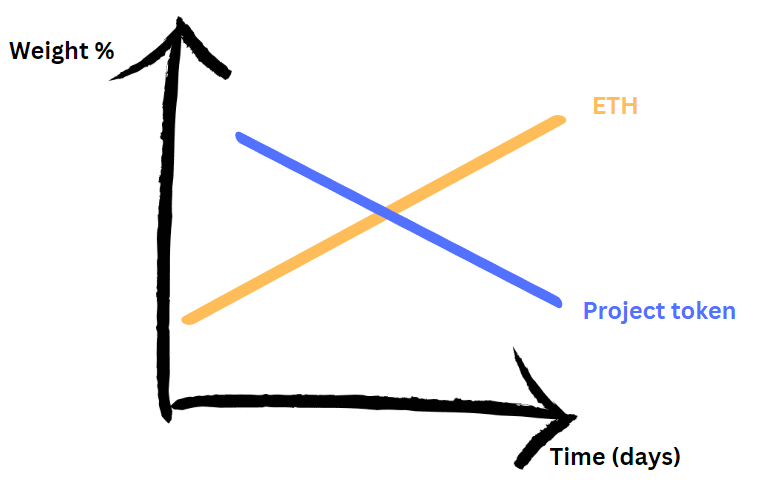
- More advanced fair launches also include a second stage called liquidity bootstrapping. This stage is used to determine the price of the token. For this, the liquidity from the first stage is used to provide liquidity for a balancer pool. This pool changes the weights of the tokens based on a pre-set curve and market demand to find the market price.
Makes sense so far?
Let’s look at some charts to get a better understanding of what some of the processes described look like in practice.
Anatomy of a fair launch
The cool folks at Savvy DeFi provided me with some of their research data on the fair launch done by ByteMasons in 2022. Savvy DeFi conducted their research as part of the preparations for their own upcoming fair launch.
Here is what they found.
The first thing to note is that ByteMasons implemented a specific method for their fair launch. Users could choose their vesting terms (how long their tokens stay locked up) at the point of transaction confirmation. When Venture terms were chosen instead of the default terms, the price of the token was reduced and the vesting period was longer.
The following chart is a snapshot of every transaction during the LGE: the higher the dot, the larger the transaction. Each transaction was recorded on the blockchain, and the y-axis shows the block height from left to right. We can split the transactions into 2 groups — default terms (token locked up for 90 days) and venture terms (token locked up for 4 years). Tokens bought under the default terms were at regular price, and tokens bought under venture terms were cheaper due to the longer lockup period.
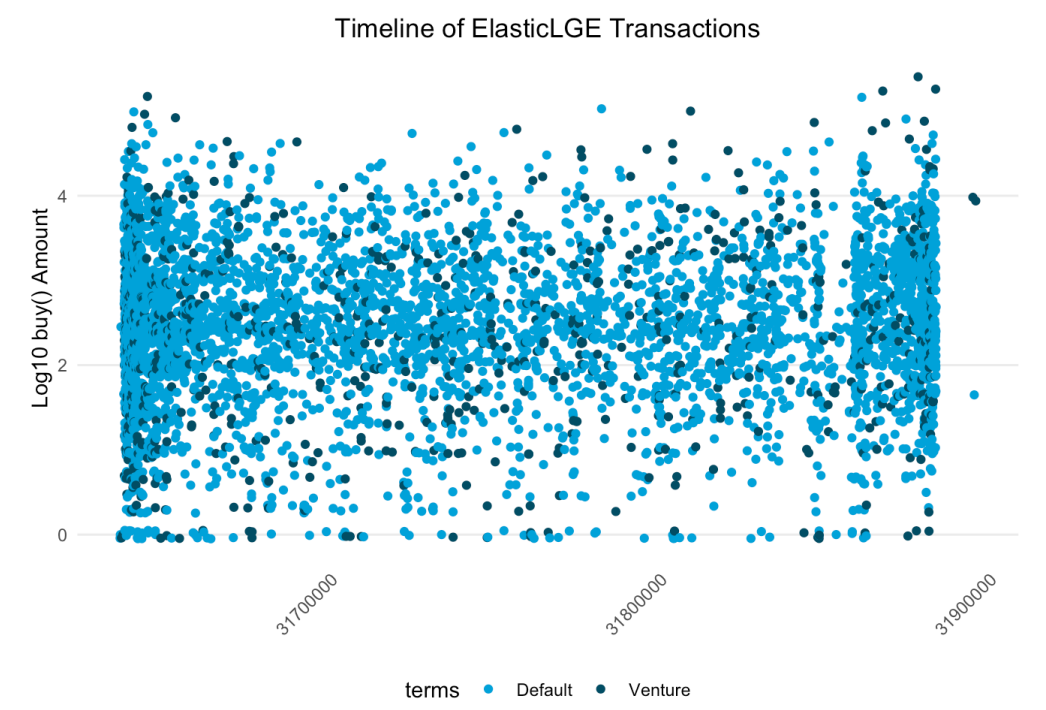
In the following chart, larger transactions are at the top. Thicker regions of the distribution mean there were more transactions of a particular size. We can see that under venture terms, more tokens were bought either in small or very large quantities.

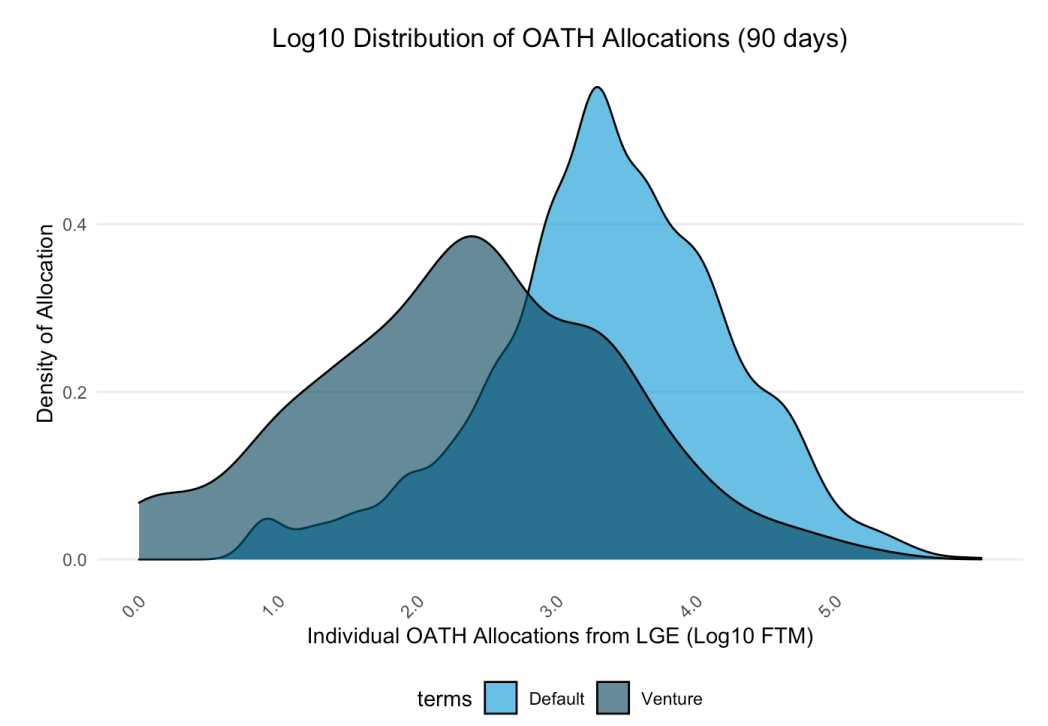
Since the default terms are fully unlocked after 90 days (compared to 4 years for the venture terms) we can look at the 90th day to get a sense of how many OATH tokens were in circulation at that point. In the following chart, which is also divided into default and venture terms, values towards the right side of the chart correspond to larger quantities of tokens entering circulation. We can see that there are more default-terms tokens entering circulation — and relatively fewer venture-terms tokens are in circulation.
As mentioned above, a fair launch’s purpose is to make the investment process fairer for all participants. So how well did ByteMasons’ fair launch perform in this regard?
On the 90th day after the launch, the token’s distribution yielded a Gini Coefficient of 0.817. The Gini Coefficient is used to measure income inequality or wealth inequality within a nation or a social group. The closer to 1 the Gini Coefficient is, the more concentrated wealth is within a population. For comparison, in 2009 the Gini coefficient for the global distribution of wealth was estimated to be 0.802. By 2019 it had increased to 0.885 (Wikipedia).
In this context, the fair launch of ByteMasons achieved a good result.
But is it possible for a fair launch to be… even fairer?
The people at Savvy DeFi think that they can achieve better results by utilizing the two stages explained at the beginning.
Fair launches — the ICOs of 2023 and beyond?
One thing already seems clear: the popularity of fair launches as a method to raise funds is increasing. As a result, a new ecosystem is emerging within the crypto sphere. And that creates a growing interest to increase the visibility of these new mechanisms.
For the time being, it is hard to say how many crypto projects will use fair launches. According to Savvy, many traditional web2 companies transitioning into crypto might not use these mechanisms yet and may still rely on the classic ICO.
However, among innovative web3 businesses, awareness about fair launches and the willingness to use them is definitely on the rise.
What interests us as crypto investors is of course one more thing: how well the fair launch tokens perform.
The performance of fair launch tokens
For the following chart I randomly picked 10 cryptocurrencies and tokens listed in Messari’s fair launch dataset plus ByteMasons’ OATH token.
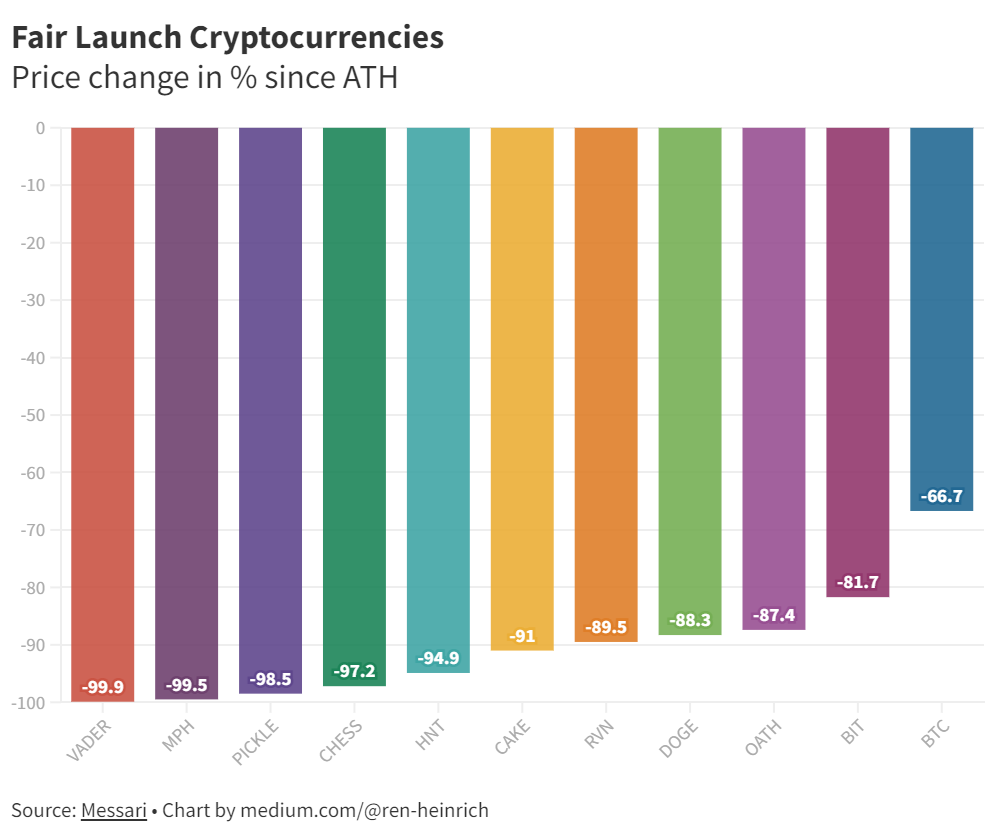
With an average loss of 90% from their last ATH, the price performance of these tokens corresponds to the market average of minus 80–90%. It is therefore reasonable to conclude that fair launches have no influence on the long-term price development of a token. I think that the usual market mechanisms have the greatest influence here.
However, their performance looks very different in the period immediately after the public listing.

This chart shows the price change in percent of the same cryptocurrencies (excluding Bitcoin) 60 days after public listing. They showed an average price increase of about 120%.
Note that the sample size I used for this is very small. Also, there can be many reasons for strong price performance in the first 60 days such as a generally positive market environment. A more comprehensive analysis would be necessary here.
Conclusion
Crypto fair launches are an exciting new development in the crypto space.
Even if the basic features of fair launches have existed for years, it will still take some time for these methods to become established on a broad basis.
The basis for this will be to establish credible processes and create transparency. And as with so many other things in crypto, it will take a while before this new solution is recognized as a positive change and is finally accepted.
The chances of that happening are very good. After all, fair launches, at least in theory, are the answer to one of the biggest criticisms of classic ICOs — the often unequal sale of tokens.
Disclaimer: This article is intended for informational and educational purposes only. It should NOT be used as financial and investment advice. I do not hold any of the tokens mentioned.
https://medium.com/coinmonks/crypto-fair-launches-the-better-icos-c9a6907fb96a


All Comments