


Web3 is accelerating and Arweave will be adopted by more developers as an infrastructure, creating a new and richer ecosystem. PermaDAO is a community of co-builders for just this purpose. Everyone involved can find a role here to contribute to the Arweave ecosystem, and any proposal or task related to Arweave can be posted here and supported by the entire community. Join PermaDAO and build Web3!
Translator: Kyle @ Contributor of PermaDAO
Reviewer: yifan XU@ Contributor of PermaDAO
Section One: Pianity Overview
1. Project Introduction
Pianity is a music NFT platform built on Arweave, aiming to bring together music artists and their communities to create, sell, purchase, and collect limited-edition songs. The music styles on Pianity are diverse and niche, mainly encompassing electronic, hip-hop, indie music, and post-rock, among others. All available in lossless audio quality for free listening.
Beyond considering music as exquisite, Pianity also offers a service for artists to release music NFTs, providing artists with a new stream of independent income. At the same time, the platform offers the functionality of trading user music NFTs, allowing users to purchase their favorite works and join the community, fostering a deeper connection between artists and fans.
2. Social Media
| Platform | Website | Followers |
| Official homepage | https://pianity.com/ | - |
| https://twitter.com/pianitynft | 25928 | |
| Discord | https://discord.gg/pianity | 7617 |
| https://www.instagram.com/pianity/?hl=fr | 7334 | |
| https://www.linkedin.com/company/pianity | 2826 | |
| Telegram | https://t.me/joinchat/KQrVv1c_WLcwZWU0 | 1968 |
| https://www.facebook.com/pianityofficial | 1077 | |
| Medium | https://blog.pianity.com/ | 273 |
| TikTok | https://www.tiktok.com/pianity | 33 |
3. Team
Background Information
Pianity is a privately-held company headquartered in Paris, France, and was founded in April 2021 as part of Arweave's Open Web Foundry (OWF) incubation program.
Core Team

Image Description: Pianity Core Team
Image Source: https://pianity.com/about
Pianity's core team consists of three co-founders: Kevin Primicerlo, Simon de Kinkelin, and Lancelot Owczarczak. Their profiles are as follows:
| Name | Position | Major | Experience |
| Kevin Primicerlo | CEO | Applied Mathematics (PhD), Computer Science | Entrepreneurial experience in investment incubation |
| Simon de Kinkelin | Partnership Lead | Law | Sales experience in the tech industry, Art direction in electronic music events |
| Lancelot Owczarczak | CTO | Computer Scientist, Software Engineer, Hacker | Development engineer in the financial industry |
The three co-founders possess their own professional skills and rich experiences, bringing diverse abilities and perspectives to the company. They can complement each other's strengths and form a comprehensive team. Their collaboration may lead to fruitful synergy, generating innovative solutions that inject new momentum into the company's development.
Advisors
Pianity also boasts a strong advisory team, including Sam Williams (Founder of Arweave), Michael Majster (Royalties, Copyright, and Music Lawyer), Rand Hindi (CEO of Zama.ai), Pierre Kosciusko-Morizet (Managing Director of Kernel Holding Investments).
4. Funding
Financing Status
On March 2, 2022, Pianity announced the completion of a $6.5 million seed funding round. This round was led by Digital Renaissance Foundation, Big Brain Holdings, with participation from IOSG, LD Capital, ViaBTC, ArkStream Capital, and others.
Major Investors
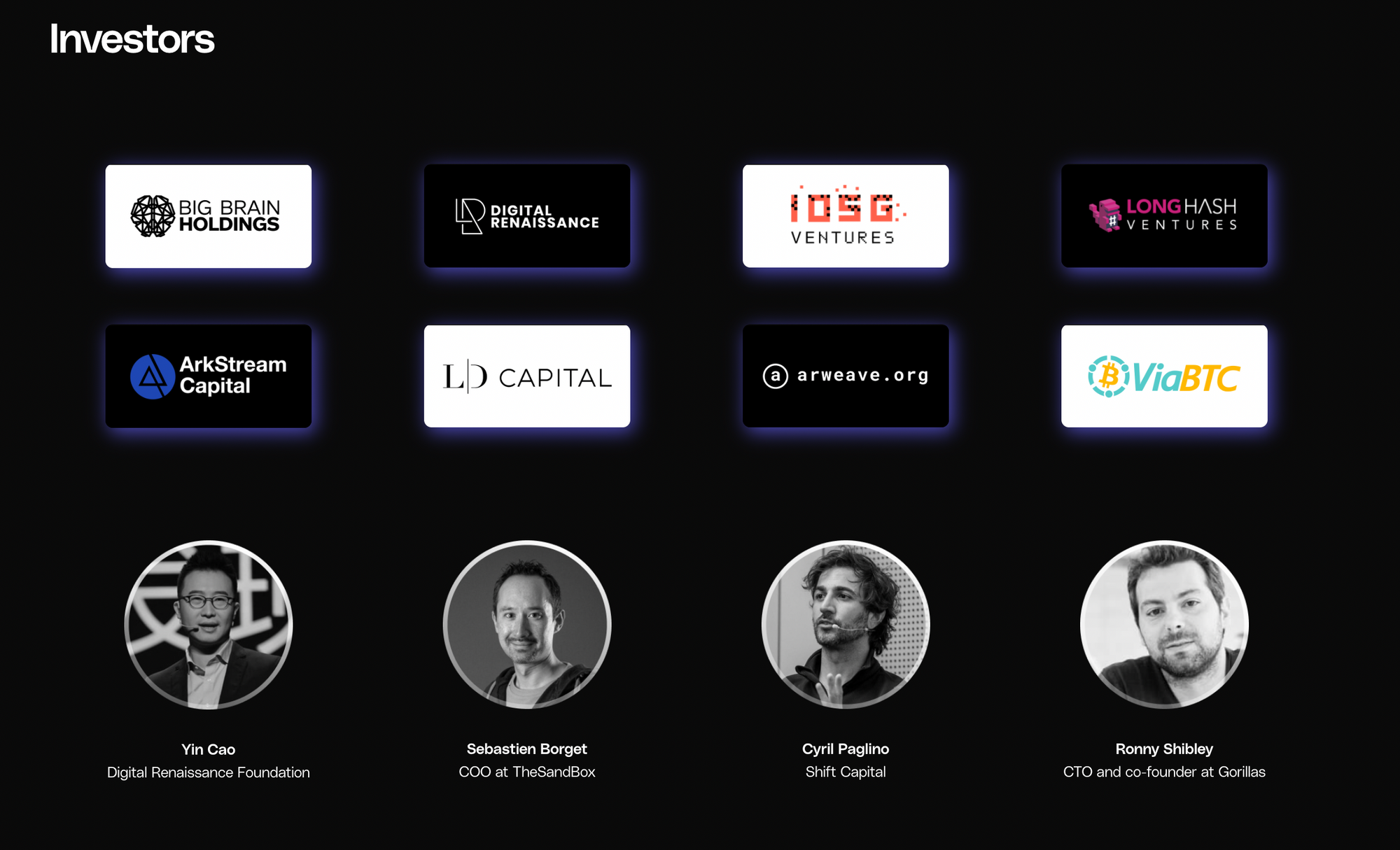
Image Description: Pianity Major Investors
Image Source: https://pianity.com/about
Institutions: Digital Renaissance Foundation, Big Brain Holdings, IOSG Ventures, Longhash Ventures, ArkStream Capital, LD Capital, Arweave, ViaBTC.
Individuals: Yin Cao (Managing Director of Digital Renaissance Foundation), Sebastien Borget (Co-founder and COO of The Sandbox), Cyril Paglino (CEO of Shift Capital), Ronny Shibley (CTO and Co-founder of Gorillas).
Section Two: Platform Features
1. Fixed-Price Sales
Pianity offers music NFT sales services for artists and collectors, allowing them to initiate listings with fixed prices in the NFT marketplace.
- For artists, they can price and sell their initial music NFTs on the primary market, setting the scarcity, sales type, price, and genre of the NFT artworks.
- For collectors, they can independently price and resell the music NFTs they've collected on the secondary market.
2. Auction Function
In addition to fixed-price sales, Pianity also offers an auction feature for music NFTs.
- For artists, they can sell unique music NFTs through auctions in the primary market, with a 24-hour auction period, and the highest bidder ultimately obtains the auctioned item.
- For collectors, they can initiate auctions for their collected music NFTs in the secondary market, without restrictions on the rarity of the music NFTs, and the auction duration can be selected as 1, 3, 7, or 14 days.
3. Bounty Function

Image Description: Pianity Bounty Function
Image Source: https://pianity.com/blog/post/introducing-bounty-nfts
The bounty function allows artists to distribute free NFTs to their fans as a reward, and these bounty NFTs can be sold on the secondary market, generating value for the recipients. For artists, distributing bounties is a win-win practice, rewarding fans with unique digital assets while also helping in building and expanding their own community.
Bounties come in two types:
- Public Bounties: Users can directly claim them on Pianity's song pages on a first-come, first-served basis.
- Private Bounties: Users can claim them through artist-distributed secret links or by scanning relevant QR codes, with these links or QR codes being sent to users via email.
4. Exclusive Function
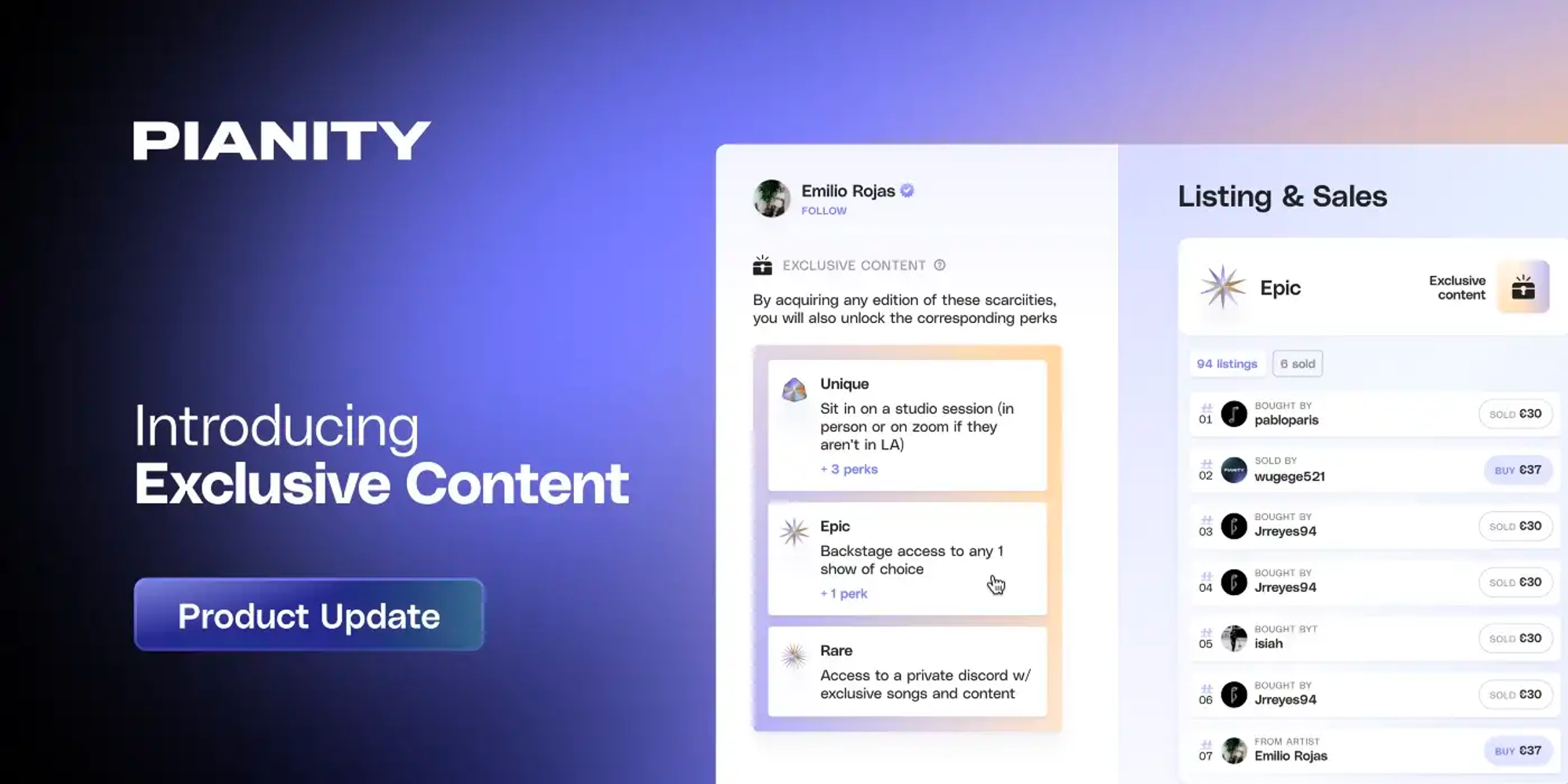
Image Description: Pianity Exclusive Privilege Function
Image Source: https://pianity.com/about
Pianity offers an exclusive perks feature that allows artists to provide different additional benefits to music NFTs of varying rarity levels. These exclusive privileges often include features such as artwork videos, JPG ownership, exclusive tracks, and signed merchandise, enhancing the personalized and valuable aspects of music NFT collections.
Music NFTs with the "perks" icon in the top right corner of the song card are pieces with exclusive privileges. These privileges are automatically unlocked upon purchase and can be accessed by clicking the "perks" icon popup. Once a collector sells an artwork with exclusive privileges, they lose access to these privileges immediately, and the exclusive privileges will transfer to the new owner.
Section Three: Pianity Platform Components
1. Music NFTs
Music NFTs, similar to the more well-known image-based NFTs, differ in that they grant ownership of music segments to holders while incorporating visual elements. Thus, users on the Pianity platform experience not only delightful music but also exquisite visuals.
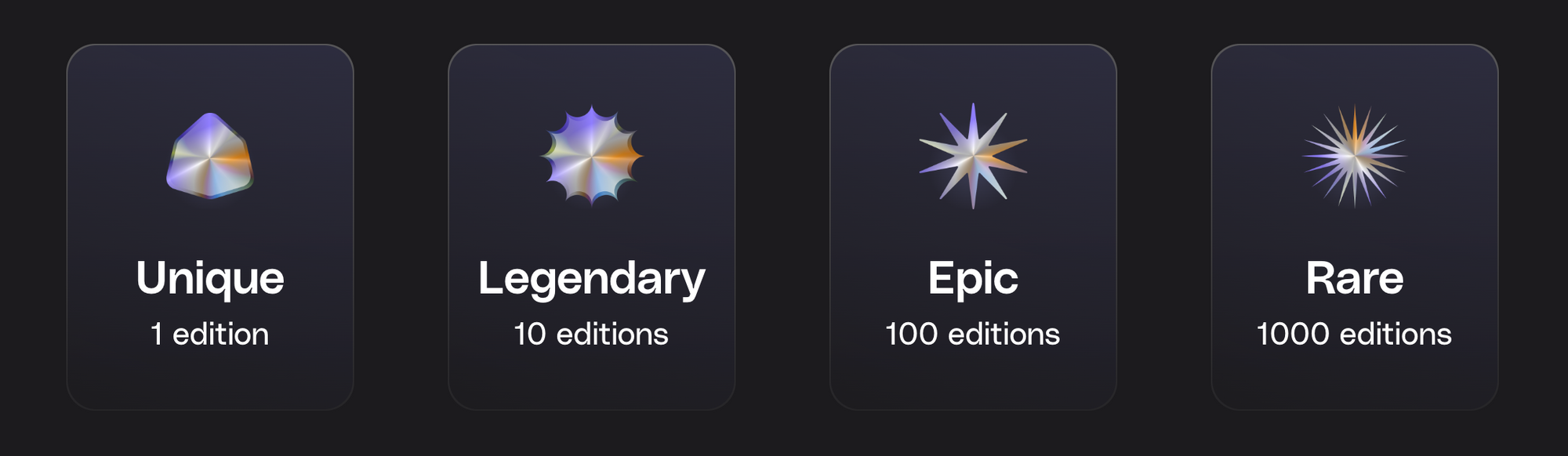
Image Description: Different Levels of NFT Rarity
Image Source: https://pianity.com/
Similar to vinyl records, music NFTs on Pianity are released in limited editions and are categorized into four different levels of rarity. Each level of rare music NFT comes with unique privileges and corresponding quantities. The rarer the song, the higher its value and the fewer in number. Specifically:
- Unique: 1 edition
- Legendary: 10 editions
- Epic: 100 editions
- Rare: 1000 editions
In comparison to existing Web3 music NFT platforms, Pianity stands out with its own unique qualities, whether in NFT standards or storage technology adopted.
Atomic NFT
Pianity adopts a novel NFT standard: Atomic NFT, as opposed to the common ERC721. Atomic NFT is a native Arweave NFT standard that integrates media files, smart contracts, and metadata, creating a unique and universally recognizable digital asset that is permanently stored on the decentralized Arweave network.
For both artists and collectors, Atomic NFT ensures the integrity and value of music artworks, while also enhancing transparency and reliability.
Utilizing Arweave for Permanent Storage
Pianity utilizes Arweave as a storage solution, where all music NFTs (Atomic NFTs) contain contracts, tokens, and stored content, permanently residing within Arweave.
Due to Arweave's characteristics of low storage costs, permanent storage, immutability, and traceability, Pianity reduces storage expenses, ensures the permanent preservation of music NFTs, and provides higher security and stability to the music NFT market.
2. NFT Market

Image Description: NFT Market
Image Source: https://pianity.com/market
Pianity's NFT market is divided into the primary market and the secondary market, catering to the diverse needs of its users. NFTs initially released by artists will circulate in the primary market, while users can purchase music NFTs in both the primary and secondary markets, as well as resell their collected music NFTs in the secondary market.
Primary Market
The primary market is where artists initially release their music NFTs. They can list their music NFTs for sale in the primary market, supporting both fixed-price sales and auctions. Users can purchase or bid on music NFTs in the primary market. Meanwhile, the Pianity platform will receive 20% of the proceeds from primary market sales, with 10% allocated for rewarding the users who participated in the transactions.
Secondary Market
The secondary market is where music NFT collectors can sell their NFTs. Sellers in the secondary market have the choice to set a fixed price or initiate auctions for their NFTs. Once an NFT is resold, the NFT collector receives 90% of the sale proceeds, with 8% as royalties to the artist and 2% as a service fee to the Pianity platform.
3. Leaderboards
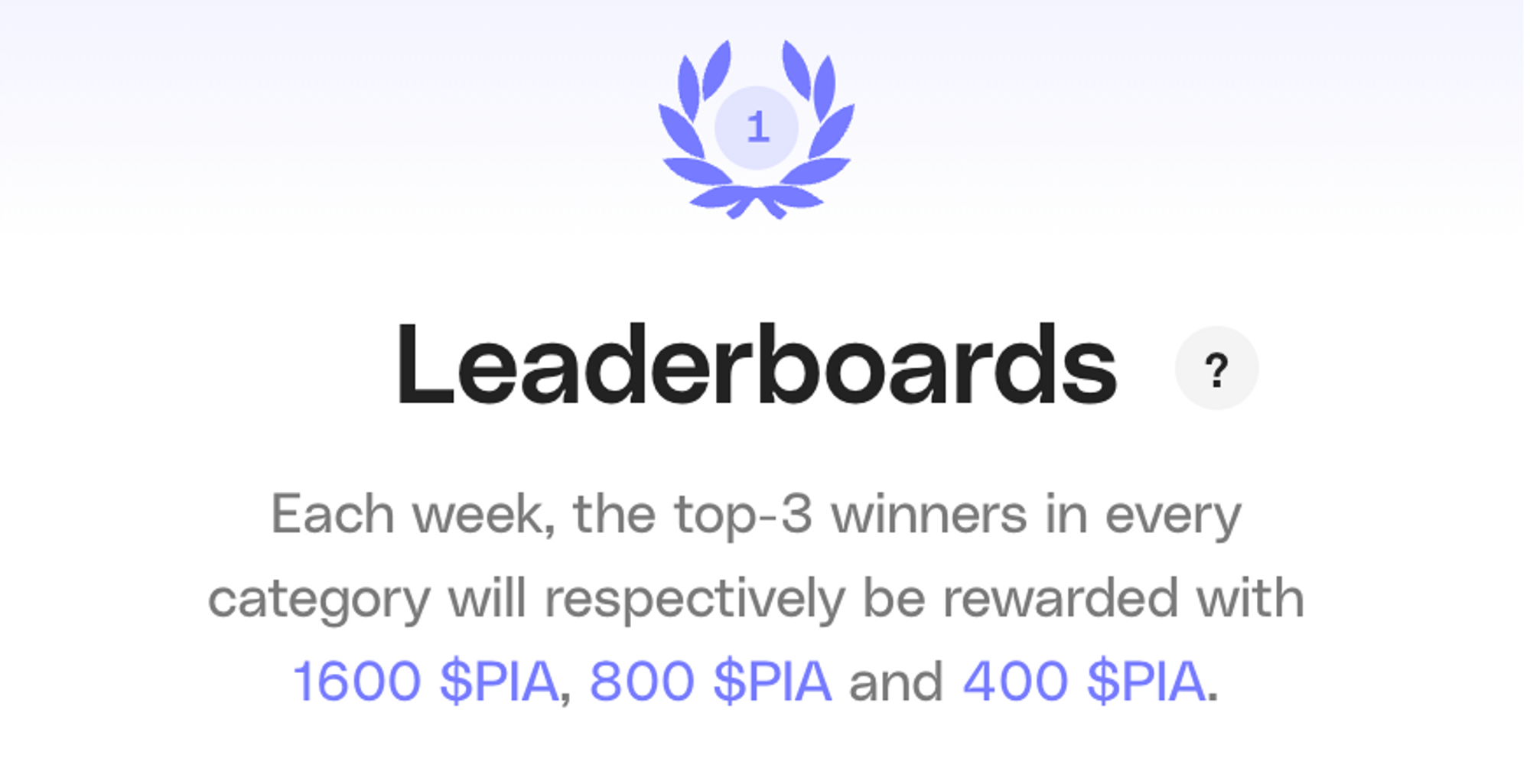
Image Description: Leaderboards
Image Source: https://pianity.com/leaderboards
The Leaderboards are designed to visually showcase active users within the Pianity community, and are divided into four categories:
- Top Curators: Users who vote the most in the popular song rankings.
- Top Moderators: Users who successfully report songs that violate Pianity's community guidelines and copyright.
- Top Primary Collectors: Users who buy the most songs in the primary market.
- Top Secondary Collectors: Users who buy the most songs in the secondary market.
As an expression of gratitude for the contributions made by active participants, Pianity rewards the top three participants in each category with $PIA tokens: 1600 $PIA for first place, 800 $PIA for second place, and 400 $PIA for third place.
4. Toplist

Image Description: Toplist
Image Source: https://pianity.com/toplist
The Toplist is continuously updated in real-time and allows users in the community with voting power to cast their votes. Twice a day, the top-ranked song on the Toplist is nominated for release in the primary market.
To ensure the fairness of the Toplist voting mechanism, Pianity has set a limit of 3000 votes per song per account. For artists, this prevents any "cheating" through vote manipulation, and encourages them to rely on the quality of their work and genuine talent. Additionally, artists need to actively promote and engage with the community to increase exposure and commercial value.
For users, they can earn 1000 votes by participating in activities like recommending Pianity to friends. Alternatively, holding $PIA tokens ( which are temporarily non-tradable). For every 1 $PIA token held for two weeks, the user receives 1 vote. Furthermore, participating in voting activities also offers the opportunity to earn $PIA tokens, provided that the voted song successfully reaches the top of the Toplist and gets released.
5. Playlists

Image Description: Playlists
Image Source: https://pianity.com/playlists
Users can create personalized playlists on Pianity, which can be set as public or private. This familiar feature allows users to organize their favorite music into corresponding playlists, enabling them to listen anytime and anywhere.
6. Community
Clubs
Pianity's clubs are like exclusive intimate music concert parties. In clubs, fans can enjoy exclusive behind-the-scenes content, interact with artists, or engage in conversations with other music enthusiasts.
Clubs are open to all artists with at least 100 unique collectors, and fans automatically become members of the artists' Clubs upon purchasing their NFTs.
PianityDAO
The most active users in Pianity have the opportunity to become members of PianityDAO, participating in weekly community meetings, gaining exclusive platform development information, and engaging in discussions about important decisions for the company's future. Pianity encourages users to actively contribute to community building and collectively drive the progress and development of the platform.
7. Mobile Application

Image Description: Mobile Application
Image Source: https://pianity.com/
On October 4, 2022, Pianity released this social music app for iOS and Android users, available for download on the Apple App Store and Google Play. The app provides free, ad-free streaming services for all users to enjoy Pianity's entire library of lossless quality music. Additionally, artists can create NFT clubs through the mobile app, where NFT holders are automatically added to the artist's club, allowing fans to interact within the community and enjoy exclusive benefits.
Section Four: Economic Model
1. Tokens
- $PIA is the native token of Pianity, currently not yet issued but will be deployed on Arweave in the future.
- Contract address: n05LTiuWcAYjizXAu-ghegaWjL89anZ6VdvuHcU6dno
- The maximum supply is 1 billion, and it remains fixed.
- The number of holding addresses: 6045, with over 90% of $PIA concentrated in two project wallets, while the rest of $PIA is distributed among other addresses.
- Pianity officially states that $PIA will not undergo ICO, and the value of $PIA will remain at $0.10 per token until it is listed.
2. Token Acquisition Methods
As of August 1, 2023, $PIA has not yet been launched, and there are three ways to obtain it.
- Participate in Weekly Rewards: Buying music NFTs on Pianity and participating in the Weekly Rewards activity allows users to receive $PIA token rewards every Thursday. The reward amount is determined based on the proportion of the total value of NFTs they hold to the total value of all NFTs on Pianity. To remain eligible for weekly rewards, users need to purchase at least 1 NFT per month.
- Rank Top Three in Leaderboards: The Leaderboards are divided into four categories, and users who rank in the top three of any category can receive $PIA rewards.
- Vote in the Toplist: Voting for songs in the Toplist can earn $PIA rewards if the voted song is successfully released in the primary market.
3. Future Empowerment of Tokens
Holding locked $PIA tokens grants you voting rights, with 1 vote earned for every 1 locked $PIA token for a duration of two weeks. Users can use these votes to vote for their favorite songs on the Toplist. Once $PIA tokens are launched, they can be traded or used on Pianity to purchase music NFTs.
According to Pianity's vision, future $PIA tokens will not be limited to the Pianity platform but will play a significant role in a broader music ecosystem. Pianity aims to establish $PIA as a widely recognized token in the music industry, adding value to both fans and artists in shaping the music landscape.
4. Economic Mechanism

Image description: Economic Operation Mechanism
Image source: Created by author Kyle
Pianity operates a mature and unique economic mechanism as follows:
User Perspective
- Incentivizing NFT Purchases: The most optimal way for users to participate is by purchasing music NFTs, which allows them to earn $PIA token rewards through the Weekly Rewards program. The higher the total NFT value held, the greater the reward.
- Encouraging Holding and Voting: Holding $PIA tokens without movement for two weeks earns voting tickets. These tickets can be used to vote for songs on the Toplist. If a voted song is successfully released in the primary market, users receive $PIA token rewards.
- Diverse Reward Mechanisms: Pianity also introduces the Leaderboards, where users who actively buy or vote to enter the top three ranks can earn additional $PIA token rewards.
- Encourage User Referrals: Users can also participate in Pianity by inviting friends to join the platform, and upon successfully registering, they receive 1000 voting tickets. Users can also earn $PIA token rewards by voting on the Toplist.
Artist Perspective
- Incentivizing High-Quality Creations: Artists can submit their music to the Toplist on Pianity, and if their work reaches the top through user votes, it can be released on the primary market. Additionally, since the platform has implemented anti-fraud mechanism (voting) implemented on the platform, artists need to focus on creating high-quality works to increase the chance of their successful releases.
- Increasing Artist Revenue and Motivation: When a music NFT is sold in the primary market, artists receive 80% of the proceeds. In the future, as music NFTs are traded in the secondary market, artists also earn 8% of the royalties.
Platform Perspective
- Primary Market Income: Pianity earns 20% of the proceeds from transactions in the primary market.
- Secondary Market Income: Pianity also earns a 2% service fee from transactions in the secondary market.
- Community Feedbacks Reward: Pianity allocates half of the revenue from the primary market as rewards for the Weekly Rewards program to users who have purchased NFTs within the month. Additionally, Pianity rewards voters who successfully contribute to a song's release on the Toplist. Each successfully released song awards $100 worth of $PIA tokens, distributed among participating voters based on the number of votes.
Summary: Positive Flywheel
Pianity's designed economic model ingeniously incentivizes users to purchase NFTs and hold $PIA tokens. The diverse reward mechanisms attract user participation and drive song releases. Meanwhile, it provides high-income opportunities for artists, encouraging them to submit high-quality artwork. The platform's revenue mechanism ensures its own development, while the distribution mechanism ensures continuous benefits for community members, increasing participation motivation. These interconnected incentives create a positive cycle, driving the platform's continuous growth and prosperity, and realizing a positive flywheel effect.
Section Five: Market Situation and Prospects
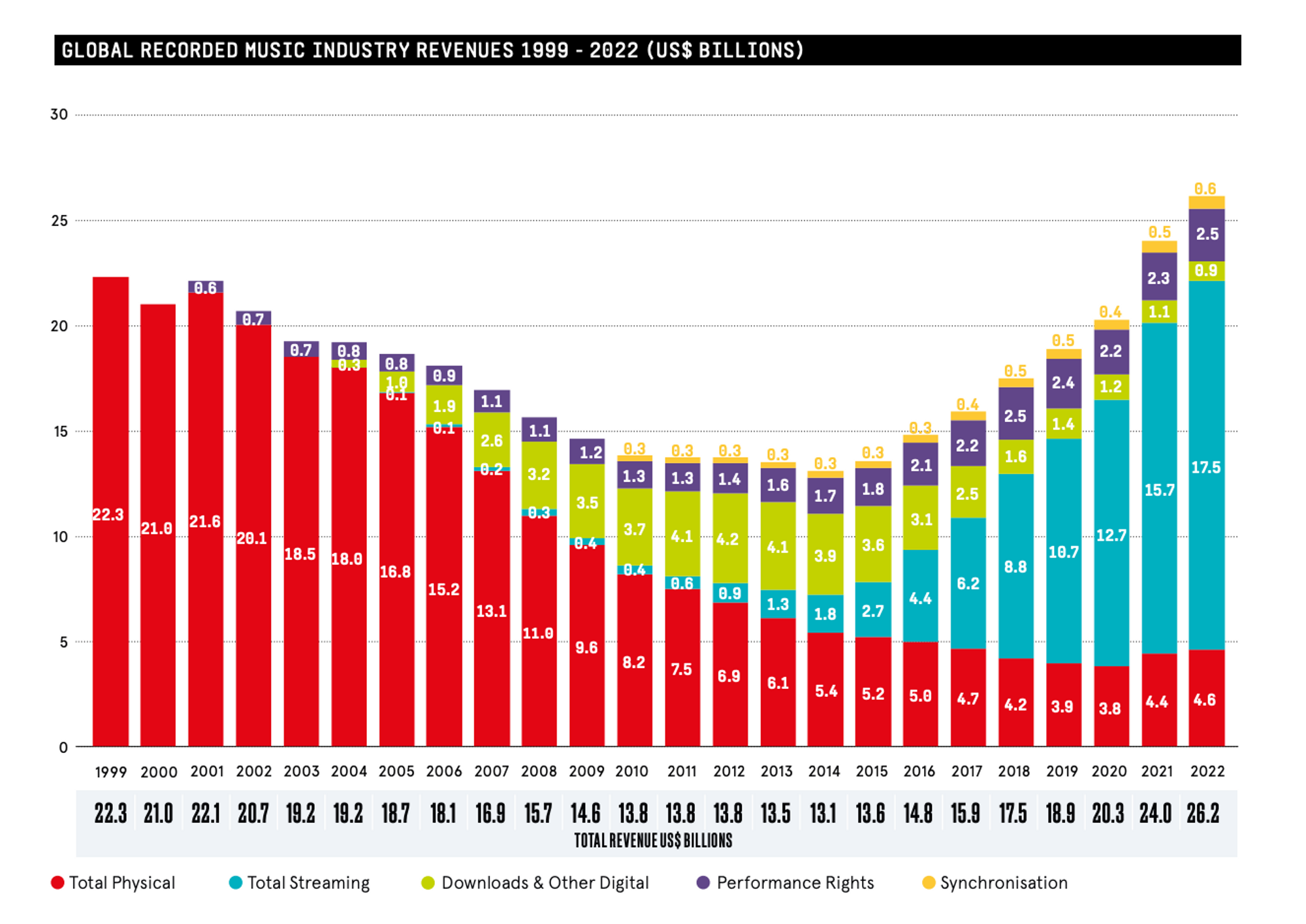
Image Description: Income Overview in the 2023 Global Music Report
Image Source: https://globalmusicreport.ifpi.org/assets/images/Ski_chart_2022.png
According to the "2023 Global Music Report" released by the International Federation of the Phonographic Industry (IFPI), driven by paid subscription streaming, the global recorded music market grew by 9.0% in 2022, reaching total revenue of $26.2 billion. Among them, revenue from subscription audio streaming increased by 10.3%, reaching $12.7 billion, with a total of 589 million paid subscribers. Overall streaming revenue (including paid subscriptions and ad-supported) increased by 11.5% to $17.5 billion, accounting for 67.0% of global recorded music total revenue. Additionally, according to Goldman Sachs' forecast, global music streaming revenue is projected to reach $89.3 billion by 2030, with paid streaming accounting for $55.6 billion.
Referencing the latest data from the traditional music industry, it is evident that the global recorded music market is on a positive growth trajectory, with a clear shift towards digitization and streaming. For the Web3 music industry, this signifies significant opportunities and potential.
While the traditional music industry has experienced rapid growth, it has also accumulated several "ills," such as complex intermediaries, unfair distribution, and copyright protection challenges. As an emerging sector, the Web3 music industry, leveraging disruptive technology and new business models, has the potential to alleviate or solve some of the problems in the traditional music industry, meeting the evolving needs of users and artists.
1. Pain Points of the Traditional Music Industry
- Complex Intermediaries: The traditional music industry involves various intermediaries, including music production, distribution, and more. These intermediaries not only incur substantial costs but also create a disconnect between musicians and audiences, leading to resource wastage. Additionally, involving multiple musicians in the creative process can complicate copyright ownership and revenue distribution, leading to inefficiencies and confusion in payment and distribution.
- Unfair Distribution: Multi-layer agents result in unequal distribution of royalties, dispersing earnings from music creators. In the case of traditional music streaming platforms, record companies and platforms receive the majority of royalties, leaving only 8% for music creators. This disproportionately affects independent or lesser-known artists, making it challenging for them to earn a substantial income.
- Copyright Protection Challenges: Protecting music copyrights is difficult, with piracy and copyright infringement still prevalent. Piracy negatively affects artists' creative motivation and affects their potential earnings from their work.
- Restricted Artistic Expression: The traditional music industry emphasizes commercialization and marketing, often prioritizing commercial success over artistic creation. This leads some music creators to be constrained by market demands, making it difficult to freely express their artistic visions.
- Limited Creative Forms: The traditional music industry emphasizes commercialization and marketing, prioritizing commercial success over artistic creativity. This leads to some music creators being constrained by market demands, making it difficult for them to freely express their musical creative ideas.
2. Breaking the Mold with Web3 Music
- Fairer revenue Distribution: Web3 music can enhance the efficiency and transparency of the entire industry. Artists can interact directly with fans on decentralized music platforms, eliminating intermediaries and reducing their share of earnings. Most importantly, artists gain better control over their works, can decide on sales and royalties independently, and receive fair compensation.
- Eliminating Information Asymmetry: Web3 music uses smart contracts to address information asymmetry. Notably, in terms of royalty payments, artists can automate royalty distribution through smart contracts, ensuring transparent music compensation.
- Promoting Creative Collaboration and Freedom: Web3 music platforms offer artists more freedom and creative space, encouraging diverse artistic expression. Decentralized creative environments enable real-time collaboration, secure sharing of creative resources, transparent ownership, and fair royalty sharing.
- Innovative Financing Models: NFT platforms provide equal opportunities for artists to be discovered, not influenced by algorithm biases. Artists can create and sell music NFTs on platforms, retaining ownership. This financing model allows fans to invest in artists by purchasing music NFTs, gaining access to exclusive content or income, and ensuring sustainable artistic development.
- Building Fan Communities: In the Web3 music area, artists establish communities by issuing music NFTs. Fans can join these communities by purchasing NFTs, engaging in discussions, providing feedback, enjoying exclusive benefits, and fostering closer connections.
Section Six: Market Competition
Web3 Music, a sector that has yet to experience a full-blown breakthrough, is eagerly anticipating the possibility of a prosperous "MusicFi Summer" in the next bull market. This raises the question: Does the Web3 Music sector possess the mature conditions from both a macro-environmental and technological perspective to become the driving force of the upcoming market surge? Amidst this landscape, does Pianity have the opportunity to emerge as a leading project in the Web3 music sector?
1. Analysis of the Web3 Music Sector
Macro-Environmental Perspective
The Web3 music industry faces competition from the traditional music industry, where established streaming services and renowned platforms have reached a level of maturity. Convincing artists and users to venture beyond their comfort zones and transition to the Web3 world poses a significant challenge. Moreover, complex copyright and licensing issues require exploration of how to integrate blockchain solutions within legal frameworks. However, as Web3 technology advances, it gradually addresses some of the pain points in the traditional music industry, offering artists more autonomy and revenue potential. This shift will lead people to recognize the potential of Web3 music, prompting artists and users to migrate to this new musical realm.
Shifting our focus on the Web3 place, compared to DeFi and GameFi, Web3 Music exhibits weaker financial attributes. In the speculative Web3 landscape, the Web3 music industry lacks a significant advantage in attracting funds and users, making it difficult to replicate the success of DeFi's model. However, when compared to GameFi, Web3 Music has its natural advantages. Currently, GameFi is criticized for its lack of playability, as even with a strong economic model, an unenjoyable game implies a loss of vitality. The music sector, on the other hand, is different; the process of creating a music work, from composition to final release, is more streamlined compared to games. The likelihood of creating high-quality and enjoyable music works is higher. Furthermore, being a global cultural phenomenon, music has a wide audience base, providing a solid user foundation for Web3 music platforms.
Technological Perspective
From a technological standpoint, Web3 music has reached a relatively mature stage. Both platform construction and data storage are well-supported by Layer1 public chains and decentralized storage technologies like Arweave and IPFS/Filecoin.
Web3 Music based on blockchain technology brings a new monetization model to the music market.,where artists can generate income by issuing music NFTs and can retain the majority portion of the earnings. Moreover, Web3 music platforms utilize smart contracts to ensure transparent and automated royalty distribution, allowing artists to receive fair compensation without intermediaries, thereby addressing the long-standing issue of royalty disputes faced by artists in the traditional music industry.
Although Web3 technology is becoming more mature, there are still barriers and hurdles to overcome. Simplifying onboarding processes and designing user-friendly interactions they compatible with Web2 are directions that the Web3 music sector needs to focus on. Several projects have offered some solutions, such as launching mobile applications that support login with Web2 email or social media accounts, facilitating seamless entry for artists and users into the Web3 world.
2. Competitor Analysis
| Introduction | Category | Funding | Enrolled Artists | Tokens | |
|---|---|---|---|---|---|
| Pianity | Pianity is a music NFT platform built on the Arweave blockchain. Musicians and their communities gather here to create, sell, purchase, and collect limited-edition songs. | NFT trading, curation platform | Seed round: $6.5 million | Long-tail artists | $PIA (not yet released) |
| Sound.xyz | Sound.XYZ is an NFT music exploration and streaming platform on the Ethereum blockchain, offering convenient wallet functionality and NFT trading pathways. | NFT trading, curation platform | Seed round: $5 million;Series A: $20 million | Snoop Dogg, Daniel Allan, San Holo, Alexander23, and Vic Mensa | - |
| OneOf | OneOf is a revolutionary and environmentally conscious music NFT platform on the Tezos blockchain, allowing users to stream, purchase, and sell NFT music. | NFT trading, curation platform | Seed round: $63 million;Strategic funding: $8.4 million | Doja Cat, John Legend, Alesso, and The Kid LAROI | - |
| Royal | Royal is an innovative music marketplace on the Polygon blockchain, aiming to enable fans and artists to jointly invest in music, earn royalties, and achieve shared ownership and growth. | NFT trading, royalty-sharing platform | Seed round: $16 million;Series A: $55 million | 3LAU, JD Ross, The Chainsmokers, Nas, Kygo, and Logic | - |
| Audius | Audius is a Web3 streaming platform on the Solana blockchain, directly connecting creators and consumers, ensuring secure ownership, and enabling instant payments for artists. | Streaming platform | First three rounds: $10.6 million;Fourth round: $5 million | deadmau5, 3LAU, and RAC | $AUDIO |
In the Web3 Music sector, Pianity, a music NFT platform built on the Arweave blockchain, is quickly gaining recognition. However, it faces tough competition from well-established players in the Web3 Music sector, such as Royal with its prominent founders, Sound, which recently raised $20 million in Series A funding, Audius, boasting a large user base, and OneOf, with deep collaborations with Warner Music and Grammy Awards.
Sub-Sector Classification
In the classification of the Web3 Music sector, we can identify four main sub-sectors: creation platforms, royalty platforms, NFT trading platforms, and streaming media platforms. Among these, Pianity and Sound belong to the creation platforms and NFT trading platforms sub-sectors, which represent the upstream and midstream of Web3 Music, responsible for creating, distributing, and trading NFTs. Royal falls under the royalty-sharing platform sub-sector, allowing users to become music investors. Audius belongs to the streaming media platform, representing the downstream of the Web3 Music sector.
Affiliated Blockchain Networks
Sound, Royal, and Audius are built on public chains with high transaction throughput and heavy financial attributes. Pianity and OneOf, on the other hand, have chosen public blockchains with relatively lower market attention and lighter financial attributes. Pianity's choice of Arweave may have some disadvantages in terms of user volume and market attention but it possesses unique brings advantages in terms of environmental sustainability, cost-effectiveness, and technical capabilities.
Firstly, Arweave's energy consumption is more environmentally friendly, being around 100 times lower than Ethereum, which still uses PoW. Secondly, Arweave's technological advantages contribute to its uniqueness. Arweave is a decentralized permanent storage network that offers not only lower minting and transaction costs compared to other platforms like Ethereum and Solana but also more secure, stable, and enduring data storage capabilities.
Funding Status
Compared to other competitors, Pianity has only completed a seed funding round, creating a gap in terms of the funding amount. This may place certain limitations on rapid growth and market expansion. However, it also implies that Pianity's substantial potential has yet to be fully unleashed With more funding in the future, Pianity will be able to invest more resources and effort to further expand its platform's influence and user base.
Enrolled Artists and Market Attention
Despite Pianity boasts unique technological advantages, there is still considerable room for improvement in terms of user base and community size. Unlike its competitors, Pianity has not yet attracted well-known artists like Snoop Dogg or Doja Cat, instead, its appeal seems to be more focused on long-tail artists. While the long-tail artist community is extensive, capturing a larger market share and attracting more users requires increased market attention and promotional efforts.
Platform Positioning and Gameplay
Regarding platform positioning and gameplay, Sound leans towards social attributes and fragmented models, OneOf emphasizes high-traffic IPs and diversified NFT, Royal focuses on royalty sharing, and Audius offers a lower barrier to entry and abundant music content. As for Pianity, it treats each music NFT as a precious vinyl record, with artists only able to sell their works in limited editions, ensuring scarcity and high value. Pianity also emphasizes curation and talent show-style features, where fans determine the release of music NFTs through voting. This differentiated strategic positioning provides Pianity with a unique business model and profit strategy, gradually capturing a market share in the Web3 Music sector.
Token Issuance
In terms of economic models, only Audius has issued tokens. Pianity's $PIA token currently only circulates within the platform but has not been officially launched, maintaining a fixed price of $0.1. Pianity's well-functioning economic model encourages user and artist engagement as $PIA circulates within the mechanism, invigorating platform activity. In the future, when $PIA is eventually issued and circulated in a larger market, it can fully leverage the incentive mechanism and attract more users and artists. Thus, Pianity still has substantial growth potential and room for expansion.
Section Seven: Pianity's Advantages and Potential
The Web3 Music sector has flourished in recent years, with the maturation of Web3 and NFT technologies presenting unprecedented innovative opportunities for the music industry. For platforms like Pianity, a music NFT platform, could it become a leading project in the Web3 Music sector, driving transformation and innovation in the music industry?
Below are some key points to consider and discuss:
1. Robust and Environmentally Friendly Technology
Arweave, a unique decentralized storage network designed for permanent data storage solutions, remains irreplaceable and unparalleled in the Web3 domain. In addition, Arweave recently completed a version 2.6 upgrade this year, further reducing storage costs and energy consumption, and enhancing its environmental sustainability. By August 2023, Arweave had already achieved 1 billion transactions, steadily gaining market recognition, and widespread adoption has become an irreversible trend.
Pianity, built on Arweave, benefits from the following advantages:
- Permanent Storage: Arweave ensures secure and stable storage of all Pianity's data, guaranteeing secure access to NFT music files.
- Cost-Effectiveness: Compared to other public chains, Arweave requires lower costs for NFT minting and transactions.
- Atomic NFTs: Atomic NFTs, Arweave's native NFT standard, unlike many other NFT standards. Atomic NFTs fully encapsulate NFTs on-chain, including NFT's smart contracts, media files, and metadata.
2. User-Friendly Web2 Design
Pianity employs a user-friendly design tailored to Web2 users, potentially attracting more music enthusiasts to the platform. Firstly, Pianity offers multiple login methods, including common encrypted wallet login options, as well as Google and Apple ID logins, enhancing user convenience. Secondly, the platform provides a mobile application for a streamlined user experience. Lastly, Pianity supports various payment methods, including cryptocurrency payments (BTC, ETH, LTC, USDC) and fiat payments (via Stripe), offering users diverse payment options.
3. Long-Tail Effect
Unlike other Web3 music platforms, Pianity focuses on long-tail artists rather than well-known musicians. This approach provides an opportunity for these niche artists to showcase their talents on Pianity. While lacking major IPs and high traffic, Pianity's music works are still of high quality and appeal to a broad audience. For music, being enjoyable remains paramount, and users who genuinely enjoy the music are likely to support it.
While individual sales from long-tail artists on Pianity may not match those of top-tier artists on other platforms, the cumulative sales volume from these artists contributes significantly to the platform's market share. Furthermore, benefiting from the long-tail effect, Pianity's music output will be more diverse and personalized, naturally fostering the creation of more high-quality music. Ultimately, the long-tail effect positions Pianity as a treasure trove of niche music, enhancing its unique market competitiveness and solidifying its stronghold.
4. Unique Emphasis on Curation
Differing from other platforms, Pianity employs a unique mechanism. Each music NFT is created through user voting on the Toplist, where users with voting power cast their votes for popular songs. However, just having voting tickets is not enough; a music NFT must rank first on the Toplist to qualify for entry into the higher-level market. This mechanism resembles scenes from "Idol Producer," where fans vigorously vote and support their idols' debuts, engage the community, and mobilizes fans, attracting more attention and participation, fostering a fan economy, encouraging users to support their favorite artists and driving platform activity and user growth.
Certainly, the introduction of well-known artists to the platform could manifest the fan economy effect even faster. This unique gameplay mechanism nourishes the soil for Pianity's growth into a towering tree.
5. Positive Economic Model Flywheel
Pianity possesses a mature and unique economic model that has already demonstrated effectiveness even before the issuance of its token. Users who purchase NFTs and vote on the Pianity platform can earn $PIA token rewards, while artists receive sales revenue through these transactions, and the platform generates income through transaction fees or service charges. Throughout the operation of the economic model, each participant receives appropriate incentives, creating a positive flywheel. With the future issuance of the $PIA token, more participants will be attracted, driving the continued development and expansion of the Pianity platform, gradually unleashing its potential.
Section Eight: Final Thoughts and Outlook
1. Migration of Music NFT Artists: From Ethereum to Arweave
Looking back at the history of PFP NFTs, we can observe that many (including well-known) crypto artists have gradually moved away from the high-traffic Ethereum blockchain. Their departure is partly due to high gas fees and a desire to avoid being entangled by capital, leading them to migrate to the lower-cost and more ideologically pure Tezos blockchain. Subsequently, artists on the Tezos blockchain have built large communities, infusing Tezos with a strong artistic atmosphere, subculture vibes, and diverse styles.
The same trend can be observed in today's music NFT market. In the early stages of development of any field, high traffic and hype are crucial for survival, making public chains with high financial attributes and attention the natural choice for NFTs. However, true music artists and enthusiasts who genuinely love music eventually gravitate toward places that are quieter, purer, and more crypto-native.
So, why not consider the Arweave blockchain? Arweave tackles the stability and security issues of NFT storage at the technical level and embodies a more native and pure essence. It stays away from the noise and frenzy of hype. While it might not be the quickest place for artists to make a quick profit, it's undoubtedly a fertile land of potential for their creative expression and interaction
2. Revolutionizing Music Creation with AI Technology
With the rapid development of artificial intelligence technology, automation, and intelligence are finding their way into various fields. The realm of music creation is no exception. The widespread adoption of AI-generated technology may bring about a profound impact: lowering the threshold of music creation, allowing anyone to become a music artist and compose the music they want to express.
In this context, more and more people are exploring the organic integration of AI technology and music NFTs. In the not-so-distant future, we may witness a wave of emerging crypto-native music artists producing unique and forward-looking crypto-native musical works. But, where is the most likely breeding ground for the wild growth of crypto-native music?
Mainstream Web3 music platforms have been relatively successful in attracting traditional music artists and capital. However, due to the intervention of capital and mainstream artists, these platforms tend to promote commercialized and mass-market music to generate more profits. Eventually, these platforms lose their purity within the crypto world, making it challenging for genuinely crypto-native music to gain recognition.
Crypto-native music represents the true essence of the crypto world and should originate from the hands of true crypto-native artists. These artists possess a profound understanding of crypto culture and use it as inspiration to create unique and innovative musical works. Meanwhile, crypto enthusiasts who harness AI technology also exhibit strong creative abilities in this field.
Pianity, as a platform that gathers long-tail artists in the Web3 music space, is more likely to discover innovative and personalized musical works. Emerging crypto-native music artists naturally become part of the long-tail artists of the Web3 music place on Pianity, characterized by strong innovation consciousness and pursuit of uniqueness. Furthermore, Pianity's use of a voting mechanism to decide the release of music NFTs ensures that outstanding works do not get buried, providing every artist with a free and fair creative environment.
3. The Rising Star of the Web3 Music Sector
Arweave has long been an underestimated public blockchain, and the same could be said for Pianity.
Built on the Arweave blockchain, Pianity employs permanent storage technology to store all data securely and ensure data integrity. Arweave's technological features guarantee the security of encrypted music data and copyright protection. It also creates a space for free creation and expression, with low costs for minting and transactions. Therefore, Pianity is poised to gradually become a gathering place for long-tail artists, giving rise to a new wave of emerging crypto-native music artists. These crypto-native music artists can establish an open and inclusive community on the Arweave blockchain, creating powerful crypto-native music works. The emerging Pianity has the potential to become a rising star in the Web3 music sector.
References:
https://www.theblockbeats.info/news/28332
https://twitter.com/starzqeth/status/1629094247680086016?s=20
https://zhuanlan.zhihu.com/p/447618035
https://www.panewslab.com/zh/articledetails/00edysu671u1.html
https://helpdesk.pianity.com/en/
https://m.8btc.com/media/6792156
https://m.techflowpost.com/article/detail_9884.html
https://foresightnews.pro/article/detail/22792
https://m.yuanyuzhoujie.com/article/14188
https://musicnftstartup.com/7-days-on-pianity-music-nft-platform/
🔗 More about PermaDAO:Website | Twitter | Telegram | Discord | Medium | Youtube



All Comments