



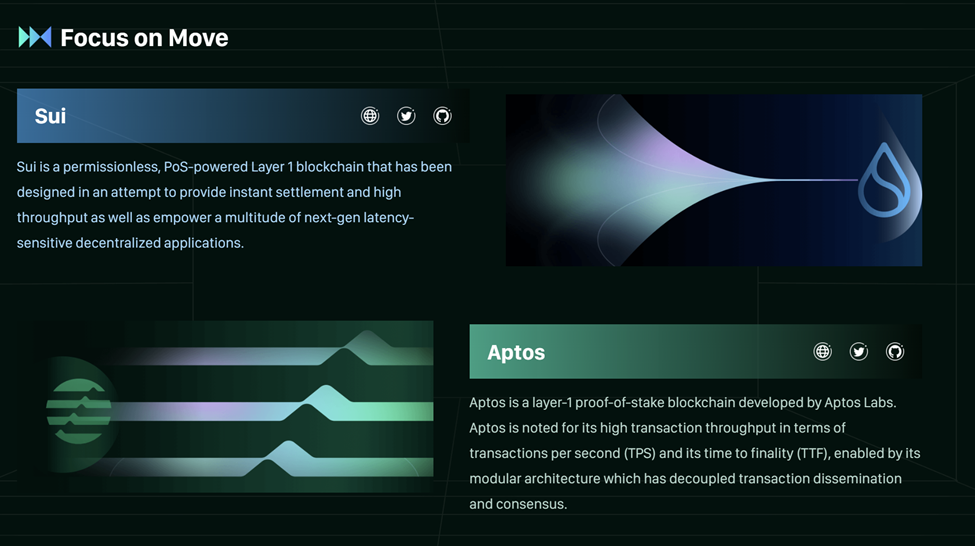
Cetus is a DEX and liquidity protocol built on the Move ecosystem, such as Aptos and Sui, Cetus is focused on meeting the expanding needs of the growing DeFi user base by building its centralized liquidity protocol and a series of ancillary functional modules dedicated to providing DeFi users with the best trading experience and superior capital efficiency.
Specifically, Cetus has the following key features:
1. SWAP anytime, anywhere
Based on Cetus' smart contracts and SDK, SWAP will become very convenient. And it also hopes to build a growing network of DeFi apps by leveraging the effective liquidity sources on Sui and Aptos.
2. Earn the most organic revenue
Cetus will achieve 10x or more capital efficiency over typical AMMs by centrally rating users' liquidity within a custom price range. Users will then be automatically rewarded for being active liquidity providers.
3. Built on a ready-to-use liquidity infrastructure
Users can simply connect their wallets and trade any token on Sui or Aptos in seconds and enjoy the better market depth and lower slippage that comes with centralized liquidity.
Introducing the Core Product - Centralized Liquidity Pool

The centralized liquidity pool is the core product of Cetus, which allows users to add liquidity within a custom price range.
Today, in most common AMM protocols used by decentralized exchanges, liquidity is typically distributed uniformly along the entire price curve (0, ∞). This model allows users to trade in the entire price range between 0 and infinity with a simple deployment.
However, the actual situation is not as smooth as one might expect. A large portion of the liquidity in the AMM pool is never used for actual trading, which is to some extent a waste of limited funds. LPs want their funds to be utilized as much as possible in order to earn more fees from them. And in the context of a uniformly distributed price curve, this can only be the opposite of what is desired.
But this problem may be solved to some extent by centralized liquidity pools.
In a centralized liquidity pool model, the liquidity provider is able to concentrate its liquidity within its designated price range based on the most active price range for a given trading pair. This approach would maximize capital efficiency and allow LPs to earn more than their usual fees.
In summary, the liquidity of traditional AMM protocols is spread across the price curve, and its inability to help users maximize capital efficiency and returns. In contrast, Cetus allows users to concentrate their liquidity in the most active price range so that they can better utilize their capital to increase returns.
Also, to accurately set price ranges, Cetus uses a discrete price mechanism that uses a fixed number of price points (ticks) within the price range. In addition, Cetus supports multiple commission bands to meet the needs of different trading pairs.
And in addition to its own applications, Cetus' centralized liquidity pool can also be used as a prognostic machine, allowing external developers or platforms to access the pool's liquidity data and historical prices.
In this model, historical data would be stored as a set of observations, while the centralized liquidity pool would track a single observation and continually overwrite it as new blocks are identified. This means that the transaction fee paid by the user can determine how long in the past the historical data can be accessed.
By storing price and historical data in the mining pool smart contract, the risk of logical errors and the cost of prophecy machine integration are greatly reduced. This also makes any attempts to manipulate prophecy machine prices much more difficult.
Rules of cost
1. Swap fees
In Cetus' centralized liquidity agreement, swap fees are allocated pro rata to all ranges of liquidity at the time of the swap transaction. Only liquidity positions in the price range where the current spot price is located will generate fee income. If the price is out of the range of the position, the position will switch to an invalid status and no fees will be charged to it.
Unlike regular AMM contracts where new swap fees are automatically credited to the liquidity pool, in a centralized liquidity agreement, swap fees are accumulated separately and the liquidity provider can claim its fee income without withdrawing liquidity.
2. Agreement fees
In order to maintain a healthy profit model that is conducive to the long-term development of the program, a certain percentage (20% by default) of the swap fee for each transaction on Cetus is taken as the agreement fee.
3、Fee Levels
In Cetus' centralized liquidity protocol, multiple pools are set up for the same token pair with different fee tiers. Initially, the protocol will allow for four tiers: 0.01%, 0.05%, 0.25%, and 1%.
The multiple fee brackets will better meet the needs of different kinds of trading pairs and will encourage the market to find the most optimal liquidity allocation solution on its own. This will provide greater flexibility for liquidity providers and swaps.
Swap Rules
Swap is one of the most common interactions with DEX. The mechanism is well understood, in short it is the sale of tokens currently owned by the swapper for a proportional amount of the target token. In the process, a small Swap fee is deducted, which is an incentive for those liquidity providers.
The way Swap is executed in the Cetus protocol is different from the order book market. While order book markets typically follow the FIFO principle, which means that order timing will be important, Cetus' Swap is executed against a passive liquidity pool, and users on Cetus who provide liquidity will earn a transaction fee based on the effective liquidity they contribute.
1. Price shock
In the order book market or CEX, the price shock of an order depends on the size and array of open limit buy or sell orders. The final execution price of an order is usually the weighted average price of multiple limit orders.
The price shock in an AMM or centralized liquidity agreement is different. During a Swap, the relative value of one token relative to another token changes dynamically and continuously, so the final execution price of a Swap will be somewhere between the starting price and the ending price. If the depth of liquidity at a given price is higher, the price impact for a given Swap size will be smaller.
2、Slippage
"Slippage" or "price slippage" is generally used to describe the price movement that may occur during a pending order.
In order to cope with possible price movements, Cetus has adopted the concept of slippage tolerance. The slippage tolerance can be set by the user and is used to determine the maximum price shock that the user is willing to accept. If the final execution price exceeds the acceptable slippage range, the transaction will fail to protect the user's interests.
Conclusion
Cetus is a DEX and liquidity protocol focused on the Move ecosystem with a core product, the Liquidity Concentration Mechanism, which provides users with an efficient and flexible way to trade and allows liquidity providers to concentrate liquidity in the most active price bands to improve capital efficiency and returns.
In addition, Cetus' multiple commission bands facilitate market self-regulation and provide greater flexibility for liquidity providers and exchangers. Also, Cetus is quite user-friendly by adopting the concept of slippage tolerance to protect the interests of its users.
Overall, Cetus provides DeFi users with a better trading experience and capital efficiency. It also has a good prospect and application value within the Move ecosystem and is worth watching.


All Comments