


By Cointime Web3 Heimawajueji
Layer 2: The preferred scaling solution in the ETH 2.0 era
Layer 2 is an umbrella term used to describe a specific set of Layer 1 extension solutions. Layer 2 is also an independent blockchain that extends Layer 1 and inherits the security of Layer 1.
The significance of the Layer 2 solution is to improve the congestion of the current Layer 1 network and also to create conditions for the mass adoption of ETH 2.0 and other Layer 1 networks.
There are three main types of Layer 2 extension solutions, namely State Channels, Plasma and Rollups, which are compared as shown in the following figure,
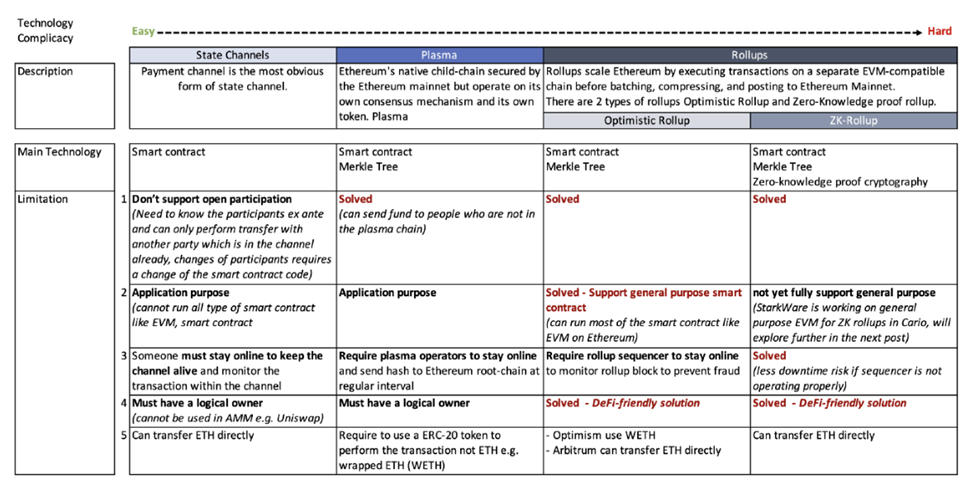
The main difference between Plasma and Rollup is that Plasma keeps all transaction data and calculations off-chain, while Rollup keeps some of the data on the Ethernet blockchain. Therefore, all Ethernet nodes can verify transactions on the Rollup sidechain, not just the participants on the sidechain. The benefits of this approach are enhanced security and avoidance of centralization.
At the same time, Rollup is universal and one can even run EVM within Rollup, allowing existing Ethernet applications to be migrated to Rollup with little need to write any new code.
The on-chain transaction data in Rollup will be highly compressed to include only the necessary data needed for network validation transactions, and other data such as state storage will remain offline on the Rollup chain. The smaller data size allows Rollups to remain well scalable on top of the Layer 1 mainnet.
There are currently 2 main types of Rollups:
1、Optimistic Rollup
The data in the Optimistic Rollup batch consists of compressed rolling Tx data, a pre-state root hash and a post-state root hash. It uses fraud proofs (same as Plasma), so Optimistic Rollup will have longer withdrawal times.
2、ZK-Rollup
In contrast to Optimistic Rollup, ZK-Rollup uses proofs of validity. In addition, each ZK-Rollup batch includes a cryptographic proof called ZK-SNARK, which proves that the post-state root is the correct result of executing the batch. The proofs can be verified on the chain very quickly regardless of the amount of computation, so withdrawals on ZK-Rollup will be instantaneous.
So why should we adopt the Layer 2 solution? It has the following advantages:
1. Lower Gas Fees
Layer 2 makes a substantial reduction in transaction fees by combining multiple off-chain transactions into a single Layer 1 transaction.
2. Mainnet Security
The Layer 2 blockchain settles transactions on the main network, enabling users to get the security of the Layer 1 network at the same time.
3、Expanding use cases
As the number of transactions per second increases, fees decrease, and new technologies emerge, the project will expand into new applications and the user experience improves.
And Reddio, which we will introduce today, is a blockchain infrastructure technology company with Layer 2 ZK-Rollup API as its main research direction.
Reddio: One-Click Layer 2 Tool
Reddio is a technology company that builds infrastructure for blockchain. It is dedicated to providing developers with an easy-to-use Layer 2 Agnostic API that will help them adopt blockchain technology more easily.
For developers who want to deploy protocols on Ether that require both the security of Ether and the scale and low Gas fees, they can get both from Reddio's services.
With Reddio, developers can:
1. quickly build an in-app and in-game NFT marketplace
2. Expand their app and game asset trading without worrying about downtime or security issues
3. Use Reddio's Javascript/Java/Python/Unity SDKs to cast NFTs without paying Gas fees
4. Build decentralized trading platforms that scale up to 10k TPS while enjoying lower transaction fees
5. Use zero-knowledge proof to safely store and transfer assets
Also, as a decentralized solution, Reddio allows users to self-store their assets, giving them full control over their assets and ensuring that no central authority can prevent them from withdrawing their assets. These assets are stored in smart contracts on the ethereum blockchain, making them secure and transparent. Even if Reddio and Starkware take down all their servers, users' assets will not be affected.
Introduction of Reddio components
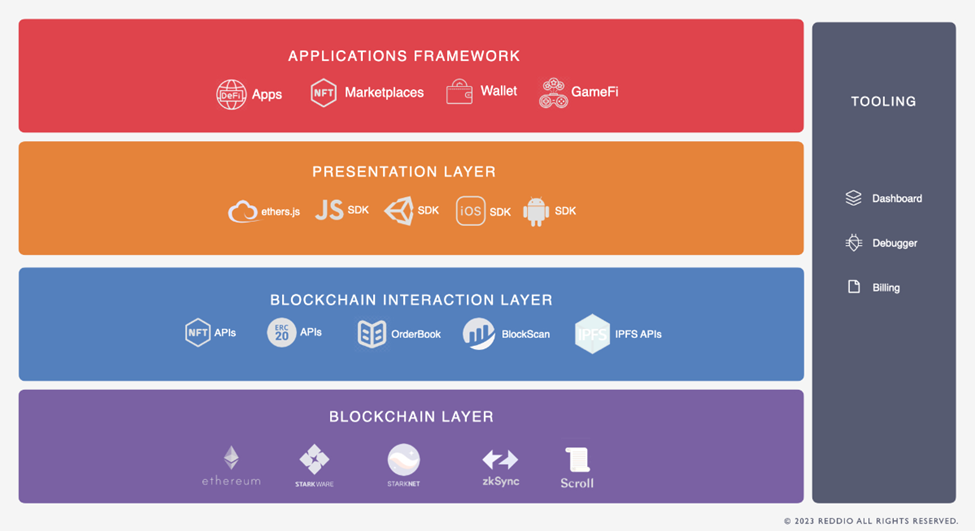
1、SDKs
Reddio provides Javascript, iOS, Android and Unity SDKs for Web3 developers to integrate their front ends across platforms.
2、APIs
If developers use iOS, Android and Unity SDKs, they will need to do backend integration. In Reddio, the APIs needed for backend development are also provided.
3、Dashboard
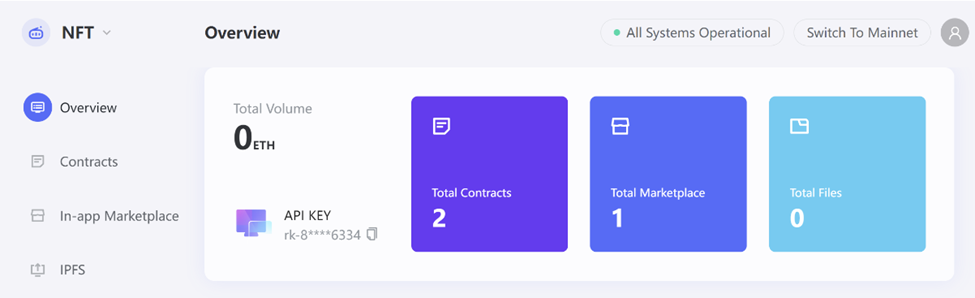
On the dashboard, users can get API keys and integrate to Reddio's API from the backend.
How Reddio works
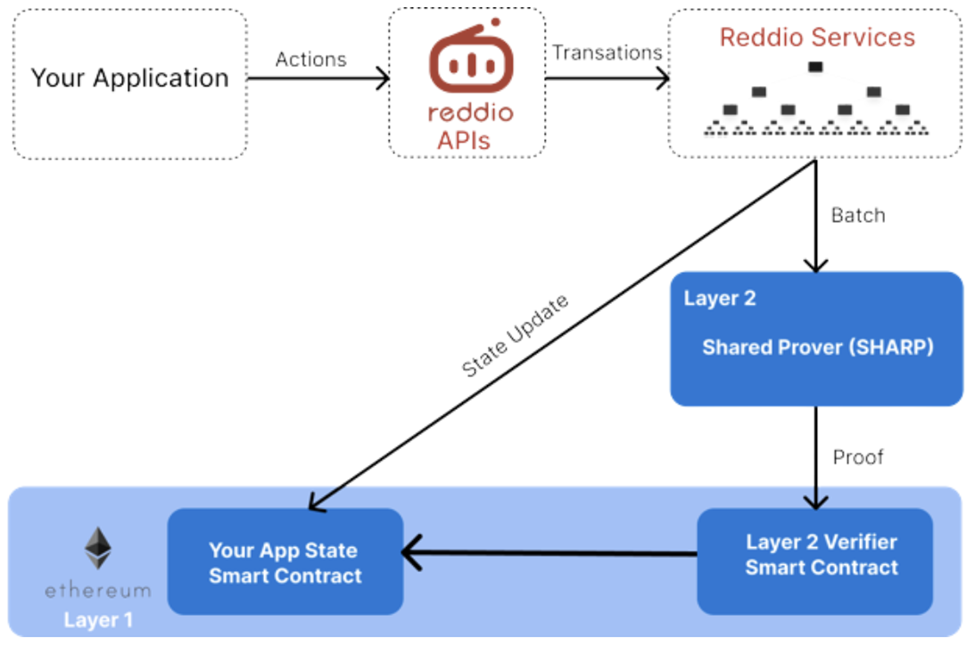
As we all know, Layer 1 is the base blockchain. And we know Ether and Bitcoin as Layer 1 blockchains. Layer 1 has remained quite active over the past few years, and as a result more blockchains have been born, such as BNB Smartchain, Solana and Flow.
Layer 2 is an umbrella term that is used to describe a specific set of Layer 1 extension solutions. At the same time, Layer 2 is also a standalone blockchain that extends Layer 1 and inherits the security of Layer 1.
The significance of the Layer 2 solution is to improve the congestion of the current Layer 1 network and also to create conditions for the mass adoption of ETH 2.0 and other Layer 1 networks.
Reddio uses zero-knowledge Rollup at Layer 2 to batch extract thousands of off-chain transactions, generate proofs to ensure that all transactions are valid, and then release the proofs on Layer 1 and then validate the proofs via smart contracts.
During this process, the user's assets are stored in Layer 1 of the smart contract and can only be released after a valid proof.
Project Features
1. Efficiency
By using Reddio's API, users can complete the integration with Web3 in only minutes.
2. High scalability and fast response time
In Layer 2 transactions, 10k TPS will be supported and 99.9% API availability will be guaranteed in Reddio. At the same time, the user's asset transaction confirmation will only happen in Layer 2.
3. Asset Security
Reddio uses Layer 2 to achieve scale, while maintaining the security of Layer 1 Ethereum by generating STARK proofs off-chain and verifying them on-chain.
And since all assets can be stored in Layer 1, users will be able to interact with their assets at any time and theoretically transfer their assets to Layer 2 and Layer 1 with just a few lines of code.
4. No smart contract experience required
Reddio provides APIs for all Layer 2 and Layer 1 functionality, so developers do not need to have smart contract experience, Reddio can generate and operate smart contracts on behalf of developers through an easy to understand API.
5. Cross-platform SDKs
Reddio is committed to making developers' applications easy to integrate, so it provides not only Javascript SDKs, but also SDKs for Unity, iOS and Android to ensure a future-proof user experience.
6. No Protocol Lock-in
Reddio works with all major Layer 2 providers such as Starkware, zkSync, Scroll, etc. This means that users who want to switch from one provider to another simply need to change one parameter.
7. Zero Gas Fee (Custom Gas Fee supported)
Through its partnership with Starkware, Reddio can offer a Layer 2 zero Gas fee experience for its StarkEx integration.
8. Self-Service and Live Support
All of Reddio's APIs/SDKs have introductory operational documentation, and a self-build developer dashboard exists to meet development needs. Also, Reddio provides support through the ticketing system and Discord community to take developer's needs and transform them into products and APIs.
Conclusion
According to the Reddio project, Reddio has acquired investment from Paradigm, and I believe that for users, Paradigm's gold sign is enough to prove Reddio's hard power. But that aside, the track chosen by Reddio itself is also quite noteworthy.
As we all know, ETH 2.0 is undoubtedly the top hotspot, and it may even be the starting point of the next era. And after 2.0, the Layer 2 section will undoubtedly explode with it, and even now, OP and ZK are both hot items at the moment.
And the current market does lack an easy-to-use Layer 2 tool, so in my opinion the future development of Reddio, which is focused on Layer 2 tools, is worth looking forward to.


All Comments