


Since the birth of Bitcoin, the cryptocurrency market has been frequently targeted by hackers. Due to its decentralized and anonymous nature, cryptocurrencies have gradually become prime targets for hacking attacks. Common forms of attacks include thefts from exchanges, exploitation of smart contract vulnerabilities, and private key leaks.
Firstly, cryptocurrency exchanges pose a high-risk area for hackers. From Mt. Gox to Coincheck, many large exchanges have experienced severe security incidents. In 2014, Mt. Gox collapsed due to security vulnerabilities, resulting in the loss of over $460 million worth of bitcoins. In January 2018, a similar incident occurred with the Japanese cryptocurrency exchange Coincheck, where over $500 million worth of cryptocurrencies were stolen. These cases demonstrate that despite the different security measures implemented by cryptocurrency exchanges, they still face significant security risks.
Secondly, smart contracts are also important targets for hackers. Smart contracts are self-executing contracts stored on the blockchain in code form, capable of implementing complex business logic. However, smart contracts are also prone to security vulnerabilities and flaws, which hackers can exploit to steal cryptocurrencies or disrupt the blockchain network. In 2016, a hacker exploited a vulnerability in the Ethereum smart contract known as The DAO, resulting in the theft of over $60 million worth of Ether. This event raised awareness within the community about smart contract vulnerabilities and forced Ethereum to undergo a hard fork to reverse the transaction.
Furthermore, private key management is a crucial security issue in the cryptocurrency market. Private keys are confidential passwords used to verify identities during digital asset transactions. If private keys are leaked, lost, or stolen, it can lead to the inability to transfer or use digital assets. Numerous cases of private key leaks have shown that poor key management and insufficient security measures are the main causes of such incidents.
As the cryptocurrency market continues to expand and financial institutions gradually enter the space, hacking issues have become more complex and severe. Protecting the security of the cryptocurrency market has become an urgent task within the industry. To address this problem, the cryptocurrency industry has begun implementing more measures, such as establishing vulnerability bounty programs, enhancing smart contract security, and strengthening private key management. Additionally, regulatory bodies have started introducing relevant regulations and policies to improve oversight of exchanges and other cryptocurrency-related institutions. However, with the constant evolution and change in hacking techniques, security issues in the cryptocurrency market still present challenges and risks. Therefore, protecting the security of the cryptocurrency market requires collective efforts and ongoing exploration from all stakeholders in the industry.
In order to enhance the security of blockchain systems, the BugRap bounty program was established in November 2022. This program has created an incentivized community that encourages white-hat hackers to test vulnerabilities and assist in their remediation, thus significantly raising the overall security level.
BugRap: Cryptocurrency Vulnerability Bounty Platform
BugRap is a vulnerability bounty platform designed to utilize the skills of white-hat hackers to identify vulnerabilities in the provided projects and address potential security risks promptly, thus creating a safer environment for project teams and users.
Through BugRap, project teams can upload their projects and set bounties, while white-hat hackers in the community can test the vulnerabilities of these projects. The BugRap security team will assist the project team in collaborating with the white-hat hackers to fix the vulnerabilities and act as an intermediary for reward distribution. Details of the vulnerabilities will only be publicly disclosed with the project team's consent.
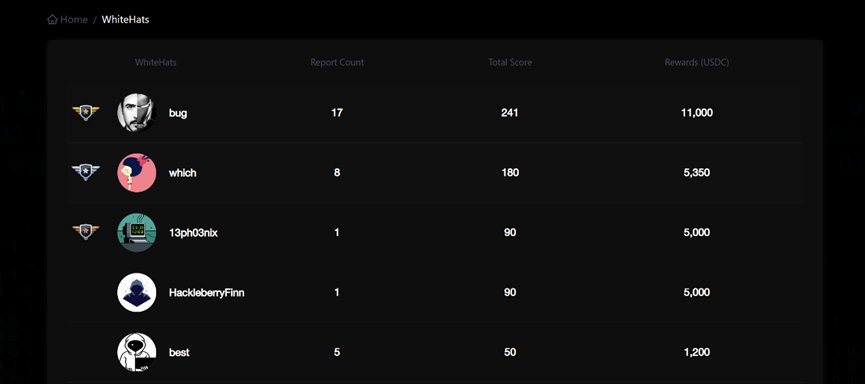
Furthermore, BugRap also offers private and controlled vulnerability competitions, which are limited to certified white-hat hackers. In addition to the large pool of white-hat resources, BugRap has partnered with several Web3 security companies, such as SlowMist, Numen Cyber, and MetaTrust, to bring in white-hat teams that help safeguard projects' security after audits.
During the provision of vulnerability bounty services, both parties are expected to adhere to the principles of "proactive, transparent, and comprehensive" information exchange, communication, and feedback. Sharing or disclosing each other's content to any third party without prior notification is strictly prohibited. If a project team wishes to join the vulnerability bounty program, they need to submit an application and provide basic information. BugRap will further communicate the details and provide a bounty program template based on the project. Once both parties confirm the timeline and operational PR details, vulnerability testing and fixing can commence. This vulnerability bounty service purely serves as technical support and does not constitute an endorsement or support for non-security matters of the project team.
Bounty Service Introduction
1. Service Fees
The basic entry fee for BugRap is $12,000 USD per year (currently waived for a limited time), plus an additional 10% of the bounty amount for confirmed valid vulnerabilities as the platform service fee.
2. Reward Distribution Process: Report-Audit-Confirmation-Fix-Reward
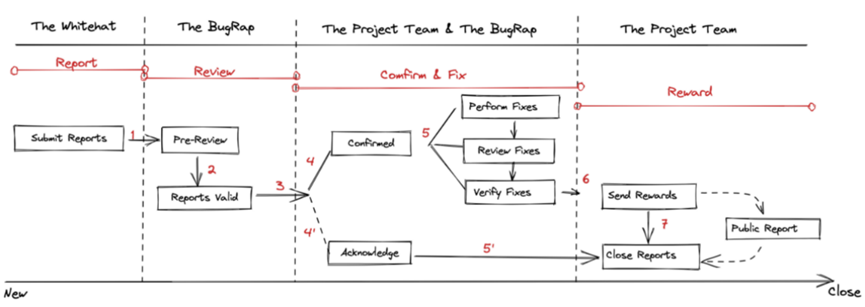
1) White-hat hackers submit vulnerability reports, and the BugRap security team conducts due diligence and verifies their authenticity.
2) The project team is assigned to address the vulnerabilities and assess the risk level and scope of impact.
3) BugRap team assists the project team in validating the vulnerabilities and risk level within three business days.
4) After the fixes are completed, the project team pays the reward to BugRap, and they have the option to choose whether to publicly disclose the report.
3. Vulnerability Bounty Process
After signing the contract, the project team needs to pay the basic service fee. BugRap will announce the collaboration between the project team and BugRap, and promote the vulnerability bounty program to the white-hat hacker community, while also facilitating communication between the project team and white-hat hackers. Once the authenticity of the vulnerability is confirmed, the project team should pay the bounty to the white-hat hackers, and BugRap will charge an additional 10% fee (not deducted from the bounty).
4. Definition and Scoring Basis of Vulnerability Types
BugRap team defines the types of vulnerabilities and scores the entire vulnerability based on relevant international standards (such as SWC, CWE, and CVSS3.1) during the pre-audit stage, to assist the project team in setting reward amounts.
5. Private and Controlled Vulnerability Bounty Programs
BugRap platform also offers private and controlled vulnerability bounty programs that are limited to certified white-hat hackers. There is no distinction between competition projects and regular projects in terms of vulnerability submission and handling process.
Through the BugRap vulnerability bounty service, project teams can address vulnerabilities promptly, enhance the security of their projects, and provide fair rewards to white-hat hackers, encouraging their active contribution to cybersecurity.
Conclusion
Security issues in the cryptocurrency market are one of the significant challenges in the industry. The threat of hacking attacks continues to evolve and strengthen, necessitating collective efforts from all stakeholders to protect digital assets and user information.
BugRap serves as a vulnerability bounty platform and offers an effective solution by incentivizing white-hat hackers to discover and fix vulnerabilities, thereby enhancing the overall security level of the cryptocurrency market.
In the future, we need to continuously explore additional solutions and technological means to address the growing risks of hacking attacks, ensuring the sustainable and stable development of the cryptocurrency market.


All Comments