

With the explosive growth of decentralized derivatives, ultra-fast limit order book DEXs (Order Book DEX), and automated liquidity pools, on-chain market trading frequency and capital scale have entered an unprecedented phase.
However, extreme market black swan events, sudden liquidity evaporation, and unilateral cascade liquidation pressure remain the ultimate benchmarks for evaluating the long-term survival capability of decentralized market-making protocols.
Traditional static market-making models often fail to dynamically adjust order book depth when facing Toxic Order Flow and high-volatility shocks, causing market makers to suffer significant inventory losses.
The authoritative financial data science research publication “Deep Reinforcement Learning-Based Market Making for High-Frequency Order Book DEXs” clearly demonstrates that integrating the classical Avellaneda-Stoikov high-frequency quantitative market-making model with Deep Q-Networks (DQN) can provide market-making systems with superior dynamic inventory risk management and adaptive circuit-breaker protection capabilities.
Against this backdrop, decentralized market-making protocol DMDAI has successfully integrated this advanced mathematical risk-control model with an on-chain Treasury mechanism through continuous system architecture optimization and algorithmic iteration.
By doing so, DMDAI has created a decentralized intelligent market-making ecosystem featuring high risk resistance, long-term stability, and sustainable operational capability.
I. Algorithmic Hedging and Dynamic Circuit Breakers: Responding to Extreme Market Volatility
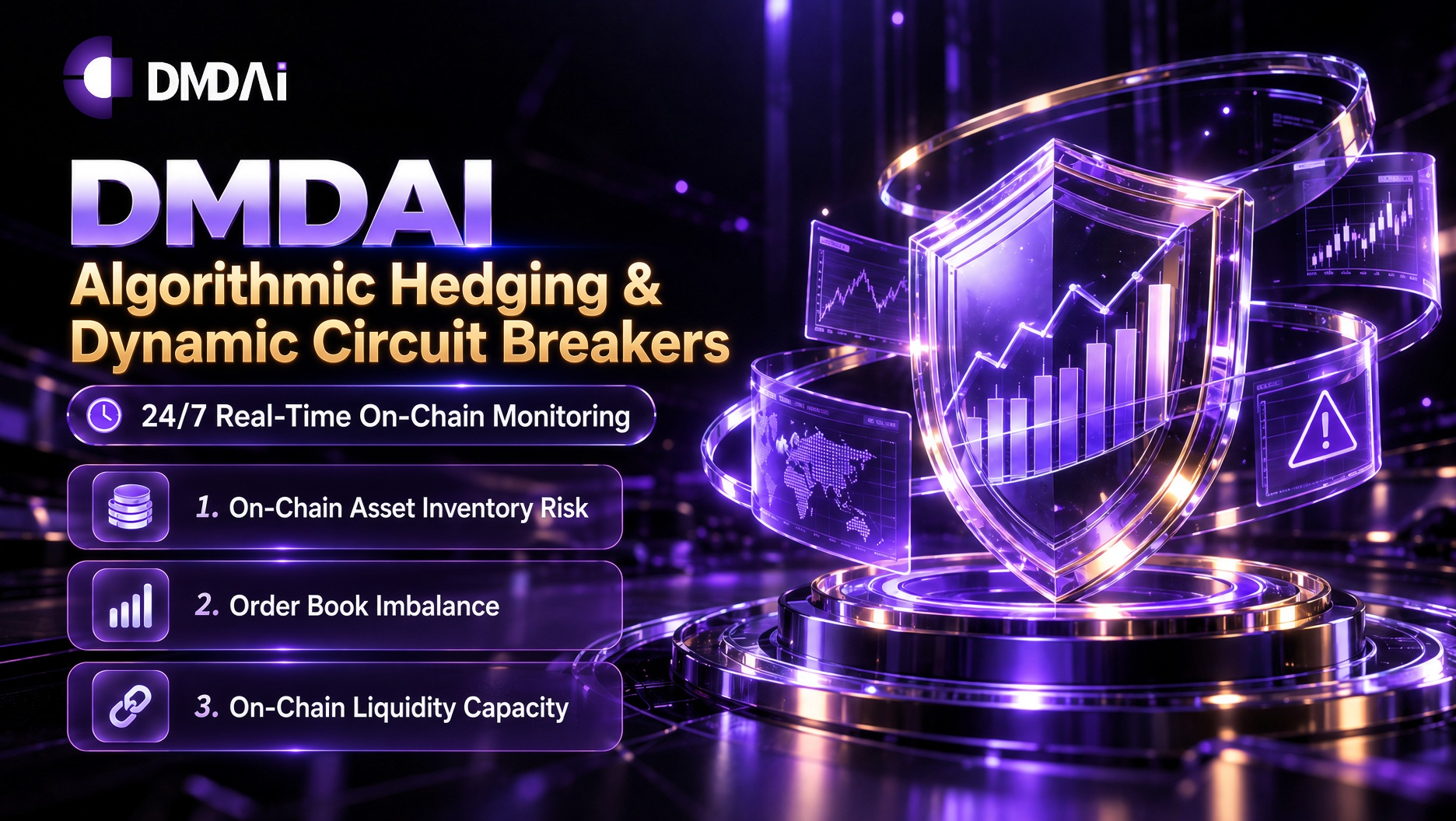
DMDAI’s AI intelligent computing strategy engine integrates Deep Reinforcement Learning (DRL)-based hedging algorithms, continuously monitoring the global asset ecosystem 24/7.
The system dynamically analyzes:
- Inventory Risk;
- Order Book Imbalance;
- On-chain liquidity carrying capacity.
During severe unilateral market declines or sudden large-scale sell-offs, traditional market makers are highly vulnerable to inventory accumulation losses and even liquidation risks due to passive order execution.
However, DMDAI’s AI strategy engine can autonomously calculate inventory skewness and risk metrics in real time.
It dynamically adjusts:
- Bid-ask spreads (Spread);
- Order placement ranges;
- Capital allocation structures.
The system can instantly activate cross-platform arbitrage hedging strategies and protective circuit-breaker mechanisms.
This mechanism not only effectively isolates market bubbles and Toxic Order Flow, preventing liquidity pools from experiencing uncontrolled liquidity drainage, but also ensures that the protocol maintains stable order book depth and liquidity supply even under extreme market turbulence.
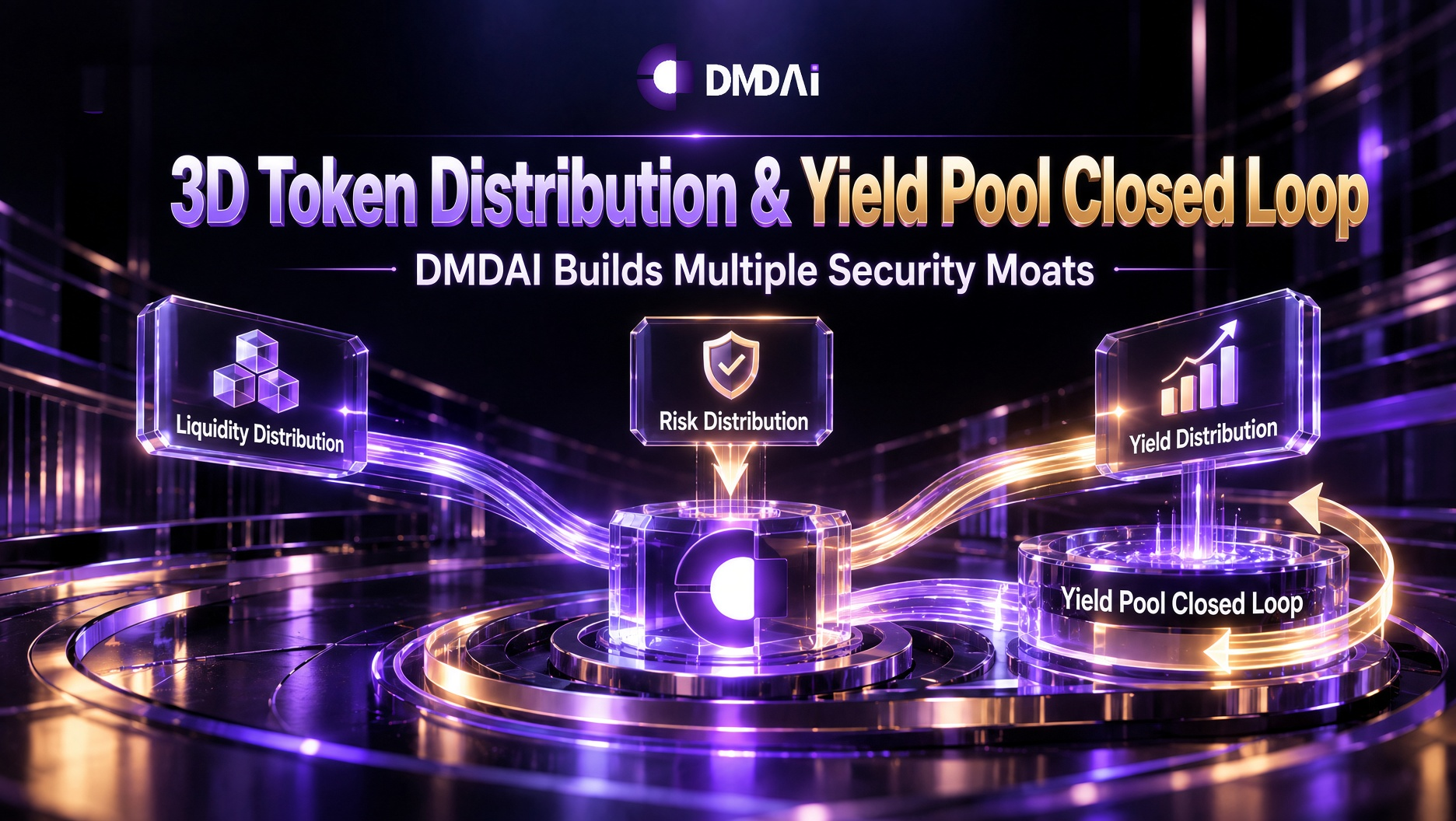
II. Three-Dimensional Asset Routing Mechanism and Yield Pool Closed Loop: Building a Multi-Layer Security Foundation
Regarding capital flow management and risk isolation, DMDAI has established a clear and transparent Three-Dimensional Asset Routing Governance Structure, creating a systematic defense framework from the foundation level.
- USDC Capital:100% of USDC funds are strictly injected into liquidity pools, directly enhancing market-making order book depth and transforming into a powerful foundation for absorbing market volatility.
- DMD Token:A portion of DMD tokens enters the on-chain multi-signature insurance pool, ensuring transparent ownership verification while strengthening consensus constraints and governance security.
- RWA / Blue-Chip Assets:Deeply integrated with Binance core blue-chip assets and U.S. equity-based Real World Assets (RWA), these assets serve as the underlying hedging anchors for 80% of the Treasury’s Risk Reserve Fund, ensuring that ecosystem liquidity can be efficiently redeemed at any time.
In addition, the ecosystem incorporates intelligent yield pools (Vaults) and withdrawal protection mechanisms.
When users choose rapid withdrawals or terminate their hash power allocation, the deducted freeze tax is 100% retained within the ecosystem’s internal closed-loop system.
These funds are utilized for:
- Automated compounding;
- Community dividend distribution;
- Ecosystem development funds.
Through this mechanism, potential market selling pressure is effectively absorbed and smoothly transformed into sustainable buying support, creating a self-repairing, positive endogenous growth cycle.
III. 100% On-chain Ownership Verification and a Transparent Future
All DMDAI market-making revenue distribution, hash power allocation scheduling, token burning mechanisms, and Treasury quota management are executed automatically through smart contracts with 100% on-chain verification and ownership confirmation.
The entire process is:
- Fully transparent;
- Traceable;
- Immutable.
Combined with the D1–D9 tiered precision calculation matrix and the global offline Community Studio support program, DMDAI is transforming advanced quantitative risk-protection capabilities into a strong foundation collectively built by global communities through decentralized AI computing networks and transparent risk-control mechanisms.
With the full launch of the new official platform dmdai.net and the gradual integration of global AI computing nodes, DMDAI will continue deepening its strategic collaboration with BNB Chain and major global liquidity infrastructure networks.
Through robust algorithmic frameworks and scientific risk-management systems, DMDAI will continue leading the on-chain market-making sector toward a new level of development.
The DMDAI team states:
“True decentralized market making requires not only efficient market-making returns, but also an unbreakable security foundation. Through the three-layer protection framework of ‘Reinforcement Learning Algorithms + 80% Risk Reserve Fund + Three-Dimensional Asset Allocation,’ DMDAI has established a new on-chain risk-control standard capable of resisting extreme black swan events. Our goal is to build a transparent, efficient, and risk-resilient Web4.0 intelligent market-making infrastructure, safeguarding the asset security of global ecosystem contributors.”


All Comments