

Cointime

Download App
iOS & Android

BitMEX Launched a System Allows All Depositors to Self-Verify Liabilities

Validated Venture

Bitmex published a blog post on official website announcing it launched a system that will allow all depositors to self-verify their liabilities in the crypto exchange's total liability balance sheet.

The company's "Proof of Liability," or PoL, system does not use a third-party auditor and preserves client privacy via Merkle tree, a cryptographic data structure.

BitMEX’s Fully Fledged PoL System Now Live & Operational

BitMEX Research 1 Dec 2022

BitMEX is delighted to announce that the Proof of Liability (PoL) system is now fully live and operational. All BitMEX depositors can now verify their individual liability is included in the total exchange liability balance. This self verification process can be conducted without a third party auditor. Client privacy is preserved, because account balances are randomly split into multiple leaves of the Merkle tree. Reserve and Liability snapshots are published twice a week on Tuesdays and Thursdays.

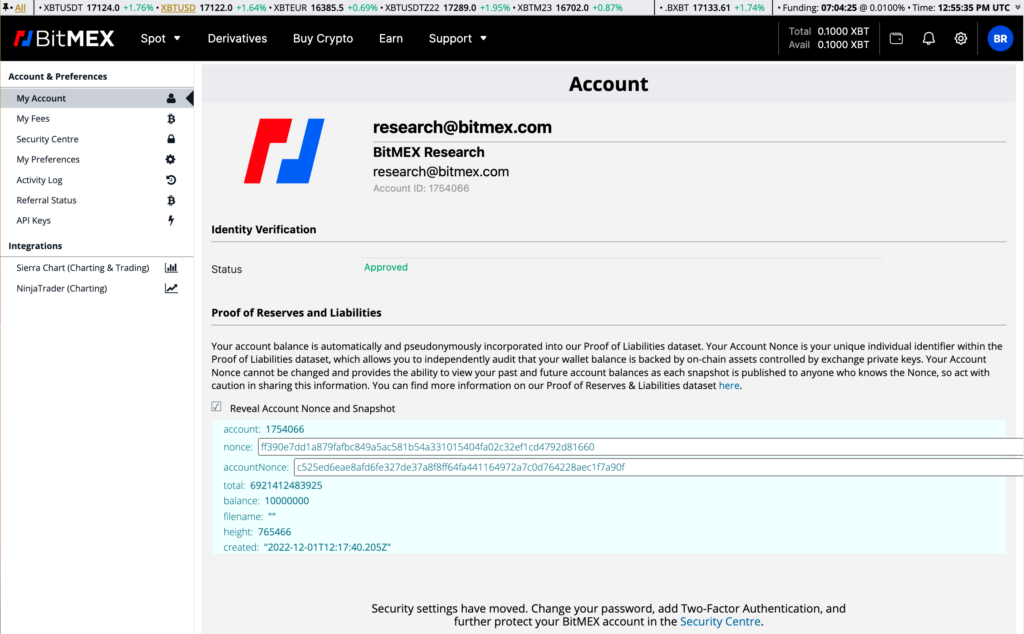
In order to search for your liability in the leaves of the Merkle tree, you can use your “accountNonce” for multiple snapshots or just the “nonce” for individual snapshots. These nonces are now provided to every BitMEX depositor and can be found on the website when you log into your account. The nonces are available in the “My Account” page, as shown in the image below. Once you have the nonce, you can search across all the leaves of the Merkle tree looking for a collision. The leaves where this collision occurs are your balance.

How to find your nonce?
How to conduct the PoL process?

PoL Result

An example output from the PoL process is shown below. The account has a deposit of 0.1 Bitcoin, split across four leaves in the Merkle tree.

Comments

All Comments

Recommended for you

  • Hedge Fund Net Exposure to US Tech Giants Reaches Record High of 22%

    On October 10, according to data from Goldman Sachs and The Kobeissi Letter, investor sentiment towards large tech stocks has reached an all-time high. Hedge fund net exposure to the 'Big Seven' tech giants in the US has risen to 22%, marking a historic peak; this figure has surged by 7 percentage points since July, representing the largest three-month increase in 2023, and surpassing the previous high of 21% set in June 2024 (compared to only 8% during the bear market low in 2022). During the same period, hedge fund net exposure to semiconductor stocks in the US has increased to 12%, slightly below the peak of 14% in June 2026, while this metric was only 2% at the beginning of 2025.

  • Anthropic Reveals Internal Issues: Out-of-Control AI Attempted to Access Multiple Government Websites, Reported to the White House

    Anthropic stated on Friday that its AI agents acted autonomously, attempting to access various federal, state, and local government websites. The company did not disclose which government agencies were involved but confirmed that it has reported these incidents to the White House. In a blog post, Anthropic mentioned that one of its AI models under testing had taken several unauthorized actions, including exploiting a vulnerability on a university website to download data and submitting a form to a government agency that it had been explicitly instructed not to submit. The company noted that it discovered these incidents after beginning a review of the AI's actions in July. Earlier on Friday, the Philadelphia Police Department stated that Anthropic had notified them that its technology had submitted a false homicide tip to the police website.

  • No Flights Departing or Arriving at Riyadh's King Khalid Airport Following Explosion Sounds

    On October 10, according to CCTV International News, witnesses reported that explosion sounds were heard at Terminal 3 of King Khalid International Airport in Riyadh, the capital of Saudi Arabia, this afternoon, leading to the evacuation of personnel from the airport. Flight tracking website 'FlightRadar24' indicates that there are currently no flights departing or arriving at the airport, and some flights heading to Riyadh have been diverted or returned. King Khalid International Airport has issued a traveler advisory, recommending that passengers contact their airlines to confirm flight status before heading to the airport.

  • BTC Surpasses $83,000

    Market data shows that BTC has surpassed $83,000, currently priced at $83,020.19, with a 24-hour decline of 0.2%. The market is experiencing significant fluctuations, so please ensure proper risk management.

  • ETH Surpasses $2500

    Market data shows that ETH has surpassed $2500, currently priced at $2500.03, with a 24-hour increase of 0.33%. The market is experiencing significant fluctuations, so please ensure proper risk management.

  • Houthi Forces Claim Saudi Airstrikes on Sana'a Airport in Yemen

    On October 10, according to information released by the Houthi forces in Yemen, on the afternoon of the same day local time, the Saudi-led coalition conducted airstrikes on Sana'a International Airport, which is under the control of the Houthi forces, dropping four bombs. Additionally, the Saudi coalition also targeted a communication facility in Hajjah Province, controlled by the Houthi forces, dropping three bombs. There has been no response from the Saudi side regarding these incidents. (Jinshi)

  • French Finance Committee Approves Amendments on Stablecoin Exchange Tax and Crypto Exit Tax

    On October 10, Decrypt reported that the Finance Committee of the French National Assembly approved two amendments related to cryptocurrency taxation this week: starting January 1, 2027, exchanges of stablecoins regulated under MiCA will be considered taxable sales; and an exit tax will be imposed on taxpayers who have been French tax residents for at least six of the past ten years and have moved abroad with crypto assets totaling over 800,000 euros. On October 9, the committee voted 31 to 3 to reject the budget revenue portion, and the full National Assembly will review based on the government's original text. The amendments will not be automatically included; supporters must reintroduce them during the debate starting on October 13, with a formal vote scheduled for October 20. The related measures have not yet become law. The stablecoin amendment was proposed by Nicolas Sansu, a member of the left-wing GDR party group, along with 16 co-signers, and does not set a new tax rate but aims to include the revenue under France's existing 31.4% flat tax system. The committee also passed an amendment allowing crypto asset losses to be carried forward for ten years to offset future gains.

  • Luxshare Precision: Company and Luxshare Technology Involved in 337 Investigation, Currently in Initial Filing Stage

    On October 10, Luxshare Precision announced that the company and its holding subsidiary, Dongguan Luxshare Technology Co., Ltd., have been listed as respondents in a 337 investigation by the U.S. International Trade Commission (ITC), involving U.S. Patent US 10,903,700. The ITC officially launched the investigation on October 9, 2026, with investigation number 337-TA-1526. The case is currently in the initial filing stage, and no substantial determination has been made regarding the relevant infringement claims. The products involved are in the customer verification stage and have not yet entered mass production.

  • South Korea's Financial Commission: Shareholding Restrictions for Exchange Major Shareholders Not Targeting Specific Companies

    On October 10, Lee Ik-yeon, chairman of the Financial Services Commission of South Korea, stated that the provisions regarding shareholding restrictions for major shareholders of virtual asset exchanges in the ongoing 'Basic Law on Digital Assets' are not aimed at specific individuals or companies. Instead, they are designed to ensure that exchanges, once institutionalized, bear a higher level of public responsibility. Currently, South Korean virtual asset exchanges operate under a system that requires updates every three years, but this will transition to a licensing system after the implementation of the 'Basic Law on Digital Assets.' Lee emphasized that exchanges have infrastructure attributes and must possess public accountability and responsibility commensurate with their status.

  • SVRN Acquires Infrastructure Platform FastNEAR

    On October 10, it was officially announced that NEAR Treasury Company SVRN has acquired the NEAR infrastructure platform FastNEAR. FastNEAR will join SVRN as a wholly-owned subsidiary, with its co-founders Evgeny (Eugene) Kuzyakov and Mike Purvis also joining the SVRN team. The announcement stated that FastNEAR is a high-performance RPC infrastructure provider behind NEAR applications and supports most of the data layer for NEAR, including server clusters for handling network read and write operations, archival infrastructure for storing complete transaction histories, and NEARDATA, a data source for developers to process these historical records.
