


On Sept. 13, news broke of yet another high-level executive parting ways with Binance.US.
This time, it was none other than Brian Shroder, the CEO and president of the exchange, who, after two years in the hot seat, was heading for a “deserved break,” as Binance CEO Changpeng “CZ” Zhao was quick to announce on X (formerly Twitter) that same day.
The news coincided with the announcement that around 100 people had also lost their jobs that day — about a third of the workforce.
A massive outflow of funds followed, with the highest being just over $66 million in a single transaction. Zhao was keen to underline that Shroder’s departure was amicable and that he had achieved everything he had set out to do.
“Ignore the FUD,” was the call from the parapets, the common plea for calm when any kind of disruption occurs.
In an industry strained and battered by tales of fraud and wrongdoing, however, this call went unheeded once again. The days since the news broke have seen significant outflows from Binance to platforms such as Jump, AU21 Capital, QCP Capital and Wintermute.
Once again, it raises issues that have long dogged the cryptosphere, chiefly those of influence and trust. There are few other sectors where layoffs or a change at the top of a company can have such an impact.
Such things are generally accepted as the natural ebb and flow of the business world, and while there may be a momentary blip, more often than not, things are back on track fairly soon afterward.
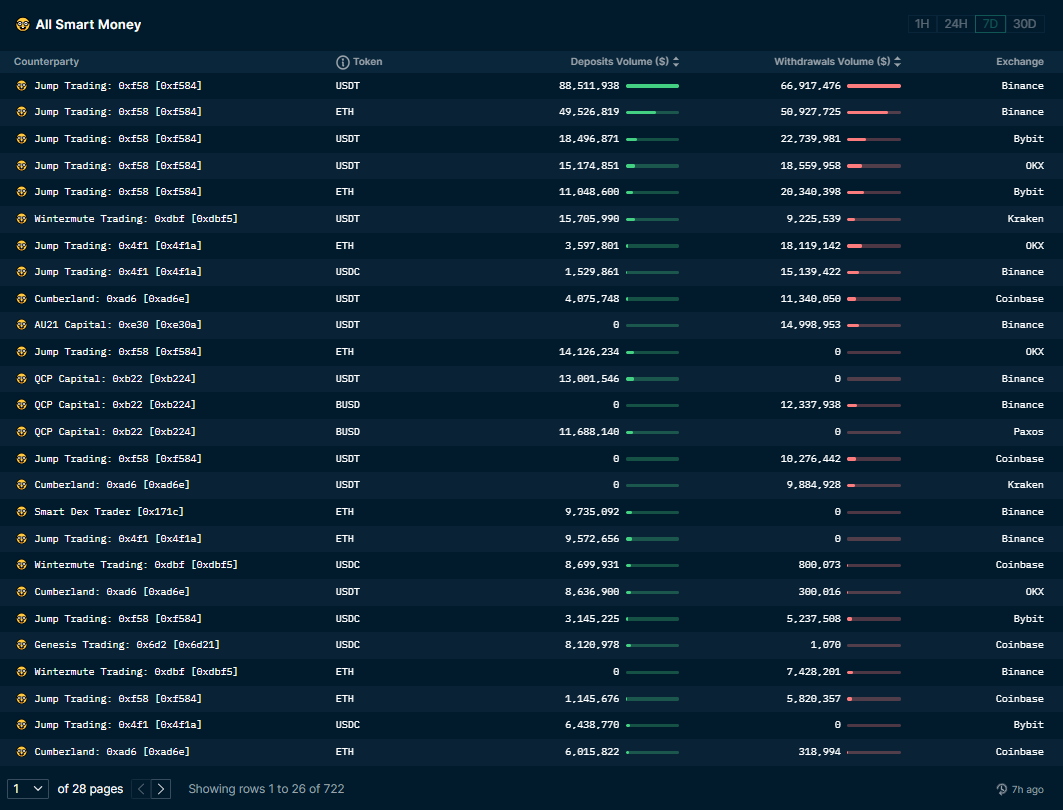
Transactions between cryptocurrency platforms in the days following the announcement. Source: Blockanalia/X
Even in this instance, from the chart, it is apparent that there were still sizeable inflows to Binance during the period. The two incidents may be completely unrelated. With so many factors involved, no one can say for sure.
Jim Graham, a cryptocurrency analyst at think tank PsyBold, told Cointelegraph: “While we can’t attribute the shift in funds wholly to last week’s announcement, we most certainly can’t reject it, either. There have been several key managerial changes in the past few months, and virtually all of them have been accompanied by a dip in holdings on the platform. Trust remains a massive obstacle for crypto platforms, and it’s an obstacle they are failing to overcome.”
Money is a valuable commodity, and even the hint that it may be in jeopardy is reason enough to react quickly and decisively.
As the saying goes, trust is earned, not given away, and the recent negative events involving crypto platforms have done little to raise that level of trust. Graham added:
“Crypto platforms need to be on par with banks regarding trust. Investors need to know that entrusting their money to them is a good, safe idea, not a risky one. Unfortunately, they are nowhere near that, and until we reach that level, these spikes are inevitable.”
So, how do the platforms get to that level of trust? Most people would simply say, stop doing bad things. Once crypto platforms act more like banks, people may trust them more.
But this is much easier said than done. For one, most banks have been around for years, some even hundreds of years. Trust has an element of longevity to it, which people like. The general feeling is if something or someone has acted responsibly and transparently for a long time, there is more of a chance that they will continue to do so.
Crypto platforms don’t have that luxury, of course. Most can only look back on a few years of existence; the only pledge they can give is their word.
On top of that, there is the age-old discussion of regulation. Licensed banks are regulated. That means an authority monitors what they do and is there to step in if things go wrong.
The last thing such an authority or the bank wants is a bank run, as this represents a complete breakdown in trust for all concerned, with the consequences that go with that. Once that has happened, it is tough to win that trust back, as witnessed during the economic crisis of 2008.
In the unregulated world of crypto exchanges, there is currently a stalemate. Some investors are in the middle, clamoring for regulation, fearing for their investments. In contrast, others are vehemently opposed, stating regulation is the very thing cryptocurrency was created to avoid.
And on either side are the exchanges and the authorities, each accusing the other of this and that in what seems like an endless spiral, with neither ready to back down.Sandra McAllister, an attorney specializing in tech litigation with Clifford Chance, told Cointelegraph:
“The need to clarify the legalities around trading cryptocurrencies, particularly in the U.S., is vitally important for the future of the industry, but the protracted processes and tactics being employed are damaging, for both sides, and that, in turn, is turning investors away.”
“The power of social media is also a pressure on the market. The bounce in the Ripple price we saw in July following the court ruling on XRP underlines that perfectly. The decision was anything but conclusive and, in reality, nothing more than a step along the path, but it was blown up on social media as a huge victory that drove up prices. We only have to see where the Ripple price is today to see how much of a victory it actually was,” she said.
Moving assets around between different exchanges or different assets is nothing new or unusual, of course. In times of economic downturn, funds tend to flow toward the “safer” havens, such as bonds and gold, before reverting to more profitable areas when things pick up.
Graham commented, “While diversifying holdings and being ready to react to ensure you are not unduly affected by negative pressures is sound financial advice, the problem facing crypto holders right now is which platform is safer than another. The FTX demise showed us that ‘too big to fail’ does not apply, so what remains?”


All Comments