


Contributor:Kaori
Table of Contents:·Blocknative stops MEV-boost relay service, over 90% of Ethereum blocks settled by only 4 entities·Community pays tribute to Blocknative, but also worries about transaction centralization·Incentive mechanism is unreasonable, bloXroute founder expresses dissatisfaction·Since the outbreak of MEV track, many leading service providers have received high valuations and financing
Blocknative suspends MEV-boost relay service, over 90% of Ethereum blocks now settled by only 4 entities
BlockBeats reported on September 28th that Ethereum infrastructure service provider Blocknative announced that it will stop its MEV-boost relay service due to the inability to maintain economic benefits. Announcement .
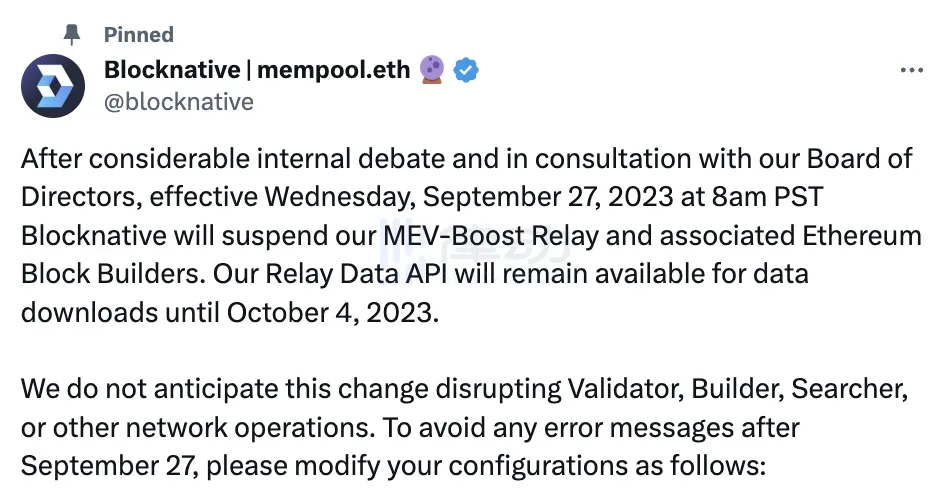
Relays play a critical role in Ethereum transaction settlement. They ensure timely and efficient processing by bridging the gap between users and the blockchain through batch processing and broadcasting transactions.
Related reading: "Explaining the MEV-Boost mechanism and Ethereum fork selection rules ""MEV-Boost is a protocol designed by Flashbots and the community to mitigate the negative impact of Maximum Extractable Value (MEV) on the Ethereum network."There are three participants in MEV-Boost: relayers - trusted auctioneers who connect block producers and block builders; builders - complex entities that build blocks to maximize their own and block producers' MEV; and producers - Ethereum's proof-of-stake validators."
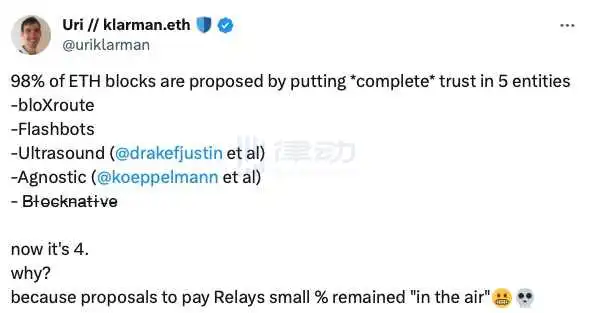
After Blocknative's exit, only four relayers, bloXroute, Flashbots, Ultrasound, and Agnostic, are still active on the network.
bloXroute members told BlockBeats that "the decentralization of Ethereum has become very fragile, and one of the leading MEV-Boost relayers and block builders, Blocknative, has reduced their services due to a lack of economic incentives."
Relay is the cornerstone of Ethereum, allowing validators to capture MEV in a decentralized manner while receiving about 4 times higher betting rewards. However, relays do not make money, and currently only 4 suppliers control 95% of the market. bloXroute is an infrastructure company that currently operates two relays, "regulated" and "max profit", controlling nearly 30% of the market share.
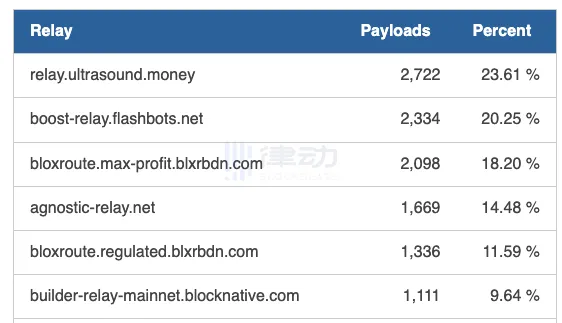
Blocknative has shut down, and the remaining four relayers are not charging service fees, which means that the operators of the core part of the Ethereum infrastructure are no longer profitable. If the economic incentive problem is not solved, the centralization problem of relayers may further worsen.
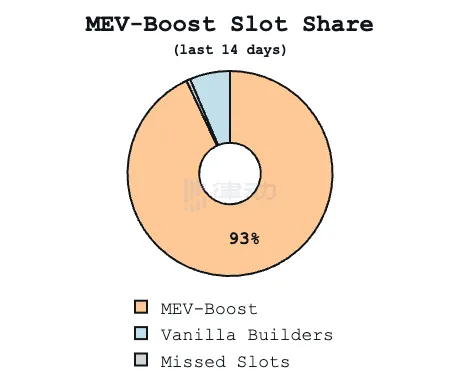
According to data from mevboost.pics, 93% of Ethereum blocks created in the past 14 days have used MEV-boost.
Homage to Blocknative by the Community, While Also Concerned About Centralization of Transactions
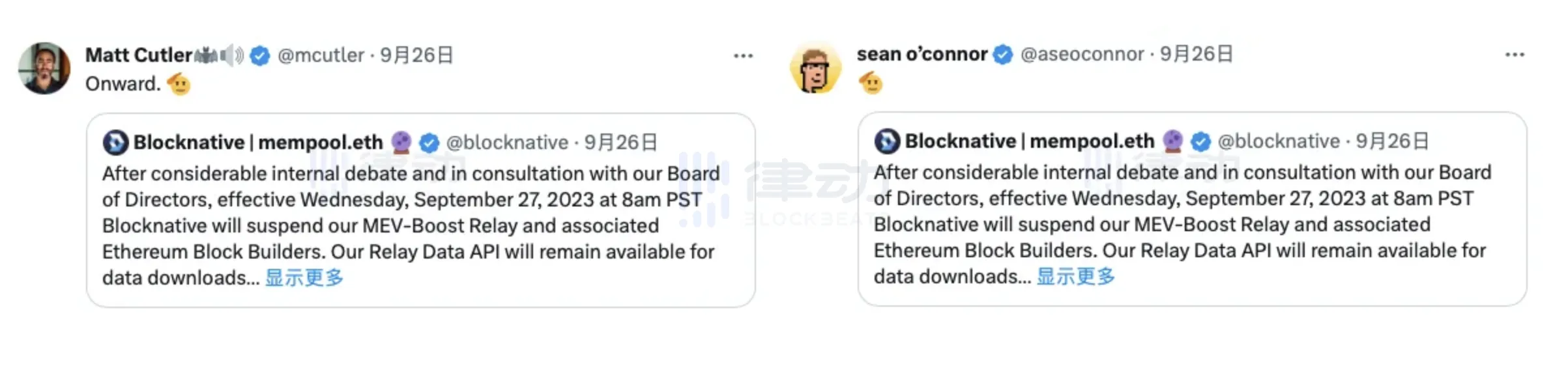
Blocknative CEO retweeted Blocknative's shutdown announcement with the caption "Onward".
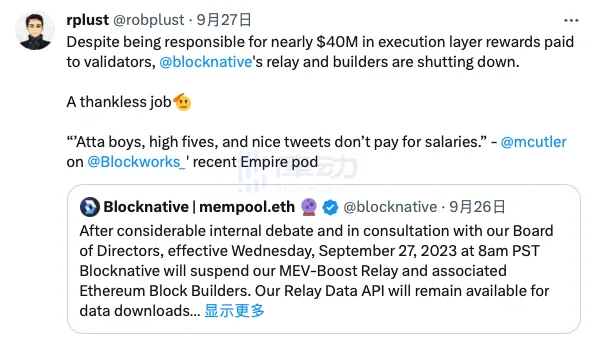
The protocol expert rplust said that relaying is a thankless job. He also said, "Atta boys, high-fives, and nice tweets don't pay the bills."
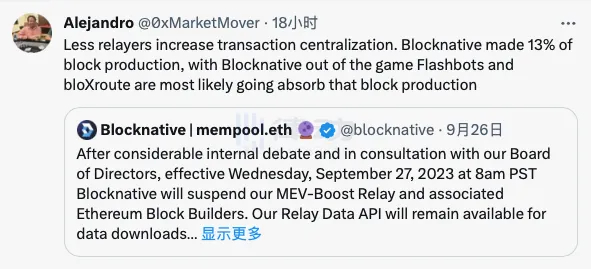
Blockchain engineer Alejandro stated in a tweet that fewer relayers increase the centralization of transactions. Blocknative accounts for 13% of block production, and with its exit, Flashbot and bloXroute will take up more market share.
Incentive mechanism is unreasonable, bloXroute founder expresses dissatisfaction
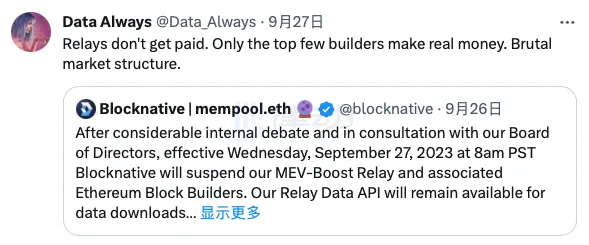
Data analyst Data Always pointed out in a tweet that relay services do not receive compensation, and only the top block builders can truly make money. This is an extremely "cruel" market structure.
bloXroute founder and CEO Uri responded in a tweet that there is currently no reasonable fee incentive mechanism in the Ethereum relay market, and proposals to improve relay fees have always been "pending".
According to Uri, there are currently two proposed improvements to the relay fee mechanism in the Ethereum community, namely "relay guilds" and fee markets.
The "Relay Union" proposal mainly solves three aspects: block builders pay about 1% of the fee to forward multi-signatures; community governance needs to adjust the percentage and distribution; all relays directly serve all validators.
According to a report by Blockworks, Flashbots previously proposed the establishment of a "PBS Guild", which would seek donations from the Ethereum community, some of which would be used to reward relayers. However, Uri Klarman, CEO of relay entity bloXroute, believes that the relay fee mechanism should be activated, and he suggests that block validators anticipate this move.
The fee market proposal mainly has four aspects: each relay charges 1% fee; validators deposit to a subset of relays; block payment subset pays 1% of the total; services are only provided by subset relays, not other relays; Uri indicates that although neither is perfect, it can motivate Blocknative or other market participants to continue running relays, but neither of these proposals has been passed.
Blockbeats previously interviewed bloXroute CEO Uri Klarman to discuss issues related to MEV, Flashbots, and centralization in Ethereum settlement.
Related reading: "Interview with bloXroute: Flashbots opens up a difficult path for DeFi to catch up with CeFi""If you want to become a blockchain builder, you need to have the ability to capture CeFi and DeFi arbitrage opportunities. To do this, you need a lot of money, a lot of funds on centralized trading platforms, and a lot of funds on DeFi. It's not just a matter of transferring ETH purchased here to other places to make a profit. It requires a lot of capital and risk management."
Since the outbreak of the MEV track, multiple leading service providers have received high valuation financing
On November 11, 2020, Blocknative raised $5 million in funding, led by Blockchain Capital, with participation from IDEO Colab Ventures, Coinbase Ventures, Industry Ventures, and Foundry Group.
On December 16, 2022, Blocknative announced the completion of a $15 million A-1 round of financing, with lead investors including Blockchain Capital, Foundry Group, Rho, IOSG Ventures, Robot Ventures, Fenbushi Capital, HackVC, and Industry Ventures. Click here for more information.
Two rounds of financing totaling $20 million, with Blockchain Capital as its main investor. Now, Blocknative has announced the shutdown of its services, which raises questions as to whether it has run out of funding and is unable to generate enough profit from its relay services to sustain its operations.
This year in July , MEV operator Flashbots completed a $60 million Series B financing with a valuation of $1 billion. In January of this year , Flashbots was reportedly discussing raising up to $50 million at a $1 billion valuation with potential supporters. Flashbots did not actively solicit potential investors, but instead invited them to participate in the financing round.


All Comments