


An Introduction to Liquid Staking
What Is Liquid Staking?
Liquid staking is a form of staking, a mechanism involving users in the process of securing a PoS network. Liquid staking was first introduced by Lido as a solution to the above problem.
Why Use Liquid Staking? How Does It Work?
In conventional staking, although users can accrue some interest by locking up their crypto in the network, these assets cannot be accessed when locked up. This means that users lose out on the opportunity to gain more yield and risk losing money in the event of a price dip.
Liquid staking involves users delegating their crypto to a validator node on a delegated PoS (DPoS) network by pooling tokens in a staking pool via a third-party liquid staking service provider — either platforms specializing in liquid staking or projects native to the network. In exchange for the tokens locked in the network, users will receive a derivative token to the underlying asset. This grants the user liquid funds following the staking of crypto. LSDs generally use two different mechanisms in the market: rebasable and exchange rate-based tokens.
Rebasable LSDs
For rebasable LSDs, the value of the underlying asset and the LSD will remain at a ratio of 1:1. The balance of the LSD is recalculated daily when the oracle reports the balance update for the underlying token. For instance, users will receive 1 stETH when they stake 1 Ether (ETH) on Lido. Once withdrawals from the Beacon Chain are allowed, users can redeem ETH by burning stETH at the same 1:1 ratio as when minting.
Exchange Rate-Based LSDs
For exchange rate-based LSDs, the value of the LSD changes over time to reflect accrued rewards and fees, but the balance remains unchanged. This means that the exchange rate between the LSD and its underlying asset changes constantly, usually on a 24-hour basis, depending on the protocol. For instance, users will receive 1 rETH when they stake 1 ETH on Rocket Pool. However, the rETH/ETH exchange rate is updated daily, based on the rewards earned by Rocker Pool’s Beacon Chain node operators, and the value of rETH increases daily. pSTAKE also makes use of this exchange rate-based model for its stkASSETs.
Liquid Staking vs. Regular Staking
Instead of having their crypto locked up in the protocol or network in the case of regular staking, liquid staking users can use their derivative tokens to further participate in DeFi activities to stack their yield on top of regular staking annual percentage returns (APRs).
Liquid staking also ensures greater decentralization in securing the network by lowering the barriers of entry to stake. The more validators present on the network, the more robust and secure the PoS network will be. In the case of post-Merge Ethereum, the minimum stake for a validator node is 32 ETH, which could be a significant sum of money for many retail users. With liquid staking, users can take part in the securing of Ethereum and receive the rewards without having to fork out the entire minimum amount of 32 ETH.
Liquid Staking Risks
Counterparty Risk
The involvement of a third party adds counterparty risk to users’ staking activity. This could present itself in smart contract risks and protocol legitimacy issues.
Centralization Risk
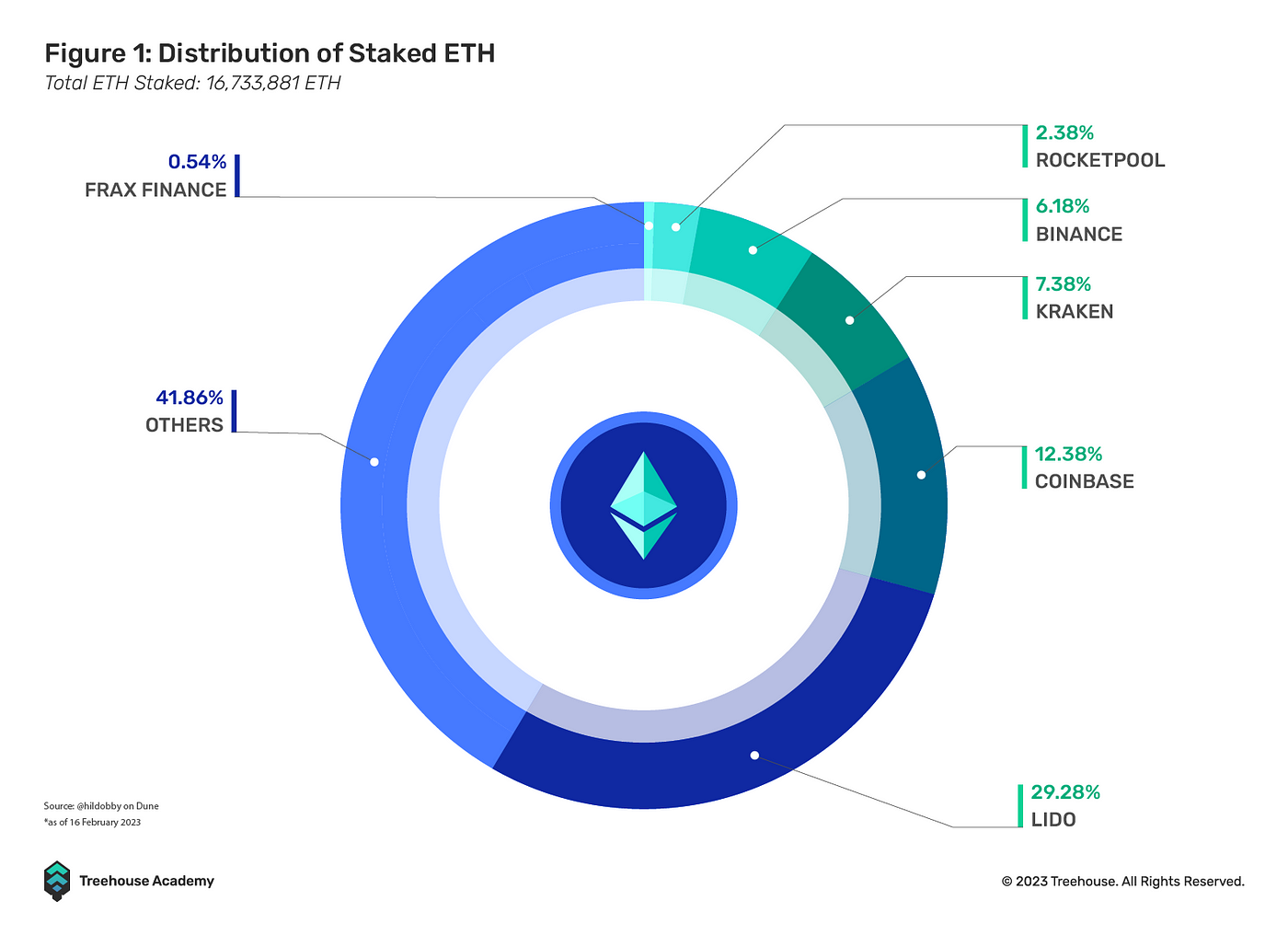
In the staking-as-a-service landscape, centralization risk remains a consideration. At the time of writing, Lido alone holds 29.28% of the market share for staked ETH across both centralized and decentralized players in the space. Although Lido is heavily audited, any form of disruption in the protocol would probably lead to network-wide disruptions.
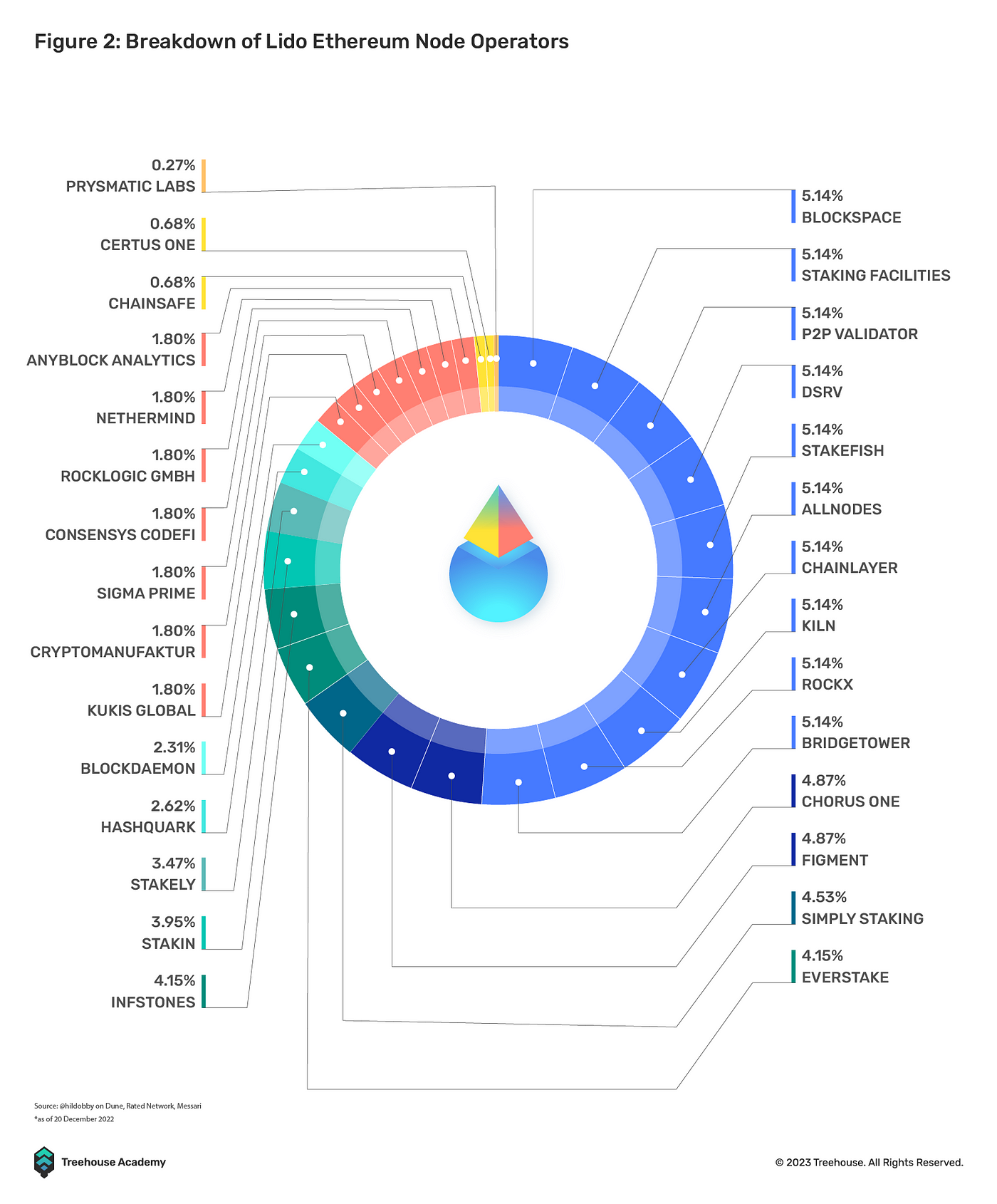
However, although Lido has 29 whitelisted node operators voted in by the Lido Decentralized Autonomous Organization (DAO) and a total of 144,408 validators, no single entity controls more than 5.14% of the stETH (or 7,422 validators), as shown in the figure below. This means that the chances of manipulation or attacks on the network should be low since there is diversification of control among the node operators.
Examples of Liquid Staking Protocols
Although liquid staking is most commonly associated with Ethereum, liquid staking is also present on other PoS networks, such as BENQI on Avalanche and pSTAKE on Ethereum, Cosmos, and BNB Chain.
Lido
Established in December 2020, Lido is a decentralized liquid staking protocol on Ethereum 2.0’s Beacon Chain governed by the Lido DAO. It pioneered the mechanism of liquid staking, a solution to the high amount of capital and the technical competency needed to stake ETH. Currently, Lido is interoperable among the Ethereum, Solana, Polygon, Polkadot, and Kusama blockchains. Users receive stTokens (e.g., stETH) upon staking their crypto.

BENQI
Through BENQI Liquid Staking (BLS), users can stake AVAX on the Avalanche C-Chain without staking on the Avalanche P-Chain, earning validating rewards from the P-Chain without needing to run a full node or locking up AVAX on a node. Users receive sAVAX tokens for their staked AVAX, which can be used to participate in other decentralized applications (dApps) to stack yield.


All Comments