


Auther:Cointime.com 237
In today's digital age, the Internet has become an integral part of people's lives. However, the digital divide is further exacerbated by the large number of areas around the world that still lack affordable broadband Internet access. This digital divide limits the ability of individuals, families and businesses that do not have access to high-speed Internet to access information, education, business opportunities and other vital resources.
To address this problem, decentralized wireless networking technologies are emerging. Decentralized wireless networking provides pervasive Internet connectivity by leveraging community-level resources and participation. It does not rely on traditional telecommunications infrastructure, but instead relies on hosts and authenticators to establish and operate wireless access points in their communities.
A decentralized wireless network has many excellent features.
First, it reduces the reliance on traditional telecom infrastructure, thereby reducing deployment and operational costs.
Second, such networks can better adapt to different geographic environments and population density variations, providing reliable Internet access to remote and sparsely populated areas.
In addition, decentralized wireless networks are flexible and scalable, allowing for rapid expansion based on demand and participant growth.
As a result, the construction and development of decentralized wireless networks will contribute significantly to the increase in broadband penetration. This will help ensure that everyone around the globe has access to broadband Internet at an affordable price, thus enabling the entire world to share equally in the opportunities and benefits of digitalization.
Airwaive: Decentralized Wireless Network Service Provider
Airwaive, a platform that connects wireless service providers with home and business owners, is designed to drive the growth of decentralized wireless networks. It provides the necessary tools and incentives to enable ISPs, hosts and verifiers to work together to build, scale and maintain such networks. Through Airwaive, individuals and organizations are able to leverage their own resources and technologies to provide reliable, high-speed and affordable Internet connectivity within their communities.
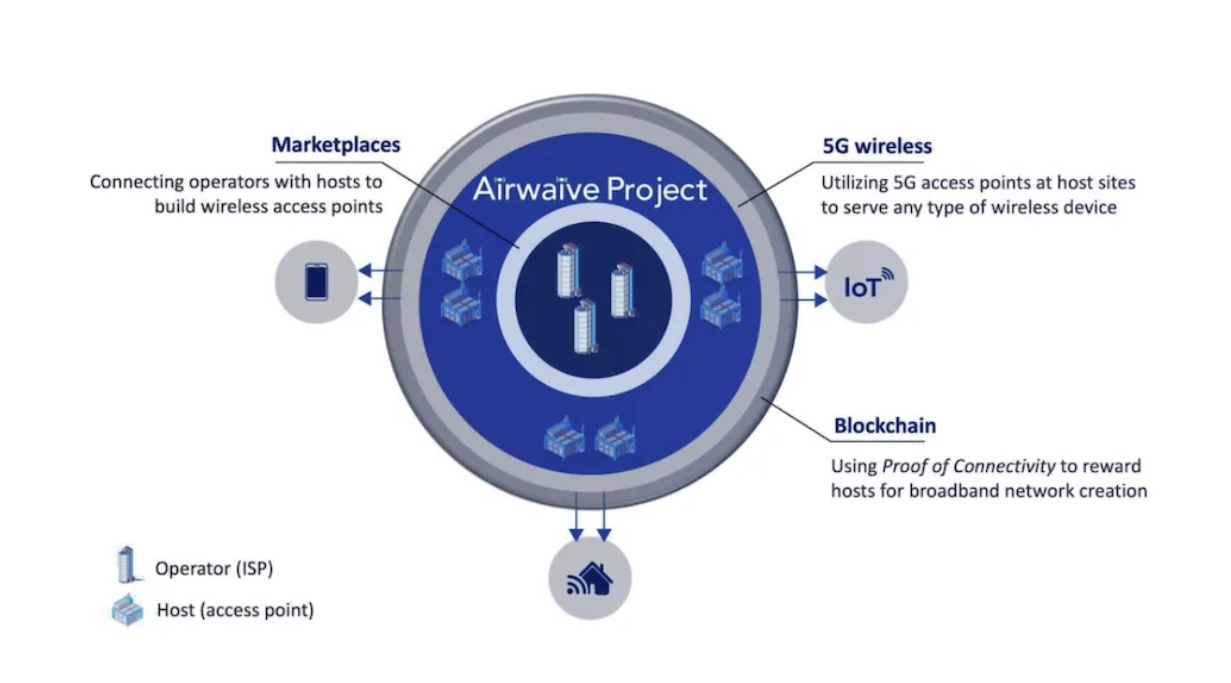
There are three roles in Airwaive's operational framework: operator, host, and user.
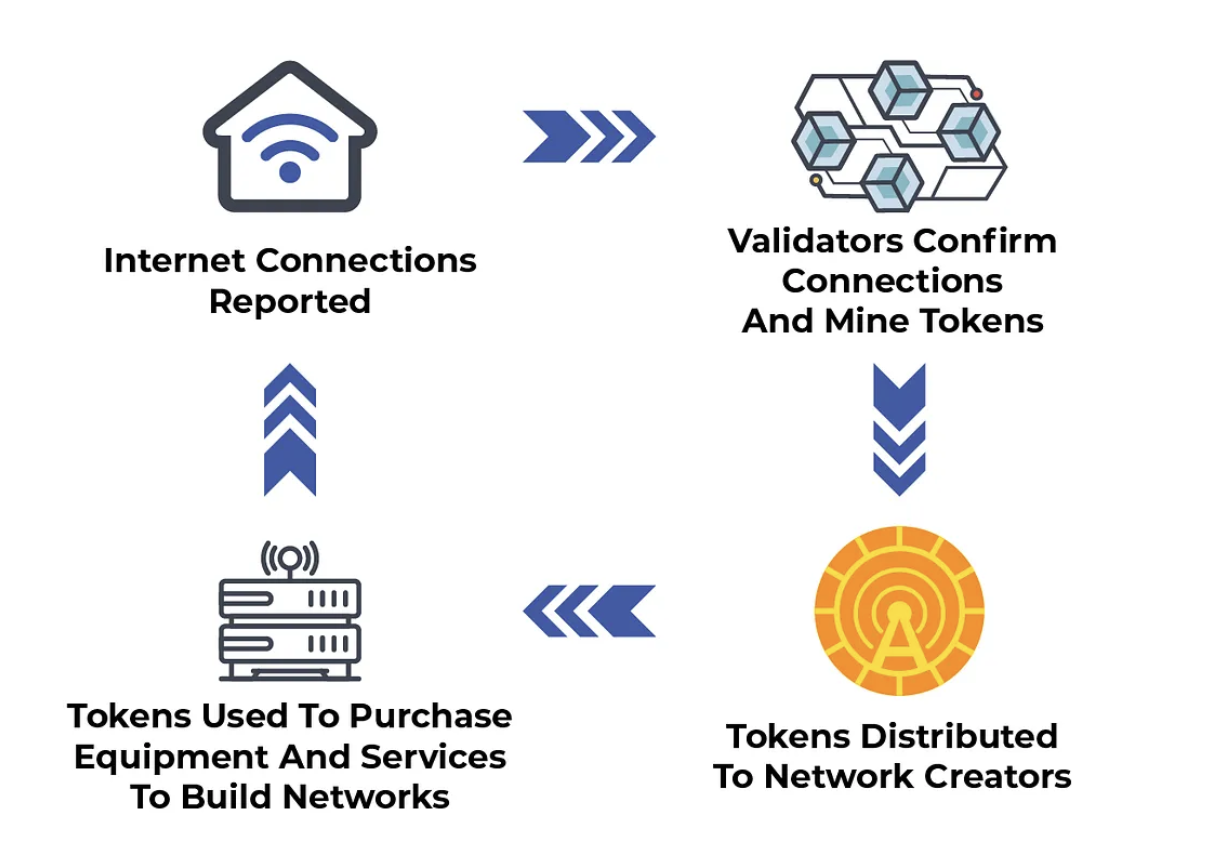
Among them, the operator is responsible for building the public or private wireless access point network. The host is the individual or organization that installs the wireless access point on the property on behalf of the operator. And a subscriber is anyone looking for better, faster or cheaper wireless Internet service.
In practice, carriers need to find hosts to install wireless access points. The user, in turn, needs to connect to the wireless Internet service through the host. In the process, the host will be paid for providing the service.
Airwaive is committed to bridging the digital divide by building a blockchain-based rewards platform that will provide an affordable Internet to people around the world.
Airwaive Academy
The Airwaive Academy, an educational platform launched by Airwaive, provides comprehensive information and resources on wireless networking. From cellular networks to WiFi, 5G and more, the Airwaive Academy is designed to help individuals and organizations understand the basics of wireless networking.
A key feature of the Airwaive Academy is its focus on 5G technology. As the next generation of cellular networks, 5G will revolutionize the way we connect and communicate. Thanks to its faster speeds and lower latency, 5G is ideally suited for applications such as virtual reality, self-driving vehicles and the Internet of Things (IoT). the Airwaive Academy will provide detailed information about 5G technology, as well as its potential use cases and benefits.
In addition to 5G, the Airwaive Academy will cover a wide range of other wireless networking topics, including WiFi, cellular networks and the Internet of Things. The Academy also covers the history of cellular networks, from voice to data, from 1G to 4G, which is important for understanding how we are evolving to the fifth generation of wireless networks (5G). While 5G is often thought of as a technology for mobile networks, such as cell phones, it is increasingly being used for fixed wireless networks that support the home Internet.
Airwaive Academy is an exciting new resource for anyone interested in wireless networking. For real estate owners, it also describes what types of properties are suitable for hosting 5G access points and how much the owner can typically gain as a host.
Financing and Partnerships
1. Financing

On February 9, 2022, Airwaive closed a $3 million seed round led by UOB Risk Management and Signum Capital, with investment from Fenbushi Capital, Spartan Group, Fundamental Labs, Digital Finance Group, Spark Digital, Gate.io, Jsquare, and Athena Ventures.
2、Collaboration
1)Hexagon
On September 15, 2022, Airwaive announced a partnership with Hexagon to decentralize wireless networks globally.
Hexagon Wireless is driving the global adoption of decentralized wireless (DeWi) infrastructure to improve the way humans communicate and connect. As the largest network builder in the Pollen Mobile ecosystem, Hexagon is helping real estate owners liquidate their assets through zero-cost, hassle-free wireless device deployments through its partnership with Airwaive.
2) Shaurrya Teleservices (STS)
On August 22, 2022, Airwaive announced an international strategic partnership with Shaurrya Teleservices (STS) to develop a 5G wireless network in India to help telecom operators lead the way in 5G technology nationwide.
3) Beanfield Metroconnect
On March 31, 2022, Airwaive announced a partnership with Beanfield Metroconnect, a Canadian fiber provider, to help bridge the digital divide.
As part of the partnership, Airwaive's software now includes nearly three thousand of Beanfield's fiber endpoints in Toronto, Montreal and Vancouver. This data enables wireless ISPs to create new community hotspots to reach markets with unmet demand.
4) CLODS
On December 14, 2022, Airwaive announced a strategic partnership with CLODS aimed at bridging the broadband coverage and access gap faced by 8.5 million Africans in more than 50 countries.
CLODS is a U.S. information technology company that provides and maintains digital infrastructure and health information networks for government, military and organizational health system operators in developing countries.
5) peaq

On November 29, 2022, Airwaive announced a partnership with peaq, the Web3 network that drives the IoT economy.
The partnership begins with a joint research, testing and cross-chain bridge that will connect Airwaive's test network to peaq's test network and will expand to support Machine Pools and other Machine DeFi services running on peaq to support connecting unconnected initiatives through Airwaive's decentralized broadband platform.
Conclusion
With the emergence of Airwaive and other decentralized wireless network service providers, we see the promise of bridging the digital divide. These innovative technologies will provide opportunities for areas that lack affordable broadband Internet access to connect to the global digital ecosystem and enjoy vital resources such as information, education and business opportunities.
As the technology further evolves and application areas expand, decentralized wireless networks are expected to be a key driver of increased broadband penetration. By reducing deployment and operational costs, adapting to different geographies and variations in population density, and offering benefits such as flexibility and scalability, such networks will connect the unconnected, enable digital inclusion and promote socio-economic development on a global scale.
Airwaive, a leading provider of decentralized wireless networks, is committed to driving this process through its platform and the Airwaive Academy education platform. airwaive's partnerships and incentives will inspire more participants to join in building and maintaining affordable wireless internet networks.
In the future, as decentralized wireless networks become further innovative and widespread, we can expect the digital divide to narrow and individuals, families and businesses across the globe to share equally in the opportunities and benefits of digitalization.


All Comments