


The latest Targeting Scams report has revealed Australians lost a record $3.1 billion to scams in 2022, as government, law enforcement and the private sector look to improve collaborative efforts to support the community in the fight against scams. This is an 80 per cent increase on total losses recorded in 2021.
The report compiles data reported to the ACCC’s Scamwatch, ReportCyber, the Australian Financial Crimes Exchange (AFCX), IDCARE and other government agencies.
It shows that investment scams were the highest loss category ($1.5 billion), followed by remote access scams ($229 million) and payment redirection scams ($224 million).
“Australians lost more money to scams than ever before in 2022, but the true cost of scams is much more than a dollar figure as they also cause emotional distress to victims, their families and businesses,” ACCC Deputy Chair Catriona Lowe said.
“As scammers become increasingly sophisticated in their tactics, it is clear a co-ordinated response across government, law enforcement and the private sector is essential to combat scams more effectively.”
“That’s why we continue to lend our expertise and support to prepare for the establishment of the Government’s National Anti-Scam Centre, with the ultimate aim of making Australia the hardest target for scammers,” Ms Lowe said.
Reports to Scamwatch
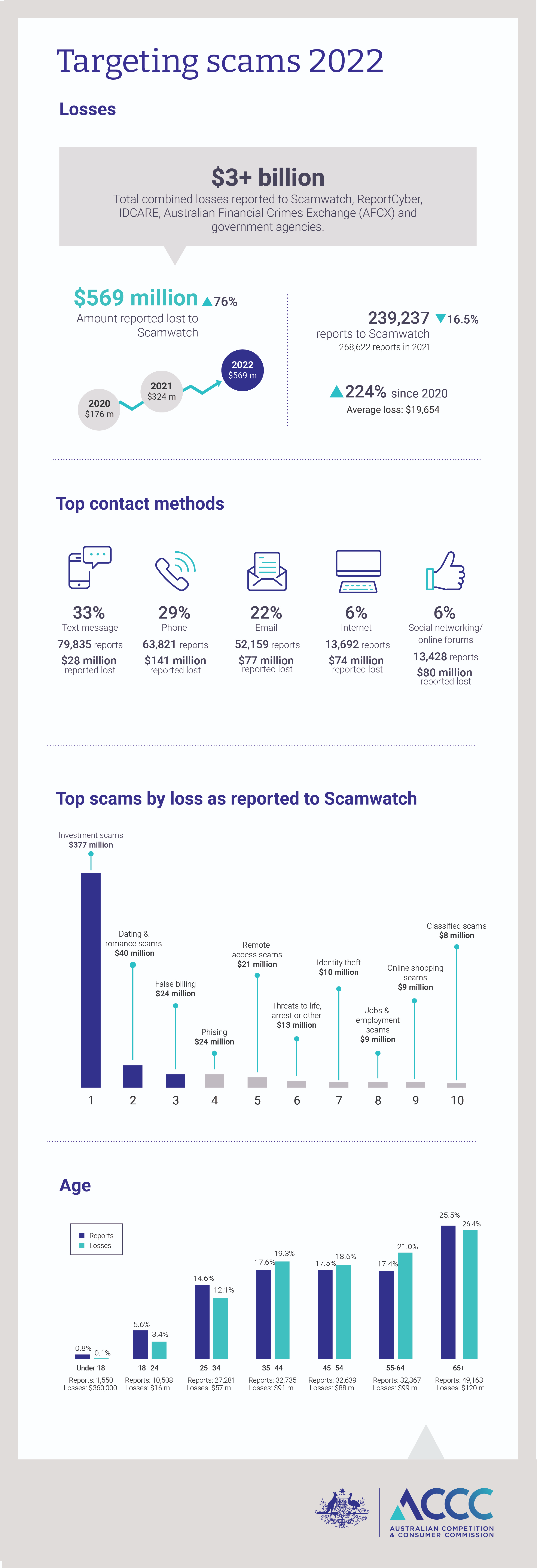
Scamwatch received 239,237 scam reports last year, a 16.5 per cent drop on the number of reports received in 2021.
However, financial losses reported to Scamwatch in 2022 totalled more than $569 million, a 76 per cent increase compared to losses reported in the previous year.
Despite fewer reports to Scamwatch, losses experienced by each victim rose by more than 50 per cent last year, to an average of almost $20,000.
This is due, in part, to scammers using new technology to lure and deceive victims.
“Scammers evolve quickly and unfortunately, many Australians are losing their life savings,” Ms Lowe said.
“We have seen alarming new tactics emerge which make scams incredibly difficult to detect. This includes everything from impersonating official phone numbers, email addresses and websites of legitimate organisations to scam texts that appear in the same conversation thread as genuine messages. This means now more than ever, anyone can fall victim to a scam.”
“There has been an explosion of reported losses to phishing scams in the past year, such as “Hi Mum” and Toll/Linkt text scams, which skyrocketed by 469 per cent to $24.6 million in 2022,” Ms Lowe said.
Collaborative efforts increase
Millions of Australians became more vulnerable to scams in 2022, following a spate of large-scale, high-profile data breaches late last year.
“Scammers are the most opportunistic of all criminals. Unfortunately, the more information a scammer has about you, the more convincing they can be,” Ms Lowe said.
“In the weeks after the data breaches, there were hundreds of reports to Scamwatch, including reports of scammers impersonating government departments and businesses to carry out identity theft and remote access scams.”
“While this brought about unprecedented collaboration across government, law enforcement and industry to share information and disrupt scams, there is still more work to be done,” Ms Lowe said.
“Unfortunately, there are still significant gaps between and within the key sectors – banks, telcos and digital platforms; and between regulators that scammers exploit to steal money from customers. So we would like to see initiatives that apply across the sectors, knowing that scammers will target the weakest link.”
The ACCC continues to advocate for a three-pronged approach to tackling scams.
“First, we need to stop scammers reaching consumers by disrupting phone calls, SMS, email, social media messaging or other ways in which scammers contact would-be victims. Second, we need to make sure consumers are supported with up-to-date information so they have the best chance of spotting a scammer when contacted. Finally, we need effective measures in place to prevent funds being transferred to scammers,” Ms Lowe said.
People experiencing vulnerability suffered record financial losses
In 2022, Australians that may have been experiencing vulnerability or hardship reported record losses.
People with a disability reported financial losses of $33.7 million, a 71 per cent increase compared to 2021.
Indigenous Australians also reported losses of $5.1 million (up five per cent compared to 2021) to Scamwatch, while the median loss for Indigenous Australian scam victims rose to $754, from $650 reported in 2021.
People from culturally and linguistically diverse communities made 11,418 scam reports which resulted in losses of $56 million, up 36 per cent compared to 2021.
“We are very concerned that people experiencing vulnerability continue to be disproportionally impacted by scams,” Ms Lowe said.
“Our report shows that people from culturally and linguistically diverse communities were significantly over-represented in terms of financial losses across a range of scam-types, accounting for more than one quarter (27.9%) of total losses associated with identity theft and about a third (32.7%) of all losses to pyramid schemes.”
“This is a worrying trend that urgently needs to be addressed by both government and industry with input from consumer advocacy groups.”
“Traditional bank transfers remain one of the most commonly reported payment methods to scammers. While some banks have made recent positive steps to protect their customers, we would welcome uniform measures across the sector, similar to the UK’s Confirmation of Payee, which matches an account number to the intended recipient across all banks,” Ms Lowe said.
Small and micro business’ losses doubled in 2022
Scamwatch data shows that small and micro businesses lost $13.7 million to scams in 2022, a 95 per cent increase compared to the previous year. The biggest contributor to these losses were payment redirection scams, also known as business email compromise.
More broadly, there was a 73 per cent increase in scam losses across the Australian business community last year, totalling $23.2 million.
Top tips for avoiding scams
- Stop – take your time before giving money or personal information.
- Think – ask yourself if the message or call could be fake?
- Protect – act quickly if something feels wrong. Contact your bank and report scams to Scamwatch.
Background
The ACCC-run Scamwatch aims to raise awareness about how to recognise, avoid and report scams. It also shares intelligence and works with government, law enforcement and the private sector to disrupt and prevent scams.
Reference to combined reports or losses include data from Scamwatch, ReportCyber, IDCARE, financial institutions and other government agencies. Adjustments were made to avoid counting reports or losses multiple times.
The report otherwise uses Scamwatch data, which is based on phone and web reports made to Scamwatch between 1 January and 31 December 2022. The next Targeting Scams report will move to a financial year reporting cycle from 1 July 2023.
In the October budget, the ACCC received seed funding from the government to scope and plan for a new National Anti-Scam Centre to support the community in the fight against scams.
Reports to Scamwatch
Scamwatch received 239,237 scam reports last year, a 16.5 per cent drop on the number of reports received in 2021.
However, financial losses reported to Scamwatch in 2022 totalled more than $569 million, a 76 per cent increase compared to losses reported in the previous year.
Despite fewer reports to Scamwatch, losses experienced by each victim rose by more than 50 per cent last year, to an average of almost $20,000.
This is due, in part, to scammers using new technology to lure and deceive victims.
“Scammers evolve quickly and unfortunately, many Australians are losing their life savings,” Ms Lowe said.
“We have seen alarming new tactics emerge which make scams incredibly difficult to detect. This includes everything from impersonating official phone numbers, email addresses and websites of legitimate organisations to scam texts that appear in the same conversation thread as genuine messages. This means now more than ever, anyone can fall victim to a scam.”
“There has been an explosion of reported losses to phishing scams in the past year, such as “Hi Mum” and Toll/Linkt text scams, which skyrocketed by 469 per cent to $24.6 million in 2022,” Ms Lowe said.
Collaborative efforts increase
Millions of Australians became more vulnerable to scams in 2022, following a spate of large-scale, high-profile data breaches late last year.
“Scammers are the most opportunistic of all criminals. Unfortunately, the more information a scammer has about you, the more convincing they can be,” Ms Lowe said.
“In the weeks after the data breaches, there were hundreds of reports to Scamwatch, including reports of scammers impersonating government departments and businesses to carry out identity theft and remote access scams.”
“While this brought about unprecedented collaboration across government, law enforcement and industry to share information and disrupt scams, there is still more work to be done,” Ms Lowe said.
“Unfortunately, there are still significant gaps between and within the key sectors – banks, telcos and digital platforms; and between regulators that scammers exploit to steal money from customers. So we would like to see initiatives that apply across the sectors, knowing that scammers will target the weakest link.”
The ACCC continues to advocate for a three-pronged approach to tackling scams.
“First, we need to stop scammers reaching consumers by disrupting phone calls, SMS, email, social media messaging or other ways in which scammers contact would-be victims. Second, we need to make sure consumers are supported with up-to-date information so they have the best chance of spotting a scammer when contacted. Finally, we need effective measures in place to prevent funds being transferred to scammers,” Ms Lowe said.
People experiencing vulnerability suffered record financial losses
In 2022, Australians that may have been experiencing vulnerability or hardship reported record losses.
People with a disability reported financial losses of $33.7 million, a 71 per cent increase compared to 2021.
Indigenous Australians also reported losses of $5.1 million (up five per cent compared to 2021) to Scamwatch, while the median loss for Indigenous Australian scam victims rose to $754, from $650 reported in 2021.
People from culturally and linguistically diverse communities made 11,418 scam reports which resulted in losses of $56 million, up 36 per cent compared to 2021.
“We are very concerned that people experiencing vulnerability continue to be disproportionally impacted by scams,” Ms Lowe said.
“Our report shows that people from culturally and linguistically diverse communities were significantly over-represented in terms of financial losses across a range of scam-types, accounting for more than one quarter (27.9%) of total losses associated with identity theft and about a third (32.7%) of all losses to pyramid schemes.”
“This is a worrying trend that urgently needs to be addressed by both government and industry with input from consumer advocacy groups.”
“Traditional bank transfers remain one of the most commonly reported payment methods to scammers. While some banks have made recent positive steps to protect their customers, we would welcome uniform measures across the sector, similar to the UK’s Confirmation of Payee, which matches an account number to the intended recipient across all banks,” Ms Lowe said.
Small and micro business’ losses doubled in 2022
Scamwatch data shows that small and micro businesses lost $13.7 million to scams in 2022, a 95 per cent increase compared to the previous year. The biggest contributor to these losses were payment redirection scams, also known as business email compromise.
More broadly, there was a 73 per cent increase in scam losses across the Australian business community last year, totalling $23.2 million.
Top tips for avoiding scams
- Stop – take your time before giving money or personal information.
- Think – ask yourself if the message or call could be fake?
- Protect – act quickly if something feels wrong. Contact your bank and report scams to Scamwatch.
Background
The ACCC-run Scamwatch aims to raise awareness about how to recognise, avoid and report scams. It also shares intelligence and works with government, law enforcement and the private sector to disrupt and prevent scams.
Reference to combined reports or losses include data from Scamwatch, ReportCyber, IDCARE, financial institutions and other government agencies. Adjustments were made to avoid counting reports or losses multiple times.
The report otherwise uses Scamwatch data, which is based on phone and web reports made to Scamwatch between 1 January and 31 December 2022. The next Targeting Scams report will move to a financial year reporting cycle from 1 July 2023.
In the October budget, the ACCC received seed funding from the government to scope and plan for a new National Anti-Scam Centre to support the community in the fight against scams.


All Comments