

In our previous article, we mentioned several issues that are currently unclear in the Account Abstraction (AA) ecosystem, including a risk in the way Bundler processes UserOperations. The risk is that if a user sends UserOperations with the same nonce to two Bundlers at the same time and the two Bundlers submit the transactions in the same block, one transaction will fail. In this case, the failed Bundler will have paid a small amount of gas cost for nothing.
In this article, I will talk about this issue in detail and it can be inferred that after the public mempool appears, the game state will be changed between Bundlers.
What Happens Exactly
To best showcase the problem, we did a test on Polygon Mumbai following these steps,
- Prepare an already deployed contract wallet
- Deposit enough fund for gas of multiple UserOperations
- Construct a UserOperation with a short calldata and no Paymaster or Aggregator, to keep it simple.
- Send this UserOperation with the same nonce to two different Bundlers at the same time. Check the EntryPoint contract history to see the transactions sent by these two Bundlers.
The table below lists some details of the two transactions. (Transaction 1; Transaction 2)
| Specs | Bundler A | Bundler B |
| Transaction Hash | 0x05d386daa07178fe5607f95fb737436e2366f58895888c713ad45e119e2084f0 | 0x74647798233177d8259039b3e5245f1f9f69885db417aa1a7d9ce33728316edb |
| Status | Success | Fail |
| From(Bundler) | 0xb6f005dec7800a7421b2a7a82270d6d7bb7bcd5a | 0x4337003fcd2f56de3977ccb806383e9161628d0e |
| UserOperation Nonce | 3 | 3 |
| Sender | 0xfE3c3675f677A2e61027d949D6A917eCE8057b1b | 0xfE3c3675f677A2e61027d949D6A917eCE8057b1b |
| Gas (Matic) | 0.00350128 | 0.0000728 |
| Gas Usage | 87,532 | 72,819 |
| Repaid from EntryPoint | 0.003782 | |
| Profit | 0.00028 | -0.0000728 |
Table 1. Two bundlers send transaction with a same UserOperation
Here is what happened for both bundlers. After receiving the UserOperation, each bundler simulated it based on the current blockchain state. Each was successful because there is enough gas in the wallet contract, calldata is fine, nonce is correct. Based on the gas calculation, this UserOperation is profitable. So they submitted it on-chain in a transaction respectively.
Next, a problem occurred because the EVM processes transactions in a linear manner, so these two transactions must have a sequence, with one transaction being processed before the other. When the first transaction was completed, the EVM found that the nonce of the UserOperation was incorrect when processing the second transaction, so the second transaction was reverted. Consequently, the two Bundlers obtained completely different results. As shown in the table above, the first Bundler earned 0.00028 Matic, while the second Bundler lost 0.0000728 Matic. The following chart shows the workflow.
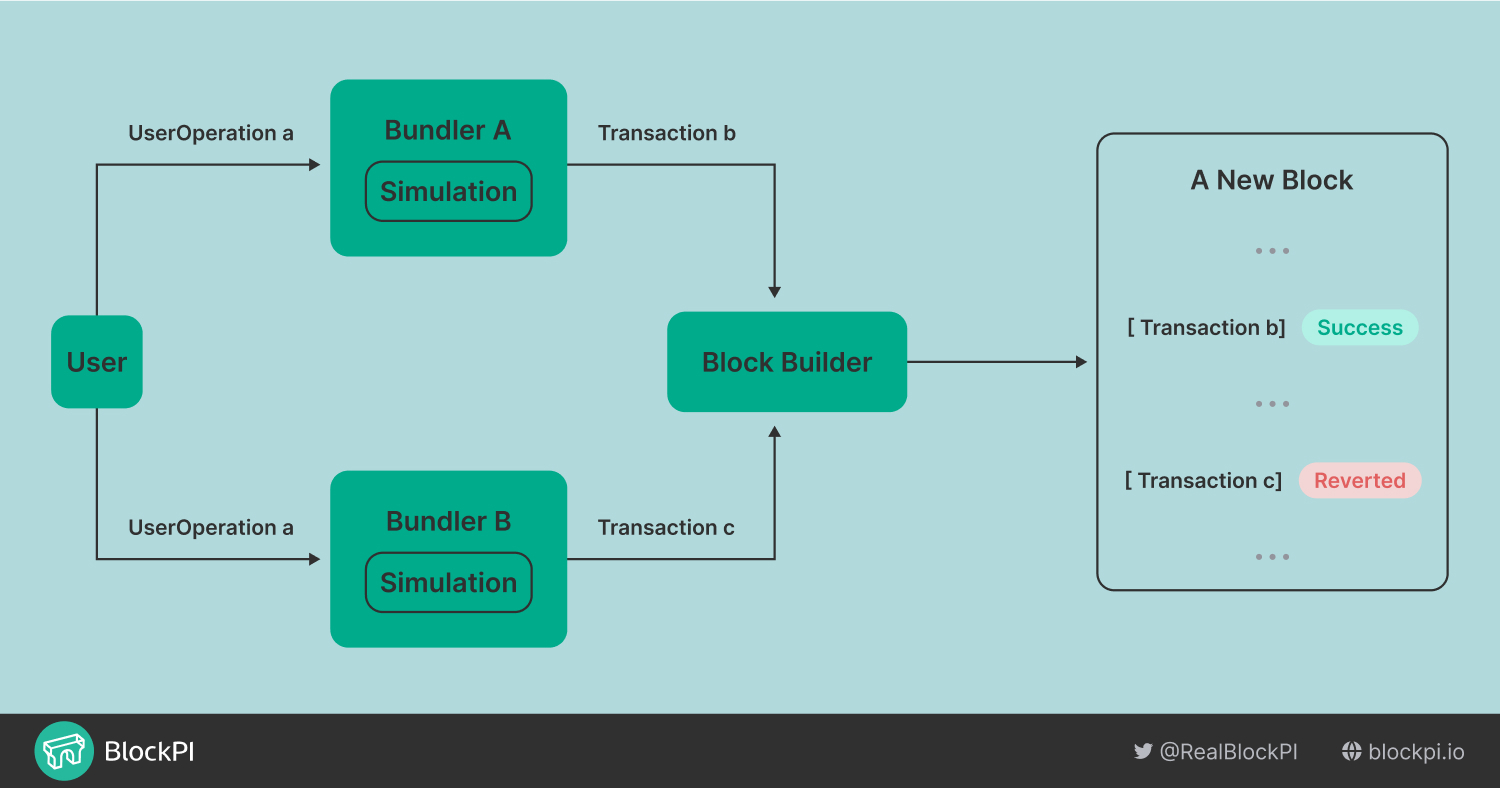
This is just a gas loss from the failed transaction (a bundle) with one UserOperation. What if the transaction includes more UserOperation? Here is another test’s result. Following the same steps of the previous test, except each bundler sent a transaction including two UserOperations instead of one. (Transaction 1; Transaction 2) The first UserOperation of Bundler A is identical from the first one of Bundler B. To be specific, as long as they have the same sender and nonce, the problem happens. We found that the entire transaction failed, which caused the bundler to pay all of the gas for nothing. Compared to the transaction with a single UserOperation, the gas increased by 5408, and the other executable UserOperation in the same transaction was not executed on-chain either. So, this transaction not only caused more economic losses to the bundler, but also caused time losses to another user.
| Specs | Bundler A | Bundler B |
| Transaction Hash | 0xe321b8c49d3ff8081a0d2589d02c8f71e20f2c0b00f6a6b6575dd2368907b47e | 0xe310a2c3a15edbed8db7989be4f4066a2fa3ea074c8aae95c42acff14fea0508 |
| Status | Success | Fail |
| From(Bundler) | 0xb6f005dec7800a7421b2a7a82270d6d7bb7bcd5a | 0xfde90001829909d3ae82bec5a5e704d134624c3e |
| Sender 1 | 0xea663B7d161b53Cf7a46035c2790fE19240f5CB2 | 0xea663B7d161b53Cf7a46035c2790fE19240f5CB2 |
| Sender 1 UserOperation Nonce | 12 | 12 |
| Sender 2 | 0x4333bF7e6927E38eAf2ED6e72d6956eb659faD64 | 0xA71A9a5128C0629FA89d7027FFB7F9eE97D7db1d |
| Gas (Matic) | 0.0114 | 0.00625 |
| Gas Usage | 142,675 | 78,227 |
| Repaid from EntryPoint | 0.0149 | |
| Profit | 0.0035 | -0.00625 |
Table 2. Two bundlers send a transaction with two UserOperations, one of which is same
The calldata is the same and pretty simple in the tests here. If those UserOperations were more complex, involved more interacting contracts or had more content themselves, then the gas loss would be even higher. On the other hand, imagine that when AA becomes more popular, Bundlers will bundle more UserOperations together. If a revert occurs, the gas loss will be even greater. The table below shows the gas of the failed transaction containing one duplicated UserOperation of increasing numbers of UserOperations in which the calldata is as same as the tests done above.
| No. of UserOps in one transaction | Gas of the failed transaction |
| 1 | 72,819 |
| 2 | 78,227 |
| 3 | 83,635 |
Table 3. Gas of the failed transaction containing one duplicated UserOperation
Dark Forest or Open Field
The vulnerability mentioned above can be exploited as a UserOperation nonce collision attack. And this must be prevented. Here, we have come up with two solutions when there is no public mempool yet.
Pre Public Mempool
A more direct method is for Bundlers to proactively disable the sender or IP address of the UserOperation after a revert occurs. However, there are two issues with this approach. First, banning IP addresses can lead to false positives, and attackers can change their sender and IP address. Second, the user may have unintentionally committed this action.
Another solution that we can think of is to introduce some randomness into the bundling process. Instead of immediately bundling and submitting the received UserOperation to the blockchain, the Bundler could wait for a random number of blocks (e.g., between 0 and 5 blocks) before simulating and bundling it. This makes the attack much less effective, as the attacker cannot guarantee that the Bundlers will bundle the UserOperation in the same block. The cost of the attack increases as the range of the random number increases. This solution may be feasible on high-speed chains, such as Arbitrum, where the block time is relatively short. However, on low-speed chains like Ethereum, where each block takes 12 seconds, the user experience may not be as good.
The above solutions are temporary before the public mempool is available. While there is a public mempool, the situation will change.
Post Public Mempool
After the public mempool is introduced, the most UserOperations are from this pool. There must be a mechanism to prevent multiple Bundlers from bundling the same UserOperation in the mempool. Etherspot, who developed the Skandha bundler client, is developing the p2p network of the mempool. According to Etherspot’s information, mempool will be available in August. The UserOperations to be bundled will be transmitted in this p2p network, and once bundled and processed on-chain, they will be marked and delisted. It is meaningless to send duplicate UserOperations to the mempool because it can be easily detected by the p2p network.
When a public mempool appears, multiple Bundlers will have access to the same pool of unconfirmed UserOperations. If the prototype of the mempool is just a version with basic functionalities, there is still a high chance that the UserOperation nonce collision happens when more than one bundler are trying to grab a certain UserOperation into their bundle at the same time. This is harmful for the bundlers community and thus the AA ecology.
As commented from Parthasarathy, the core developer from Etherspot, the p2p interface will be piloted in a chain that supports mev-boost/block builders. This will ensure the elimination of duplicate submissions and reduce online rejections. Marc from Candide team also told us that collaborating with block builders is by design and not optional, one cannot and should not run a bundler in the p2p mempool without a service like mevboost on a public mempool on Ethereum.
If designed this way, the bundler competition in the mempool will not be as disordered as in the dark forest. Combining each bundler's private mempool, bundlers can efficiently process the UserOperations, meanwhile achieve their maximum profit.
We believe that the development of AA will definitely go through a process of discovering and solving problems, and what we are discussing here is just one of them. After going through these developments, AA will eventually be widely adopted. As an innovative web3 infrastructure, we will continue to conduct more research and testing in the field of AA, and hope that more developers will participate in our AA community.


All Comments