

Cointime

Download App
iOS & Android

Visa deepens blockchain push with Tempo validator node launch

Visa has launched a validator node on the Tempo blockchain, taking a direct role in verifying and processing transactions on a network designed for real-time stablecoin payments.

Visa said the node is operated in-house using its own infrastructure and was developed over six months working with Tempo’s engineering team, positioning the company as an “anchor validator” alongside early participants including Stripe and Zodia Custody.

The role places Visa in the transaction validation layer, where it helps order and confirm payments while supporting network security and performance during the network’s early phase.

Tempo is a Layer 1 blockchain designed for real-time payments and stablecoin-based transactions, with validators responsible for confirming transactions and maintaining the network’s ledger.

Validators on the network can earn stablecoin-denominated rewards when selected to package transactions into blocks, according to the announcement. However, a company spokesperson told Cointelegraph that “Visa’s primary focus in this phase is on the strategic and technical role of operating a validator, rather than on economics.”

The move adds to Visa’s existing blockchain activity, including its recently announced role as a validator on the Canton Network, where it works with financial institutions on privacy-focused onchain payment systems.

Payment companies expand stablecoin infrastructure

As stablecoins gain traction in payments, major payment companies are expanding infrastructure that connects traditional finance with blockchain-based settlement.

In October 2024, Stripe finalized a $1.1 billion agreement to acquire stablecoin platform Bridge. The following year, it introduced stablecoin-based accounts for clients in more than 100 countries, allowing businesses to send, receive and hold US-dollar stablecoins similar to traditional bank balances.

Last month, Mastercard agreed to acquire stablecoin infrastructure company BVNK in a deal valued at up to $1.8 billion. BVNK enables businesses to send and receive stablecoin payments, convert between fiat and crypto, and operate across more than 130 countries.

Meanwhile, Visa has focused on building and operating its own systems. In July, the company expanded its settlement platform to support tokens such as PayPal USD 

(PYUSD)and Euro Coin (EURC), as well as networks including Stellar (XLM)and Avalanche (AVAX).

In March, it also expanded its stablecoin card partnership with Bridge to 18 countries, with plans to reach more than 100 markets by year-end.

According to DefiLlama data, stablecoin market capitalization stood at nearly $319 billion at the time of writing, up from about $307.5 billion at the start of the year.
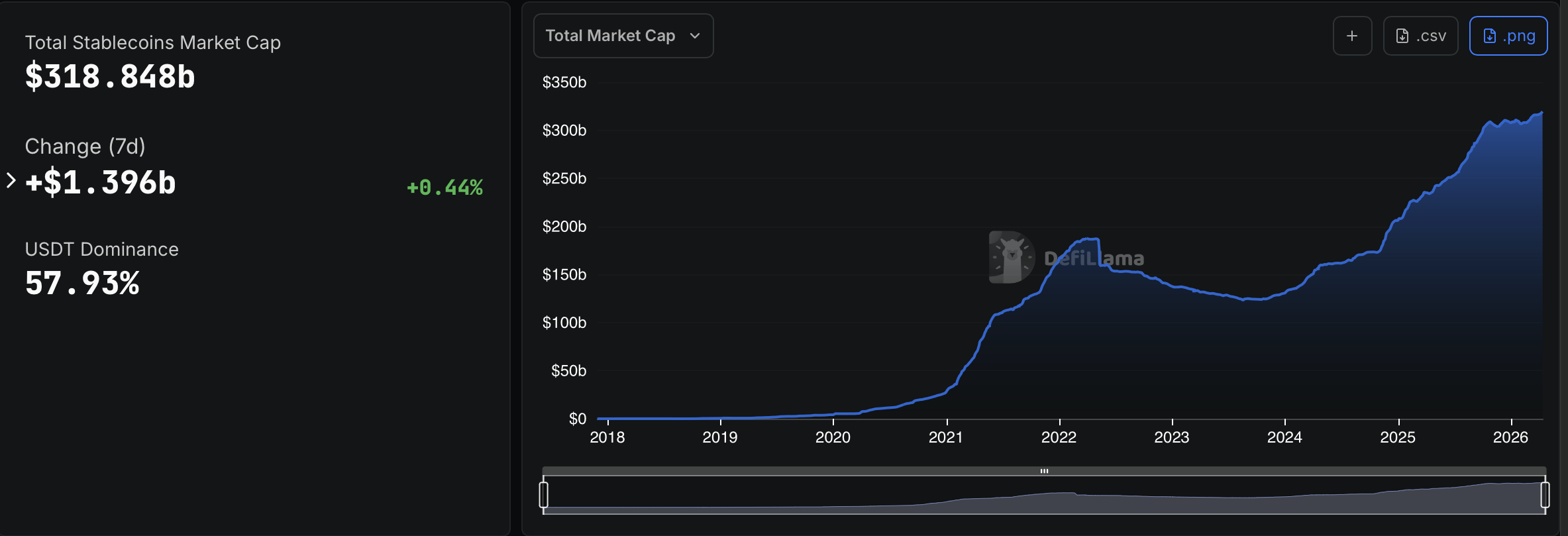
  Stablecoin market cap. Source: DefiLlama
Comments

All Comments

Recommended for you

  • BTC Surpasses $82,000

    Market data shows that BTC has surpassed $82,000, currently priced at $82,038.65, with a 24-hour increase of 0.31%. The market is experiencing significant volatility, so please ensure proper risk management.

  • ETH Surpasses $2400

    Market data shows that ETH has surpassed $2400, currently priced at $2400.26, with a 24-hour decline of 1.33%. The market is experiencing significant volatility, so please ensure proper risk management.

  • BTC Surpasses $81,000

    Market data shows that BTC has surpassed $81,000, currently priced at $81,016.34, with a 24-hour decline of 1.53%. The market is experiencing significant volatility, so please ensure proper risk management.

  • BTC Falls Below $80,000

    Market data shows that BTC has fallen below $80,000, currently priced at $79,940.09, with a 24-hour decline of 3.44%. The market is experiencing significant volatility, so please ensure proper risk management.

  • Philadelphia Semiconductor Index Set to Lose Over $2 Trillion in Market Value in Seven Trading Days

    The Philadelphia Semiconductor Index is poised to evaporate over $2 trillion in market value within seven trading days.

  • Philadelphia Semiconductor Index Drops 4% to Lowest Level in Nearly a Month

    The Philadelphia Semiconductor Index fell by 4.01% during the day, currently reported at 11,215.37 points. Nvidia dropped by 3.25%, Broadcom fell by 2.87%, Micron decreased by 5.79%, Intel declined by 5.81%, AMD dropped by 6.28%, Qualcomm rose by 0.66%, TSMC fell by 4.37%, and ASML decreased by 3.34%.

  • Philadelphia Semiconductor Index Falls 4% to Lowest Level in Nearly a Month

    The Philadelphia Semiconductor Index dropped 4.01% during the day, currently reported at 11,215.37 points. Nvidia fell by 3.25%, Broadcom by 2.87%, Micron by 5.79%, Intel by 5.81%, AMD by 6.28%, Qualcomm rose by 0.66%, TSMC fell by 4.37%, and ASML dropped by 3.34%.

  • Ripple Prime Launches Perpetual Contract Trading Services for Institutional Clients

    According to Bloomberg, Ripple's main brokerage division, Ripple Prime, is launching perpetual contracts for real-world assets (RWA) aimed at institutional clients, covering over 100 reference markets including stocks, indices, ETFs, and commodities. This product is offered through Trade.xyz on Hyperliquid, continuing Ripple Prime's previous initiative to provide clients with access to cryptocurrency perpetual contract trading.

  • NYC Comptroller Urges Anthropic to Pause IPO Plans

    On October 15, New York City Comptroller Mark Levine stated in an interview that he has written to Anthropic CEO Dario Amodei, urging the company to suspend its planned initial public offering (IPO). In the letter, he called for Anthropic to pause its IPO plans until it can fully and transparently address concerns related to AI safety, governance, and development that the company itself has raised. Levine wrote that the company should focus on mitigating these risks rather than advancing the IPO. Currently, New York City has an investment exposure of less than $10 million in Anthropic through the private market.

  • US September PPI Rises 6.3% Year-on-Year, Exceeding Market Expectations

    The US Producer Price Index (PPI) for September recorded a year-on-year increase of 6.3%, the highest since May 2026, surpassing market expectations of 5.3%. The month-on-month PPI for September was reported at 1.3%, significantly higher than the market forecast of 0.5%. Additionally, US retail sales for September showed a month-on-month increase of 0.8%, also exceeding market expectations.
