

PMF stands for Product-Market Fit, which refers to the degree of alignment between a product and market demand. Specifically, PMF is achieved when a product meets market needs and gains user acceptance. Typically, when a product successfully fulfills market demand and users provide positive feedback and experiences, it can be said to have achieved PMF. This means that the product's features, characteristics, and value align closely with user needs and expectations, and users are willing to purchase and continue using the product.
The first step in achieving PMF is identifying market demand. While finding a market with high demand may not be overly challenging — for instance, the DeFi sector is currently popular due to widespread trading needs — launching a DeFi project does not guarantee immediate PMF. Challenges arise in effectively selling your project/product to the market.
Successfully achieving PMF goes beyond identifying market demand. As mentioned earlier, the DeFi sector is highly competitive, with numerous projects emerging daily. If your product is one among many DeFi projects, what can you do to stand out? How can you ensure that users choose your product over others? This requires effective packaging of your product.
Standing out among numerous projects first requires clear product positioning. Product positioning is a crucial concept in marketing. It defines the impression and position of a product or brand in the minds of consumers, helping businesses find the unique selling points of the product and convey them to the target market.
Determining the product's positioning can be encapsulated in a slogan or a statement. Whatever the form, the content should be concise, clearly conveying the product's uniqueness and core value, allowing users to remember and understand your product at a glance.
Sometimes, having a clear product positioning in the market is more important than having more comprehensive features, a richer ecosystem, or faster feature updates. For instance, Uniswap is always the first DEX mentioned in discussions about decentralized exchanges. Despite supporting fewer chains compared to other competitors in the same sector and releasing only one update per year, Uniswap still holds 47% of the DEX trading market share. Apart from the first-mover advantage, Uniswap's strong positioning as a trading platform has been crucial.
In addition to considering product positioning, you can enrich product packaging by highlighting aspects such as team members, VC support, and the roadmap. The team behind the product and its supporters are essential packaging factors. Having a strong, experienced team, along with support from reputable investors, can increase user trust and favorability toward the product. Moreover, a clear and concise roadmap is vital for demonstrating the product's future development direction and plans to users.
Once you've established the product positioning, it's essential to package the product from two aspects: data and assets. For projects that have already issued tokens, data and assets complement each other. Improving product data means more users expect from the project, leading to an increase in asset holders and transactions, resulting in data growth, forming a virtuous cycle.
For projects that haven't issued tokens, packaging the product involves selling the future by outlining what's to come, thereby raising user expectations. In Web3, user expectations come from and are reflected in data.
Collecting user feedback and improving product experience at the product level increases users' willingness to use the product, leading to data growth. But what about methods from an operational standpoint?
Collaborating with businesses or brands in related industries to hold joint campaigns can attract more target users' attention and participation through cross-industry cooperation. Joint campaigns are common means to enhance product data and awareness in both Web2 and Web3:
In Web2, joint campaigns are ubiquitous:
In the fashion industry: Collaborations between Nike and Jacquemus, Gucci and The North Face, LV and Yayoi Kusama, and UNIQLO's collaborations with various well-known IPs.
In the tea beverage sector: A plethora of joint campaigns were launched by various milk tea or coffee brands in 2023, each featuring limited edition beverages in collaboration with popular IPs, with a new one appearing every three days on average.
The proliferation of joint campaigns across major brands and different sectors underscores the fact that collaborations between brands can boost sales. Joint campaigns can help promote your product.
Although industries may differ, the survival principles of products exhibit a certain consistency. The experiences gleaned from Web2 products based on quantity and duration of time can similarly apply to Web3. Is there data that can concretely demonstrate the effectiveness of joint campaigns?
We can refer to the data of Rhino.fi at different periods:
This table references Rhino.fi's SNS engagement data during normal periods and during campaign launches, along with corresponding participation numbers, to give a rough understanding of the sales audience a successful joint campaign can help a project reach.
| Item | Engagement Data | Participants |
| Normal Times | 4.6 ~ 10k | / |
| During Events | 24k+ | No data |
| Activity on Growth Platforms (non-joint) | 95.5k+ | 600+ |
| Joint campaigns on TaskOn(Growth Platform) | 120k+ | 25.7k+ |
Currently, some projects operate at the community level, creating groups on platforms like Telegram and Discord to facilitate member interactions, which can be considered community building.
However, community building can be more immersive. A community is not just a place for users to exchange opinions but also serves as a bridge between users and the project, facilitating user experience within the project's ecosystem. Successful projects rely heavily on community support.
Regarding how to build a community, the challenges faced at different stages may vary. I won't delve into them here, but you can refer to the following articles:
Web3 Community Growth Strategies: How to Build a Successful Community
Building a Successful Web3 Community: Healthy Growth
As mentioned earlier, data and assets are complementary. So how can projects leverage assets to get closer to PMF?
For projects that have issued tokens, activities can not only boost product data but also promote transactions and increase asset liquidity through user behavior. For example, including trading tasks directly in activities can achieve this. This approach is common in both centralized and decentralized exchanges (CEX and DEX), such as the trading competitions often launched by exchanges after listing new tokens.

For projects that haven't issued tokens yet, users often have expectations for Token Generation Events (TGE). But is there an alternative before TGE that can temporarily replace the role of assets?
Points.
With Blast breaking through the L2 landscape through the point system, more and more projects are adopting it:
- StakeStone and Scroll jointly launched cross-chain point activities where users can query accumulated points through the Scroll point system.
- Entangle introduced a point program to incentivize users to stake NGL tokens.
- Bitget Wallet completed the issuance and verification of platform token BWB points, with an exchange ratio of 4.1 BWB Points: 1 BWB.
With the increasing demand for points, there are even projects speculating on the points market, supporting users to trade points of projects before TGE.
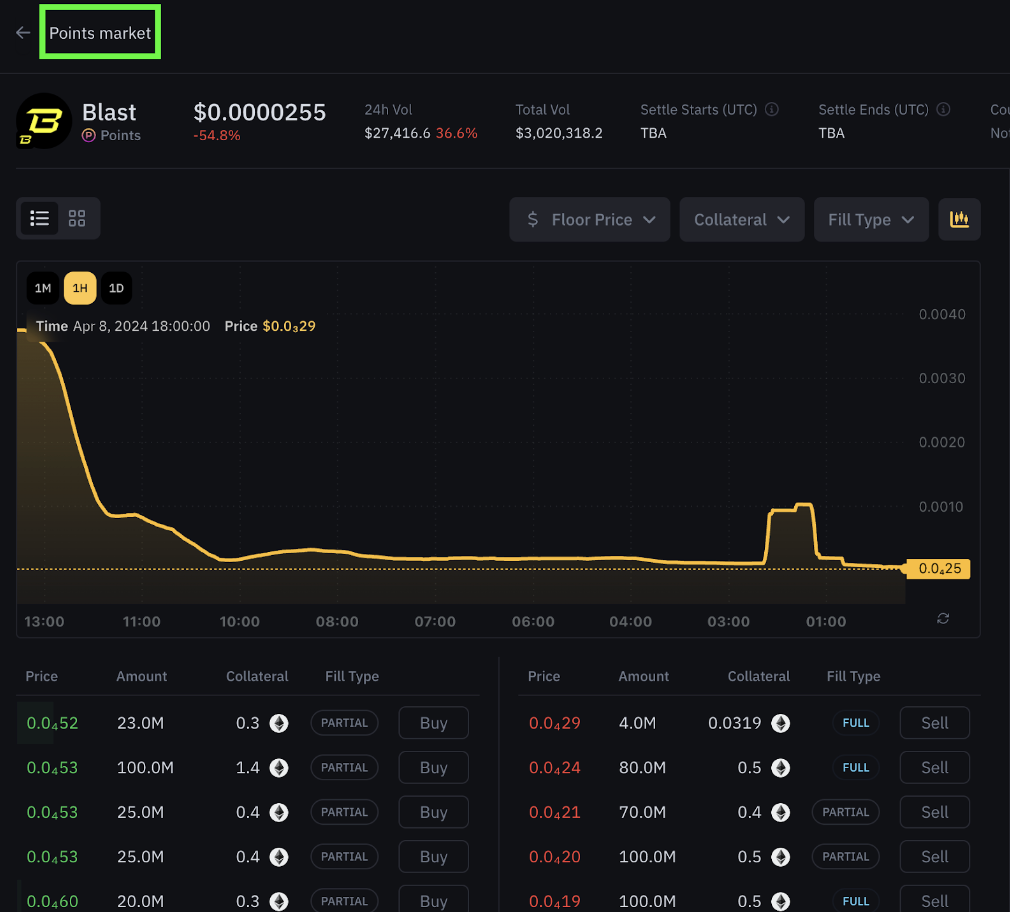
With the points trading market fully established, are there tools that support the rapid setup of point systems?
Growth platforms offer comprehensive solutions.
For example, Bitget Wallet has launched its own community on TaskOn, introducing the project's point system.
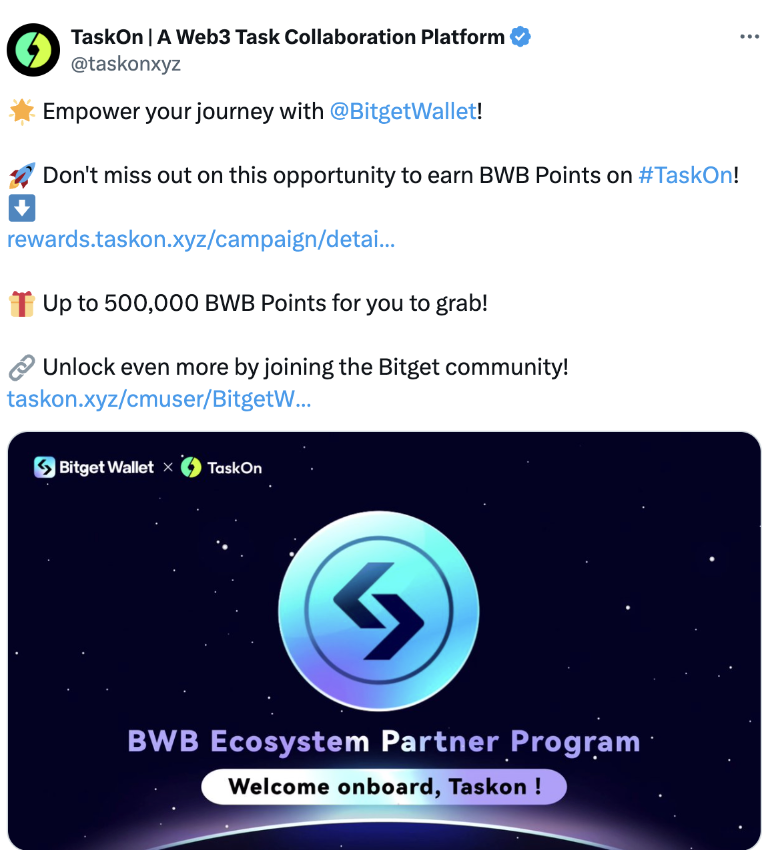
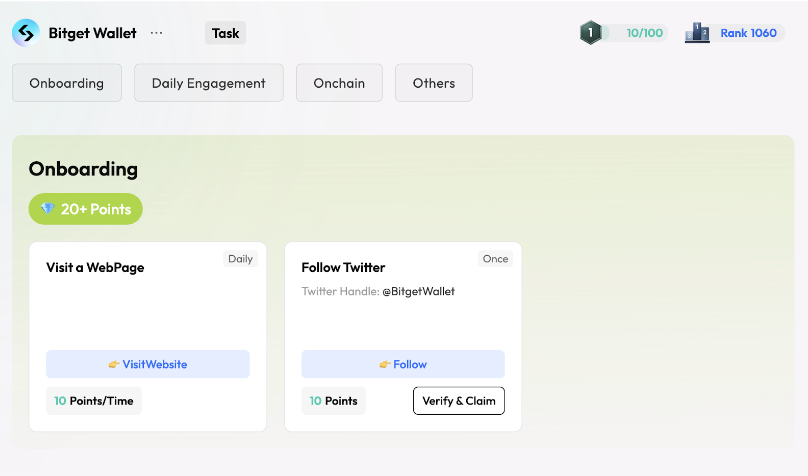
Creating anticipation among users for a project is crucial, as anticipation leads to action, ultimately achieving PMF. Joint campaigns, community building, and point systems are all powerful tools for enhancing product data and asset liquidity, thereby increasing user anticipation.


All Comments