
Cointime

Download App
iOS & Android

Lazarus-linked macOS malware hits crypto and fintech firms

Validated Media

Security researchers have linked a new macOS malware campaign to the Lazarus Group, the North Korea-linked hacking operation behind some of the crypto industry’s biggest thefts.

Flagged on Tuesday, the new “Mach-O Man” malware kit is distributed via “ClickFix” social engineering schemes across traditional businesses and crypto companies, according to Mauro Eldritch, offensive security expert and founder of threat intelligence company BCA Ltd.

Victims are lured into a fake Zoom or Google Meet call where they are prompted to execute commands that download the malware in the background, allowing attackers to bypass traditional controls without detection to gain access to credentials and corporate systems, the security researcher said in a Tuesday report.

Researchers said the campaign can lead to account takeovers, unauthorized infrastructure access, financial losses and the exposure of critical data, underscoring how Lazarus continues to expand its targeting beyond crypto-native companies.

The Lazarus Group is the main suspect in some of the largest-ever cryptocurrency hacks, including the $1.4 billion hack of Bybit exchange in 2025, the industry’s largest so far. 
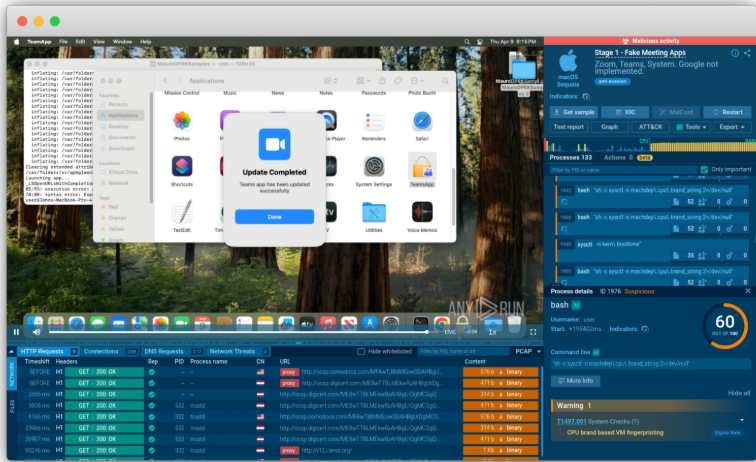
Fake Mach-O Man Kit apps. Source: ANY.RUN


Mach-o Man kit seeks to implement hidden stealer malware

The final stage of the campaign is a stealer designed to extract browser extension data, stored browser credentials, cookies, macOS Keychain entries and other sensitive information from infected devices.
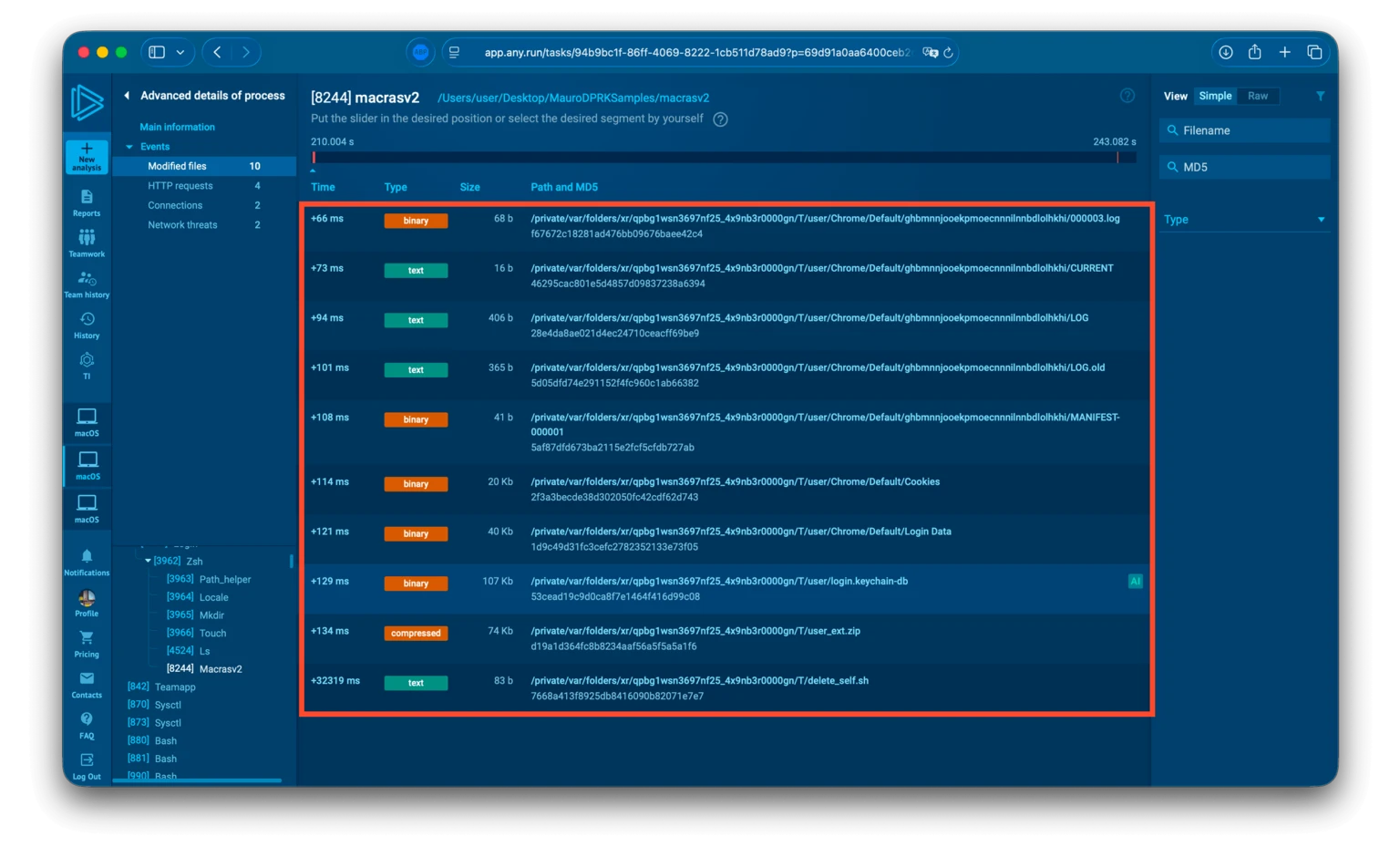
Final staging director for stealer malware. Source: Any.run


After collection, the data is archived into a zip file and exfiltrated through Telegram to the attackers. Finally, the malware’s self-deletion script removes the entire kit using the system’s rm command, which bypasses user confirmation and permissions when removing files.

The novel malware kit was reconstructed by the security expert through cloud-based malware sandbox Any.run’s macOS analysis capabilities.

Earlier in April, North Korean hackers used AI-enabled social engineering schemes to steal about $100,000 worth of funds from crypto wallet Zerion, after gaining access to some team members’ logged-in sessions, credentials and the company’s private keys, Cointelegraph reported on April 15. 

Comments

All Comments

Recommended for you

  • Hang Seng Tech Index Declines by 1%

    On October 21, the Hang Seng Tech Index saw its decline widen to 1%, while the Hang Seng Index fell by 0.7%. Kuaishou Technology dropped over 12%, and CATL fell by more than 11%.

  • UK Government Debt Exceeds £3 Trillion for the First Time

    On October 21, the UK government's borrowing in the first six months of this fiscal year exceeded expectations, highlighting the constraints faced by Chancellor of the Exchequer Jeremy Hunt ahead of his first budget announcement next week. From April to September, the UK's fiscal deficit widened to £97.8 billion (approximately $130 billion), which is £6 billion higher than the forecast made by the Office for Budget Responsibility (OBR) in March. In September, government borrowing reached £24.5 billion, surpassing both the OBR's predictions and the levels from the same period last year. This set of data reflects the latest state of public finances ahead of the budget announcement on October 28, where Hunt must outline the policy direction for Prime Minister Rishi Sunak's new government while avoiding panic in the bond market, as concerns grow over the high level of UK government debt. The total UK government debt has now exceeded £3 trillion for the first time. Despite the UK economy demonstrating strong resilience against energy shocks caused by the Middle East conflict and tax revenues exceeding OBR forecasts, government borrowing has still been higher than expected for the fiscal year 2025 to 2026 so far.

  • Oman Crude Premium to Dubai Falls to Nearly 3-Month Low as Middle East Oil Exports Remain Resilient

    On October 21, a key crude oil benchmark in the Middle East dropped to its lowest level in nearly three months, indicating that despite escalating attacks on shipping by Iran, the region's oil exports are showing strong resilience. According to General Index data, this week, the premium of Oman crude over Dubai crude fell to around $4 per barrel, the lowest level since late July. This price difference reflects the strength of the physical crude oil market in the Gulf region. In the early stages of the conflict, this premium soared to over $60 per barrel as the Strait of Hormuz was nearly closed. Despite the risk of attacks, major oil-exporting countries in the Middle East have successfully allowed more tankers to pass through the waterway or completely bypassed the Strait of Hormuz via pipelines. These efforts have weakened Iran's attempts to leverage its position by disrupting global energy flows.

  • Korean Stocks Close Up Over 3%

    On October 21, the South Korean KOSPI index closed up 182.93 points, an increase of 3.29%, reaching 5735.67 points. Samsung Electronics rose by 5.67%, while SK Hynix increased by 5.8%.

  • President Trump: Large Data Centers Must Generate Their Own Power and Benefit Communities

    On October 21, President Trump stated that newly constructed large—sometimes even giant—data centers must generate their own power and either return excess electricity to the local community or sell it to the grid. This way, electricity prices are not only unlikely to rise but may actually decrease significantly! Other relevant parties should take similar measures! If businesses want their data centers to be welcomed, they should pay 'dividends' to the community and/or individuals within the community. I have closely observed this process: data centers that were initially very unpopular in certain areas became highly favored after reaching economic compensation agreements. Reaching agreements and building data centers is greatly beneficial for the United States!

  • Two Whales Open Long Positions on Nearly 30,000 ZEC in 15 Hours on Hyperliquid

    On October 21, according to on-chain analysis platform Lookonchain, two whale addresses opened long positions totaling 29,798 ZEC with 10x leverage on Hyperliquid within the past 15 hours, valued at approximately $37.57 million. The data shows that address 0x30af…6393e opened a long position of 14,800 ZEC at an average price of $1,243.28 (approximately $18.65 million, isolated margin), while address 0xbf73…5d58 opened a long position of 15,000 ZEC at an average price of $1,217.06 (approximately $18.91 million, full margin). Based on the current price of about $1,260.5, the unrealized profits for both addresses are approximately $255,000 and $655,000, totaling about $910,000.

  • French AI Planning Software Company Pigment Raises $250 Million at $2.3 Billion Valuation

    On October 21, Bloomberg reported that French AI business planning software company Pigment announced the completion of a $250 million funding round, reaching a valuation of $2.3 billion. This round was led by Scaleup Europe Fund, with participation from Nvidia, World Innovation Lab, Iconiq, IVP, and Meritech Capital. CEO Eléonore Crespo stated that the company plans to attract Asian investors to accelerate its business expansion in Asia. Founded in 2019, Pigment primarily offers a financial and business planning platform for enterprises and has launched agentic AI features; its annual recurring revenue (ARR) has surpassed $100 million.

  • Samsung Plans to Transition Xi'an Factory to 286-Layer Flash Chip Production by 2027

    According to reports, sources indicate that Samsung plans to transition its Xi'an factory in China to the production of 286-layer flash chips by 2027. Meanwhile, SK Hynix intends to produce chips with 240 layers and above at its factory in Dalian, China. (Golden Ten)

  • Netanyahu Pushes to Restart Military Actions Against Iran, U.S. Officials Say 'No Rush'

    On October 21, the Financial Times reported that Israeli Prime Minister Benjamin Netanyahu is advocating for a resumption of large-scale military strikes against Iran. Earlier this month, he instructed the military to develop operational plans for a new wave of large-scale offensives. Three informed sources revealed that the Israeli military had previously devised a bombing operation plan lasting several days, originally scheduled to commence on the weekend of October 10, targeting civilian infrastructure such as power plants, nuclear facilities, and regime-related objectives in Iran. However, this operation was ultimately not carried out. The sources indicated that the cancellation was due to Trump's opposition to reigniting conflict before the U.S. midterm elections on November 3. The bombing operation was intended to be more intense than the joint U.S.-Israeli military actions against Iran that began in February this year. One source noted that it is 'not impossible' for Israel and Washington to restart strike actions in the coming weeks. An official stated that Israeli officials submitted an updated list of Iranian strike targets to the U.S., which included targets identified based on the latest intelligence, including civilian infrastructure that had not been struck earlier this year. However, White House Deputy Press Secretary Anna Kelly stated that Iran is in a 'very bad situation, both economically and militarily.' She pointed out that U.S. efforts to blockade Iranian ports and facilitate the export of Gulf oil through the Strait are proving effective, emphasizing that 'the U.S. will not launch any attacks on Iran before the midterm elections.' (Jin Shi)

  • US Bitcoin Spot ETF Sees Net Inflow of $23.2 Million, Ethereum Spot ETF Sees Net Outflow of $26.1 Million

    On October 21, the total net inflow for Bitcoin spot ETFs in the US was $23.2 million, with IBIT seeing a net inflow of $29.9 million, FBTC a net inflow of $3.6 million, and BITB a net outflow of $10.3 million. The total net outflow for Ethereum spot ETFs was $26.1 million, with ETHA experiencing a net outflow of $33 million, FETH a net inflow of $3.6 million, and Grayscale Ethereum Mini Trust (ETH) a net inflow of $3.3 million. (Farside)
