

Cointime

Download App
iOS & Android

Bitcoin mining difficulty falls 7.7% as miner pressure persists

Bitcoin’s mining difficulty fell by around 7.7% at the latest adjustment on March 20 to 133.79 trillion at block 941,472, the sharpest drop since February, according to CoinWarz data.

The latest move takes difficulty down from around 145 trillion in mid-March and roughly 148 trillion at the start of the year. A lower difficulty means it takes less computational work to earn the same block reward, slightly improving revenue per unit of hashrate for firms that stay online.

The adjustment followed slower-than-target block production over the prior 2,016 blocks. CloverPool data showed average block times at about 12 minutes 36 seconds, well above Bitcoin’s 10-minute target, forcing the network to recalibrate lower.

In February, difficulty dropped sharply after weather-related disruptions in the United States temporarily knocked large American mining facilities offline, and it later rebounded by about 15% as hashrate returned to the network once power conditions normalized. 

Bitcoin difficulty measures how hard it is for miners to find a valid hash for the next block and is automatically adjusted to keep issuance steady at one block every 10 minutes.

When more computing power, or hashrate, joins the network, difficulty rises to prevent blocks from being mined too quickly, while a decline in hashrate triggers a lower difficulty, making it easier for remaining miners to earn rewards. 
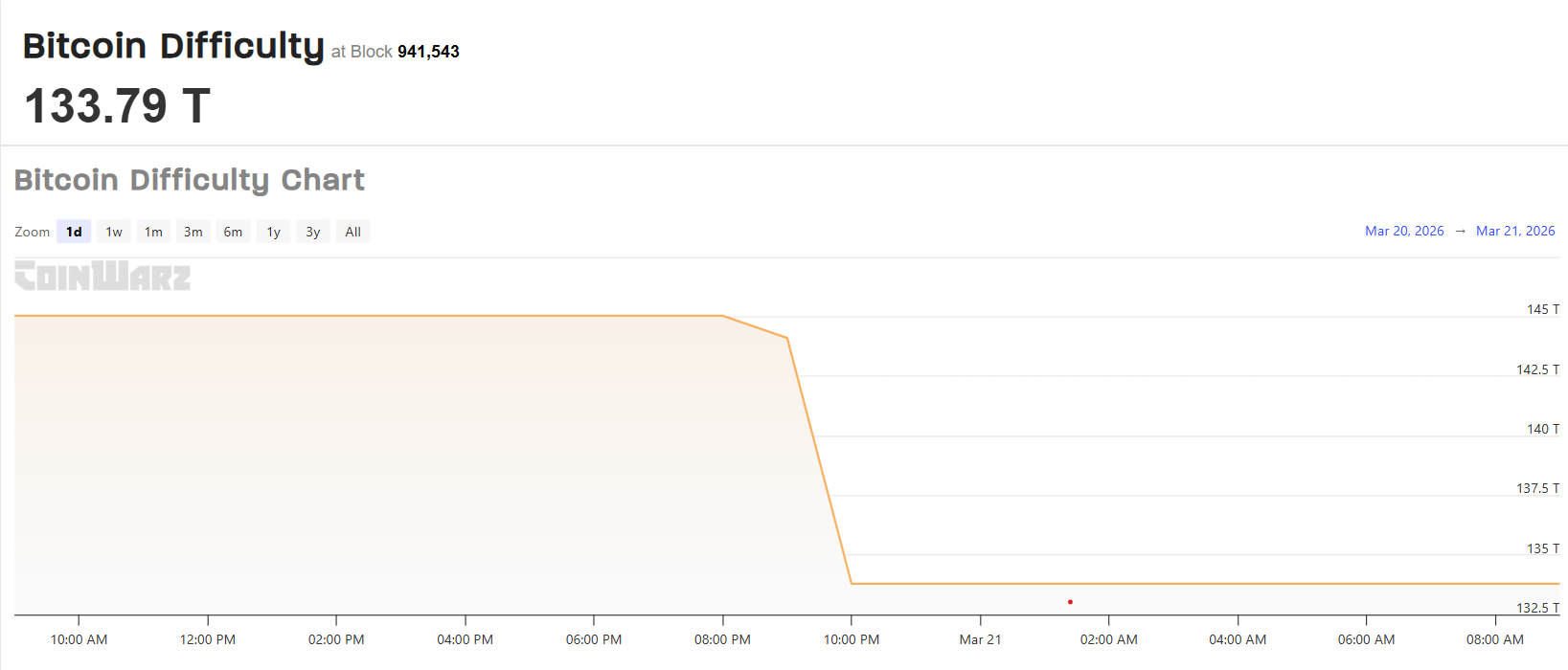
  Bitcoin difficulty drops 7.7%. Source: CoinWarz


The next difficulty adjustment is currently estimated for April 3, though that projection changes with each new block.

Miners pivot to AI as power costs bite

The difficulty reset also comes as several listed miners push further into AI and high-performance computing infrastructure in search of steadier returns on power and data-center capacity.

Last week, crypto trader Ran Neuner argued AI had become Bitcoin mining’s biggest competitor as both industries compete for electricity, even going as far as to say that “AI has killed Bitcoin forever.” 

Bitcoin miners such as Core Scientific, MARA Holdings, Hut 8 and Cipher Mining have begun reallocating capacity or pivoting toward AI workloads, while some operators have reduced hashrate or shut down less efficient rigs as profitability tightens.

On Feb 21, Bitdeer liquidated 943 BTC from reserves and sold newly mined coins, cutting corporate holdings to zero. In its latest weekly update on March 21, it confirmed that its BTC holdings remained at zero.

Comments

All Comments

Recommended for you

  • BTC Surpasses $82,000

    Market data shows that BTC has surpassed $82,000, currently priced at $82,038.65, with a 24-hour increase of 0.31%. The market is experiencing significant volatility, so please ensure proper risk management.

  • ETH Surpasses $2400

    Market data shows that ETH has surpassed $2400, currently priced at $2400.26, with a 24-hour decline of 1.33%. The market is experiencing significant volatility, so please ensure proper risk management.

  • BTC Surpasses $81,000

    Market data shows that BTC has surpassed $81,000, currently priced at $81,016.34, with a 24-hour decline of 1.53%. The market is experiencing significant volatility, so please ensure proper risk management.

  • BTC Falls Below $80,000

    Market data shows that BTC has fallen below $80,000, currently priced at $79,940.09, with a 24-hour decline of 3.44%. The market is experiencing significant volatility, so please ensure proper risk management.

  • Philadelphia Semiconductor Index Set to Lose Over $2 Trillion in Market Value in Seven Trading Days

    The Philadelphia Semiconductor Index is poised to evaporate over $2 trillion in market value within seven trading days.

  • Philadelphia Semiconductor Index Drops 4% to Lowest Level in Nearly a Month

    The Philadelphia Semiconductor Index fell by 4.01% during the day, currently reported at 11,215.37 points. Nvidia dropped by 3.25%, Broadcom fell by 2.87%, Micron decreased by 5.79%, Intel declined by 5.81%, AMD dropped by 6.28%, Qualcomm rose by 0.66%, TSMC fell by 4.37%, and ASML decreased by 3.34%.

  • Philadelphia Semiconductor Index Falls 4% to Lowest Level in Nearly a Month

    The Philadelphia Semiconductor Index dropped 4.01% during the day, currently reported at 11,215.37 points. Nvidia fell by 3.25%, Broadcom by 2.87%, Micron by 5.79%, Intel by 5.81%, AMD by 6.28%, Qualcomm rose by 0.66%, TSMC fell by 4.37%, and ASML dropped by 3.34%.

  • Ripple Prime Launches Perpetual Contract Trading Services for Institutional Clients

    According to Bloomberg, Ripple's main brokerage division, Ripple Prime, is launching perpetual contracts for real-world assets (RWA) aimed at institutional clients, covering over 100 reference markets including stocks, indices, ETFs, and commodities. This product is offered through Trade.xyz on Hyperliquid, continuing Ripple Prime's previous initiative to provide clients with access to cryptocurrency perpetual contract trading.

  • NYC Comptroller Urges Anthropic to Pause IPO Plans

    On October 15, New York City Comptroller Mark Levine stated in an interview that he has written to Anthropic CEO Dario Amodei, urging the company to suspend its planned initial public offering (IPO). In the letter, he called for Anthropic to pause its IPO plans until it can fully and transparently address concerns related to AI safety, governance, and development that the company itself has raised. Levine wrote that the company should focus on mitigating these risks rather than advancing the IPO. Currently, New York City has an investment exposure of less than $10 million in Anthropic through the private market.

  • US September PPI Rises 6.3% Year-on-Year, Exceeding Market Expectations

    The US Producer Price Index (PPI) for September recorded a year-on-year increase of 6.3%, the highest since May 2026, surpassing market expectations of 5.3%. The month-on-month PPI for September was reported at 1.3%, significantly higher than the market forecast of 0.5%. Additionally, US retail sales for September showed a month-on-month increase of 0.8%, also exceeding market expectations.
