

Social data (traffic, user base, customers) has always been the core key to the development of all projects. The traffic dilemma currently faced by Web3 is two-fold. In addition to the high learning and cognitive barriers faced by new users, which hinder incremental growth, DApps are also disconnected from Web3 communities, lacking effective channels to activate the existing user base.
This leads to a paradoxical situation in the current Web3 landscape. From the perspective of Web3 projects, the current DApps (DeFi, GameFi, NFTs, DAOs) are short of effective user acquisition methods and a unified channel to incentivize on-chain users to experience new products and services, thereby failing to achieve user expansion and promotion.
As the Web3 social sector develops, it becomes increasingly necessary for Web3 project teams to integrate more comprehensive user data to support their operational decisions. Port3 Network attempts to address this pain point. Port3 Network’s development vision is centered around building a “decentralized social data layer,” aiming to aggregate on-chain and off-chain data (both Web2 and Web3 data) to provide data-driven capabilities for Web3 applications.
SoQuest, as the first application of Port3 Network, is designed to achieve the initial data collection goals of Port3. It has now evolved into a popular Web3 Quest platform that is well-received by users, serving as an aggregator for over 1800 projects and nearly 800,000 users in the Web3 realm.
Port3: Becoming the “Web3 Social Data Oracle”
In simple terms, Port3’s development vision is to establish a decentralized social data layer. Its core objective is to create a Web3 social data oracle that assists DApps and project teams in aggregating and analyzing comprehensive on-chain and off-chain data to support their operational decisions.
On one hand, compared to native on-chain Web3 data, Web2 applications (such as Twitter, Telegram, Discord, Reddit, etc.) have non-standardized content data formats. Extracting valuable information from them is challenging, as they often require users to actively contribute data to form their “on-chain resumes.” They heavily rely on incentive mechanisms to counter users’ inherent inertia.
On the other hand, within the vast amount of on-chain data, there is a wide range of social data beyond financial scenarios like DeFi. Examples include social identities on ENS, donations on Gitcoin, articles published on Mirror, on-chain achievements on Rabbithole, data credentials on Galxe, and more.
The nature of “social” data on the blockchain differs significantly from previous “financial” data like DeFi, and it is not as easily verifiable as price data. Thus, the more complex on-chain behavioral data and the underlying social graph and connections remain largely untapped.
This results in valuable on-chain-to-on-chain data for DApps and project teams being largely untapped, limiting the attractiveness and innovation support for the application side. Port3 has built its own tools to facilitate user data acquisition, standardization, and management. It then provides an output platform for the data, along with use cases such as identity establishment, targeted marketing, analysis, Launchpad allocations, access token gatekeeping for communities, exploration of activities and bounties, and more.
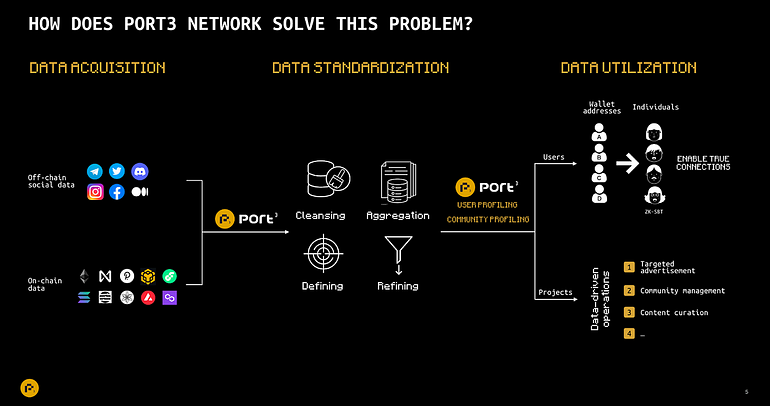
In summary, Port3’s social data infrastructure is primarily divided into three main phases: “Data Collection,” “Data Aggregation,” and “Data Application”:
- Data Collection: This phase involves gathering on-chain and off-chain data (both Web2 and Web3 data) to cover a wide range of user activities comprehensively.
- Data Aggregation: This phase encompasses a complete data processing workflow, analyzing the collected data further to compress a large amount of low-density data into usable indicators, identity tags, and other data formats.
- Data Application: This phase represents a crucial component of Port3’s infrastructure, providing support for the functionalities of upper-layer applications.
Building upon this structure, Port3 employs a combination of on-chain and off-chain global user data collection, multi-dimensional data analysis across various scenarios, and precise user engagement through multiple channels. This forms a comprehensive set of development tools to help DApps connect with users and achieve refined operations. In February 2023, Port3 Network was selected as one of the incubation projects for BNB Chain MVB V.
For DApps and project teams, all product demands that can be resolved through on-chain operations can be freely published via the task system. This approach is akin to issuing “bounty tasks,” and tasks can even be combined and gradually released in a progressive manner, aligning with the project’s entire development stage.
This signifies that Web3 project teams (DeFi, GameFi, NFTs, DAOs, etc.) can integrate with Port3 to support operational decisions with data from both Web2 and Web3 sources. Additionally, they can use SoQuest’s task platform to seamlessly and standardized release various tasks, guiding users toward their own products without requiring permissions.
Port3 Product Matrix and Ecological Architecture
Currently, Port3 has established an interconnected set of products, including the Robot Matrix, the SoQuest Task Platform, and the SoGraph Analysis Platform, among others.
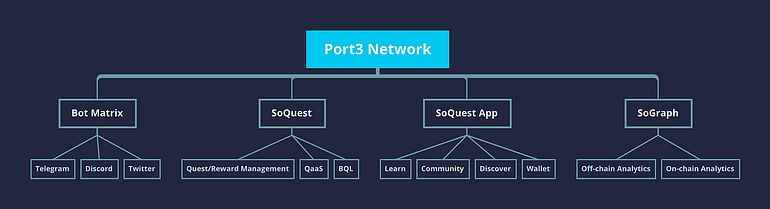
Robot Matrix
The SoQuest Robot Matrix is used for analyzing and detecting social actions related to all projects collaborating with SoQuest. Projects that wish to join the Telegram and Discord communities for off-chain tasks require robots. These robots cover over 10 public blockchains and offer functions such as token quotes, and market sentiment analysis, and even facilitate activities like Crypto airdrops and transfers between users.
The SoQuest Robot also aggregates and normalizes data scattered across various social platforms, providing organized data for project analysis. Since its launch in 2022, the robot has covered over 5,000 top-tier Web3 communities, with over 10 million users on Discord and over 4 million users on Telegram.
SoQuest, Web3 Native Quest Platform
SoQuest is an open Web3 native Quest platform. Projects, Key Opinion Leaders (KOLs), and DAO organizations create their own Spaces on the platform and initiate various on-chain and off-chain Quest activities, setting NFT or token rewards to attract participants to map data from Web2 activities to Web3. This enables projects to swiftly acquire and convert users within Web2 platforms.
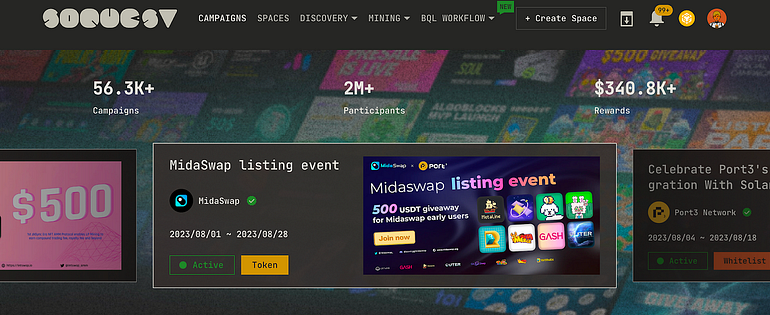
The SoQuest task platform has attracted participation from over 2 million users.
As of now, SoQuest has engaged nearly 800,000 users from over 100 countries worldwide. It supports over 16 public blockchains and has onboarded more than 1,800 projects. Port3 has also launched the SoQuest mobile application, compatible with both Android and iOS systems, aimed at building user communities and educating new users in the future.
SoGraph Analysis Platform
The SoGraph Analysis Platform combines elements of Lunarcrush and Nansen, tracking token market trends, market sentiment, interactions of Key Opinion Leaders (KOLs), and general social space activities. It primarily merges off-chain data from various Web2 social platforms with a range of on-chain data. Through machine learning and extensive data processing algorithms, this data is transformed into market-relevant indicators, member lists, social/spam activity levels, sentiment indicators, and more.
This comprehensive data can be utilized for various applications in the next phase. Diverse data applications and task incentives can attract more users to participate in the construction of the data layer, thus creating a positive feedback loop.
Continuous Innovation — QaaS and BQL
SoQuest continues to innovate in the field of Quests. In addition to the early introduction of Web3 task detection, it has recently launched new technologies and services such as the QaaS Widget and BQL.
The QaaS Widget integrates Quest’s display, detection, and analysis capabilities into a single widget, which can be embedded into the project’s own web pages for seamless integration. Project teams can monitor activity, overall project traffic growth, and conversion effects, and have a clear understanding of the funnel through the dashboard. As the competition in the Quest field enters the second half, the openness of QaaS signifies not only functionality but also the deepening capabilities of Quest services. This also marks the standardization of Quest services. Users are billed based on usage through Credits during the use of Quest features.
BQL (Blockchain Quest Language) is a language that automates complex on-chain operations. Written BQL can directly convert users into on-chain users of the project. Users only need to click to run, execute a series of on-chain interactions, and complete complex operations in a single step. This represents the ultimate form of Quests.
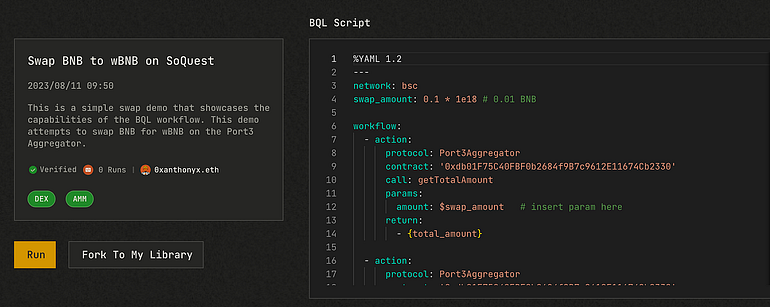
In the future, the combination of freely accessible Web2 + Web3 on-chain data (related events and data triggers) and BQL on-chain action execution can generate various interaction strategies and processes. These can be applied to a variety of scenarios, such as user conversion for project teams, interactive airdrops, on-chain arbitrage, and more. Importantly, this aligns well with the background of the AI era, as it achieves automated and intelligent control mechanisms for on-chain closed loops, serving as a precursor to on-chain AI assistants.
Financing and Project Roadmap
In February of this year, Port3 Network successfully raised $3 million in seed funding, led by KuCoin Ventures, with participation from Jump Crypto, SNZ, Adaverse, Block Infinity, Paramita, ViaBTC, Cryptonite, Lapin Digital, Cogitent, and Momentum6.
According to the official roadmap disclosed, Port3 Network plans to launch a mining mechanism in the third quarter, distributing Gemstone rewards to loyal users. Additionally, the ecosystem will be further enriched, data sources expanded, and DeFi component development improved. The adoption across multiple chains will also steadily expand. Furthermore, there is a consideration for implementing a Token Generation Event (TGE).
Summary
In theory, there are billions of signals hidden both on-chain and off-chain, offering tremendous potential for personalized exploration and utilization. However, in reality, the vast majority of Web3 projects and DApp products are essentially “begging with a golden bowl”: DApp products struggle to leverage on-chain data for positive feedback in their operations and development. They lack awareness of their user base, struggle with growth strategies, and are unable to filter and guide traffic effectively.
From this perspective, the key to standing out in the competitive landscape of “internal competition” among DApps lies in effectively connecting with the right users, creating precise value for suitable users, and fostering network effects and ecosystem prosperity.
Port3’s goal is to efficiently aggregate and analyze on-chain and off-chain data, becoming a “decentralized social data layer” for DApps. It aims to help project teams understand existing user bases while addressing the needs of Web3 products for user acquisition, traffic generation, and community building. This, in turn, enables DApps to establish stronger connections with users.
In the world of Web3, apart from the product itself, product operations and community engagement are the only sustainable moats. Through Port3, project teams can gradually grow their user base, while users can accumulate their own data and enjoy stable returns.
By effectively bridging the gap between data and DApps, Port3 seeks to empower both sides of the equation, fostering a more connected and prosperous ecosystem in the Web3 landscape.
Port3 Website: https://www.port3.io/
SoQuest Website: https://soquest.xyz/
Twitter: https://twitter.com/Port3Network
Discord: https://discord.com/invite/JV5gT5cGCk
Telegram Announcement: https://t.me/port3network
Medium: https://medium.com/@Port3
Docs:https://port3.notion.site/Help-Center-adc21596e0ce4441a4ccc2f5d68404b8
Branding Kit: https://drive.google.com/drive/u/0/folders/1MVzcJcDwdoCxOx9uviHG9ErSaGPvzkyv


All Comments