

Most founders don't raise enough money.
A large majority of founders that raised in 2020 or 2021 have needed to raise a bridge round to stay alive in 2023.
These founders fall into two buckets, they either raised:
- A $5M+ seed round
- An arbitrary and seemingly logical amount that VCs were prepared to give them
In the first scenario, these founders likely spent their money on excessive hiring, or on large marketing budgets. With this approach, no amount of money is enough.

In the second scenario, these founders almost certainly have had a rough time dealing with pivots, slow market traction and a lack of resources. I have a lot of sympathy for this group of founders, but unfortunately, the odds are heavily stacked against them.
What these founders failed to understand is that the amount of money you raise should always be relative to what you’re building and what you’re looking to achieve. In some cases, having too little money will be detrimental and in other instances, too much will derail a company entirely. In this article, I uncover how you should be thinking about your seed raise, and how to avoid having to raise a bridge round.
Why raise a pre-seed/seed round?
Seed rounds should only be used to build product and find Product-Market-Fit (PMF). The amount of capital required to accomplish both of these things varies greatly depending on what a startup is looking to build. Last week we spoke about the capital intensiveness of a Foundation Model startup. For those businesses, they might actually need to raise $50M+ to build their product and find PMF.
For other businesses, this might mean $1.5M. It really depends on the complexity of the product and the dynamics of the industry.
However, too many founders raise too little money to deal with the trials and tribulations of getting a startup to PMF (we'll dissect this later). There's also a small number of founders who are in the privileged position of being able to raise a lot of money (in some cases, too much), but waste the opportunity by focusing on the wrong things.
In this case, many of these founders aim to jump ahead of their maturity level. For example, before finding and experiencing PMF, they might scale their team like crazy and hire for roles that are required for a Series B+ company. This dilutes the culture of the team, as you have people who aren't actively contributing to building the product or finding PMF.
The easiest way to think about different stages of financing is by applying the 'Jobs-to-be-done ' (JTBD) framework.
- At Seed, this is building product and finding PMF
- At Series A, this is hiring a small team to make the business run smoother and grow the customer base.
- At Series B, this is scaling the team further to capture the market and increase revenue.
- At Series C, this should be achieving a level of profitability and maintaining that.
- At Series D and beyond, startups should be maintaining that profitability and using extra capital to look for adjacent opportunities to go after.
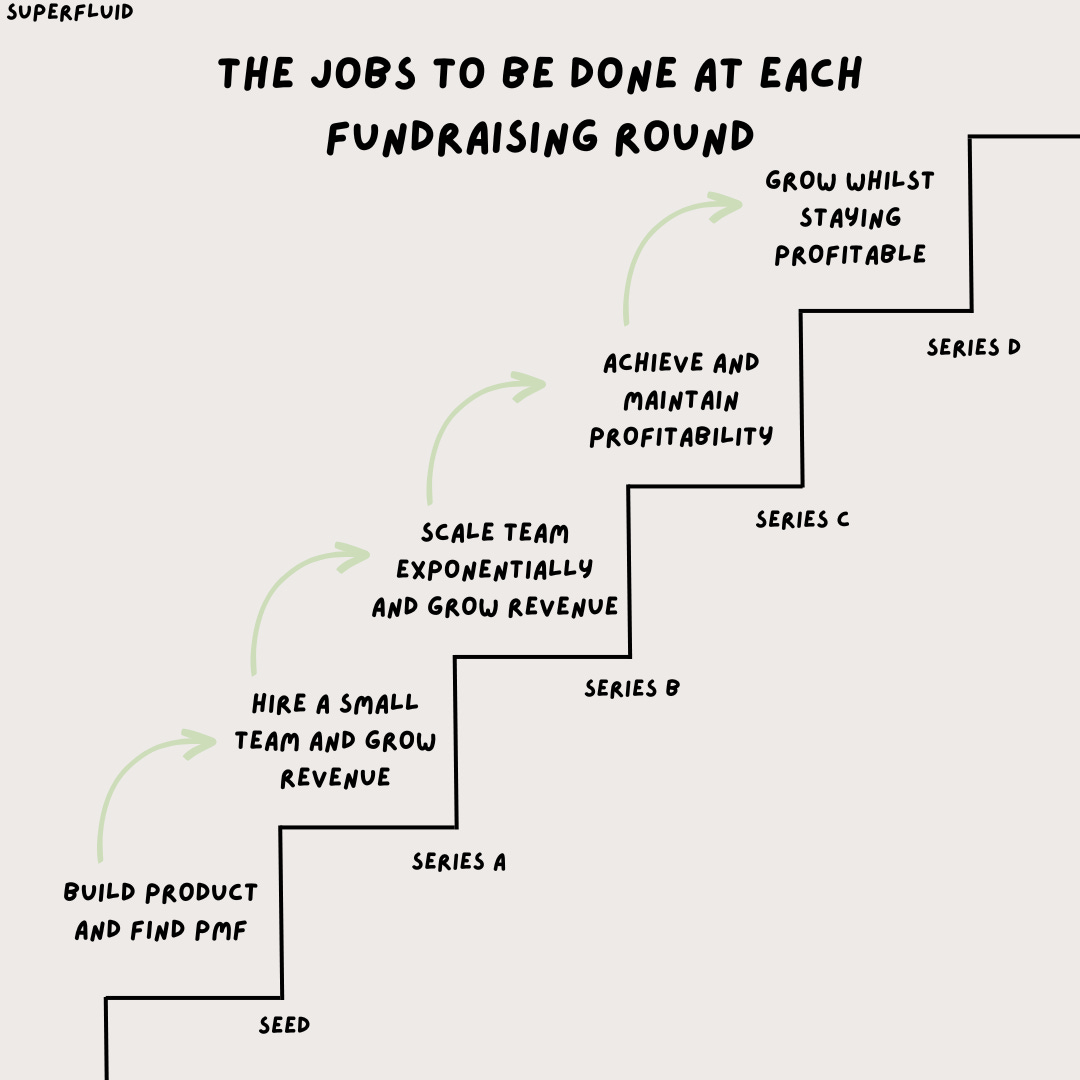
This sequencing is incredibly important to ensure that you're prioritising the right thing at any given point in time. Obviously, the timeline for how this all unfolds will vary wildly for different businesses. For some, achieving PMF will take a few years, while for others this will take a few months. Again, it largely depends on the complexity of the product and the dynamics of the market.
However, many founders raise seed rounds without understanding or internalising this. It's so incredibly important to understand how you define PMF, and what that might look like. Moreover, it's important to know where you might go wrong, or what happens if your initial assumptions are not correct and you need to pivot.
How do you know what PMF looks like?
The easiest way to know whether you've hit product-market fit is when you're getting a lot of inbound demand from the market. Rahul Vohra, the founder of Superhuman, talks about this in his seminal article on measuring PMF here.
A quick summary of that article, is that a leading indicator of PMF can be determined by asking your users the following question: “How would you feel if you could no longer use the product?” and then measuring the percent who answer “very disappointed.” The magic benchmark is about 40%. You want 40% or more users to answer "very disappointed" to really ascertain if you've found PMF.
However, despite having this metric, a massive mistake that many founders make is having a premature belief that they've found PMF by either relying on anecdotal data or applying the benchmark liberally. To be clear, it's entirely possible to have numerous customers and some level of growth without achieving true PMF. In recent times, apps such as Lensa and even BeReal have been strong examples of this.
They were hot and buzzy for a few weeks or months and then felt a huge drop off in user engagement. Even ChatGPT is facing this pressure, with website traffic starting to fall last month.

It's usually at the point of all this hype and overwhelming demand that startups raise a large round due to inbound investor interest. Usually, this goes badly with millions spent on sales and marketing for a product that serves a momentary desire but nothing more than that. Moreover, this is also when team bloat occurs where salespeople are hired quickly to deal with inbound demand and engineers are hired to keep the product from breaking.
Ideally, until you see sustained demand and hype for the product, you stay scrappy and agile. Be certain that you've actually achieved PMF before raising a larger round and hiring people. But also remember that PMF isn't permanent. You need to maintain and compound your initial traction. Stick to the metric above religiously, and always monitor your level of PMF.
Dealing with Pivots
Pivots are expensive.
They cost time, mental fortitude, capital and equity.
In startup land, pivots are somewhat glorified. The common trope is that every time you pivot, you're one step closer to building something of value. There are always examples of companies that started off building one thing and then are now crazy successful in building something else.
However, raising a seed round means that the clock is ticking for you to build a product and grow. Despite being celebrated through press releases and media, it's not an accomplishment to raise a round of financing. Instead, it signals the start of the journey. So the longer a company takes to get started, the more pressure it has to deliver in a shorter period of time.
As a result, whilst investors can afford to take on risks and make directionally correct bets, founders need to be precise in their bets. Ideally, founders are correct on their first try. This will save you from incredible stress, but also protect your cap table from dilutive pivots that require multiple bridge rounds and injections of capital.
As such, when thinking about how much you should be raising, timing plays a huge part in this. If you've already gone through a few pivots or iterations, and you're incredibly confident of where there is a strong opportunity, then you can probably afford to raise less. If you're not as confident, or you think you might need to pivot in some form, then I'd urge you not to raise capital until you've found something that you have strong conviction in.
Again, it goes back to being clear about what you want to achieve by raising.
Forecasting Resource Requirements
The biggest costs for a seed business are usually hiring and almost every founder is guilty of over-hiring.
Usually, founders think the right thing to do is to hire lots of people because that will make it easier to build a product and get it into the market. Unfortunately, this is never the case.
Hiring ahead of the curve typically slows everything down and makes it hard for a startup to move quickly and react to customer feedback. Basically, all the seed-stage companies that hired quickly in 2021/22 have all had to go through layoffs due to over-hiring.
Again, think about hiring through an outcomes-orientated lens.
What do you think you need to do to get to PMF? (i.e., how do you make sure that more than 40% of your users will feel very disappointed if they can't use your product) and what type of skill sets do you require to get there?
From here, you can write out job descriptions and work backwards till you find someone that fits your requirements. Usually, for a seed stage business, you won't need to hire more than 2-3 extra employees if you have two founders. Again, the caveat here is that this advice is for a typical software business.
Once you've done this, use salary benchmarking guides to estimate how much you'll need to spend on hiring. It doesn’t have to be completely accurate, but you do need to be realistic with your estimates.
Forecasting your budget requirements isn’t meant to be complex. It can be as simple as “I need to hire 2x senior engineers. These will cost 180k a year, meaning I need to budget at least $360K for the next two years.” It sounds and looks easy, but surprisingly, most people don’t think that way.
Managing a Pre-Seed/Seed Budget
Usually, this is where most founders mess up.
Founders usually raise way too much money, or way too little and don’t know how to manage either scenario well.
Raise too much money, and all capital discipline goes out the window. Salaries aren’t benchmarked properly, and lots of incentives are devised to generate customer demand that gives companies a false sense of PMF. Once these stop, usage drops off a cliff and companies end up faltering and dying.
Raise too little and you can just about make early hires, without buffer room to account for pivots, or business moving slower than expected. This is a surefire way of having to raise your next round in a distressed position or killing your company.
My rule of thumb is usually to advise founders to do the following:
- Map out full hiring requirements and figure out how much you need to pay them over 2 years
- Raise 25% more than this number to have a solid buffer
- Post-raise, slash the number of people you plan to hire in half. In most cases, you don’t need as many people as you originally think and if you do, you can always hire them later. It’s easier to delay hiring versus having to conduct layoffs.
By raising a bit more than what is necessary and by constraining your hiring, you’ll be able to bank a large portion of your raise to deal with all the things that can go wrong with startups.
Keep in mind, this strategy only works if you’ve instilled the right culture within your team. As soon as you raise any amount of venture capital, the pressure to succeed is just that much higher. By making sure you raise the right amount, operate in a capital-constrained manner, and are solely focused on finding PMF, you’ll be well on your way to building a large business.
Make sure to subscribe now to not miss next week’s article Subscribe now



All Comments