

A proposal to stitch Ethereum’s fragmented liquidity together extends beyond its own ecosystem and may bring other blockchains into the fold.
On March 29, Gnosis, a long-time Ethereum builder and blockchain infrastructure company, unveiled that it is developing the Ethereum Economic Zone (EEZ) with Zisk, a zero-knowledge virtual machine project.
The EEZ is aimed at linking layer-2 rollups more tightly to Ethereum layer 1, with Ether remaining as the gas token and settlement layer. It introduces a model where smart contracts can interact across the mainnet and EEZ rollups with atomic execution.
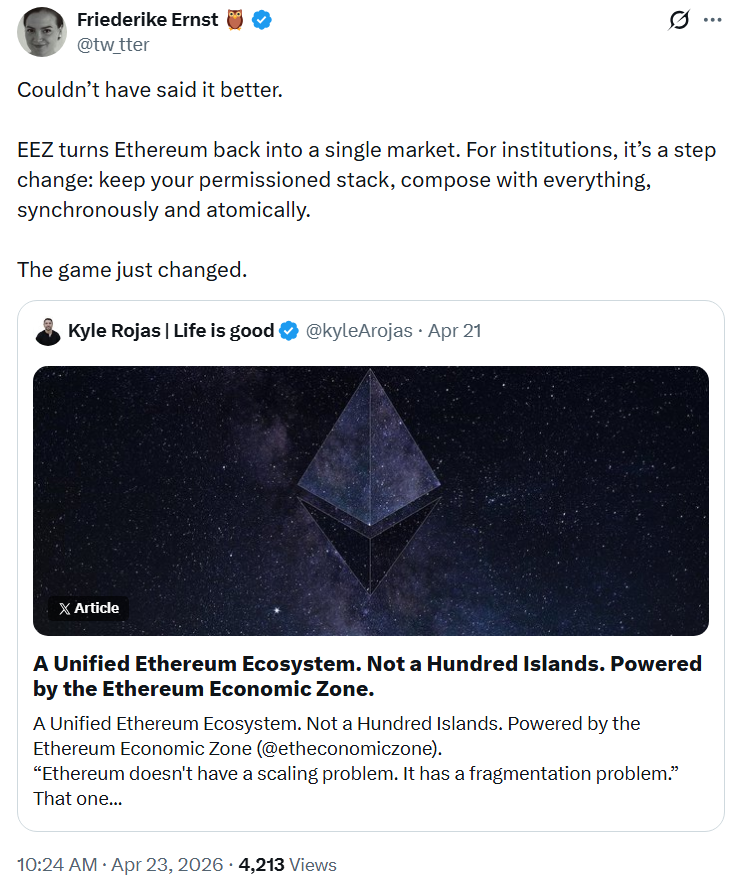
However, Gnosis co-founder Frederike Ernst told Cointelegraph that networks outside the Ethereum ecosystem can join the EEZ as well.
“A lot of networks outside the traditional Ethereum ecosystem have reached out to us,” Ernst said.
I have the hope that this doesn't just unify the greater Ethereum ecosystem, but it actually grows the greater Ethereum to chains that so far we've kind of excluded mentally from this model because they didn't fit the template of what a chain should look like.
How Ethereum’s scaling path fractured its ecosystem
In the past, Ethereum has repeatedly seen transaction fees spike to unusable levels during periods of heavy demand. The pattern emerged early, from the initial coin offering boom to the surge in activity driven by the non-fungible token (NFT) game CryptoKitties. It resurfaced during DeFi summer of 2020 and again in the NFT boom of 2021.
Each wave strained the network and priced out everyday users. In response, Ethereum shifted toward a rollup-centric roadmap, aiming to offload activity to L2s.
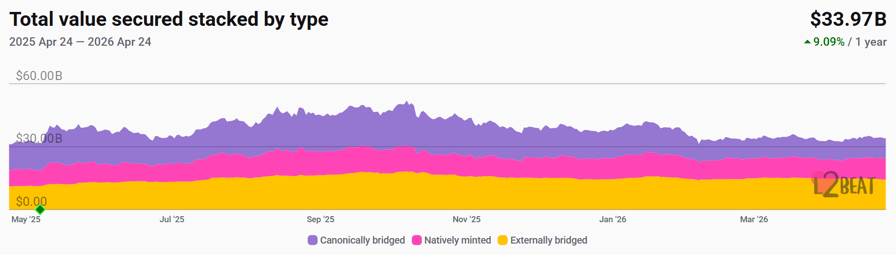
The approach has largely reduced fee spikes, but it has also redirected a significant share of economic activity away from the base layer. Some critics have described the relationship as “parasitic.”
“Currently — because there is no synchronous composability between L2 and L1 — L2s have to replicate the entire L1 ecosystem. You have an Aave deployment on every notable L2, a Maker deployment, and so on,” Ernst said.
She added:
That’s a struggle for L2s, but also for protocols, which now have to maintain multiple versions of the same system across chains. It fragments liquidity, because instead of one market, you end up with 20.”
The EEZ’s solution to get these markets to behave as one again is to give chains the ability to prove their state to other networks in the economic zone.
Under the hood, a smart contract on one network can call a smart contract on another network and receive a response within the same block. It can then use that response to execute further actions, so the networks start behaving like a single system.
Technically, this is handled by builders, the entities that construct blocks before validators propose them.
“If a call is made to a smart contract, they can recognize when it refers to a contract on another network and determine whether the corresponding transaction can be executed there as well,” Ernst said. “They then include both transactions atomically, so either both happen or neither does.”
The reorg problem and the price of joining
Bankless called the EEZ the most “serious answer” to Ethereum’s fragmentation problem. If successful, it would allow transactions to execute across the ecosystem, enabling L2s to interact directly with applications on Ethereum without duplicating them across chains.
The broader vision extends beyond L2s to other L1s, but there are three boxes networks must tick to join, according to Ernst:
- Well-defined state transition function: The network must clearly define how it moves from one block to the next so builders can understand and simulate its state transitions.
- Ability to prove state for each block: The network must generate cryptographic proofs of its state, allowing other chains in the EEZ to verify it when composing transactions.
- Ability to reorg with Ethereum: The network must be able to reorganize its state in sync with Ethereum to preserve atomic execution across chains.
The first requirement is almost a given for most blockchains, while the second can be met by systems capable of generating cryptographic proofs of their state, such as ZK rollups or zkVM-based architectures.
The third is the “tricky one.”
“What happens when Ethereum reorgs, and all of a sudden this guy is no longer here? What happens to this guy?” Ernst said, gesturing with both fists to represent transactions on different networks.
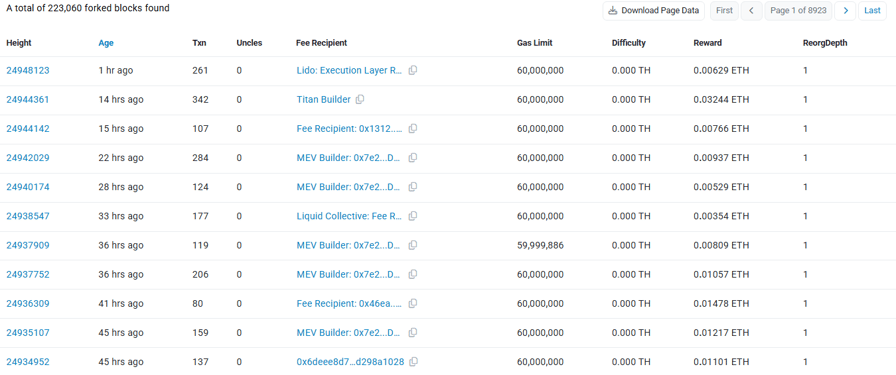
In Ethereum, reorgs occur when competing versions of recent block history are produced and the network selects one as canonical. This can occur due to latency issues. Block reorgs occur regularly and are usually harmless, though more serious cases can point to malicious attacks.
“The requirement to reorg with Ethereum is a pretty tough one for a lot of the chains, but it’s kind of the price you have to pay in order to use everything that’s already on Ethereum,” Ernst said.
Not every chain will choose to join Ethereum
The requirements mean networks weighing whether to join the EEZ do not need to be EVM-based and can even be permissioned.
“Having a permissioned chain and still allowing it to interoperate with Ethereum, or parts of Ethereum, is a super valuable proposition,” Ernst said.
The initiative was originally designed as a ZK-based system. While ZK remains the preferred approach, networks joining the EEZ can also use other types of proving systems.
Ernst added that one of the networks EEZ has engaged with is the Canton Network, an institution-focused system gaining traction in real-world assets. However, the reorg requirement may hold such networks back from joining.
A potential solution is single-slot finality, which Ethereum researchers have been exploring as a possible upgrade. Single slot finality would make a block final the moment it is produced, effectively eliminating reorgs under normal conditions.
While EEZ enables rollups to access Ethereum’s liquidity and applications more seamlessly, the same model could extend to L1s outside the ecosystem. At the same time, not all L2s have the same incentives to join. Ernst said only a small number are viable as standalone ecosystems. She described Base as “definitely” one of them, while Arbitrum is “arguable.” Most others are not viable on their own.
“Every ecosystem that’s not viable gains much more than it gives up by joining the EEZ, and the rest will just have to decide, ‘am I Ethereum or am I not Ethereum?’” she said.
Ernst added that EEZ participation won’t be binding and networks are free to leave.
It’s not like Hotel California where you check in and then you never check out.”
If the EEZ works, Ethereum shifts from being just a base layer to becoming a coordination layer for multiple chains, consolidating liquidity and activity across the ecosystem. If it doesn’t, fragmentation persists and value continues to spread across competing networks.


All Comments