



Since the launch of OpenAI's ChatGPT, the rapid development of generative AI applications has marked a significant turning point in the AI industry, similar to the impact of AlphaGo. Beginning with OpenAI's GPT-3, followed by GPT-4o, Anthropic’s Claude, and Meta's LLaMA, numerous advanced LLMs (Large Language Models) and generative models have continued to evolve.
Amid this rapid progress, the focus has largely been on model performance, architecture, and computing power, often overlooking a crucial factor: the quality of data. OpenAI researcher James Betker highlighted this by stating, “only quality data yields quality models,” underscoring data's foundational importance. Building precise and reliable AI models requires high-quality data, which involves not only large datasets but also rigorous refinement and accurate labeling.
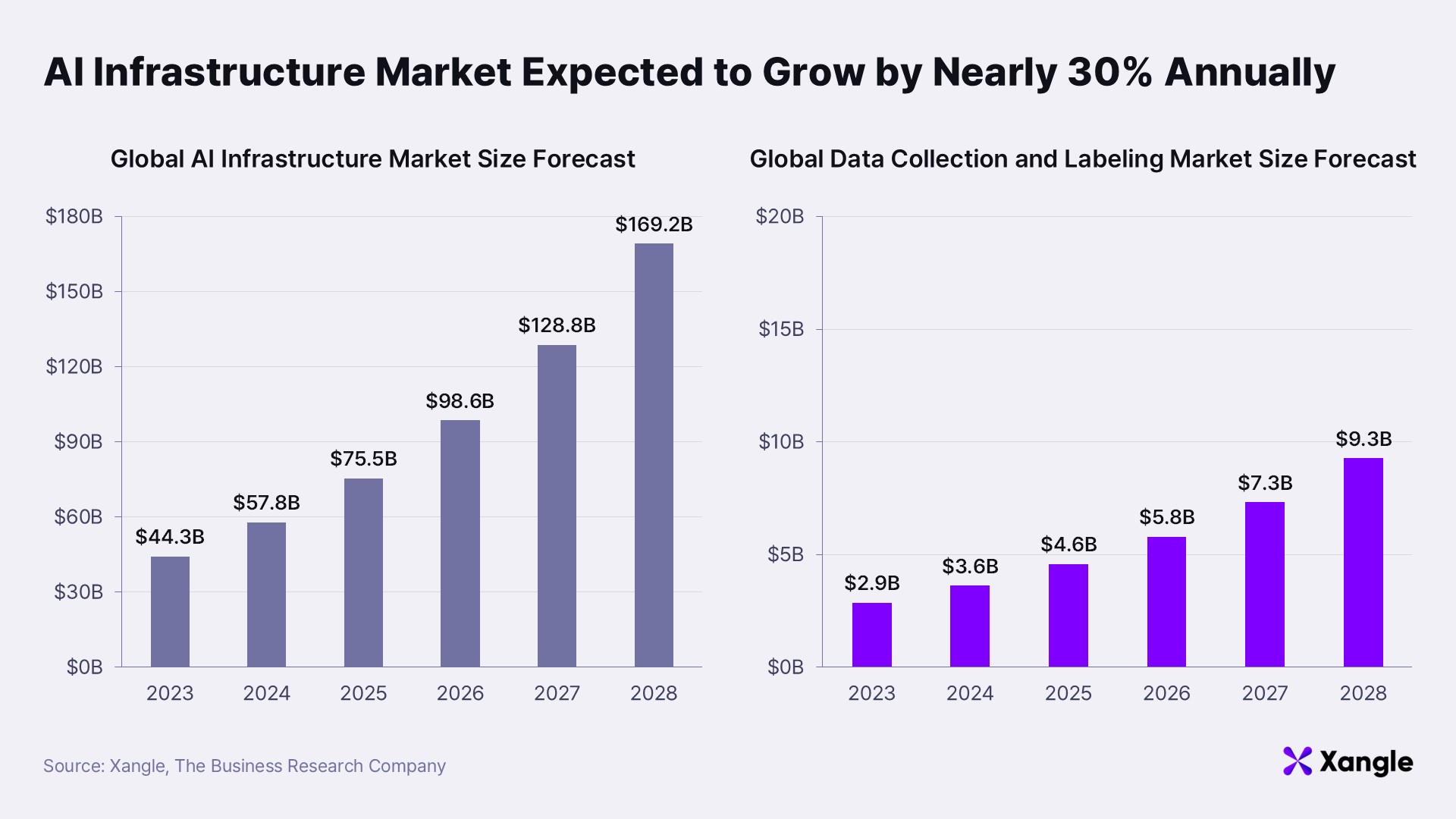
The AI industry has grown rapidly alongside technological advances, driving expansion in the data collection and labeling market. Previously, data labeling required extensive human input. Today, techniques such as AI-assisted labeling systems and Reinforcement Learning from Human Feedback (RLHF) have emerged, significantly enhancing the efficiency and precision of data labeling. For example, OpenAI’s GPT models use RLHF to continually refine data quality and relevance based on user feedback. These innovations have become crucial tools in data preprocessing, boosting the accuracy and reliability of AI models.
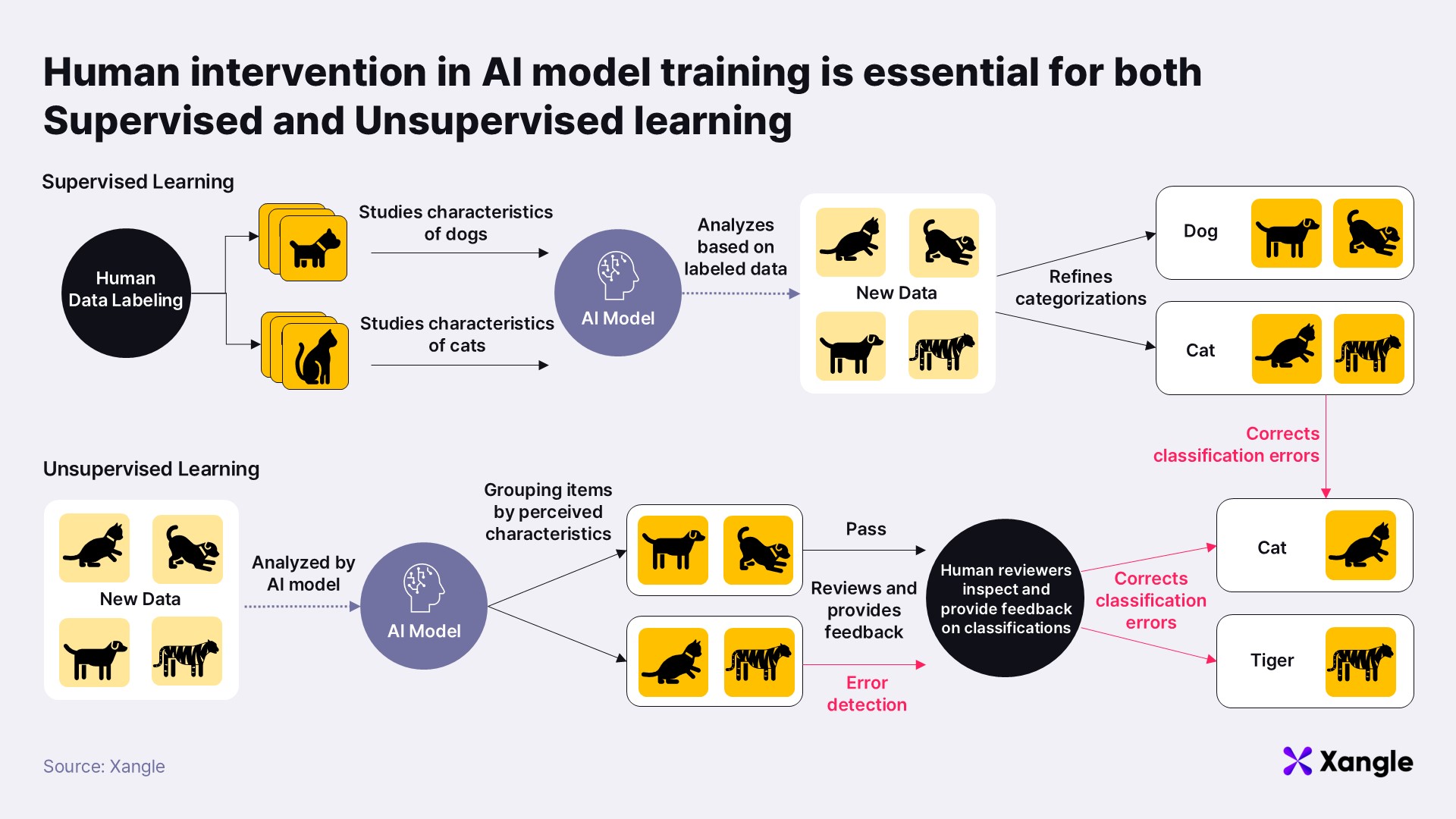
Despite these advancements, human involvement remains essential in the data pipeline. AI model training generally follows one of two approaches: supervised or unsupervised learning. Both require human oversight to ensure data accuracy and relevance. In supervised learning, labeled datasets created through human classification are indispensable; inaccurate labeling can lead to flawed model outcomes. In unsupervised learning, human judgment is required to evaluate and validate AI-generated classifications. Ultimately, regardless of the training approach, human intuition and expertise are essential to ensure data accurately represents useful information. Given that data quality is key to AI model performance, the role of humans in data creation remains vital.
Recognizing this, Pundi AI is leveraging blockchain to transparently record data contributors' efforts, ensuring the quality and reliability of labeled data, and enhancing the fairness and efficiency of data transactions. Pundi AI combines PundiX’s expertise in cryptocurrency payments with FunctionX, a Cosmos-based EVM-compatible chain. This transformation reflects a strategic decision to combine PundiX’s strengths in payment systems with FunctionX’s interoperability with Ethereum and Cosmos. The synergy between these elements is expected to create significant advantages in AI data transactions and applications.
As has been emphasized repeatedly, while the architecture and computational power of AI models are crucial, it is the quality and diversity of the data these models are trained on that ultimately determines their performance. However, in practice, the processes of data collection and utilization in the AI industry face several challenges. Issues include ambiguous data ownership, lack of transparent rewards for data providers, and difficulties in ensuring data reliability.
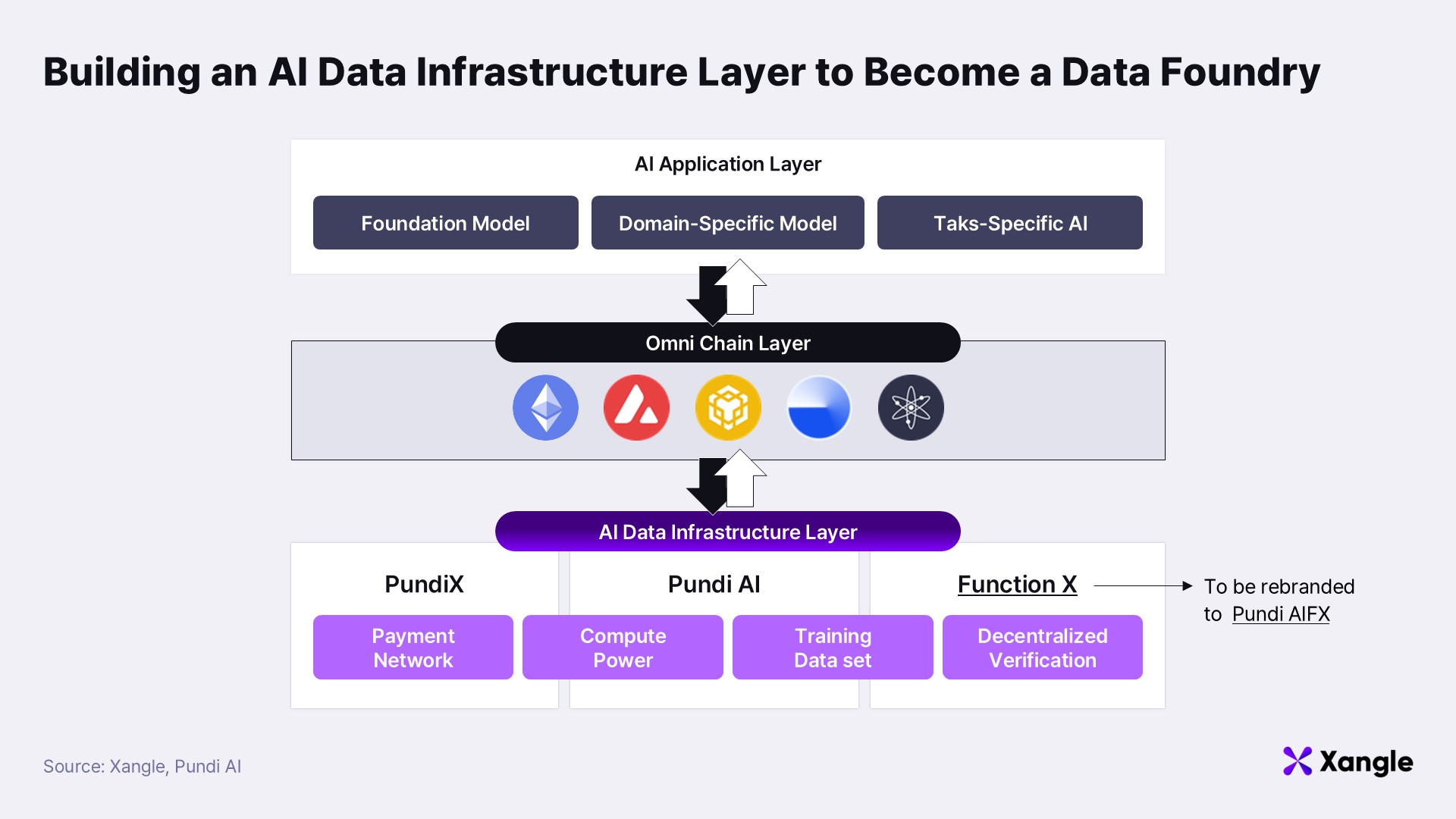
To address these challenges, Pundi AI proposes a decentralized AI data ecosystem powered by blockchain technology. Pundi AI’s business approach is realistic—it focuses not on developing AI models to compete with major tech companies, but on serving as a ‘foundry’ for data collection and labeling. This strategy aims to supply the “fuel” (data) that powers AI development, tuning, and applications, thereby strengthening the foundation of the AI ecosystem.
However, for large-scale foundation models like ChatGPT, the volume of training data required far exceeds the amount that humans can label. Thus, there are inherent limitations in a decentralized platform where humans directly contribute to foundation models. The true value of a decentralized data platform may ultimately lie in the development of numerous “domain-specific models” or “task-specific AI” models, which are fine-tuned for specific purposes. Proving the utility of such a decentralized data platform in these areas is a key challenge Pundi AI will need to address going forward.
In the Pundi AI ecosystem, Pundi AIFX is responsible for tokenizing and transmitting data using blockchain technology. Formerly known as the FunctionX chain, this rebranded chain will function as an omni-chain for AI data interoperability. Pundi AIFX (formerly FunctionX) enables the transfer and trading of tokenized AI data across blockchains, effectively combining AI data with blockchain.
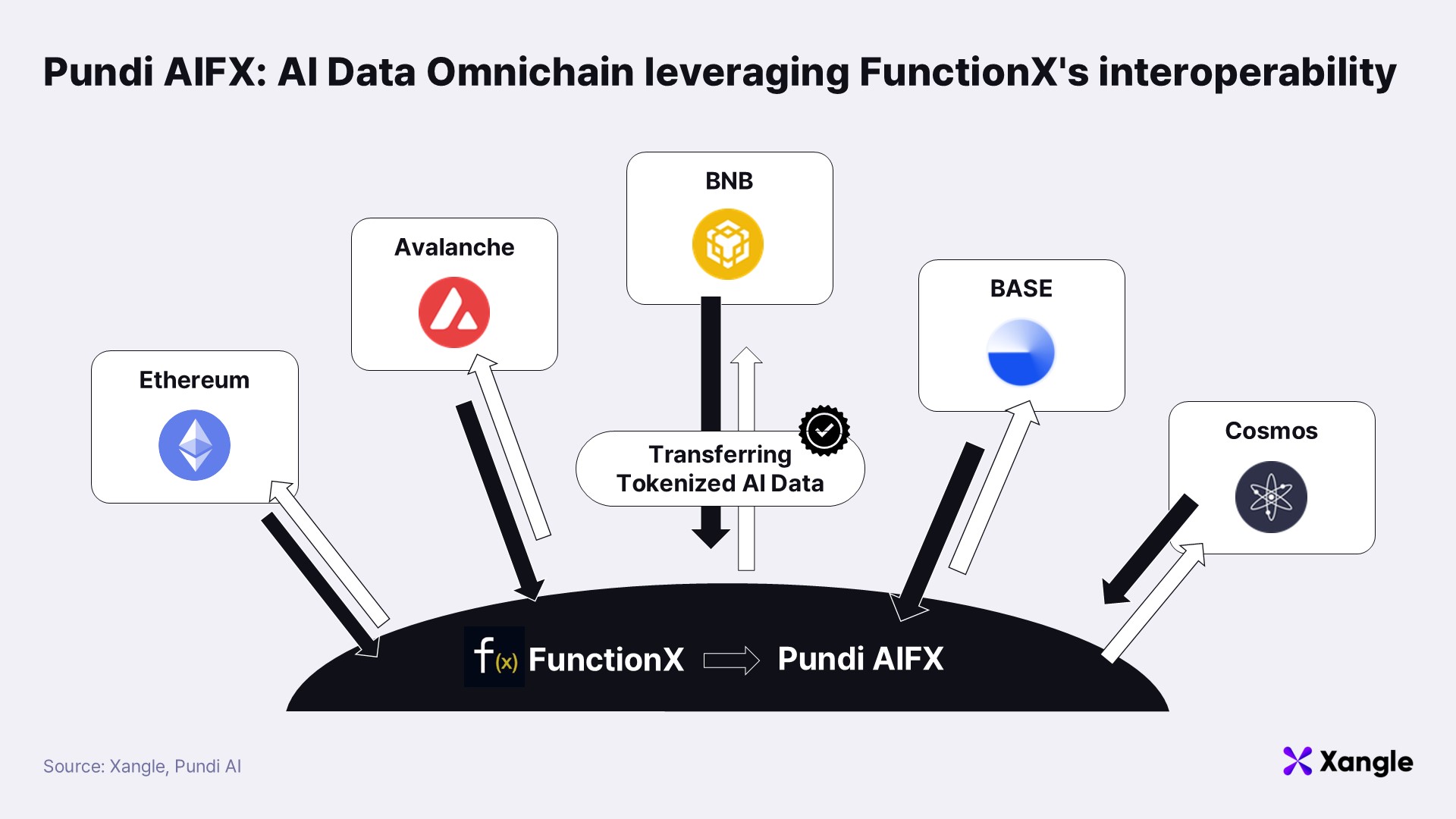
Pundi AIFX is built on the Cosmos SDK and provides interoperability with various Cosmos and EVM-compatible networks. Through bridges connected to each chain, tokenized AI data can move smoothly, allowing for more flexible data use within the AI ecosystem.
Furthermore, by introducing blockchain smart contracts into AI data creation, Pundi AI brings added reliability and transparency to data protection and reward structures. Data is tokenized as NFTs to clearly establish ownership, and smart contracts automatically distribute rewards when data is used. All transactions are transparently recorded on the blockchain, ensuring that the origin of AI training data can be verified, thus enhancing its trustworthiness.
Through its ”Tag to Earn” model, Pundi AI aims to inject economic incentives into a decentralized AI data market. Unlike the traditional “Play to Earn” model, which offers rewards for gaming activities, “Tag to Earn” focuses on more productive work. This model is designed to reward participants directly for tagging or annotating data, which is essential for AI training, thereby encouraging a wider pool of contributors to supply the data needed for the AI industry.
Ultimately, the Pundi AI platform will provide a decentralized AI Data Marketplace (scheduled for release within the year) that connects data providers with users. This marketplace will facilitate the easy discovery and purchase of labeled data tailored for specific purposes, offering fair compensation to data contributors and improving the credibility of the data industry. All data transaction records are stored on the blockchain, ensuring clear management of data sources and integrity.
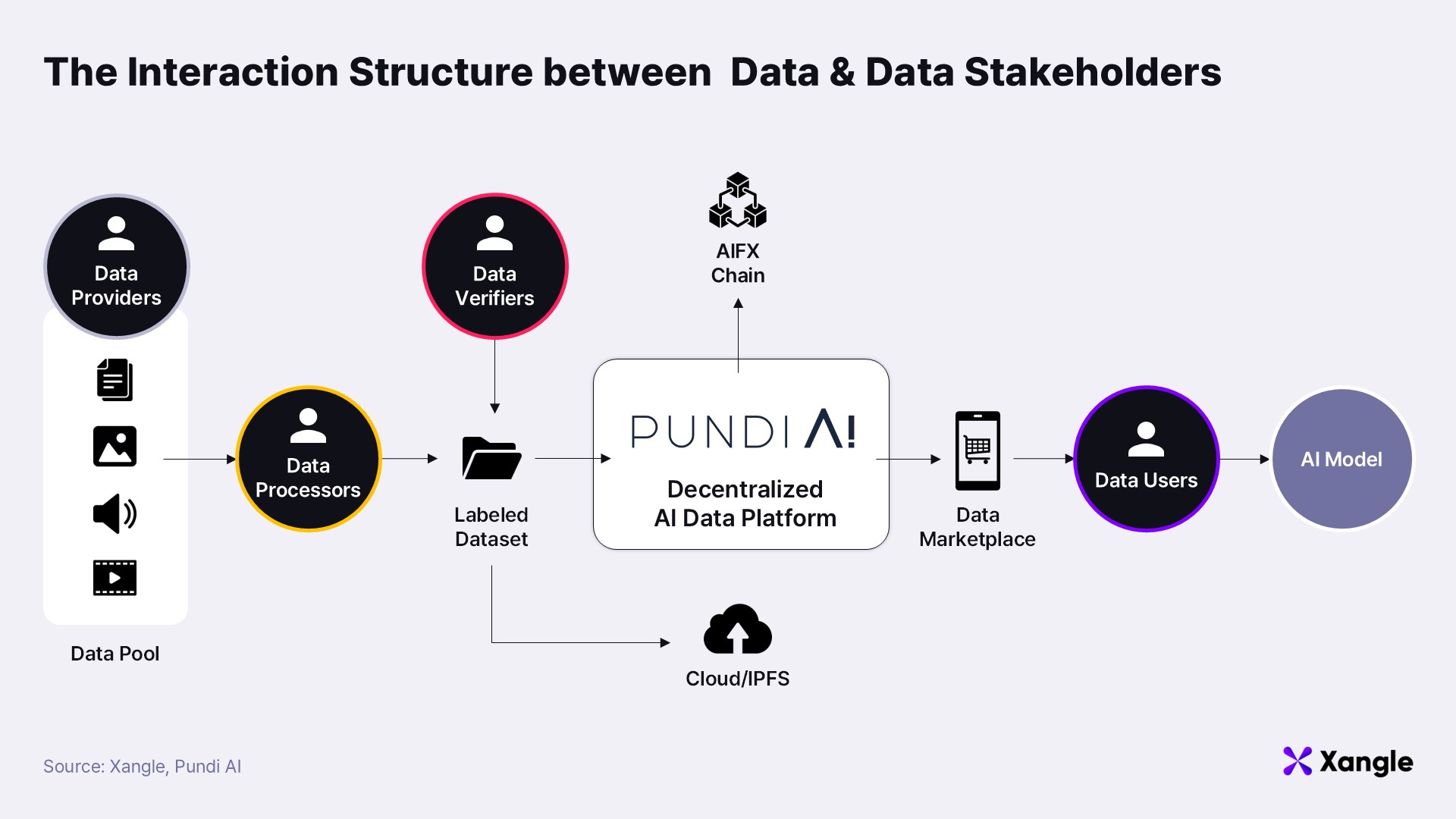
The Pundi AI platform is a decentralized data platform comprising various stakeholders in the AI data ecosystem—data providers, processors, validators, and users. This ecosystem enables transparent and fair management of data throughout the entire process, from creation to utilization, through interaction among participants and data.
Data providers upload original data, such as text, images, and videos, supplying the platform with initial data. Data processors transform the provided data into formats suitable for AI learning, directly contributing to model performance. Data validators ensure the quality and accuracy of the data, thereby producing reliable data. Finally, Data users, including AI model developers and businesses, purchase and utilize the data to enhance the performance of their AI models.
All these processes are transparently managed via blockchain. Each step—from data upload to labeling, storage, purchase, and validation—is recorded and managed through smart contracts and NFTs, ensuring clear data ownership and fair rewards. This system allows data contributors to receive equitable compensation and enables users to quickly and easily access high-quality, trustworthy data.
However, the success of Pundi AI hinges on how actively data contributors participate on the platform. Without a steady supply of data, the platform structure may struggle to function effectively. Thus, the platform must offer compelling incentives and streamlined processes to attract data providers, while also focusing on partnerships with institutions interested in data labeling and preprocessing to secure a continuous flow of specialized data.
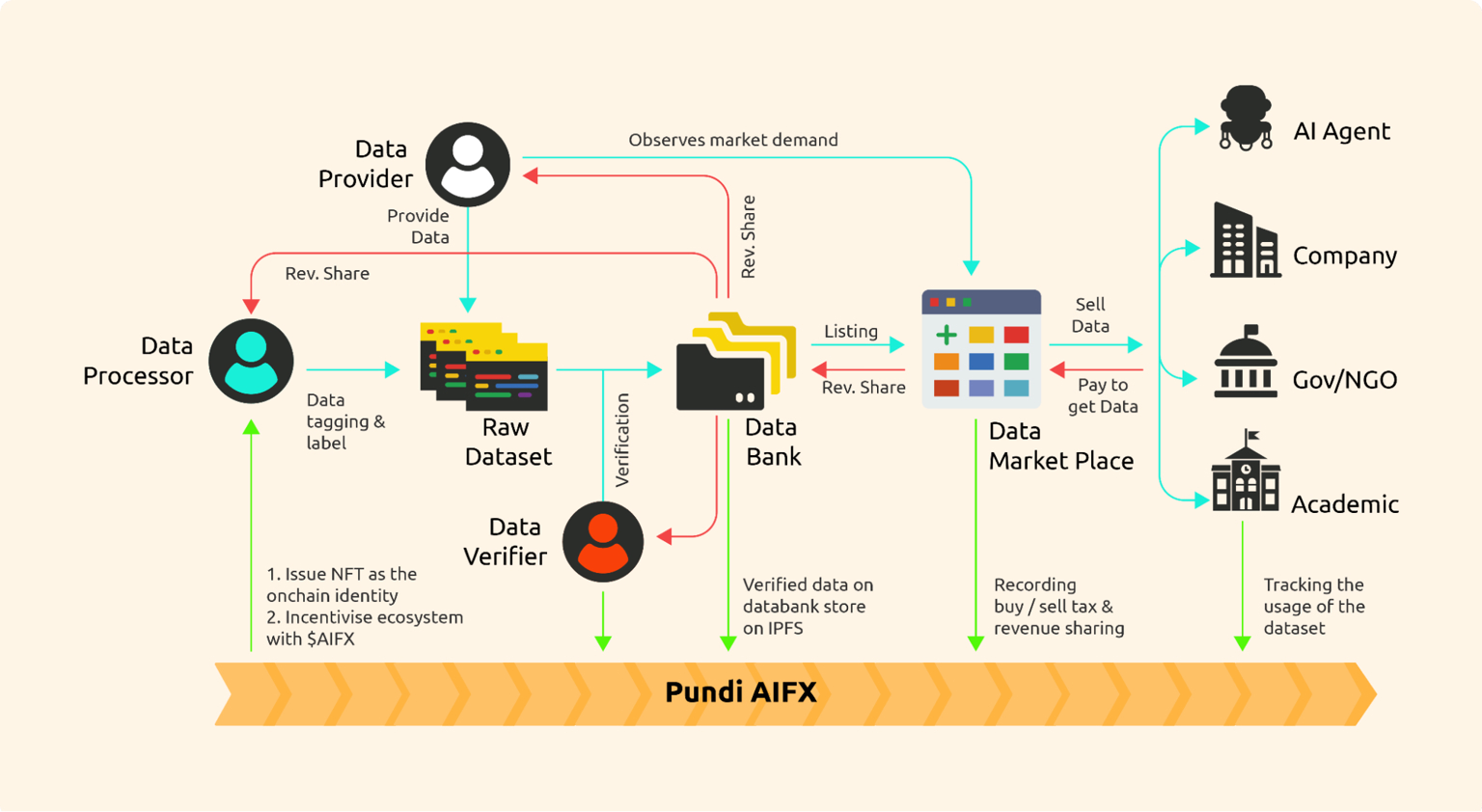
Pundi AI’s tokenomics, encapsulated in its AI Flywheel model, is designed as a virtuous cycle where data, contributors, and buyers interact to drive advancements in AI technology. Within this framework, the $FX token (soon to be renamed $AIFX) will serve as the main currency of the Pundi AI ecosystem, bridging the gap between data contributors and data users. Users will utilize $FX to purchase data, while contributors will receive fair compensation for the data they provide. All of these transactions are managed transparently through blockchain and smart contracts.
Revenue generated from data transactions is funneled into a rewards pool, which is periodically distributed to contributors via smart contracts to ensure fairness and transparency. Data processors are rewarded once the data is validated by validators, who also receive compensation for their role. Additionally, data contributors are provided with supplementary incentives so that they receive base compensation even if their contributed data is not selected. This structure motivates continuous participation, rewarding contributors for their efforts to maintain high data quality. Furthermore, the $FX reward pool will feature staking options, enabling contributors to accumulate rewards over the long term and earn additional returns.
For this tokenomics model to function effectively, it must offer sufficient rewards to attract participants. It is expected that some time will be needed for Pundi AI’s AI Flywheel to operate smoothly and attract widespread participation.
PURSE+ is a browser plugin that combines SocialFi (Social Finance) and AI, enabling users to participate in data collection, tagging, and analysis on Twitter. As part of the Pundi AI initiative, PURSE+ aims to enhance the diversity and quality of data and strengthen AI capabilities through community-driven contributions. With user-friendly tools, PURSE+ offers opportunities for users with limited technical knowledge to contribute to the data ecosystem, thereby significantly boosting scalability and sustainability within the AI industry.

*Image(Right): The author's experience with PURSE+
Through the PURSE+ plugin, users can collect and label SNS data as part of their daily Twitter activities. Users are rewarded with points, which can be exchanged for Purse+ tokens, providing tangible rewards. By seamlessly integrating AI and SocialFi, PURSE+ creates a decentralized environment for data contributions to support AI development.
The AI Startup PitchFest by Pundi AI is a competitive program designed to discover and support innovative AI startups worldwide. Participating startups present AI solutions that showcase originality, innovation, and market potential, offering practical solutions to real-world AI challenges. Each team’s solution is evaluated based on market fit, scalability, and feasibility.
Finalist teams in the PitchFest receive a range of support benefits, including up to $100,000 in incubation funds, access to development tools, and free office space in Singapore for six months. Beyond material support, the teams benefit from mentorship with AI and blockchain experts, enabling them to refine business development, marketing, and fundraising strategies. Additionally, they gain connections to Pundi AI’s partner and customer networks, helping them establish a foothold in the global market. Pundi AI plans to continue various supportive initiatives linked to its platform.
Pundi AI has adopted a business model focused on building a decentralized data foundry for the AI industry, emphasizing the importance of data. By addressing issues of ownership, transparency, and compensation inherent in centralized data collection and utilization, Pundi AI offers a decentralized data platform powered by blockchain, redefining blockchain's role within the AI ecosystem.
One of the standout features is Pundi AIFX OmniChain, which maximizes data interoperability by enabling the transfer of tokenized data generated on the platform across various blockchain networks. Additionally, the ‘Tag to Earn’ model and decentralized data marketplace enhance collaboration between data providers and users, encouraging sustained participation through fair compensation. This structure creates a mutually beneficial ecosystem for data providers, processors, validators, and users, potentially securing both data quality and diversity.
However, Pundi AI remains in its early stages, and several challenges lie ahead before the platform achieves widespread success. First, it’s crucial that the platform continually provides sufficient economic incentives to attract data providers. Second, the data interoperability framework and tokenomics proposed by the platform must effectively deliver practical value to users. Third, the data provided must be meaningful enough for B2B clients to warrant payment, which is essential for a sustainable business model. Finally, to supply data suited for domain-specific models and purpose-built AI, it will be necessary to make concerted efforts to acquire specialized data relevant to these applications.
When discussing PundiX and functionX’s pivot towards the AI industry, I expressed doubts to foundation representatives about whether this strategy of aligning with the AI trend would be effective in the market. In response, they suggested that a dynamic shift to roles that align with industry developments would be a more meaningful direction. If the Pundi AI platform can overcome the challenges mentioned above and its AI Flywheel structure operates successfully, proving the relevance of blockchain technology within the AI industry, Pundi AI may evolve beyond its past projects to become a leading initiative in the integration of AI and blockchain.


All Comments