



Bitcoin, as a pioneer in the blockchain industry, has reached a level of recognition within institutional finance through the introduction of spot ETFs. Despite its vast market capitalization, Bitcoin has been largely limited in its utility beyond being a "store of value," due to its programming language and structural constraints. Unlike Ethereum, which transitioned to a Proof of Stake (PoS) model and formed a vast security economy ecosystem through staking, Bitcoin, which uses the Proof of Work (PoW) mechanism, has lacked similar economic incentives, creating a significant barrier to the growth of its ecosystem.
Bitcoin uses a relatively simple programming language called Script and processes transactions using a data structure known as UTXO (Unspent Transaction Output). The Script language intentionally restricts certain functions to prevent computational complexity, which enhances Bitcoin’s security. For instance, Script does not allow operations that could result in uncertain outcomes and does not support complex programming constructs like loops.
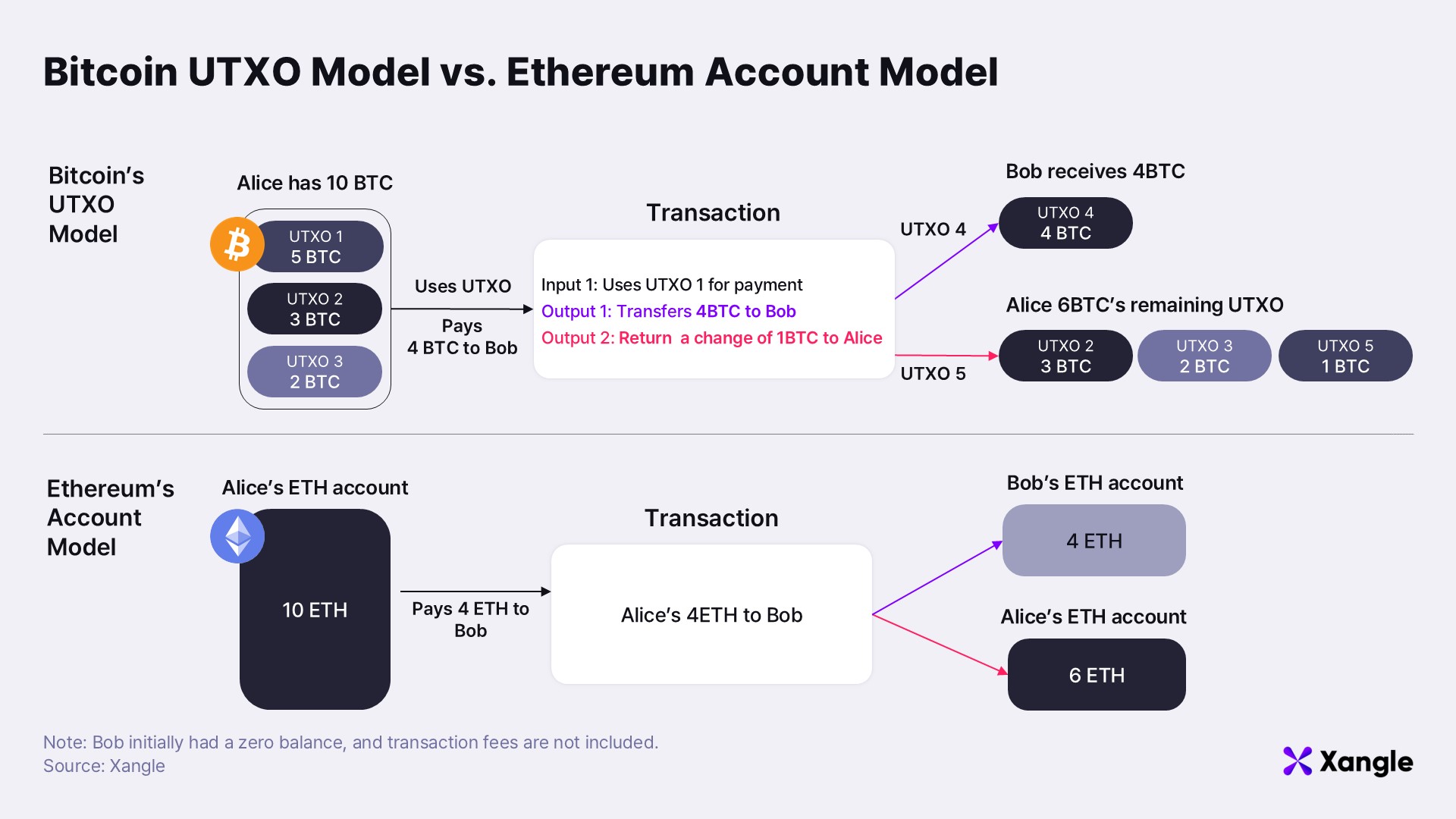
However, this structure presents challenges when attempting to implement more complex functionalities. In addition to Script, the UTXO model further limits Bitcoin’s scalability. While UTXO enhances security and transparency by managing each transaction outcome separately, it struggles with implementing and scaling complex programs compared to Ethereum’s state-based processing model, which uses accounts (Account) to manage state. Consequently, Bitcoin finds it difficult to support the diverse range of financial services and smart contracts available on platforms like Ethereum, limiting the potential to add and expand various functions.
As a result, the limitations of the Script language have made it difficult to execute various decentralized finance (DeFi) applications and smart contracts on Bitcoin, as is possible on Ethereum. This has hindered the expansion of the Bitcoin ecosystem by not providing the flexibility needed to run diverse decentralized applications (dApps) and smart contracts.
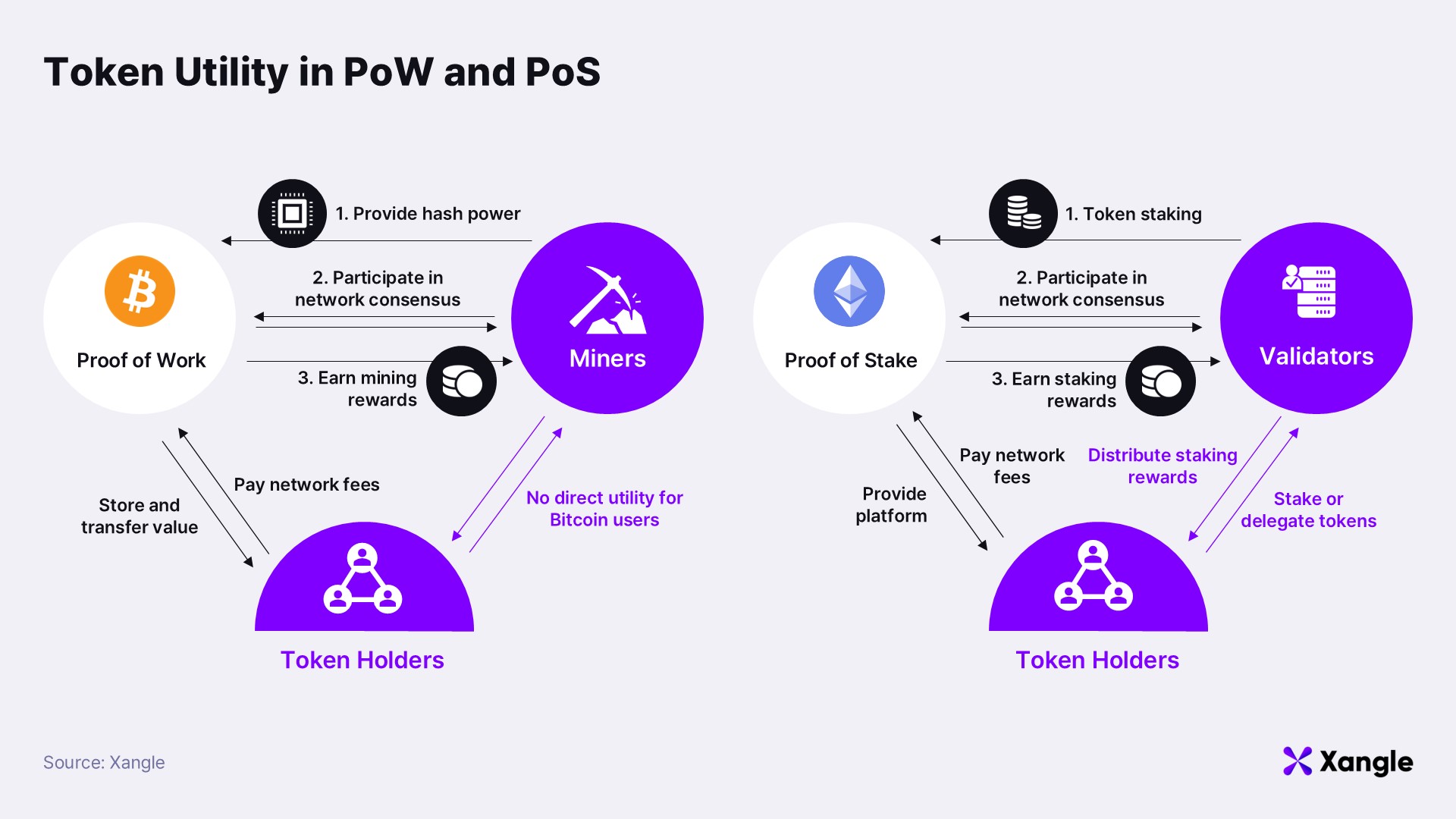
The structural limitations of Bitcoin, as previously discussed, have greatly restricted its range of applications, and its Proof of Work (PoW) mechanism has further exacerbated these limitations. In a PoW system, Bitcoin providers, or miners, are primarily incentivized through block rewards and transaction fees. However, for Bitcoin holders, the only economic incentive has been to hold onto their Bitcoin in the hope of price appreciation, with no additional benefits from network participation. This structure has confined Bitcoin’s utility primarily to its role as a "store of value," rather than promoting active utilization within its network.
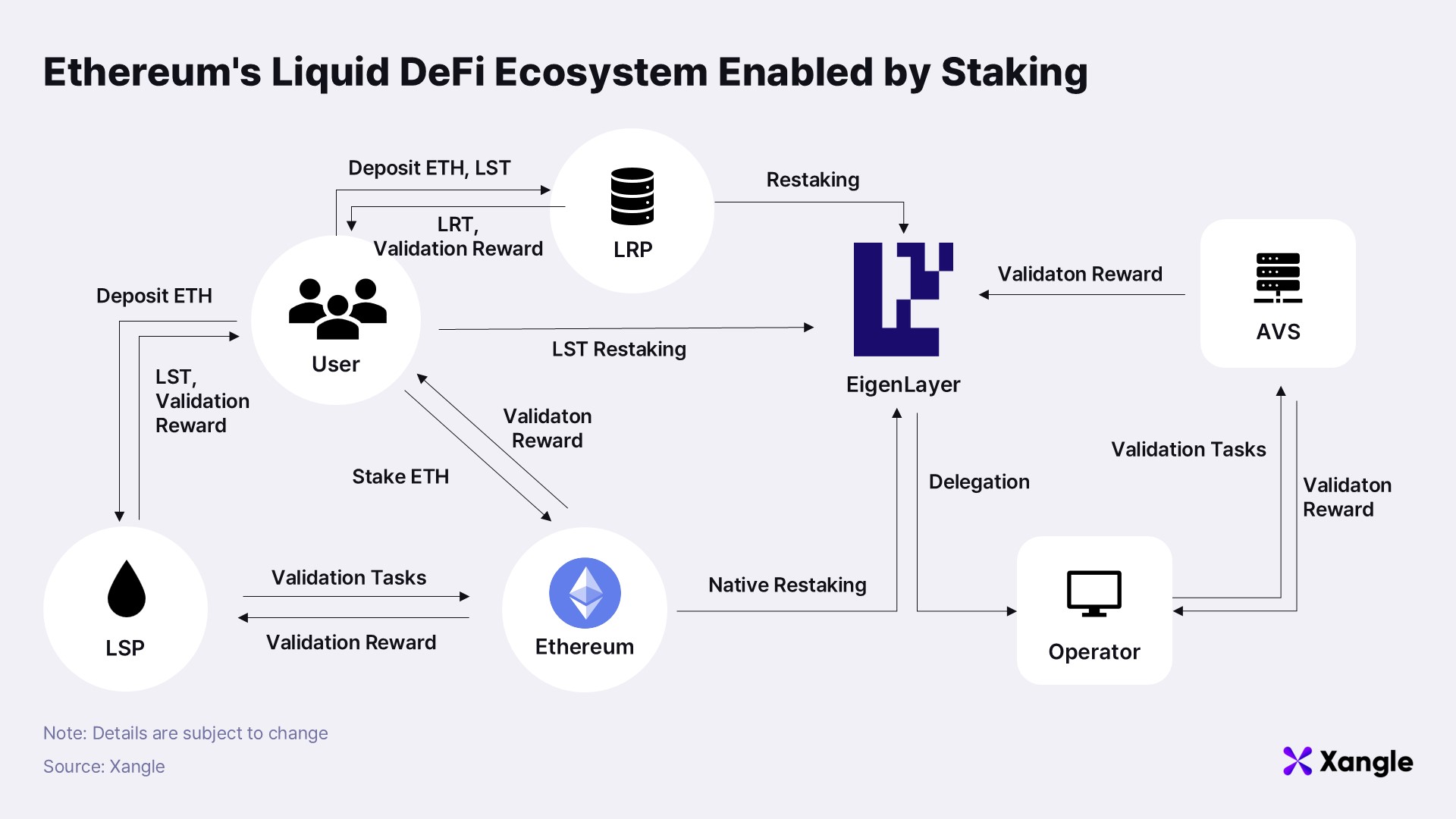
In contrast, Ethereum, through the ‘The Merge’ upgrade, transitioned from PoW to PoS, introducing a system where staking not only enhances network security but also offers staking rewards. This transition has spurred economic expansion within the Ethereum ecosystem, leading to innovative concepts like Liquid Staking Tokens (LSTs), where staked Ethereum is used as collateral for various financial products. Moreover, the narrative of Liquid Restaking, which involves using staked assets to enhance the security of other middleware services, has evolved within Ethereum, creating a structure that generates new economic value.

Source: Dune(@hildoby)
The growing interest in Restaking is evident in the chart above. The amount of ETH staked in Restaking protocols, highlighted in mint green, has increased rapidly over the past six months, with approximately 2.7 million ETH staked in protocols like EigenLayer. This demonstrates the market’s keen interest in this area.

Given Bitcoin's structural constraints, its lack of economic incentives similar to those of Ethereum might seem like an insurmountable obstacle to expanding its utility. However, Bitcoin’s enormous market capitalization, which reached approximately $1.3 trillion as of August 2024, provides a strong incentive to explore new ways to expand its utility. Advocates for Bitcoin’s expanded use have observed the economic structure and growth potential demonstrated by Ethereum’s ecosystem and are motivated by Bitcoin’s vast capital to create a larger and more robust ecosystem.
Babylon is at the forefront of this effort, having recently launched Phase 1 of its Bitcoin staking mainnet, marking a significant step in expanding Bitcoin’s utility. In Phase 1, Babylon has enabled the submission of Bitcoin staking transactions, allowing users to self-delegate to a validating entity known as a Finality Provider without transferring ownership of their Bitcoin. How did Babylon overcome Bitcoin's structural limitations to implement staking? In this research, we will explore how Babylon aims to pioneer a PoS-secure economic structure through Bitcoin staking by overcoming the limitations of Bitcoin's Script language and creating compelling economic incentives.
To address the inherent limitations of Bitcoin's scripting language, Babylon has meticulously designed a complementary protocol. The Babylon Chain, built on the robust foundation of Cosmos CometBFT, not only upholds Bitcoin's stringent security standards but also enables the execution of more complex and diverse functionalities. This is made possible through the integration of an independent validation entity known as the Finality Provider, entrusted with Bitcoin. By harmoniously integrating various modules and programs, Babylon extends the utility of Bitcoin far beyond its original design constraints.
Babylon's architecture has been crafted to complement and extend the capabilities of Bitcoin, specifically addressing the limitations of its scripting language. This architecture is designed to maintain Bitcoin’s security while supporting a broader range of functionalities. The integration of diverse modules and programs, each interacting synergistically, ensures a significant expansion of Bitcoin’s utility.
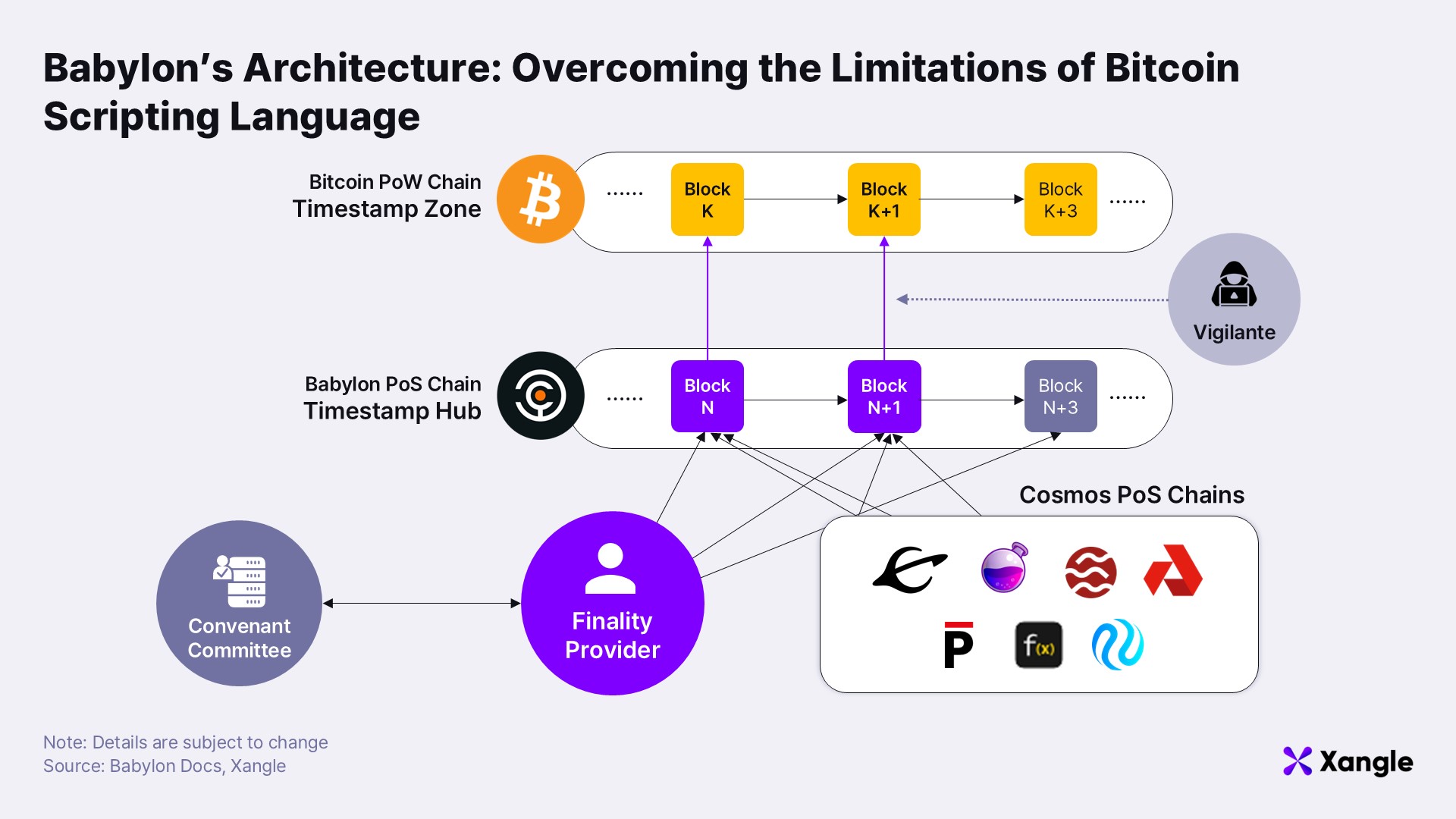
- Babylon PoS Chain: Babylon operates its own Proof of Stake (PoS) chain, built on the Cosmos SDK, which interacts with the Bitcoin network to provide enhanced security services. This PoS chain is interconnected with other PoS chains within the Cosmos ecosystem, thereby bolstering their security. Like other PoS chains, Babylon utilizes validators who validate blocks through the CometBFT consensus algorithm. Validators are expected to delegate Babylon tokens (dPoS) and receive Babylon tokens as rewards, following similar mechanics seen in other PoS networks.
- Finality Provider(FP): Finality Providers play a pivotal role in ensuring the finality of transactions within the Bitcoin staking process. Leveraging the Extractable One-Time Signature (EOTS) mechanism, FPs generate finality signatures for blocks, thereby mitigating security threats such as double-signing. When staked Bitcoin is used as security across various PoS chains, an incentive structure rewards coins from these chains, with a portion allocated to FPs. The Babylon protocol is designed to increase Bitcoin staking volumes by attracting Validators and FPs through a clear and rewarding incentive system.
- Covenant Committee: The Covenant Committee is crucial to the unlocking process of Bitcoin staking transactions. Using a multi-signature method, the committee verifies and approves the unlocking process, ensuring the security of Bitcoin assets. This structure effectively addresses the limitations of Bitcoin’s scripting language while maintaining high security standards.
- Vigilante Program: The Vigilante Program is tasked with monitoring and preempting malicious activities within the network. It plays a critical role in the early detection and response to potential security threats that may arise during the Bitcoin staking process, thereby enhancing the overall stability and security of the Babylon protocol.
This multifaceted design, with its interlinked validators and governance mechanisms, effectively mitigates the constraints imposed by Bitcoin’s scripting language. It significantly expands Bitcoin's utility by enabling the Babylon network to support more complex smart contracts and financial instruments. Babylon's innovative approach not only preserves Bitcoin's inherent security but also lays the foundation for a dynamic and rich ecosystem, akin to that of Ethereum.
The Taproot upgrade has revolutionized Bitcoin’s scripting capabilities, enabling more sophisticated smart contract functionalities. Central to this advancement is the Extractable One-Time Signature (EOTS) algorithm, which is founded on the Schnorr Signature algorithm introduced with Taproot. Schnorr Signatures are instrumental in facilitating more complex transactions within the Bitcoin network, while simultaneously enhancing efficiency and security.
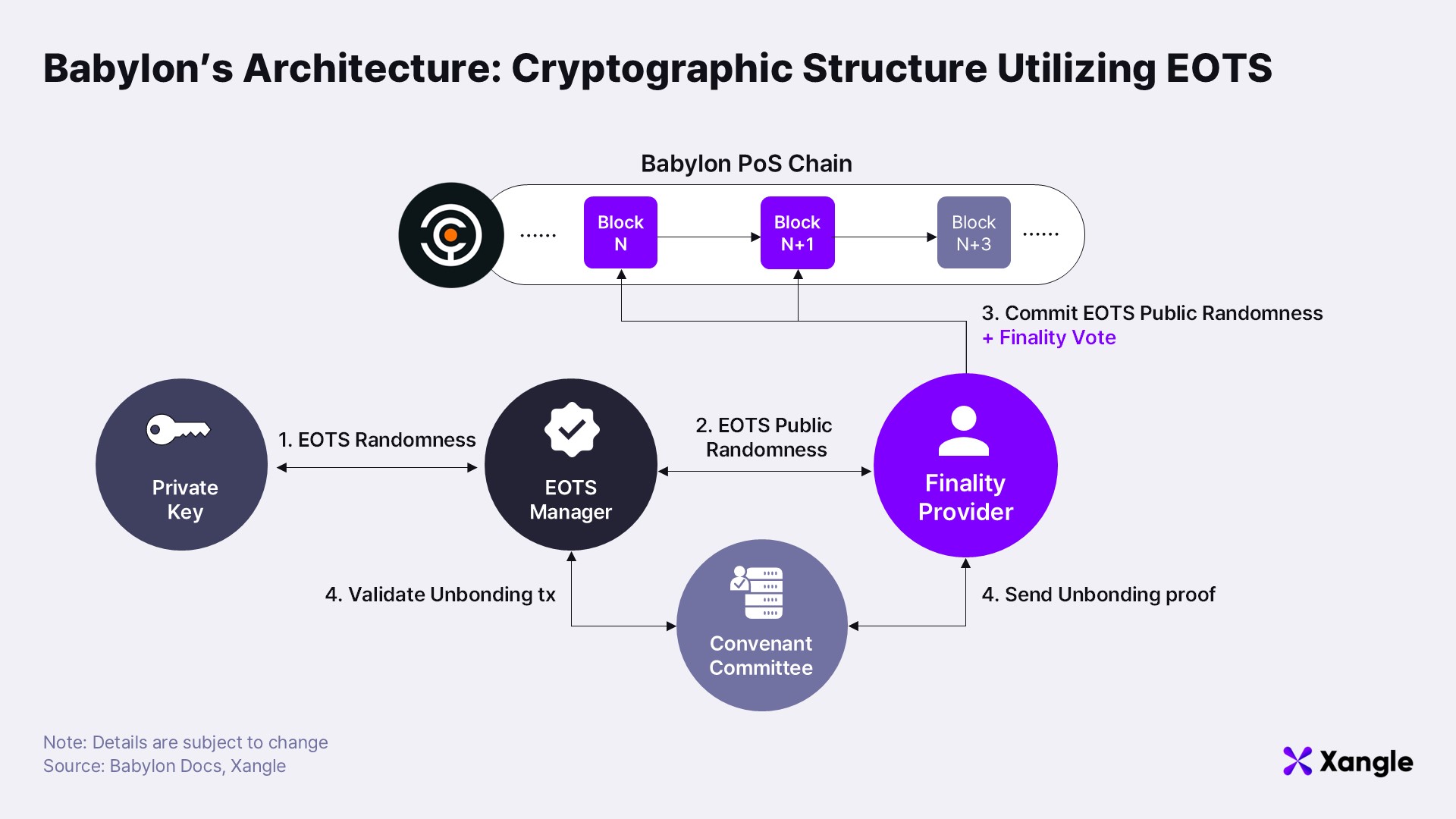
The Extractable One-Time Signature (EOTS) algorithm is a cornerstone of the Babylon protocol, enabling Finality Providers (FPs) to generate finality signatures for blocks. This algorithm harnesses the unique properties of Schnorr Signatures to deter malicious activities, such as double-signing, by ensuring that any attempt to sign two different messages with the same secret nonce results in the exposure of the secret key.
The EOTS mechanism within the Babylon protocol operates as follows:
- EOTS Randomness Generation:The EOTS Manager generates a random value, or randomness, which the Finality Provider (FP) will use when signing the block. This randomness is crucial for securely protecting the FP's private key.
- Delivery of EOTS Public Randomness:The generated randomness is delivered to the FP by the EOTS Manager. The FP uses it to sign the block, helping to protect the private key during the signing process. In case of double-signing, the private key associated with the public key is automatically revealed, triggering a slashing transaction against the malicious FP
- Commitment of EOTS Public Randomness and Finality Vote:The FP commits the finality vote result to the blockchain along with the EOTS Public Randomness. This secures the block’s finality and prevents double-signing. This step strengthens Babylon protocol’s security while minimizing signing errors by the FP.
- Collaboration with the Covenant Committee:The Covenant Committee plays a critical verification role when the FP attempts to unbond (unstake) Bitcoin. When the FP requests unbonding, the Covenant Committee verifies the legitimacy of the request and checks if the unbonding was correctly processed. During this process, the Covenant Committee collaborates with the EOTS Manager to ensure accurate transaction execution, and only then approves the unbonding. This process reinforces security in unbonding.
By leveraging cryptographic mechanisms such as EOTS and the Covenant Committee, Babylon effectively overcomes the limitations of Bitcoin’s scripting language, enabling Bitcoin staking, slashing, and unbonding. These mechanisms are crucial in preserving the integrity of Bitcoin staking transactions, preventing errors that may arise when FPs generate finality signatures for blocks. This approach not only fortifies the security and reliability of transactions but also significantly contributes to the overall stability and robustness of the Babylon protocol.
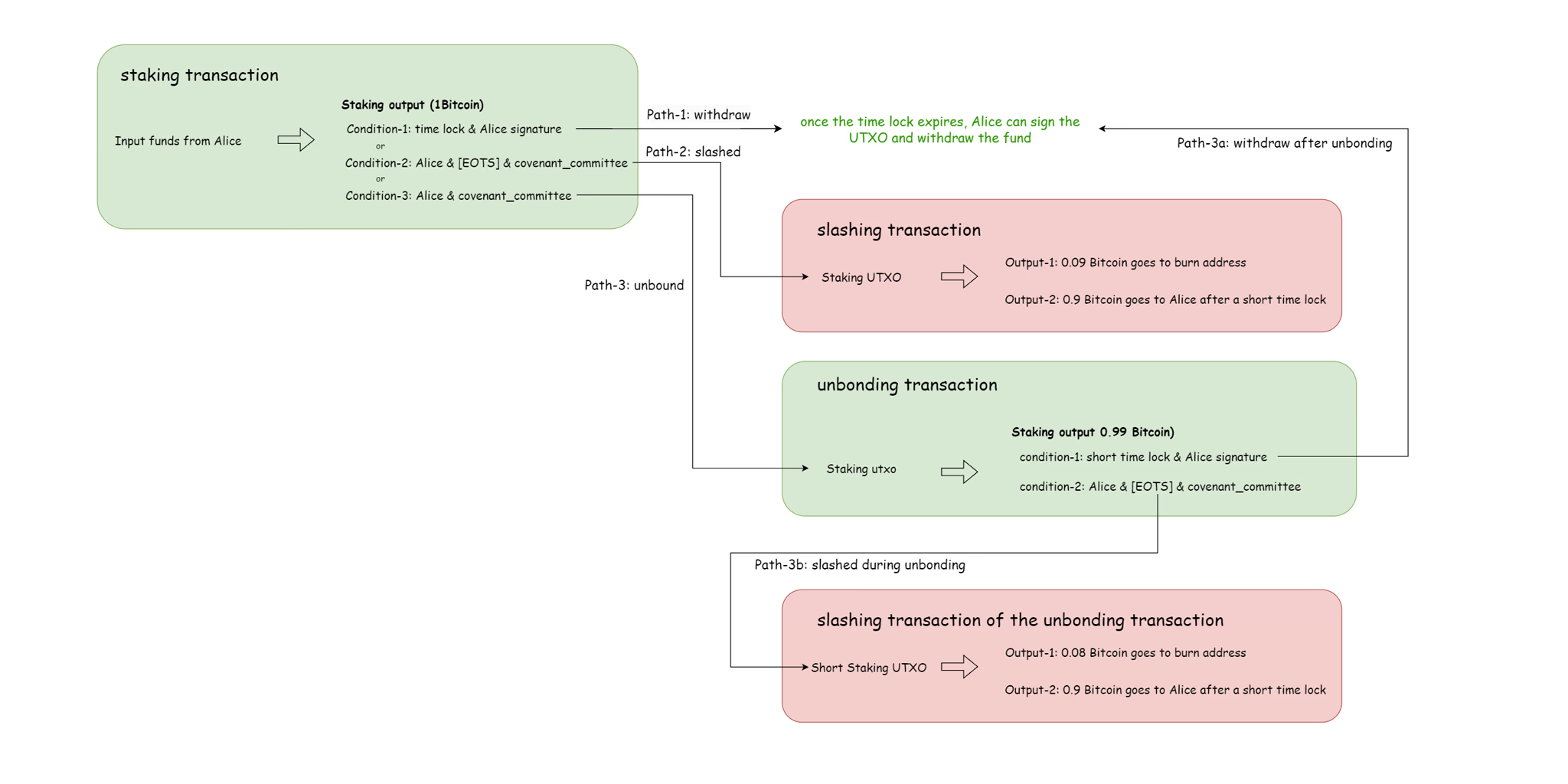
Babylon introduces an innovative economic incentive to the Proof-of-Work (PoW) Bitcoin network through the concept of “staking,” thereby unlocking new use cases for Bitcoin that were previously unattainable. This incentive framework not only offers monetization avenues for Bitcoin holders but also fortifies the security of various PoS chains.

Babylon has created a new use case within the Bitcoin ecosystem—Bitcoin Staking. The primary goal is to establish a security economic structure that not only reinforces the security of other PoS chains through staked Bitcoin secured by PoW but also provides additional economic incentives. If successfully launched and commercialized, Bitcoin will evolve beyond being merely a store of value, becoming a multifaceted asset with various utilities.
Reflecting on the Ethereum ecosystem, it's anticipated that Bitcoin Liquid Staking Token (LST) DeFi will emerge as a growing sector through Bitcoin staking. Given the technical constraint that prevents the immediate unstaking of staked assets, Bitcoin staking is expected to drive the growth of various Bitcoin DeFi services, with LST assets at the forefront. Consequently, this new asset class derived from staked Bitcoin offers holders opportunities to generate income beyond long-term holding, thereby activating the Bitcoin network.
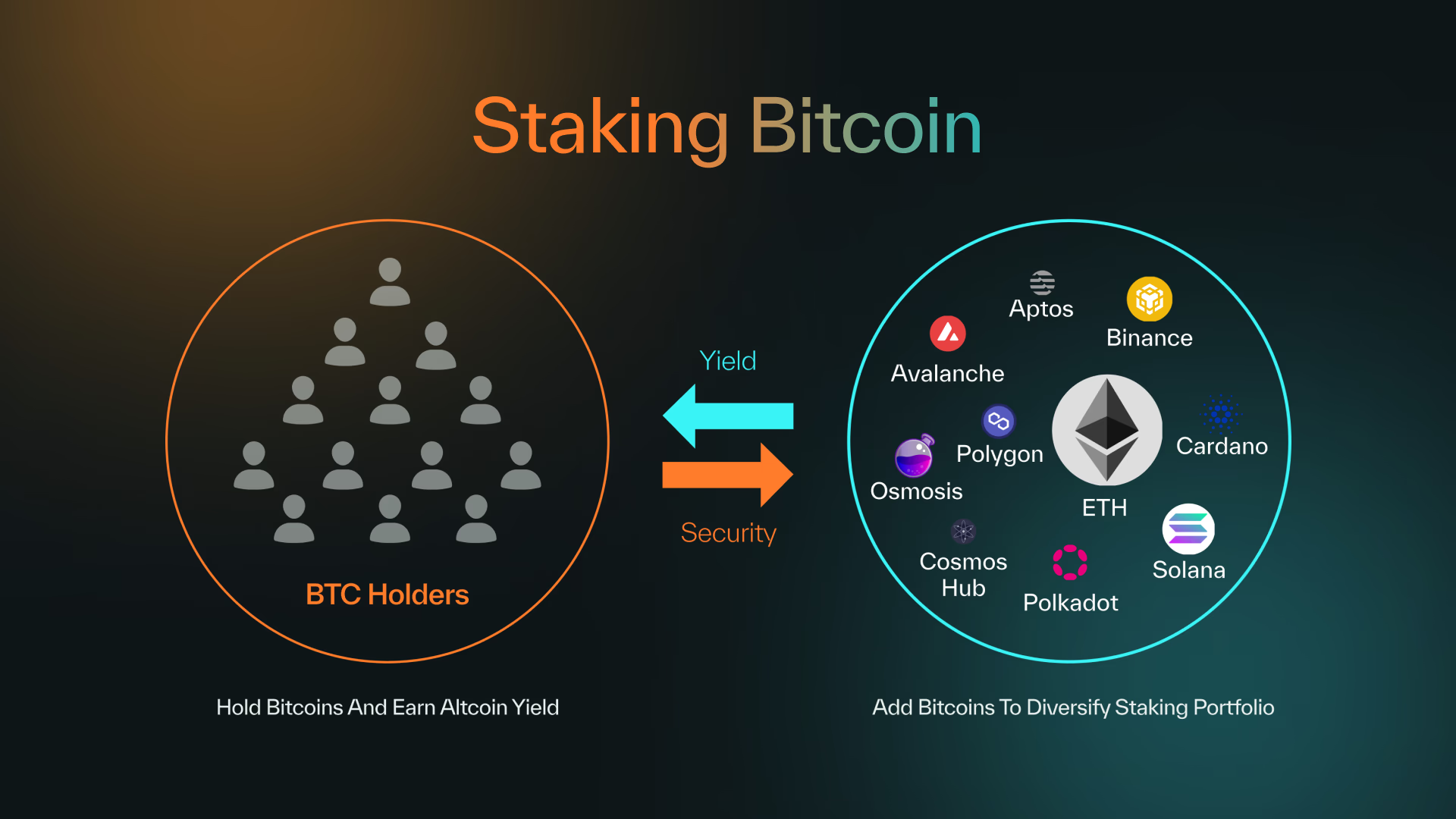
Babylon is the first to propose an innovative approach to enhancing the security of PoS chains using Bitcoin. This approach focuses on creating a new economic structure within the PoS ecosystem where Bitcoin is utilized as a key asset, moving beyond the traditional concept of merely holding Bitcoin.
At Cosmoverse 2023, Babylon unveiled its Bitcoin Staking Protocol MVP and set a goal to convert 210,000 Bitcoins into decentralized staking assets within the PoS economy. Through Bitcoin staking, PoS chains can utilize Bitcoin as a security asset alongside their native tokens, thus enabling them to leverage Bitcoin's substantial market cap to secure higher security. This approach helps alleviate the issue of high inflation that PoS chains often face to secure staking capital, thereby supporting the network's economic health.
This structure particularly benefits new PoS chains. While existing PoS chains have had to maintain security through their native assets, Babylon's Bitcoin staking protocol provides them with access to a broader capital pool, addressing security challenges. For example, emerging and small-cap PoS chains within ecosystems like Cosmos, which require high staking rates for network security, can reduce the burden of initial security stabilization by leveraging Babylon's Bitcoin staking assets.
Additionally, the Bitcoin staking protocol opens up new possibilities for PoS chains to utilize Bitcoin assets. Although Bitcoin has long been used as a store of value, it can now be employed as a staking asset, enhancing network security and serving as a liquid asset. This framework not only enables PoS chains to strengthen their security using Bitcoin but also creates a new framework for asset interoperability, offering new economic incentives to participants.
Ultimately, Babylon's Bitcoin Staking Protocol will create a new economic value through the interaction between Bitcoin and PoS chains. This system encourages network participants to engage more actively in security and staking, transforming Bitcoin from a simple store of value into a key security asset within the PoS ecosystem.
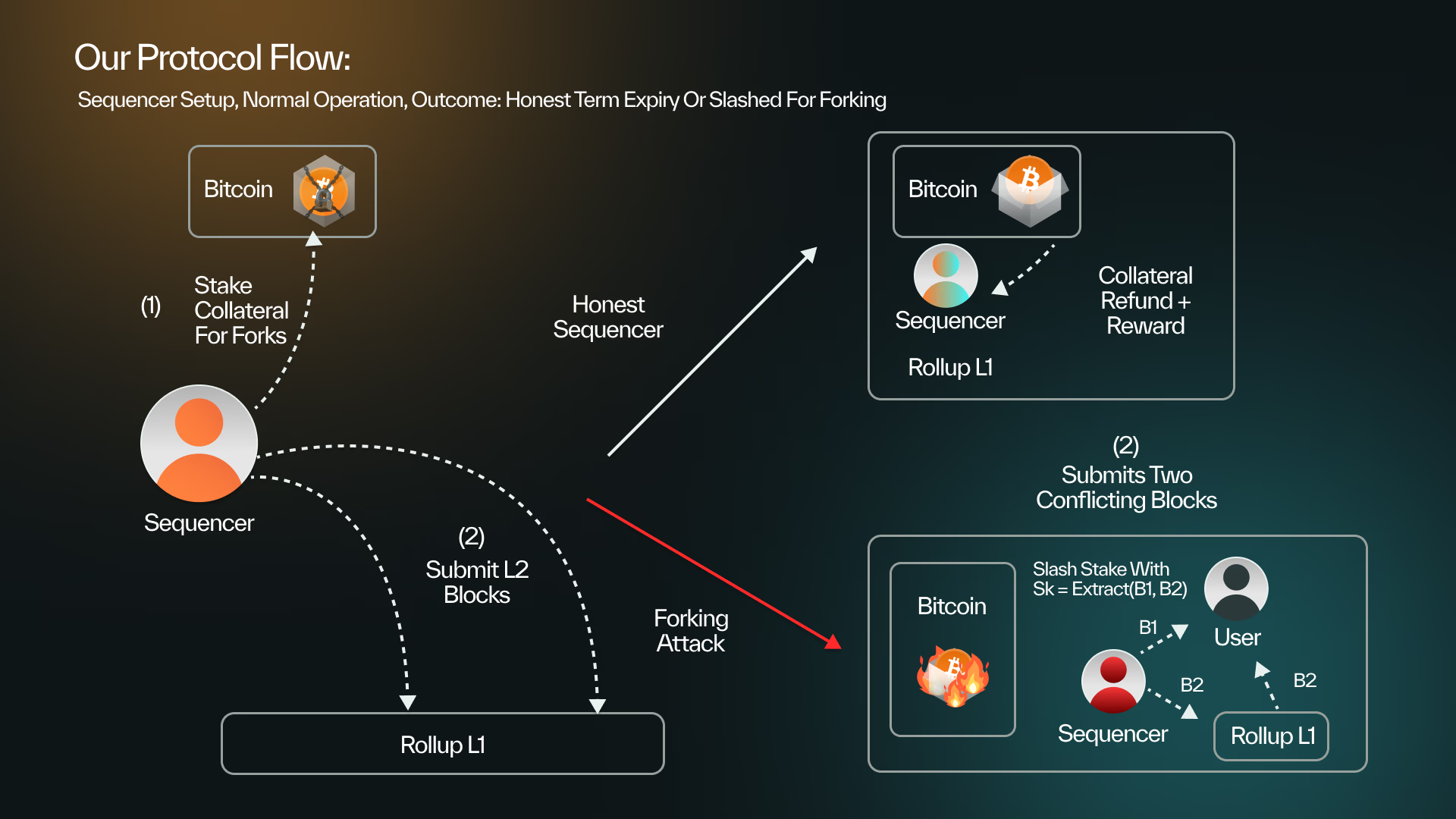
Babylon seeks to extend its security-enhancing economic structure, established through Bitcoin staking, beyond PoS chains to the rollup ecosystem. Rollups are Layer 2 (L2) solutions designed to address the scalability challenges of Layer 1 (L1) blockchains by processing transactions off-chain and subsequently submitting the results to L1 for security purposes. However, the current rollup architecture inherently carries centralization risks due to its reliance on a centralized sequencer.
To address these centralization issues, Babylon introduces an innovative approach that leverages Bitcoin staking. By delegating Bitcoin to the rollup’s sequencer, the staked Bitcoin serves as a critical guarantor of the rollup’s finality, thereby providing a strong economic deterrent against potential malicious actions, such as double-spending. If a sequencer engages in such malicious behavior, the staked Bitcoin would be subject to slashing, resulting in significant financial penalties for the sequencer.
Furthermore, Babylon is also exploring plans to decentralize the sequencer's role through the use of Bitcoin staking. By engaging multiple finality providers to verify and sign off on the blocks produced by the sequencer, the security of rollups can be significantly bolstered. This decentralized model mitigates the centralization risks currently present in rollup ecosystems and helps establish a more secure and economically incentivized framework.
In essence, Babylon's strategy for enhancing rollup security through Bitcoin staking represents a transformative shift away from traditional centralized models, opening the door to a decentralized security paradigm that creates new economic opportunities within the rollup ecosystem.
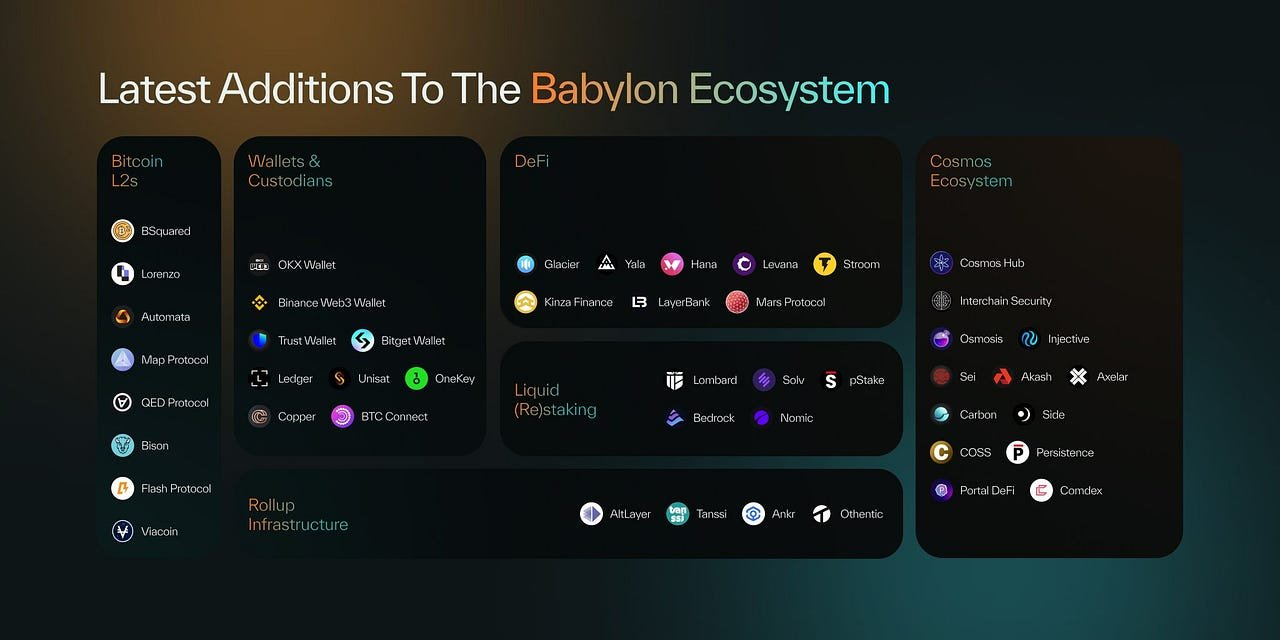
Babylon’s Bitcoin staking protocol is experiencing rapid growth through collaboration with various partners. Several projects are emerging that leverage Bitcoin staking to create new use cases and economic opportunities. Some of the key projects include:
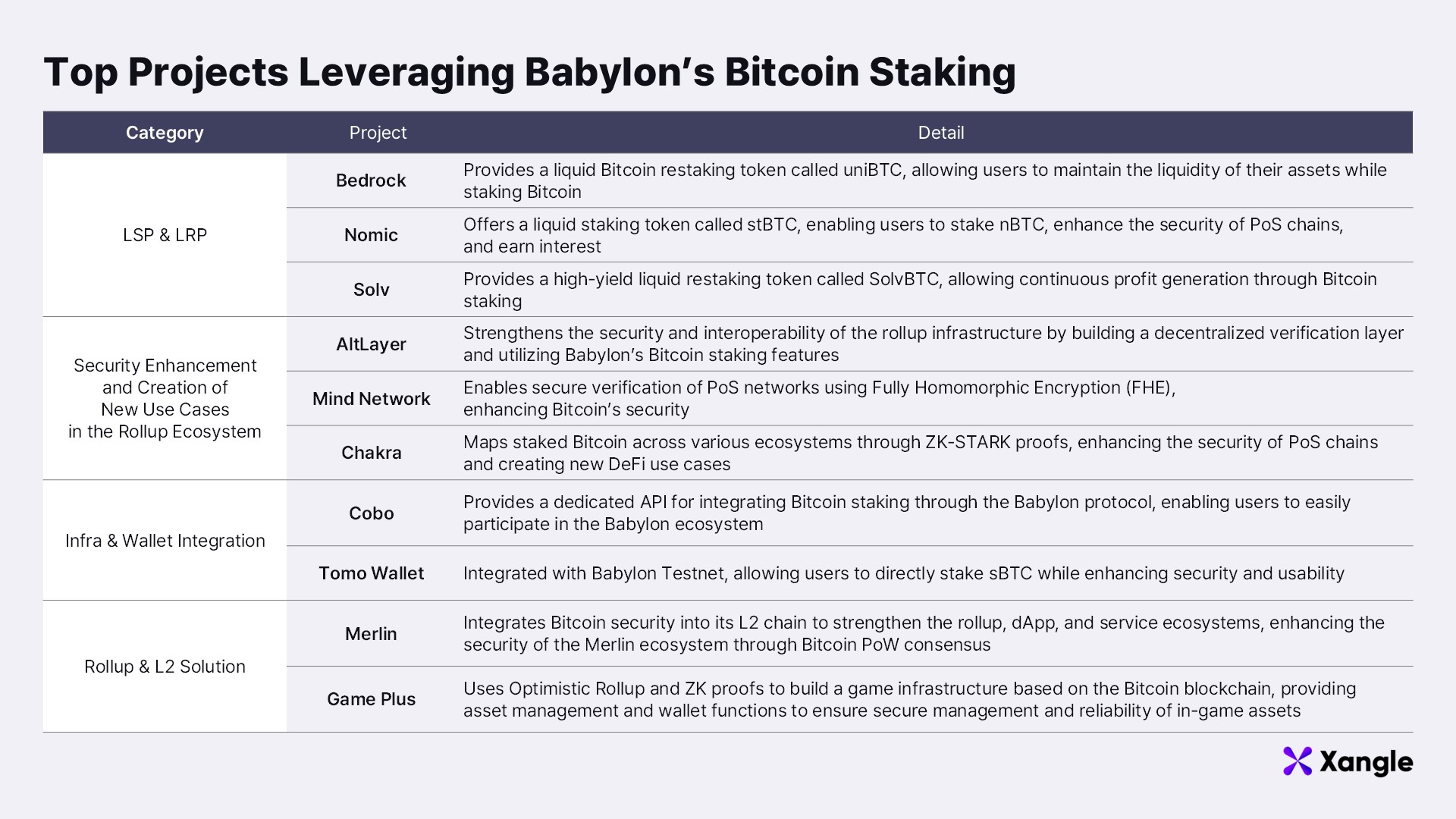
These projects, by contributing to the expansion of Bitcoin’s utility, are fueling the rapid growth of Babylon’s Bitcoin staking ecosystem. This expansion is expected to enhance the security and liquidity of numerous PoS chains and rollup ecosystems, with Bitcoin serving as the backbone.
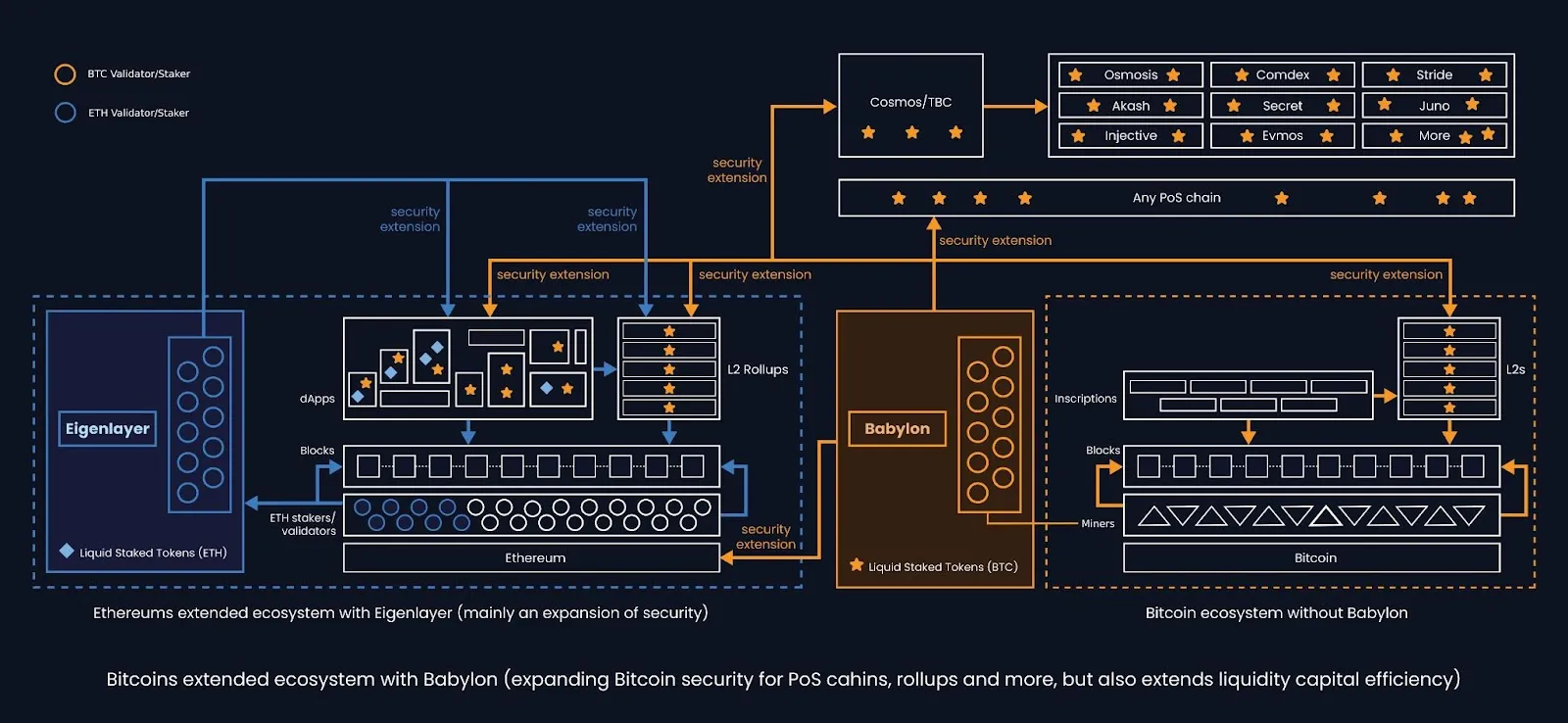
Babylon’s Bitcoin staking protocol has reached a significant milestone in its quest to overcome Bitcoin’s inherent limitations and expand its utility. Historically, Bitcoin’s scripting language and PoW structure posed challenges to implementing complex smart contracts and diverse utilities. However, Babylon has tackled these issues by leveraging the Taproot upgrade and advanced cryptographic techniques. This has not only made Bitcoin staking feasible but also opened new avenues for enhancing the security of PoS chains and the rollup ecosystem.
These innovations have transformed Bitcoin from a mere store of value into a key component of a more complex economic structure, where it plays a crucial role in strengthening the security of PoS chains and providing new revenue opportunities for Bitcoin holders. This development lays the groundwork for creating secure economic structures across the broader blockchain ecosystem. In this context, Ethereum’s EigenLayer, a re-staking protocol, is expected to complement Babylon’s efforts, helping to establish a more resilient and secure economic framework for the entire PoS ecosystem.
However, the journey of Bitcoin staking technology is still in its early stages, and several challenges lie ahead. As the mainnet rollout progresses, ensuring flawless interaction between Bitcoin’s scripting language and Babylon’s architecture is critical. Particular attention must be given to the potential centralization risks and security issues arising from the concentration of Bitcoin in Finality Providers. These risks could undermine the reliability of Bitcoin staking technology, necessitating further refinements in rule-setting and enhancements to the economic reward structure to ensure long-term stability.
During Phase 1 of the Bitcoin Staking Mainnet launch, Babylon quickly reached its staking cap of 1,000 BTC, underscoring the high level of market interest and the protocol’s viability. This achievement not only demonstrated Babylon’s market potential but also reflected the strong support from Bitcoin holders for its expanded utility. As Babylon continues to advance its technology and build secure economic structures, it remains to be seen how far these innovations will drive the growth of the Bitcoin ecosystem.


All Comments