

Cointime

Download App
iOS & Android

Higher CPI print for March already 'baked in' to BTC price — Analysts

The latest rise in the consumer price index (CPI) was “in line with estimates,” and rising inflation has already been priced into the macroeconomic data for the March CPI print, according to market analysts at exchange-traded product (ETP) issuer 21Shares.

Shelter rose 0.2% in February, while the food sector of the CPI rose 0.4%, energy increased by 0.6%, and the index for all items, excluding food and energy, rose by 0.2%, according to the US Bureau of Labor Statistics (BLS) February CPI report.
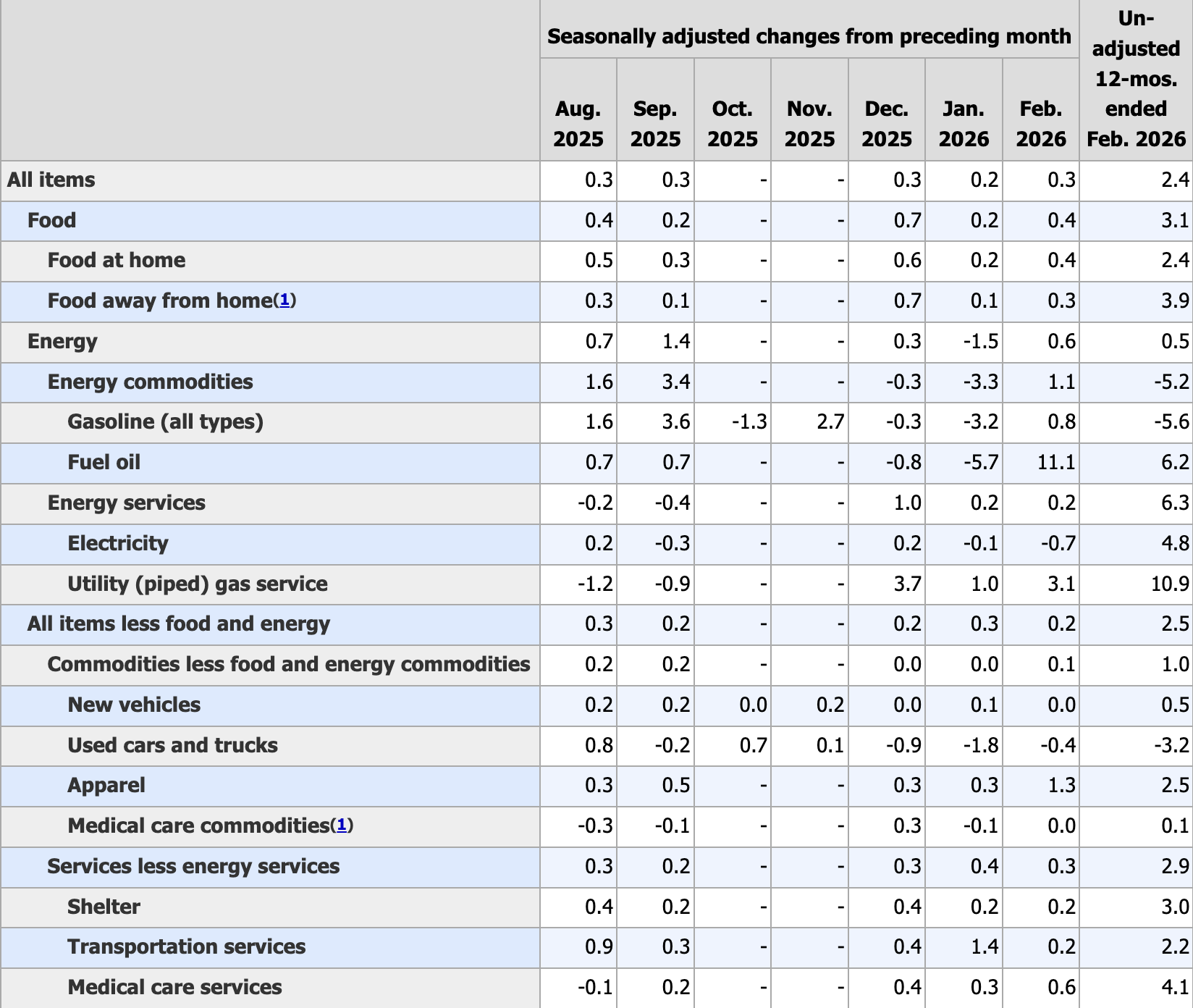
  CPI inflation data for different sectors of the economy. Source: Bureau of Labor Statistics

Stephen Coltman, head of macro at 21shares, said the upcoming CPI prints place even more pressure on the Federal Open Market Committee (FOMC), the body that decides interest rate policy. He said: 

“What matters now is the Fed’s reaction function to the coming higher CPI prints. Do they ‘look through’ this temporary shock despite having been burned in the previous inflation cycle? Or do they tilt hawkish as a precautionary measure?” 

Crypto markets remain resilient following the February CPI report, with the Total 3 market indicator, which tracks the entire crypto market capitalization excluding Bitcoin and Ether, only declining by about 1% from the intraday high of about $722 billion.

What does this mean for BTC’s price?

“In the immediate term, Bitcoin is likely to remain rangebound between $68,000 and $74,000. However, a breakout past the $75,000 resistance zone appears imminent,” according to Matt Mena, crypto research strategist at 21Shares.
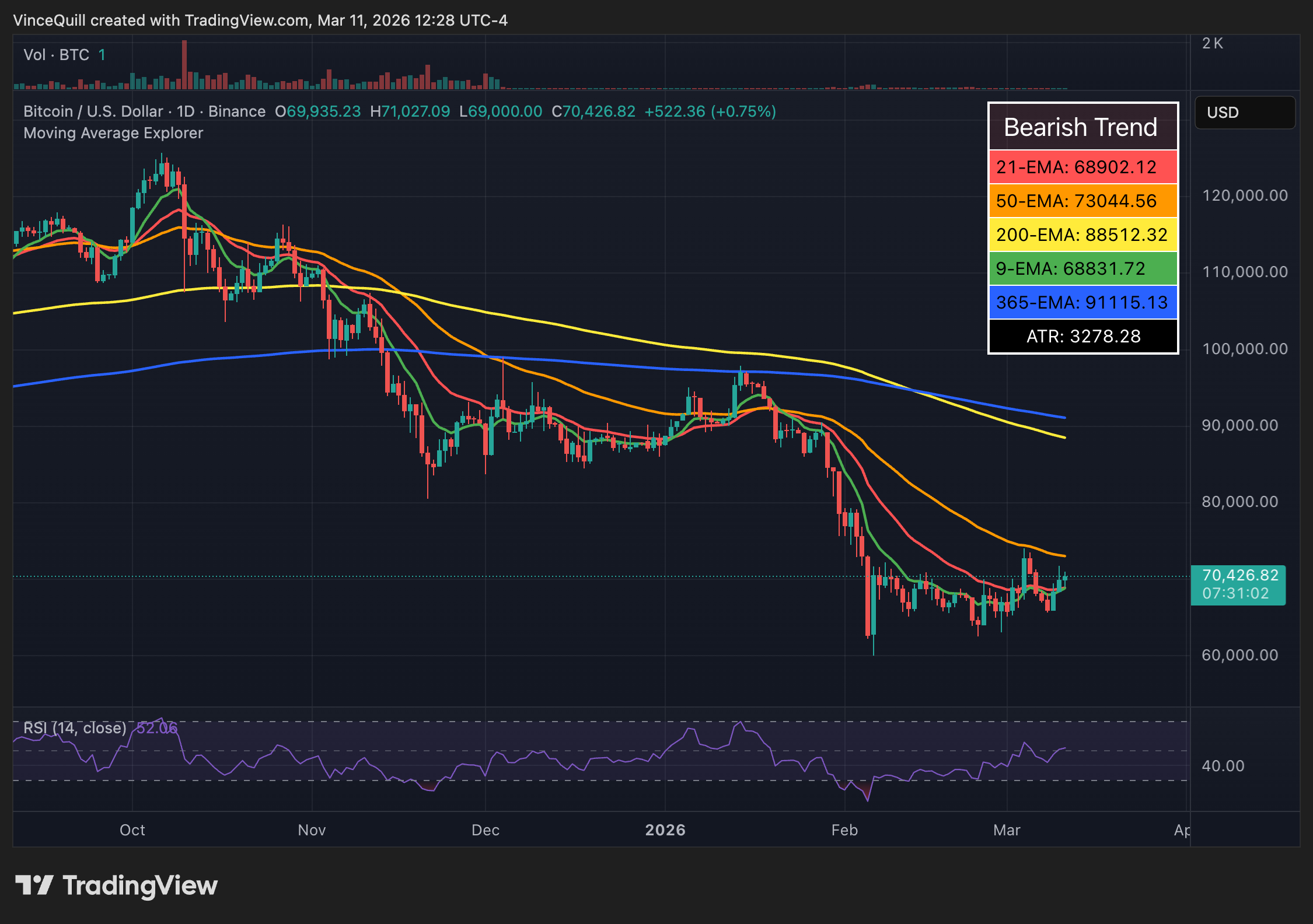
  The price of BTC remained resilient, barely moving in reaction to the February CPI print. Source: TradingView

If BTC manages to break above the $75,000 level, it could enter a consolidation phase between $75,000 and $80,000 in the medium-term, Mena said.

Historic price data shows that BTC typically rebounds by 15% or more after geopolitical market shocks, which would put its price in the $77,000 to $80,000 range, he said.

A market recovery to these levels could also be “accelerated” if the FOMC resumes easing interest rates in 2026, according to Mena.

Only 0.6% of traders expect an interest rate cut from the current 3.50%-3.75% range at the March 18 FOMC meeting, according to the CME FedWatch tool.

Comments

All Comments

Recommended for you

  • Zhipu Launches and Open Sources GLM-5.3-Flash

    On August 26, Zhipu launched and open-sourced GLM-5.3-Flash (320B-A18B), the first native multimodal model in the GLM-5 series. It features a total of 320 billion parameters and surpasses GLM-5.2, achieving a score of 57 on the globally recognized Artificial Analysis Intelligence Index (AA Comprehensive Intelligence Index), placing it among the leading models worldwide, on par with Anthropic's popular model Claude Opus 4.8. In the self-developed Z.ai Code Bench evaluation, its programming performance is comparable to that of Claude Opus 4.8. Additionally, GLM-5.3-Flash is priced at 1/10 of GLM-5.3, and during a limited-time discount, it is priced at 1/20 of GLM-5.3, which is 1/40 of Opus 4.8. The same intelligence at 1/40 the price, cutting-edge capabilities without the need to hold back.

  • Zhipu Launches and Open Sources GLM-5.3-Flash

    On August 26, Zhipu launched and open-sourced GLM-5.3-Flash (320B-A18B), the first native multimodal model in the GLM-5 series. It has a total of 320 billion parameters and surpasses GLM-5.2, achieving a score of 57 in the globally recognized Artificial Analysis Intelligence Index (AA Comprehensive Intelligence Index), placing it among the leading models worldwide, on par with Anthropic's popular model Claude Opus 4.8. In the self-developed Z.ai Code Bench evaluation, its programming performance is comparable to that of Claude Opus 4.8. Meanwhile, GLM-5.3-Flash is priced at 1/10 of GLM-5.3, and during a limited-time discount, it is available for 1/20 of GLM-5.3's price, which is 1/40 of Opus 4.8's price. The same intelligence, at 1/40 the cost, provides cutting-edge capabilities without the need to hold back.

  • Ethereum Developers Propose Restructuring Validator Staking Contract to Prepare for Quantum Attacks

    On August 26, Ethereum researchers proposed a draft to rebuild the validator deposit contract in preparation for the future introduction of quantum-resistant signature mechanisms, allowing for a gradual phase-out of the existing BLS signature format. This proposal enables the deposit contract to support keys of different sizes and public key types, assigning labels for each cryptographic scheme, with the current BLS signature labeled as 0 and potential future quantum-resistant schemes receiving new labels. Currently, approximately 42.4 million ETH, worth around $10.4 billion, are staked in Ethereum, all relying on BLS validator keys. This draft is still in its early stages and must be implemented alongside subsequent consensus layer upgrades, with the Ethereum Foundation's overall quantum resistance roadmap targeting around 2029.

  • Ethereum Developers Propose Restructuring Validator Staking Contract to Prepare for Quantum Attacks

    On August 26, Ethereum researchers proposed a draft to rebuild the validator deposit contract in preparation for the future introduction of quantum-resistant signature mechanisms, allowing for a gradual phase-out of the existing BLS signature format. This proposal enables the deposit contract to support keys of different sizes and public key types, assigning labels for each cryptographic scheme, with the current BLS signature labeled as 0, and future quantum-resistant schemes to be assigned additional labels. Currently, approximately 42.4 million ETH, valued at around $10.4 billion, are staked in Ethereum, all relying on BLS validator keys. The draft remains in its early stages and must be implemented alongside subsequent consensus layer upgrades, with the Ethereum Foundation's overall quantum resistance roadmap targeting around 2029.

  • Spot Gold Falls Below $4600/Ounce

    On August 26, spot gold fell below $4600 per ounce, declining by 1.30% during the day.

  • Spot Gold Falls Below $4600/Ounce

    On August 26, spot gold fell below $4600 per ounce, declining by 1.30% during the day.

  • SEC Submits New Crypto Custody Regulations Proposal to White House

    On August 26, Bloomberg reported that the U.S. Securities and Exchange Commission (SEC) has submitted a proposal to the Office of Management and Budget (OMB) regarding new regulations for investment advisors holding client digital assets. The rule aims to 'clarify the framework for investment advisors and investment companies to custody crypto assets,' addressing inquiries from institutions on how to comply with the custody of digital assets. It plans to eliminate certain existing custody requirements that are considered 'outdated' due to market evolution and current trading and custody practices. This proposal is seen as a step by financial regulators to advance the current administration's crypto agenda while relevant legislation remains stalled in the Senate. It will take effect after review by the OMB, a vote by SEC commissioners, and a public comment period.

  • BTC Falls Below $78,000

    Market data shows that BTC has fallen below $78,000, currently priced at $77,983.75, with a 24-hour decline of 1.03%. The market is experiencing significant volatility, so please ensure proper risk management.

  • BTC Falls Below $78,000

    Market data shows that BTC has fallen below $78,000, currently priced at $77,983.75, with a 24-hour decline of 1.03%. The market is experiencing significant volatility, so please ensure proper risk management.

  • Alibaba Qwen Releases Qwen 3.8-Flash Model

    On August 26, Alibaba Qwen launched the Qwen 3.8-Flash model, which is a multimodal MoE model and an early preview of the Qwen 4 architecture. The production version of Qwen 3.8-Flash will soon be available through the Qwen Cloud API, priced at just $0.16 per million input tokens and $0.47 per million output tokens. The model features 125 billion parameters plus 51 billion N-gram embedding parameters, but activates only 6 billion parameters per token, achieving high cost-effectiveness.
