

Meta just launched its text-based Twitter clone, Threads. Keep reading and I’ll tell you how I’m thinking through the launch and what I’m looking for next.
(And if you missed the last piece, I wrote about Twitch’s new competitor Kick. The stakes are lower, but its equally as amusing.)
Was this email forwarded to you?
The Empire Strikes Back

Meta, Facebook and Instagram’s parent company, just launched Threads, a text-based Twitter clone. According to Zuck’s profile on Threads, it hit 30 million sign-ups in less than 24 hours, which would be 60x faster than the 60 days it took ChatGPT to hit 30 million (as I hit send, I’m seeing rumors its passed 50 million, but nothing’s been confirmed yet).
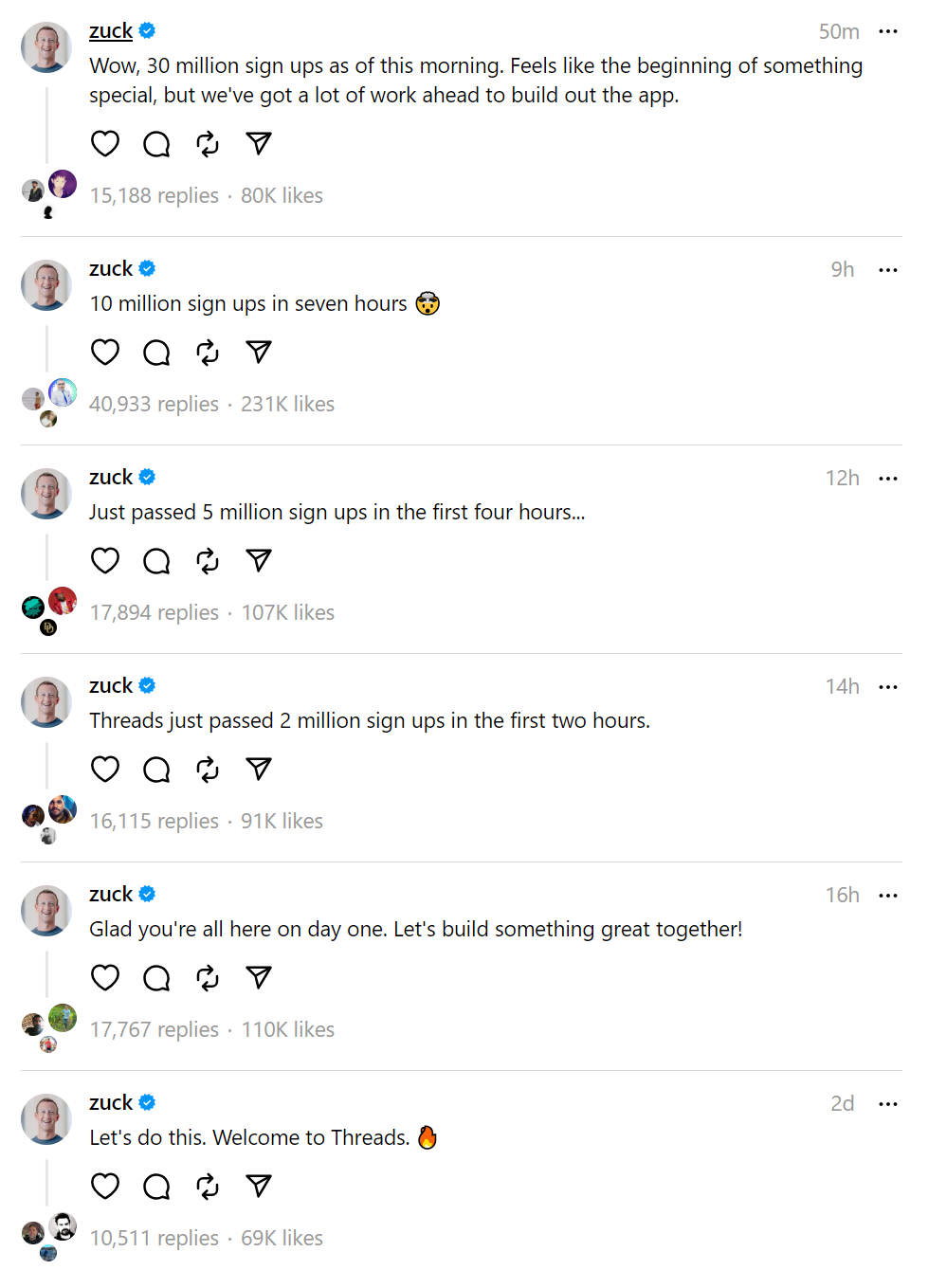
I don’t expect this to slow down anytime soon. 30 million sign-ups is a drop in the bucket for Meta at 1-2% of its multi-billion userbase. And it hasn’t even leveraged its largest product yet, Facebook
The Perfect Launch
Threads launched last night on top of Instagram’s social graph. This meant you needed an IG account to sign-up, and it pre-populated the Threads feed with every account you followed on IG.
We know Elon has been pushing celebrities who left Twitter to get back on. The problem has always been that most of them already have large followings on Instagram, and Twitter was too much work, and not to mention a completely different content format and meta game.
Now, if they do want to experiment with text, Threads gives them all their followers immediately. It was one of the smartest things Meta did with this launch, as I mentioned a few weeks ago:
What I think is most interesting is Threads automatically brings over their Instagram follower graph. For the average IG power user, this makes Threads a much better option than starting from scratch on Twitter so as long as they have followers using it. And for the average consumer, a pre-populated follower graph also makes it easier to get started.
But it wasn’t even the smartest thing they did. They also made the feed like TikTok, where the follower graph doesn’t matter, and anyone (follower or not) can potentially see any piece of content. It’s the reason TikTok was successful. Twitter started borrowing this algorithmic feed years ago, and its gotten more aggressive under Elon’s ownership.
Three years ago I wrote about how and why TikTok did this:
It went after each market's biggest social influencers, and quickly built them social capital on the app. In the early days, everyone on its operations teams was tasked with roping in influencers (and long-rumored to have found ways to pay them to post)…
Deliberate product decisions compounded this process. Extremely short videos, algorithmic discovery on the FYP, the muted importance of a follower graph, and constant traffic into the app via heavy marketing, cross-platform posting, promotion by influencers, and (eventually) habit allowed TikTok to deliberately control the allocation of social capital across the network to its most talented creators, both new or old, as new users poured into the app. Alex Zhu, Musical.ly founder and now Head of Product at TikTok, likens the process to creating a new country and giving a greenfield of opportunities to a new class of creators. Hyper fast user onboarding and no friend graph let it use the entirety of time spent in-app allocating this social capital. Casey Newton described this perfectly:
"In previous eras, most of the spoils went to the platform’s earliest adopters - mining value gets harder as the platform ages. TikTok, on the other hand, promotes all content regardless of who made it or how many followers [social capital] they have."
In business, superior distribution (reach with customers, users, etc) usually wins in the long run. A common way to beat a competitor with a distribution advantage is to build a better product that eventually surpasses their distribution. Despite fewer users, the product decisions above gave new TikTok creators instant distribution advantages over existing platforms. This was similar to when Instagram added Stories and gave creators instant distribution advantages over Snapchat. Creators with ~100k followers on Snapchat eventually switched to posting the same content for their ~1 million followers on Instagram. On TikTok, the best videos could instantly reach the entire user base.
The hardest part about building any new network is getting started - this concept called “network effects” exists for a reason. Meta strategically seeded Threads with hundreds of “Threads is coming” articles over the past two weeks. Everyone who reads the news, one of Twitter’s primary use cases, knew Threads was coming. And people could pre-install the app, meaning they’d get a push notification when it hit the app store. It also launched a day earlier than planned, creating a mad scramble to get on.
This sequence of events made the app extremely active when it launched (or at least appear to be so). And now Meta can start leveraging its superior distribution - to my knowledge, Facebook’s family of apps is the largest scaled product in the world.
Who Controls The Memes Controls the Universe
One thing to keep in mind is the Twitter and Instagram social graphs are very different. This was the primary thing I was initially skeptical of two weeks ago. I think this point is still really important, but it won’t matter soon.
Anyone who’s deep into social media strategy knows memes drive engagement across all the social platforms. This stat is a few years old now, but still fascinates me: meme content gets shared seven times more than non-meme content on Instagram. This is because memes are the universal language of the internet. They convey emotion, they cross borders and demographics, and they make complex topics more consumable for a mass audience.
There are countless Instagram meme accounts that are essentially just screenshots of tweets. thetinderblog is one of them. Here’s its six most recent posts:
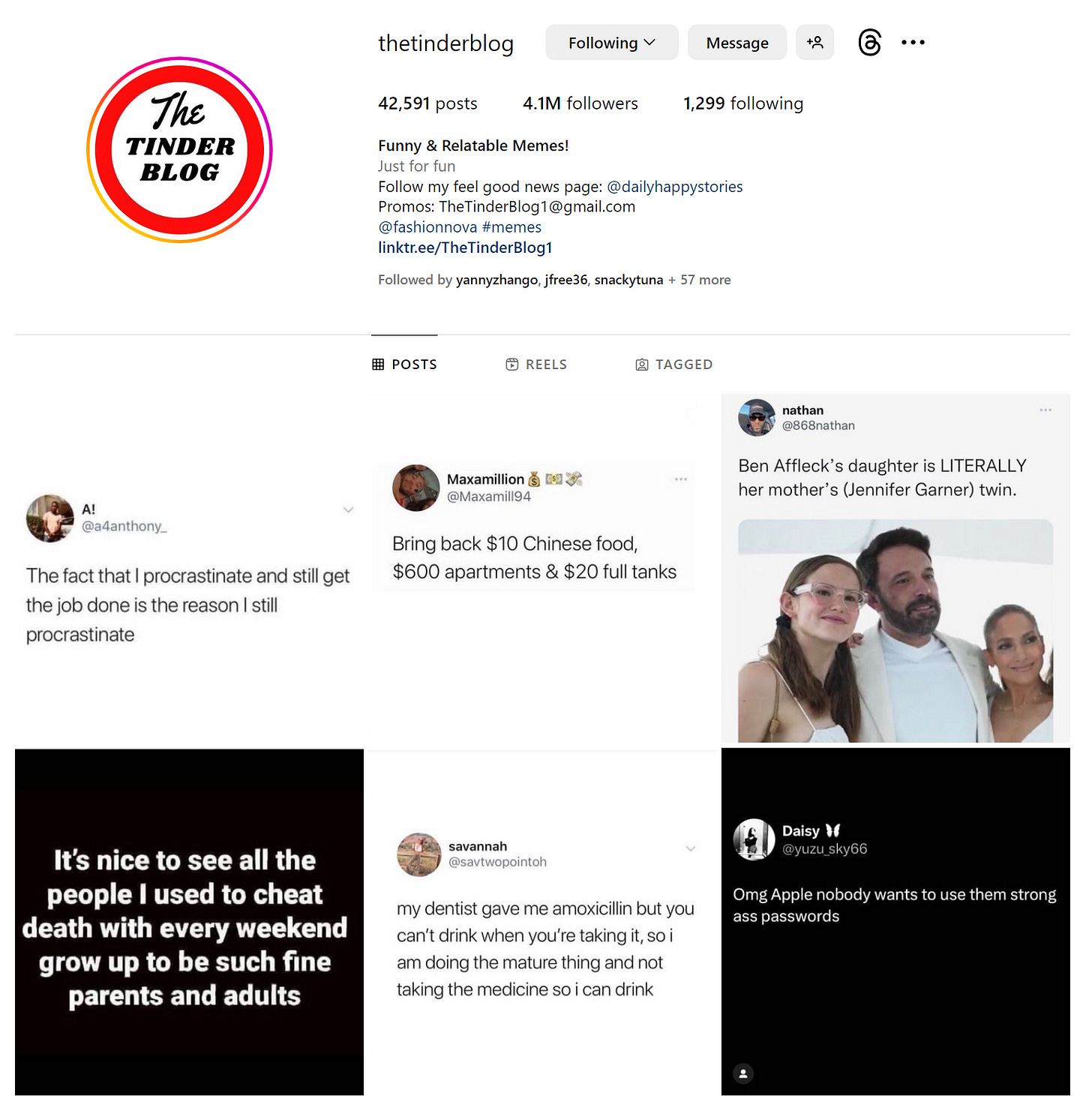
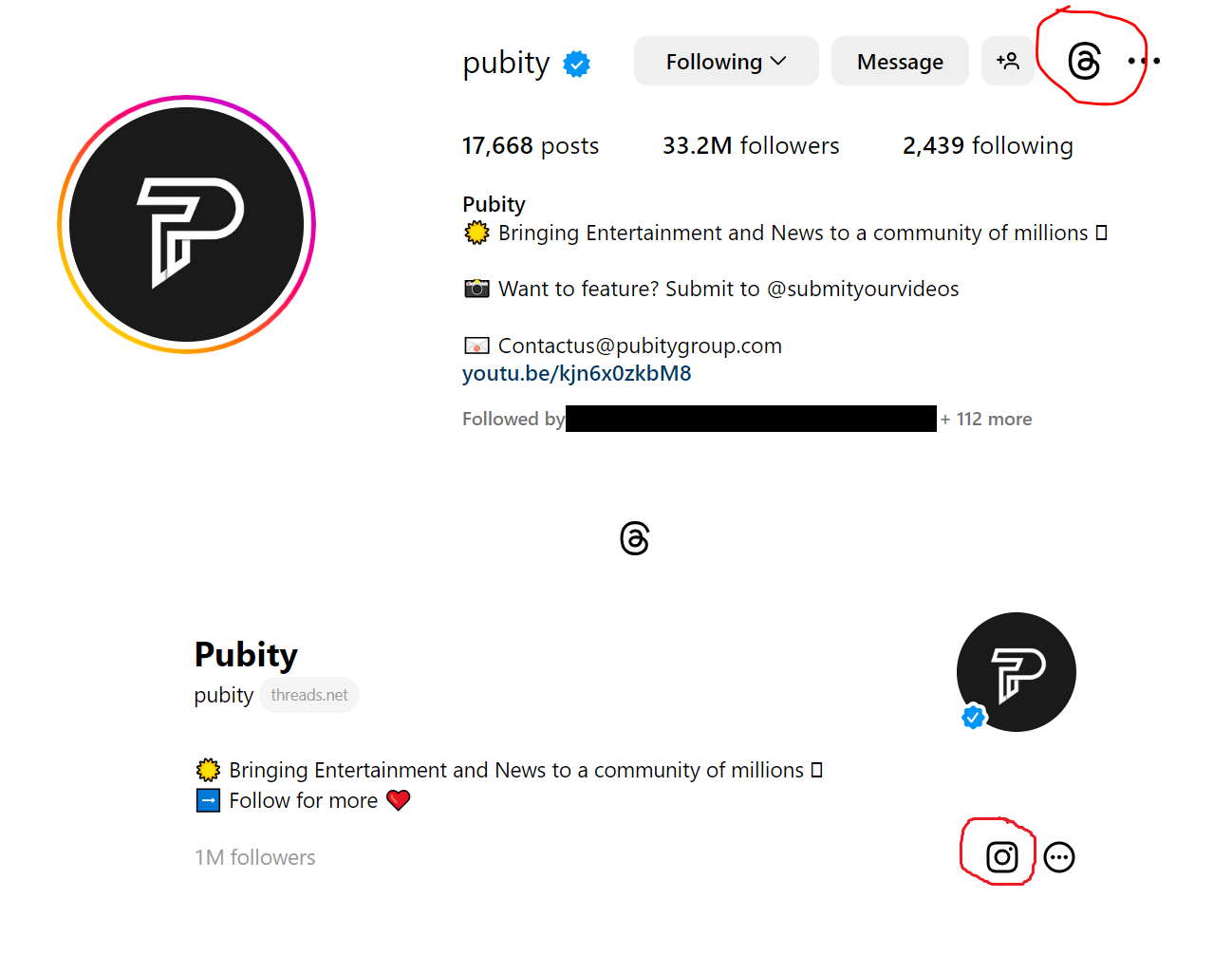
Other accounts that use tweets as a popular format are HouseofHighlights (sports) and Pubity (memes). I spent about 15 seconds finding these in my own feed, there are tens of thousands of similar large accounts on Instagram. Surprisingly, both of these two already have more followers on Threads (HH and P) than they do on Twitter (HH and P). You probably see where I’m going with this.
Within a three hour span during the course of writing this, House of Highlights gained 150,000 followers on Threads compared to the 300 it added on Twitter (a few hours later before publishing, it has 764,000 on Threads). And Pubity has already passed 1 million followers on Threads compared to the 195,000 total it has on Twitter since joining in September of 2017.
As someone with over 200,000 followers and subscribers across the internet, its hard to convey just:
- How big of a dopamine hit this is for a content creator, and
- How impactful it is telling advertisers and partners you doubled your reach in a few months (assuming Threads continues scaling and reaches a few hundred million DAUs by the end of the year). If Threads sticks, you can bet Pubity easily doubles its revenue this year.
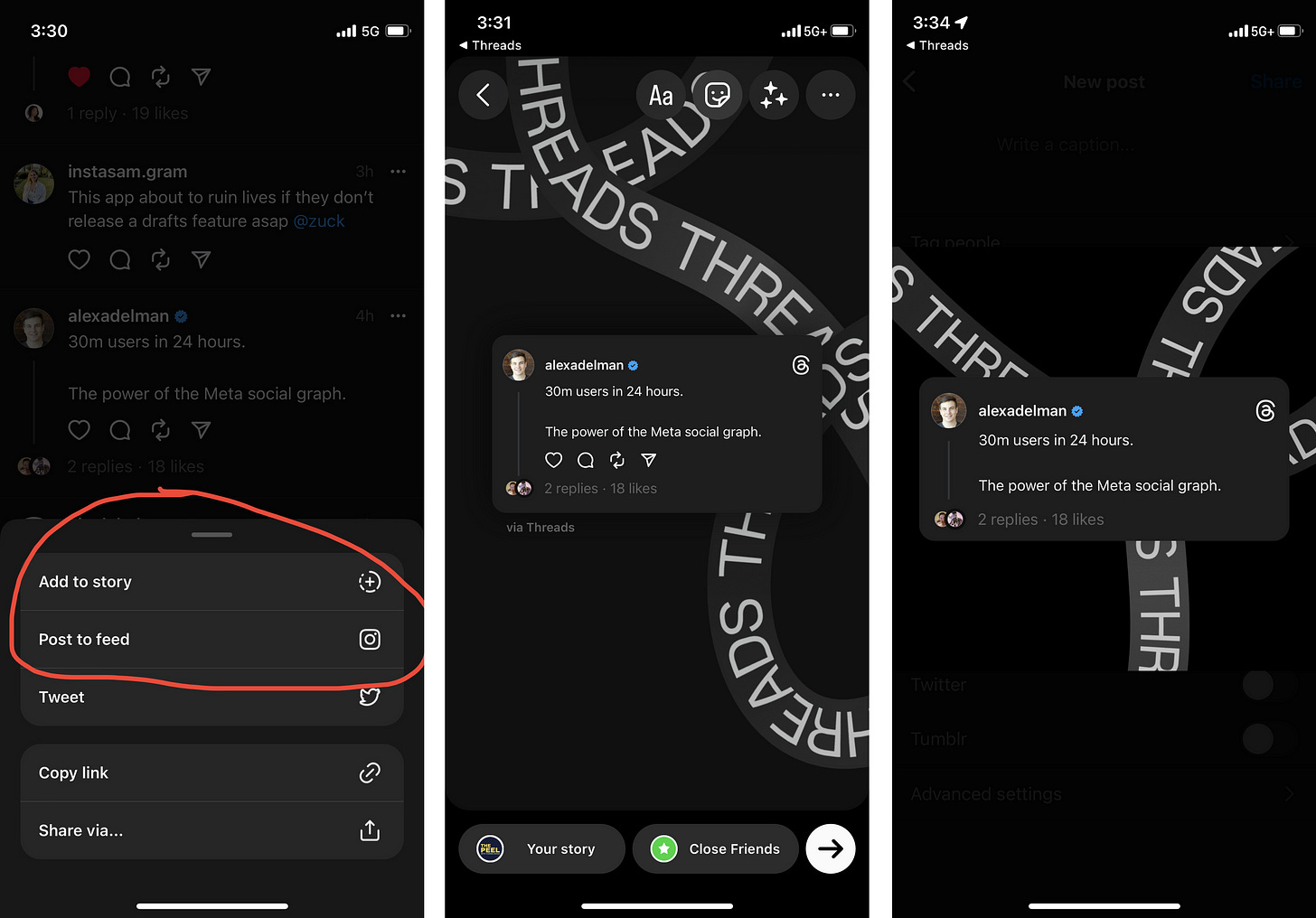
Threads has positioned itself to seize the memes of production. “Share to Story” and “Post to Feed” is built directly into the share button. The posts below look different than the classic tweet screenshot (Meta needs to figure this out), but its easier than creating a screenshot from a tweet.
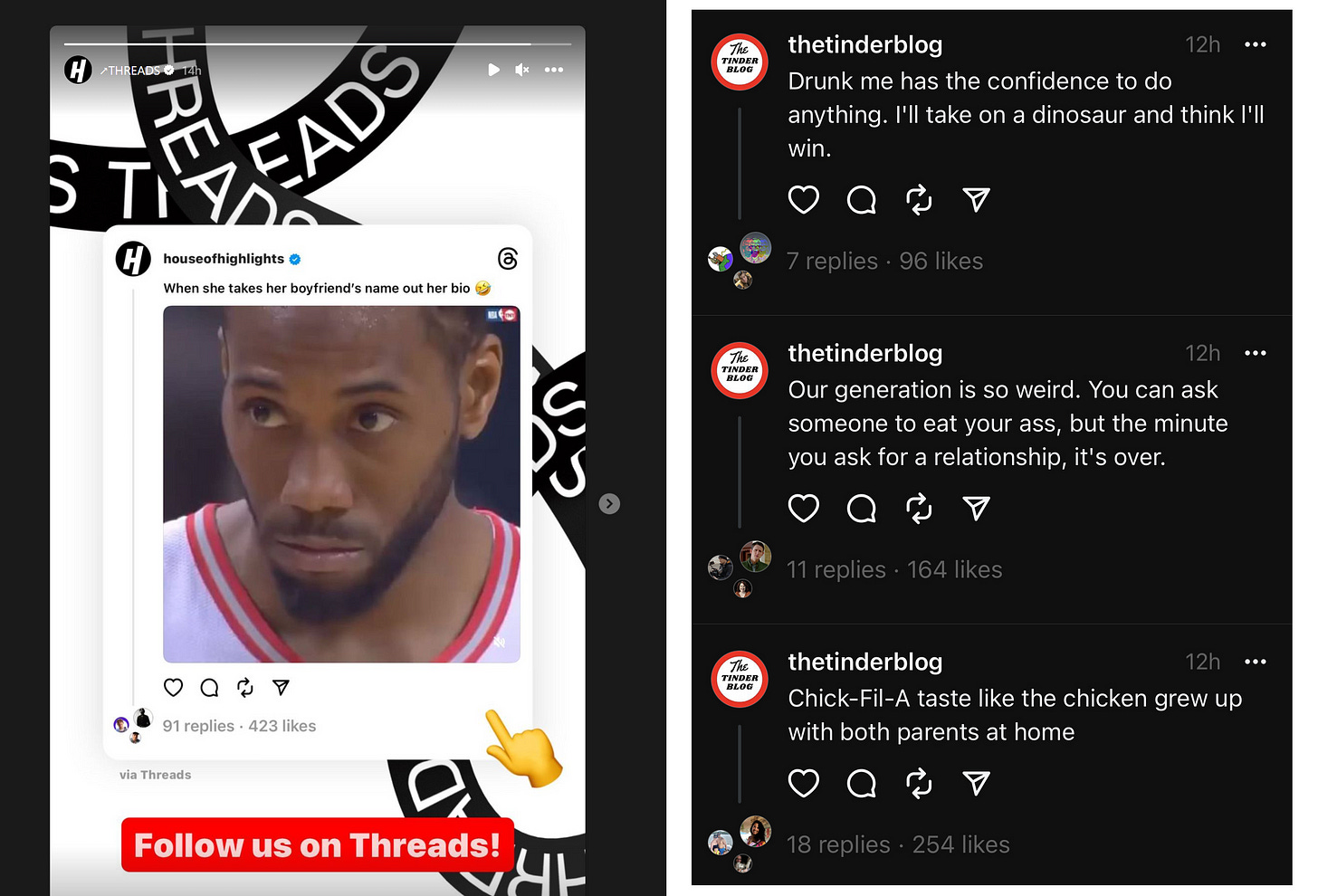
House of Highlights is already starting to use Threads for its “Tweet screenshot” Instagram content, which by the way also advertises Threads to all its 44.1 million followers. And TheTinderBlog is starting to experiment with the same content on Threads that goes viral as a Twitter screenshot.
Building the best tool to create a specific content medium is exactly what TikTok did with video, largely to the detriment of Instagram:
Initially, many creators used TikTok to create videos to post on other platforms. TikTok forces videos to be posted in order to export them, and also inserts a watermark on every exported video. Influencers on Weibo, Instagram, YouTube, and Twitter all drove traffic back to Douyin and TikTok, whether they realized it or not. Many creators who initially used it as an editing tool would deliberately start posting more when they noticed fans started following and interacting with them on the app.
If Instagram can get its largest accounts to create content on Threads that’s easy to cross-post on Instagram, it seeds the network with content as Meta pours in new users.
Don’t Bet Against Zuck
The savviest move in all of this is how Meta’s rewarding existing Instagram power users while also creating opportunity for new ones to rise. Earning social capital (as explained in Eugene Wei’s Status as a Service) is the reason users join and contribute to new networks. Not only will accounts create content to cross-post on Instagram, they’ll create it to build social capital on Threads. And with an algorithmic feed, it doesn’t take many accounts doing this to fill the network with interesting content.
Making the follower graph instantly portable further raises the already-high bar for an Instagram account to clear in order to start on Twitter. The two apps also cross-promote each other, meaning Instagram accounts out to “stake their claim in the new country” and grab attention on Threads are also benefiting back on Instagram too. There’s no reason for them not to be using Threads.
It was also smart to hide how many accounts someone follows on Threads. Followers have historically been the universal currency of the internet, with most people aware of their “ratio”, or how many people follow them compared to how many they follow. By hiding who someone is following, there’s no focus on that ratio, and everyone is more willing to dish out follows, distributing even more social capital (and dopamine).
Threads isn’t perfect. It needs a desktop product, as nothing beats a keyboard for creating text-based content (except for maybe generative AI?). The algorithmic feed is going to suck for live news and sports, however multiple major US sports league’s did just wrap up playoffs a few weeks ago. And there’s a clear lack of other basic functionality like Direct Messages. But ultimately, Zuck controls a firehose of traffic. And it can unleash that firehouse on Threads, essentially whenever it wants, dishing out social capital to whoever and whatever is necessary to build and scale this new product.
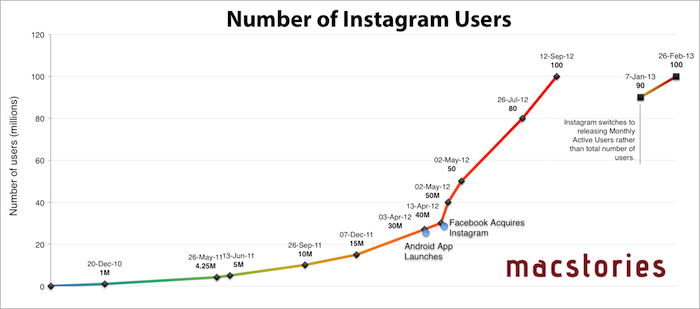
Meta is very familiar with this strategy. Back when it acquired Instagram in 2012, it favored Instagram content in the Facebook feed, helping it quickly convert new users. As seen below, it's evident that 50-75% of Instagram downloads ultimately came from Facebook in the years following the acquisition. And this was at a much smaller scale, when mobile usage was just ramping up, and Facebook itself was still converting its userbase from desktop to mobile.
If this new text-first product catches on, it also gives Meta the room to go full-TikTok with Instagram. People who don’t like it can move to Threads. And it allows Meta to not only compete with Twitter, but also Reddit, the two remaining largest text-first social networks.
Don’t Bet Against Elon
Finally, if Threads fails and we all collectively only take away one thing from this saga, make it this. The fact that Zuck is doing a full-court press with a Twitter clone means one thing: Twitter is working.
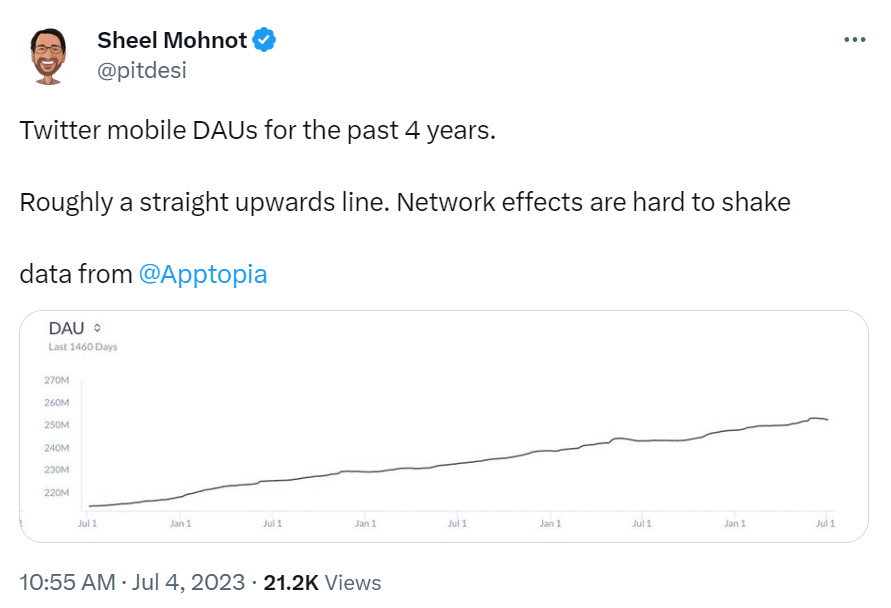
Contrary to the discourse, people are still using Twitter. And it’s growing. Elon’s making quick progress overhauling the culture from a big, publicly traded tech company to something that looks and operates more like a startup. The longer Meta lets Twitter continue getting stronger, the harder it will be to beat.
Twitter still needs to figure out what its business model will look like. Meta has over 10 million advertisers, which take a long time to acquire and that it can very easily layer on top of Threads whenever it wants to. It puts Elon in a very challenging position. He needs to decide if he wants to go head-on in advertising or figure out something else, like subscriptions. He doesn’t have a lot of time, but he’s also the richest person in the world - that’s worth something in this.
Zuck is ruthless to defend the mighty ad dollar. Specifically, US ad dollars. It’s easy to forget, but the “Ban TikTok” rhetoric popped up the day TikTok launched it’s self-serve ad platform in the US. That’s not a coincidence. After losing to Facebook a decade ago, Twitter was essentially run like a non-profit for years. Even its Stories clone, Fleets, was doing well (according to friends close to the product inside Twitter) before it was shut down in August of 2021. Now that Twitter appears to be a threat again, Zuck is back on the offensive.
Needless to say, it feels like this cage match is just getting started. I’m excited to see how big Threads get, how fast it gets there, and what happens next. 🍿



All Comments