

Cointime

Download App
iOS & Android

US lawmakers introduce bill to crack down on prediction markets war bets

Two Democratic lawmakers in the US Congress have introduced legislation in response to “government corruption” over bets on prediction markets platforms.

In a Tuesday announcement, Texas Representative Greg Casar and Connecticut Senator Chris Murphy said they had introduced the Banning Event Trading on Sensitive Operations and ​Federal Functions (BETS OFF) Act after several Polymarket accounts made “highly unusual bets” that a war between the US and Israel against Iran would begin.

Murphy said on March 4 that it was likely that people with “inside information” of US President Donald Trump’s plan to bomb Iran had made the bets.

“We shouldn’t live in a country where someone sitting in the situation room making decisions about whether to invade or to bomb, decisions about war and peace, life and death, that those decisions could be driven by the fact that they have hundreds of thousands of dollars riding on the decision,” said Casar.
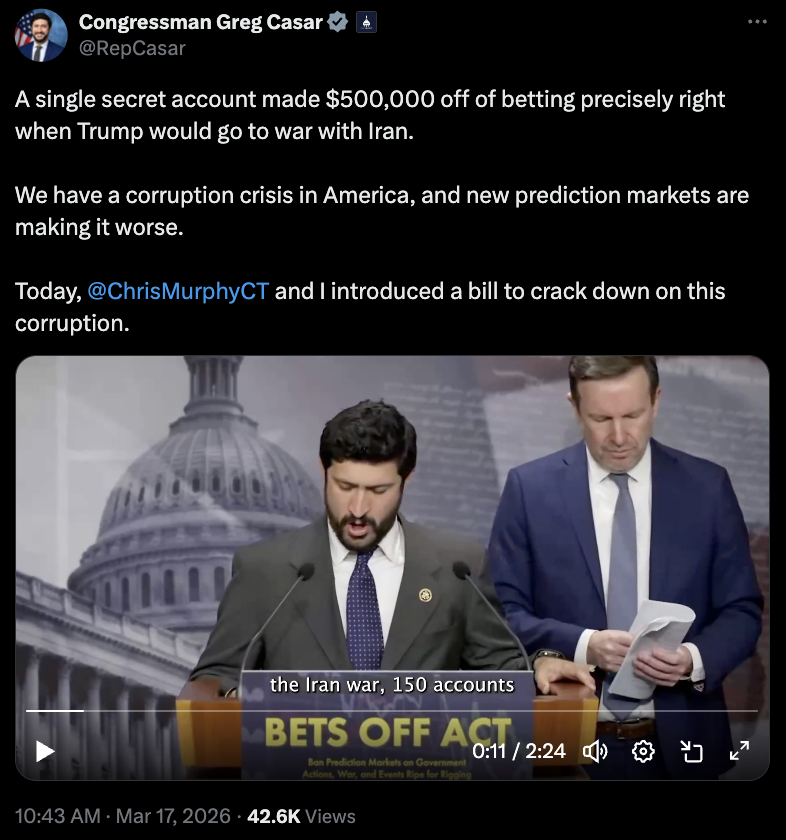
  Source: Representative Greg Casar


The bill is the latest twist in US lawmakers’ efforts to crack down on prediction market platforms and accounts allegedly using insider information to profit from government actions. Last week, California Senator Adam Schiff introduced the DEATH BETS Act to prevent prediction markets platforms from listing events contracts related to war, terrorism, assassination and individual deaths.

Platforms like Polymarket and Kalshi offer bets on a variety of outcomes, including sporting events and US politics. However, users betting on the specifics of the US-Israel conflict with Iran have ignited controversy in many areas of government. On Monday, a military correspondent with the Times of Israel said that he had received death threats over his report of the date when an Iranian missile had struck Israel, all “in order to resolve a prediction on Polymarket.”

War-related bets still live on Polymarket

As of Tuesday, Polymarket still offered users the opportunity to place bets on the outcomes of several potential decisions in the US-Israel conflict against Iran, including on whether the US would send ground forces into the country, when a ceasefire might happen, and changes to Iranian leadership.

“The promise of prediction markets is to harness the wisdom of the crowd to create accurate, unbiased forecasts for the most important events to society,” said Polymarket in a note on Middle East markets. “That ability is particularly invaluable in gut-wrenching times like today. After discussing with those directly affected by the attacks, who had dozens of questions, we realized that prediction markets could give them the answers they needed in ways TV news and [X, formerly Twitter] could not.”

Kalshi, in contrast, offered event contracts related to the Iranian conflict but not on specific military actions, such as if the country might reach a nuclear deal with the US and whether Trump or other elected officials might visit Iran.


Comments

All Comments

Recommended for you

  • Nvidia's 2028 Fiscal Year Revenue Outlook Exceeds Market Expectations, Pre-Market Up Nearly 6%

    On August 27, Nvidia's stock rose nearly 6% in pre-market trading. The company reported Q2 revenue of $96.2 billion for fiscal year 2027, a 106% year-over-year increase; adjusted earnings per share were $2.22, up 120% from the previous year. Nvidia's CFO stated during the earnings call that revenue for fiscal year 2028 is expected to grow by approximately 70%, significantly surpassing the market estimate of 45%. Nvidia's CEO Jensen Huang noted that this is the first time the company has provided performance guidance a year in advance.

  • China and the U.S. Maintain Communication on Presidential Interaction This Year

    On August 27, today, Foreign Ministry spokesperson Lin Jian hosted a regular press conference. A reporter asked about the high-level interactions between China and the U.S. In response, Lin Jian stated that both sides are maintaining communication regarding the arrangements for presidential interaction this year. (CCTV News)

  • China and the U.S. Maintain Communication on Presidential Interaction This Year

    On August 27, today, Foreign Ministry spokesperson Lin Jian hosted a regular press conference. A reporter asked about the high-level interactions between China and the U.S. In response, Lin Jian stated that both sides are maintaining communication regarding the arrangements for presidential interaction this year. (CCTV News)

  • Ministry of Commerce Responds to U.S. Consideration of Additional 7.5% Tariff on China

    On August 27, the Ministry of Commerce held a regular press conference. Spokesperson Huang Ling responded to questions regarding the U.S. government's consideration of imposing an additional 7.5% tariff on goods imported from China. She stated that the U.S. initiated a Section 301 investigation against 16 economies, including China, citing 'overcapacity' as a reason. This politicization of economic and trade issues is a typical act of unilateralism and protectionism, which China firmly opposes. We will continue to closely monitor and comprehensively assess the subsequent actions of the U.S. and reserve the right to take all necessary measures. (Xinhua News Agency)

  • Korean Stocks Rise 1.53%

    On August 27, the Korea Composite Stock Price Index closed up 104.16 points, an increase of 1.53%, ending at 6912.37 points. Among individual stocks, Samsung Electronics rose by 1.72%, while SK Hynix increased by 2.49%.

  • Korean Stocks Rise 1.53%

    On August 27, the Korea Composite Stock Price Index closed up 104.16 points, an increase of 1.53%, ending at 6912.37 points. Among individual stocks, Samsung Electronics rose by 1.72%, and SK Hynix increased by 2.49%.

  • Analyst: Market May Slightly Raise Fed Rate Hike Expectations Ahead of September Meeting

    On August 27, Reto Cueni, Chief Economist at Stifel Group, stated in a report that the market may slightly increase expectations for a Federal Reserve rate hike at the September meeting. However, he noted that the majority of the market still likely expects the Fed not to raise rates, and Stifel Group itself currently does not anticipate a rate hike. Cueni said, "At present, we continue to maintain the view that the Fed will not raise rates further in the second half of this year." According to LSEG data, the money market currently assigns a 65% probability that the Fed will keep rates unchanged at the September meeting.

  • Analyst: Market Rate Hike Expectations May Slightly Increase Before September Fed Meeting

    On August 27, news emerged that Reto Cueni, Chief Economist at Stifel Group, stated in a report that the market may slightly raise its expectations for a rate hike at the Federal Reserve's September meeting. However, he pointed out that the market still largely anticipates that the Fed will not raise rates, and Stifel Group itself does not currently believe a hike will occur. Cueni remarked, 'At this time, we maintain our judgment that the Fed will not raise rates further in the second half of this year.' According to LSEG data, the money market currently estimates a 65% probability that the Fed will keep interest rates unchanged at the September meeting.

  • Kuwait and Qatar Increase Oil Exports via Strait of Hormuz, Reaching 70% of Pre-Conflict Levels

    On August 27, the two smaller oil-producing countries in the Persian Gulf, Kuwait and Qatar, are increasing their crude oil shipments through the Strait of Hormuz, further boosting the oil transport volume in this waterway. Traders revealed that before the outbreak of the Iran war, the two countries combined exported about 2 million barrels of oil per day, and the current export volume has recovered to 70% of pre-conflict levels. The UAE was the first Gulf oil producer to resume large-scale oil exports through the Strait of Hormuz, using a method known as 'shuttle transportation' for ship-to-ship transfers in the Gulf of Oman. Subsequently, Saudi Arabia also joined in. Traders indicated that approximately 7 to 8 million barrels of oil are currently being exported daily through the Strait of Hormuz, up from about 4 million barrels in mid-July, which is roughly three-quarters of pre-war levels. Vortexa reported on Monday that the oil flow through this waterway is nearing 10 million barrels per day.

  • Kuwait and Qatar Increase Oil Exports via Strait of Hormuz, Volume Reaches 70% of Pre-Conflict Levels

    On August 27, the two smaller oil-producing countries in the Persian Gulf, Kuwait and Qatar, are increasing their crude oil shipments through the Strait of Hormuz, further boosting the oil transport volume in this waterway. Traders revealed that before the outbreak of the Iran war, the two countries combined exported about 2 million barrels of oil per day, and the current export volume has recovered to 70% of pre-conflict levels. The UAE was the first Gulf oil producer to resume large-scale oil exports through the Strait of Hormuz, using a method known as 'shuttle transport' for ship-to-ship transfers in the Gulf of Oman. Subsequently, Saudi Arabia also joined in. Traders indicate that approximately 7 to 8 million barrels of oil are currently being exported through the Strait of Hormuz daily, up from about 4 million barrels in mid-July, which is roughly three-quarters of pre-war levels. Vortexa reported on Monday that the oil flow through this waterway is approaching 10 million barrels per day.