

Cointime

Download App
iOS & Android

First crypto bill vote fails to get 100% Republican support despite Trump’s call

Cryptocurrency-related bills backed by US President Donald Trump failed to clear a key procedural step in the House of Representatives on Tuesday, despite the president’s public push for action.

Trump had urged Republican lawmakers to “get the first vote done this afternoon” on legislation to regulate payment stablecoins as part of a larger effort to pass crypto legislation before the August recess.

In a Tuesday post on his social media platform Truth Social, Trump ordered all Republicans to vote yes on the Guiding and Establishing National Innovation for US Stablecoins, or GENIUS Act, a bill designed to regulate payment stablecoins in the US.

The legislation is one of three bills, along with ones to address market structure and central bank digital currencies, that Republican House leaders had been pushing as part of the party’s “crypto week” plans.

The president may have been referring to a House resolution to consider the three bills and a defense bill, which failed to get support from a majority of lawmakers present on Tuesday — at least 13 Republicans may have voted against the resolution.

House Speaker Mike Johnson reportedly said the chamber would take up another vote “this afternoon.”
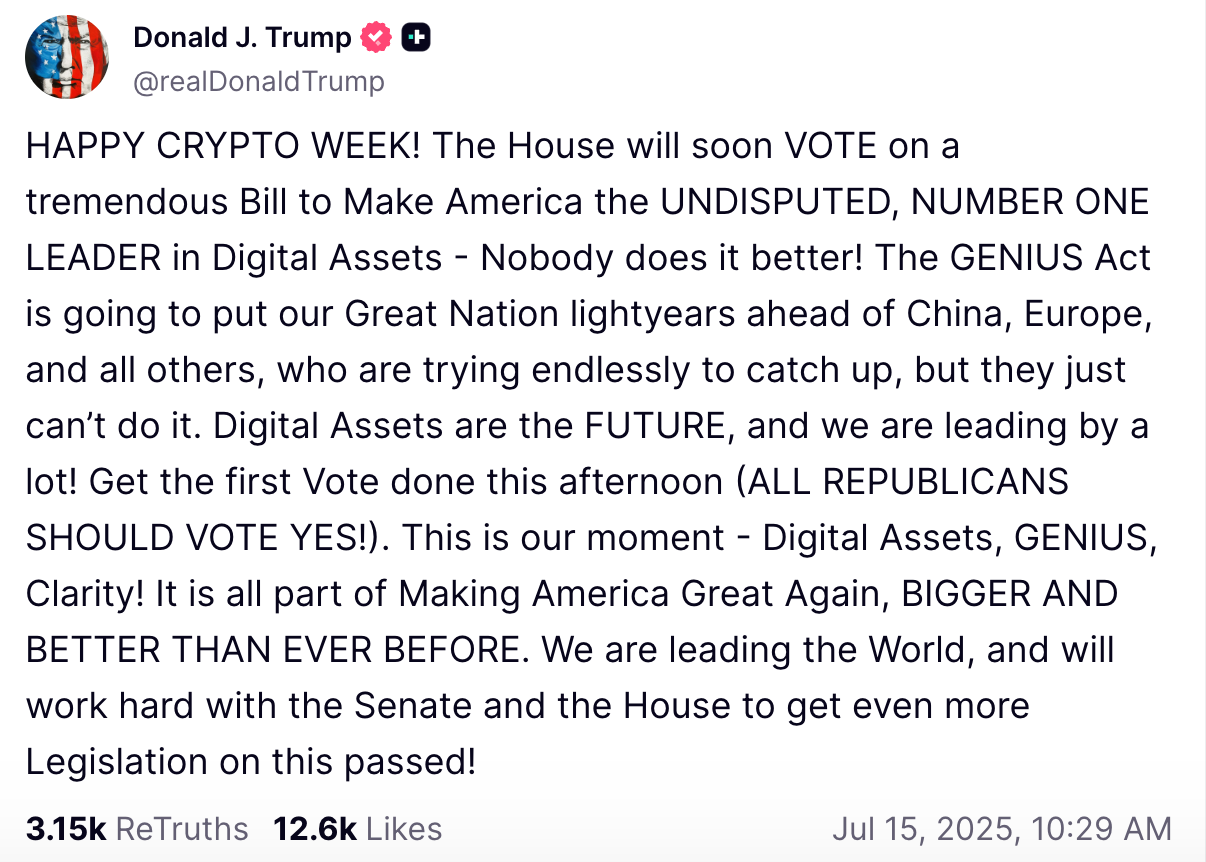
  Source: Donald Trump

The GENIUS Act, which passed through the Senate in June with bipartisan support despite initial resistance from many Democrats, is expected to head for a floor vote in the House by Thursday. At the time of publication, the bill was scheduled to be considered by the House sometime this week, but it was unclear whether the chamber planned a separate floor vote on Tuesday.

Signing off on a stablecoin law while investing in stablecoins?

Trump has personally come under scrutiny for his role in pushing the stablecoin legislation due to his involvement in his family-backed crypto company World Liberty Financial (WLF), which issued its own stablecoin and suggested a conflict of interest. Bloomberg reported on Friday that Binance helped create WLF’s USD1 stablecoin, also used by an Abu Dhabi-based investment firm to settle a $2 billion investment into the crypto exchange. 

“World Liberty Financial has received a significant portion of its funding from overseas, which has brought about serious ethical and national security concerns,” said California Representative Maxine Waters’ office on Tuesday, adding: “[F]oreign investment is not just a business deal, it’s a direct payment to the sitting US president with the goal of currying favor and influence within the White House.”

Many Democratic leaders have responded to Republicans’ push for the digital assets bills with their own “anti-crypto corruption week” agenda. They are calling for amendments in the three bills to address consumer protection and prevent the president, vice president, and members of Congress from holding or promoting crypto over concerns with conflicts of interest.


Comments

All Comments

Recommended for you

  • Nvidia's 2028 Fiscal Year Revenue Outlook Exceeds Market Expectations, Pre-Market Up Nearly 6%

    On August 27, Nvidia's stock rose nearly 6% in pre-market trading. The company reported Q2 revenue of $96.2 billion for fiscal year 2027, a 106% year-over-year increase; adjusted earnings per share were $2.22, up 120% from the previous year. Nvidia's CFO stated during the earnings call that revenue for fiscal year 2028 is expected to grow by approximately 70%, significantly surpassing the market estimate of 45%. Nvidia's CEO Jensen Huang noted that this is the first time the company has provided performance guidance a year in advance.

  • China and the U.S. Maintain Communication on Presidential Interaction This Year

    On August 27, today, Foreign Ministry spokesperson Lin Jian hosted a regular press conference. A reporter asked about the high-level interactions between China and the U.S. In response, Lin Jian stated that both sides are maintaining communication regarding the arrangements for presidential interaction this year. (CCTV News)

  • China and the U.S. Maintain Communication on Presidential Interaction This Year

    On August 27, today, Foreign Ministry spokesperson Lin Jian hosted a regular press conference. A reporter asked about the high-level interactions between China and the U.S. In response, Lin Jian stated that both sides are maintaining communication regarding the arrangements for presidential interaction this year. (CCTV News)

  • Ministry of Commerce Responds to U.S. Consideration of Additional 7.5% Tariff on China

    On August 27, the Ministry of Commerce held a regular press conference. Spokesperson Huang Ling responded to questions regarding the U.S. government's consideration of imposing an additional 7.5% tariff on goods imported from China. She stated that the U.S. initiated a Section 301 investigation against 16 economies, including China, citing 'overcapacity' as a reason. This politicization of economic and trade issues is a typical act of unilateralism and protectionism, which China firmly opposes. We will continue to closely monitor and comprehensively assess the subsequent actions of the U.S. and reserve the right to take all necessary measures. (Xinhua News Agency)

  • Korean Stocks Rise 1.53%

    On August 27, the Korea Composite Stock Price Index closed up 104.16 points, an increase of 1.53%, ending at 6912.37 points. Among individual stocks, Samsung Electronics rose by 1.72%, while SK Hynix increased by 2.49%.

  • Korean Stocks Rise 1.53%

    On August 27, the Korea Composite Stock Price Index closed up 104.16 points, an increase of 1.53%, ending at 6912.37 points. Among individual stocks, Samsung Electronics rose by 1.72%, and SK Hynix increased by 2.49%.

  • Analyst: Market May Slightly Raise Fed Rate Hike Expectations Ahead of September Meeting

    On August 27, Reto Cueni, Chief Economist at Stifel Group, stated in a report that the market may slightly increase expectations for a Federal Reserve rate hike at the September meeting. However, he noted that the majority of the market still likely expects the Fed not to raise rates, and Stifel Group itself currently does not anticipate a rate hike. Cueni said, "At present, we continue to maintain the view that the Fed will not raise rates further in the second half of this year." According to LSEG data, the money market currently assigns a 65% probability that the Fed will keep rates unchanged at the September meeting.

  • Analyst: Market Rate Hike Expectations May Slightly Increase Before September Fed Meeting

    On August 27, news emerged that Reto Cueni, Chief Economist at Stifel Group, stated in a report that the market may slightly raise its expectations for a rate hike at the Federal Reserve's September meeting. However, he pointed out that the market still largely anticipates that the Fed will not raise rates, and Stifel Group itself does not currently believe a hike will occur. Cueni remarked, 'At this time, we maintain our judgment that the Fed will not raise rates further in the second half of this year.' According to LSEG data, the money market currently estimates a 65% probability that the Fed will keep interest rates unchanged at the September meeting.

  • Kuwait and Qatar Increase Oil Exports via Strait of Hormuz, Reaching 70% of Pre-Conflict Levels

    On August 27, the two smaller oil-producing countries in the Persian Gulf, Kuwait and Qatar, are increasing their crude oil shipments through the Strait of Hormuz, further boosting the oil transport volume in this waterway. Traders revealed that before the outbreak of the Iran war, the two countries combined exported about 2 million barrels of oil per day, and the current export volume has recovered to 70% of pre-conflict levels. The UAE was the first Gulf oil producer to resume large-scale oil exports through the Strait of Hormuz, using a method known as 'shuttle transportation' for ship-to-ship transfers in the Gulf of Oman. Subsequently, Saudi Arabia also joined in. Traders indicated that approximately 7 to 8 million barrels of oil are currently being exported daily through the Strait of Hormuz, up from about 4 million barrels in mid-July, which is roughly three-quarters of pre-war levels. Vortexa reported on Monday that the oil flow through this waterway is nearing 10 million barrels per day.

  • Kuwait and Qatar Increase Oil Exports via Strait of Hormuz, Volume Reaches 70% of Pre-Conflict Levels

    On August 27, the two smaller oil-producing countries in the Persian Gulf, Kuwait and Qatar, are increasing their crude oil shipments through the Strait of Hormuz, further boosting the oil transport volume in this waterway. Traders revealed that before the outbreak of the Iran war, the two countries combined exported about 2 million barrels of oil per day, and the current export volume has recovered to 70% of pre-conflict levels. The UAE was the first Gulf oil producer to resume large-scale oil exports through the Strait of Hormuz, using a method known as 'shuttle transport' for ship-to-ship transfers in the Gulf of Oman. Subsequently, Saudi Arabia also joined in. Traders indicate that approximately 7 to 8 million barrels of oil are currently being exported through the Strait of Hormuz daily, up from about 4 million barrels in mid-July, which is roughly three-quarters of pre-war levels. Vortexa reported on Monday that the oil flow through this waterway is approaching 10 million barrels per day.