

Cointime

Download App
iOS & Android

Tokenized RWA market grows 420% since 2025 on regulatory clarity, access

The size of the tokenized real-world asset (RWA) market has increased by more than 420% since the start of 2025, as investors were treated to easier market access and regulatory clarity, according to analysts.

The RWA market cap was about $5.8 billion on Jan. 1, 2025, but has since risen to more than $30.2 billion as of Wednesday, according to analytics platform RWA.xyz. Tokenized US Treasurys experienced the largest increase, from $3.9 billion at the start of 2025 to more than $15 billion, followed by commodities.

Dominick John, an analyst at Zeus Research, told Cointelegraph the surge in the RWA sector was driven by tokenized Treasurys, which offer compliant onchain access to real-world yield and effectively turn blockchain rails into a distribution layer for institutional capital.

“Expansion into tokenized funds and equities has materially increased the addressable market. This points to a shift from speculative inflows toward yield-driven capital,” he said.
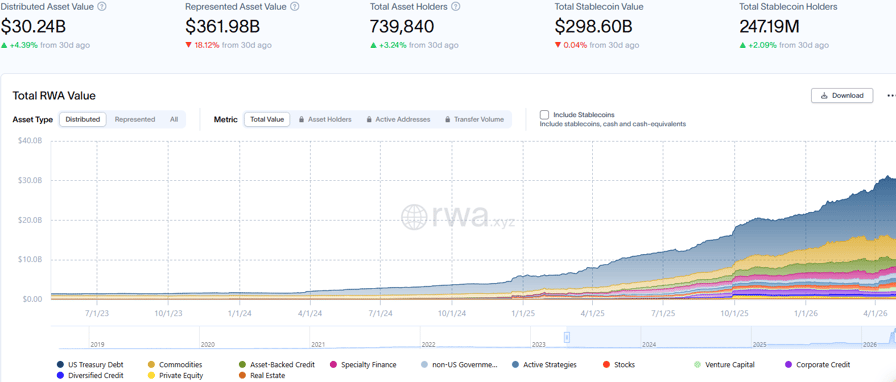
  The RWA market capitalization was around $30.2 billion as of Wednesday. Source: RWA.xyz


“Tokenized commodities like gold have gained traction, particularly amid heightened volatility from ongoing geopolitical tensions, as 24/7 markets unlock continuous liquidity and global access when traditional venues are closed,” the analyst added.  

Tokenization has been one of the drivers of institutional interest in blockchain and crypto over the past year. Cathie Wood’s ARK Invest predicts digital assets could grow into a $28 trillion market by 2030, with Bitcoin, decentralized finance, stablecoins and tokenized RWAs as key drivers.

Regulatory clarity coaxed institutional players into the market

Regulatory clarity through legislation such as Europe’s Markets in Crypto-Assets Regulation (MiCA) has also helped attract institutional players and fresh capital to the RWA sector, according to a Thursday report from crypto data aggregator CoinGecko.

Zhong Yang Chan, CoinGecko’s head of research, and research analyst Yuqian Lim said in the report that a few years ago, the RWA market rallied more on hype than substance. 

“However, the RWA sector has finally started to take shape from 2024 onward. Regulatory clarity has enabled major TradFi institutional players to dip their toes in. As early experiments paved the way by turning into best practices and playbooks, the pace of tokenization has noticeably accelerated,” they said.
  Source: CoinGecko


BlackRock’s USD Institutional Digital Liquidity Fund (BUIDL) went live in March 2024. The tokenized US Treasury fund provides onchain access to short-term US government debt. Fidelity followed suit in September 2025 with its own tokenized Fidelity Digital Interest Token (FDIT).

“2025 has proven to be a watershed year for RWAs. For both crypto-native and traditional players, competition within the RWA and tokenization stack has intensified, with issuers now differentiating on regulatory standing, asset coverage and distribution reach,” Zhong and Yuqian added.

Continued growth could depend on other areas of the sector 

Tokenized Treasurys and commodities have experienced the largest rise in the RWA sector, but in the long term, other areas will likely need to be catalysts for continued growth, said John of Zeus Research. 

“Growth remains strong as tokenized Treasurys keep absorbing capital and bring more institutions on board, but the rate of expansion should moderate as the easiest flow has been allocated,” he said.

“The next leg higher depends on whether tokenized equities, funds and private credit scale meaningfully.”


Comments

All Comments

Recommended for you

  • Russian Foreign Minister Lavrov: Meeting with U.S. Secretary of State Rubio Scheduled for Tomorrow

    On July 22, Russian Foreign Minister Lavrov stated that the meeting with U.S. Secretary of State Rubio has been scheduled for tomorrow.

  • Supermicro Surges Over 14% Pre-Market as Q4 Gross Margin Doubles Guidance, New Orders Exceed $60 Billion

    On July 22, AI server manufacturer Supermicro (SMCI.US) surged over 14% in pre-market trading to $29.17. On the news, the company released preliminary results for the fourth fiscal quarter ended June 30. The company's GAAP and non-GAAP gross margins are expected to be between 15% and 17%, nearly double the previously guided range of 8.2% to 8.4%. Management attributed this better-than-expected performance to favorable customer structure and product mix. Meanwhile, the company's total new orders for the quarter exceeded $60 billion, a record high.

  • US Optical Communication Stocks Fall in Pre-market, Marvell Down Over 2%

    On July 22, US optical communication concept stocks fell collectively in pre-market trading, with Astera Labs, Coherent, Credo Technology, Ciena, AXT Inc, and MaxLinear falling more than 3%, and Fabrinet, Lumentum, Corning, Applied Optoelectronics, Tower Semiconductor, Marvell Technology, POET Technologies, and GlobalFoundries falling more than 2%.

  • US AI chip stocks fall pre-market, Intel down 3%

    On July 22, US stock market AI chip stocks generally fell before the market open, with Intel down 3%, TSMC, AMD, and Qualcomm down over 2%, Broadcom down nearly 2%, and NXP and Nvidia down over 2%.

  • Russia Develops 150nm Lithography Machine, Performance Comparable to Pentium 4 from 20 Years Ago

    On July 22, according to Fast Technology, Russia's Green City Nanotechnology Center (ZNTC) has successfully developed a prototype of an electron beam lithography machine (ELL) with a design standard of 150nm. The project is a key research and development task under the framework of Russia's national plan for scientific and technological development, codenamed Progress ELL 150. This device is mainly used for manufacturing photomasks, and can also directly draw circuit patterns on substrates without using masks. The 150nm process roughly corresponds to the performance level of Intel's Pentium 4 from 20 years ago. In 2025, ZNTC demonstrated a similar device with 350nm resolution, and has now advanced to 90nm and 130nm technology nodes. Industry experts point out that such equipment is only suitable for small batch production of specialized chips in fields such as aerospace and defense.

  • Beijing State-owned Capital: Nearly 10 Billion Yuan Allocated to Stock Market from Own Funds

    On July 22, Beijing State-owned Capital Operation and Management Co., Ltd. announced that, as of now, it has allocated nearly 10 billion yuan from its own funds to invest in the stock market. Going forward, the company will continue to support listed company stocks using its own funds and through its subsidiaries, including securities firms and public funds, while also backing the development of the Beijing Stock Exchange. Rooted in its functional role as a state-owned capital operator, the firm is committed to safeguarding the strategic value of core assets of listed companies and contributing to the stable and healthy growth of the capital market through concrete actions, as a state-owned enterprise based in Beijing. (Beijing State-owned Capital)

  • U.S. Stock Futures Fall, Major Indices Decline

    U.S. stock futures are lower, with Nasdaq 100 futures down 1%, S&P 500 futures down 0.4%, and Dow futures down 0.3%.

  • Japan's Two-Year Government Bond Yield Rises to 1.47%, First Time Since 1995

    Japan's two-year government bond yield rose to 1.47%, the first time since 1995.

  • WTI and Brent Crude Surge Over 4%

    On July 22, international oil prices surged rapidly. WTI crude oil futures rose over 4% to $87.77 per barrel; Brent crude oil futures rose over 4% to $94.71 per barrel.