

Cointime

Download App
iOS & Android

AI drives surge in ‘bug bounty’ reports, but the ‘slop’ is rising too

Crypto protocols have warned that an increase in AI use has led to a flood of bogus bug bounty submissions, putting a strain on teams trying to identify real threats to their protocols. 

Bug bounties are a system to reward “good” hackers for submitting reports about potential vulnerabilities and are popular in the crypto industry. AI has now made it easier to sift through large amounts of code to find possible bugs, though AI is also known to hallucinate

“AI is changing the way that bug bounty programs must operate,” said Barry Plunkett, co-CEO of Cosmos Labs, on Tuesday, responding to a bug bounty hunter who accused the protocol of ignoring their vulnerability report. 
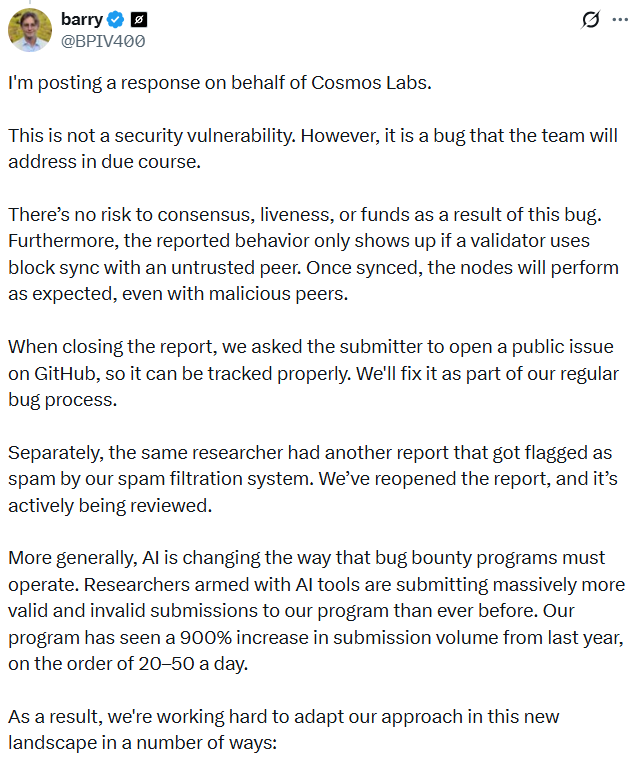
  Source: Barry Plunkett


“Our program has seen a 900% increase in submission volume from last year, on the order of 20-50 per day,” he said, adding that it’s led to a huge increase in both valid and invalid reports. 

Kadan Stadelmann, a blockchain developer and chief technology officer at Komodo Platform, told Cointelegraph he has also seen a notable increase in bug bounty submissions and payouts across organizations. 

“There has definitely been an increase in low-quality bug bounty submissions, some of which have been false positives, potentially suggesting AI sourcing. One potential explanation is that AI has caused a decrease in the cost to produce a report, resulting in an influx of submissions.” 

In January, Daniel Stenberg, the creator of the open-source data transfer tool curl, which is used in many apps, including blockchain infrastructure, announced he was ending his bug bounty program because of an influx of “AI slop in vulnerability reports,” and he was exhausted from sifting through them.
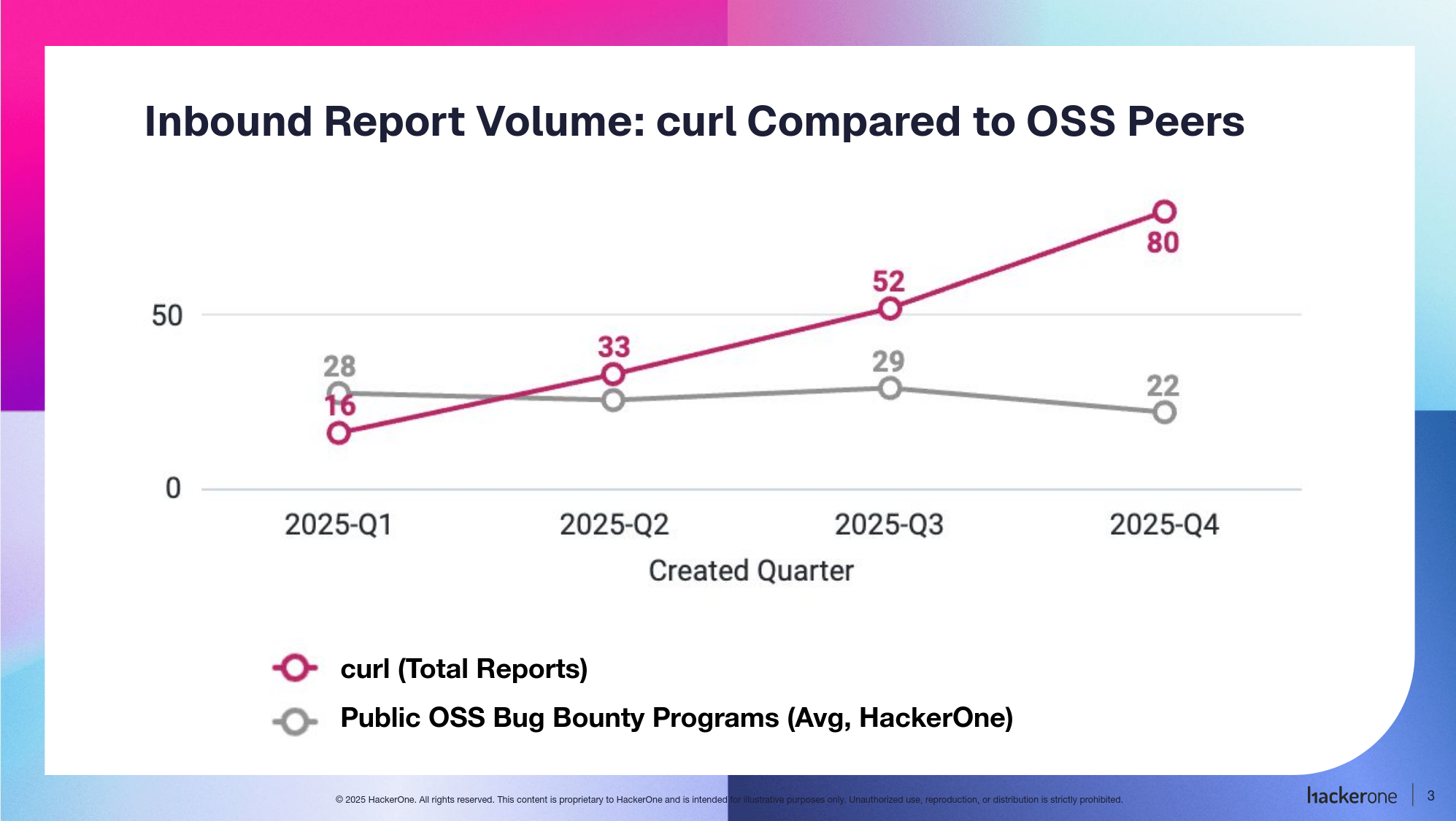
  The creator of the open-source data transfer tool curl said he has received an influx of bug bounty submissions. Source: Daniel Stenberg


HackerOne, one of the largest bug bounty platforms in the world, reported in January that there were 85,000 valid bounty submissions in 2025, up 7% from the previous year.

AI could be both the cause and the solution

Plunkett said Cosmos Labs has already started to adapt its approach as a result of the uptick in bug bounty submissions by tightening how it scores submissions, prioritizing trusted researchers with a proven track record and working with other bug bounty providers that offer more advanced triage.

Meanwhile, Stadelmann said bug bounty programs have proven integral to defending decentralized systems, and adopting AI to assist in sifting through the noise could be a solution.

“Blockchain teams will have to create AI deterrents to sift through incoming bug bounties. The smaller the team, the bigger the problem of increased bug bounties will become. Software engineers won't have the capacity to examine everything,” he said.

“This is where defensive AI systems to automatically sift through incoming bug bounties will be crucial. Teams dependent on bug bounties will need to develop stricter standards on their bug bounty programs as a means of lowering the number of incoming reports.”


Comments

All Comments

Recommended for you

  • Russian Foreign Minister Lavrov: Meeting with U.S. Secretary of State Rubio Scheduled for Tomorrow

    On July 22, Russian Foreign Minister Lavrov stated that the meeting with U.S. Secretary of State Rubio has been scheduled for tomorrow.

  • Supermicro Surges Over 14% Pre-Market as Q4 Gross Margin Doubles Guidance, New Orders Exceed $60 Billion

    On July 22, AI server manufacturer Supermicro (SMCI.US) surged over 14% in pre-market trading to $29.17. On the news, the company released preliminary results for the fourth fiscal quarter ended June 30. The company's GAAP and non-GAAP gross margins are expected to be between 15% and 17%, nearly double the previously guided range of 8.2% to 8.4%. Management attributed this better-than-expected performance to favorable customer structure and product mix. Meanwhile, the company's total new orders for the quarter exceeded $60 billion, a record high.

  • US Optical Communication Stocks Fall in Pre-market, Marvell Down Over 2%

    On July 22, US optical communication concept stocks fell collectively in pre-market trading, with Astera Labs, Coherent, Credo Technology, Ciena, AXT Inc, and MaxLinear falling more than 3%, and Fabrinet, Lumentum, Corning, Applied Optoelectronics, Tower Semiconductor, Marvell Technology, POET Technologies, and GlobalFoundries falling more than 2%.

  • US AI chip stocks fall pre-market, Intel down 3%

    On July 22, US stock market AI chip stocks generally fell before the market open, with Intel down 3%, TSMC, AMD, and Qualcomm down over 2%, Broadcom down nearly 2%, and NXP and Nvidia down over 2%.

  • Russia Develops 150nm Lithography Machine, Performance Comparable to Pentium 4 from 20 Years Ago

    On July 22, according to Fast Technology, Russia's Green City Nanotechnology Center (ZNTC) has successfully developed a prototype of an electron beam lithography machine (ELL) with a design standard of 150nm. The project is a key research and development task under the framework of Russia's national plan for scientific and technological development, codenamed Progress ELL 150. This device is mainly used for manufacturing photomasks, and can also directly draw circuit patterns on substrates without using masks. The 150nm process roughly corresponds to the performance level of Intel's Pentium 4 from 20 years ago. In 2025, ZNTC demonstrated a similar device with 350nm resolution, and has now advanced to 90nm and 130nm technology nodes. Industry experts point out that such equipment is only suitable for small batch production of specialized chips in fields such as aerospace and defense.

  • Beijing State-owned Capital: Nearly 10 Billion Yuan Allocated to Stock Market from Own Funds

    On July 22, Beijing State-owned Capital Operation and Management Co., Ltd. announced that, as of now, it has allocated nearly 10 billion yuan from its own funds to invest in the stock market. Going forward, the company will continue to support listed company stocks using its own funds and through its subsidiaries, including securities firms and public funds, while also backing the development of the Beijing Stock Exchange. Rooted in its functional role as a state-owned capital operator, the firm is committed to safeguarding the strategic value of core assets of listed companies and contributing to the stable and healthy growth of the capital market through concrete actions, as a state-owned enterprise based in Beijing. (Beijing State-owned Capital)

  • U.S. Stock Futures Fall, Major Indices Decline

    U.S. stock futures are lower, with Nasdaq 100 futures down 1%, S&P 500 futures down 0.4%, and Dow futures down 0.3%.

  • Japan's Two-Year Government Bond Yield Rises to 1.47%, First Time Since 1995

    Japan's two-year government bond yield rose to 1.47%, the first time since 1995.

  • WTI and Brent Crude Surge Over 4%

    On July 22, international oil prices surged rapidly. WTI crude oil futures rose over 4% to $87.77 per barrel; Brent crude oil futures rose over 4% to $94.71 per barrel.