


In Web2, the ownership and control of data is concentrated in the hands of a few large corporations. Although these corporations earn huge profits, they do not share them with users. For years, there has been a major problem with constant violations of user data security and privacy. At the same time, there have been lively discussions about the Web3 revolution in recent years. However, there seems to be little discussion of the changes in data ownership in this new context, and how it differs from Web2. RIDO’s mission is to explore data ownership in the context of Web3 and make efforts to promote the Web3 revolution.
Before we begin, let’s try to summarize the benefits of returning Web3 data ownership to users:
- Centralized companies and institutions cannot arbitrarily delete, control, or leak user data, thus ensuring the security of user data.
- User data can be used across platforms, improving the user experience. Cross-application use of data can also help new companies break the data monopoly of traditional large companies, promote competition, and drive innovation.
- Empower users to realize data assetization and data monetization, build data trading markets, and promote the development of DataFi.
At first glance, everything may appear beautiful, but on closer inspection, many problems arise. If data ownership is returned directly to users and they have full control over their data, the last two points above cannot be achieved. For instance, in the game League of Legends (LOL), a user’s level and win rate should belong to the user. However, if users can arbitrarily modify their level and win rate (e.g., level: invincible king, win rate: 120%), the “authenticity” of the data cannot be guaranteed. Untrustworthy data is likely to be unusable in applications, let alone monetized.
RIDO’s mission is to explore the reasons behind these problems and attempt to solve them.
I. How to Define Data Ownership in Web3
What changes from Web2 to Web3 have led to the issues mentioned above?
In Web2, centralized institutions control the generation, control, and use of data, and the security of data information is guaranteed by the reputation of these institutions. However, in Web3, data security should be guaranteed by the decentralized network, not by the data owner. Therefore, we need to redefine data ownership in Web3.
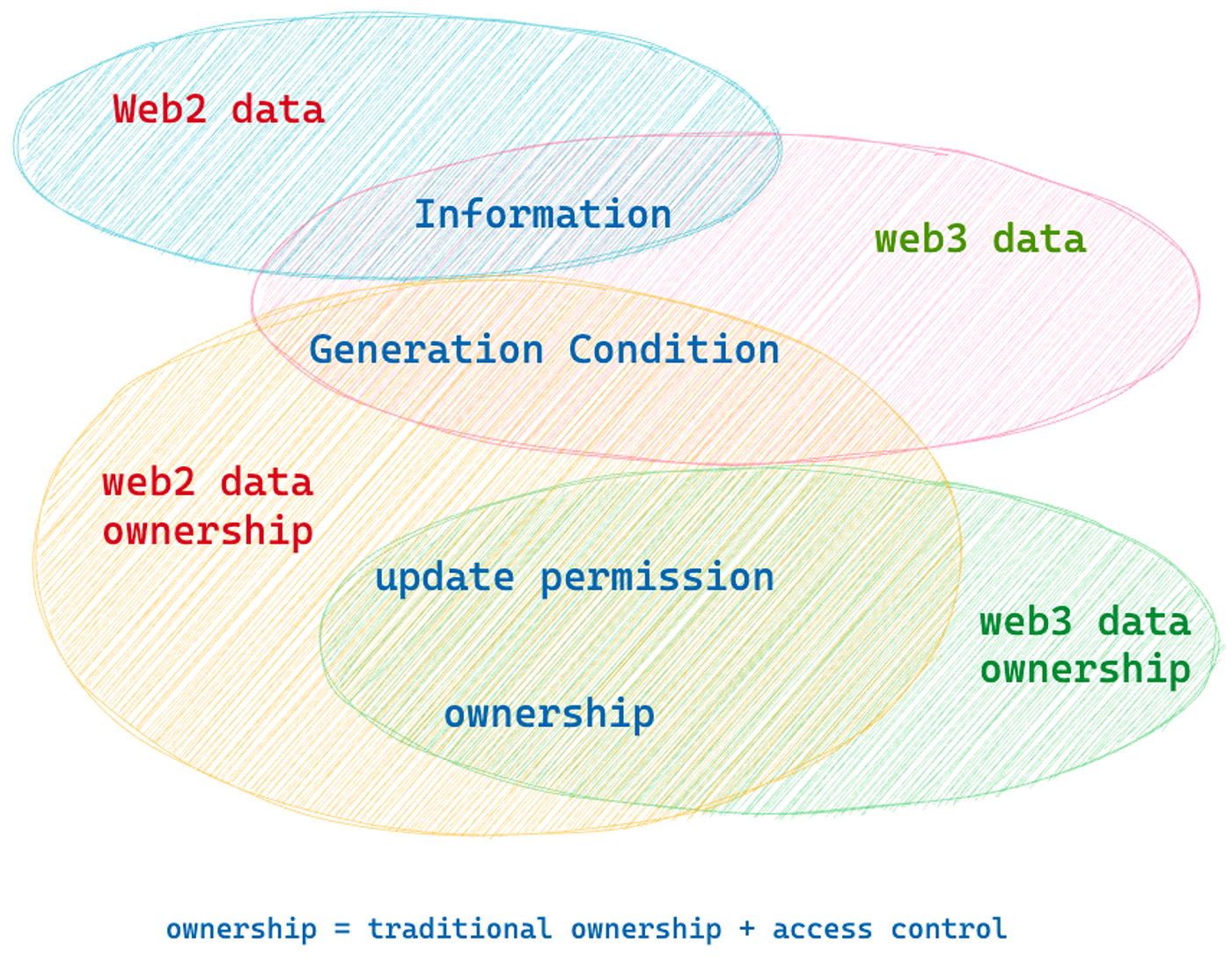
Data in Web2: Only the information itself (level and win rate), as well as the security of the information, is endorsed by centralized institutions.
Data in Web3: Includes information and the conditions for generating information. Information can only be modified according to established rules.For example, in a profile, the value of an EOA (Externally Owned Account) can only be set to address A if the user owns the private key of A. The security of the information is guaranteed by a decentralized network.
Data Ownership in Web2: The owner has full control over their data, including the ability to modify it and control access to it.
Data Ownership in Web3: The owner has the right to update data, but can only modify it according to the rules of modification. They own the data and can control access to it.
What RIDO Does
Figure 2 shows the difference between RIDO and Web3 data ownership 1.0, based on the redefinition of Web3 data ownership.

In Web3 data ownership 1.0, users have full control over their data, and access control is limited to basic permissions (NFT-izing CRUD permissions is the most common method). In RIDO, users only hold the data ownership and can implement any access control logic through coding (Anyone who sends me 1 usd can get my resume). Meanwhile, in RIDO, data structure can be defined along with the method of modifying the data through coding.(e.g. Only the holder of account A’s private key can write account A into their own profile.). RIDO also includes the option for data ownership trading. When defining data, it can be specified whether the data can be transferred. We will explain the meaning of data ownership transferability in detail later in this article.
Compared to existing decentralized storage protocols, RIDO completely liberates the rights brought to users by Web3.

II. How RIDO Works
After understanding the mission of RIDO, we will now introduce the architecture and design logic of RIDO.
1. Logical Architecture
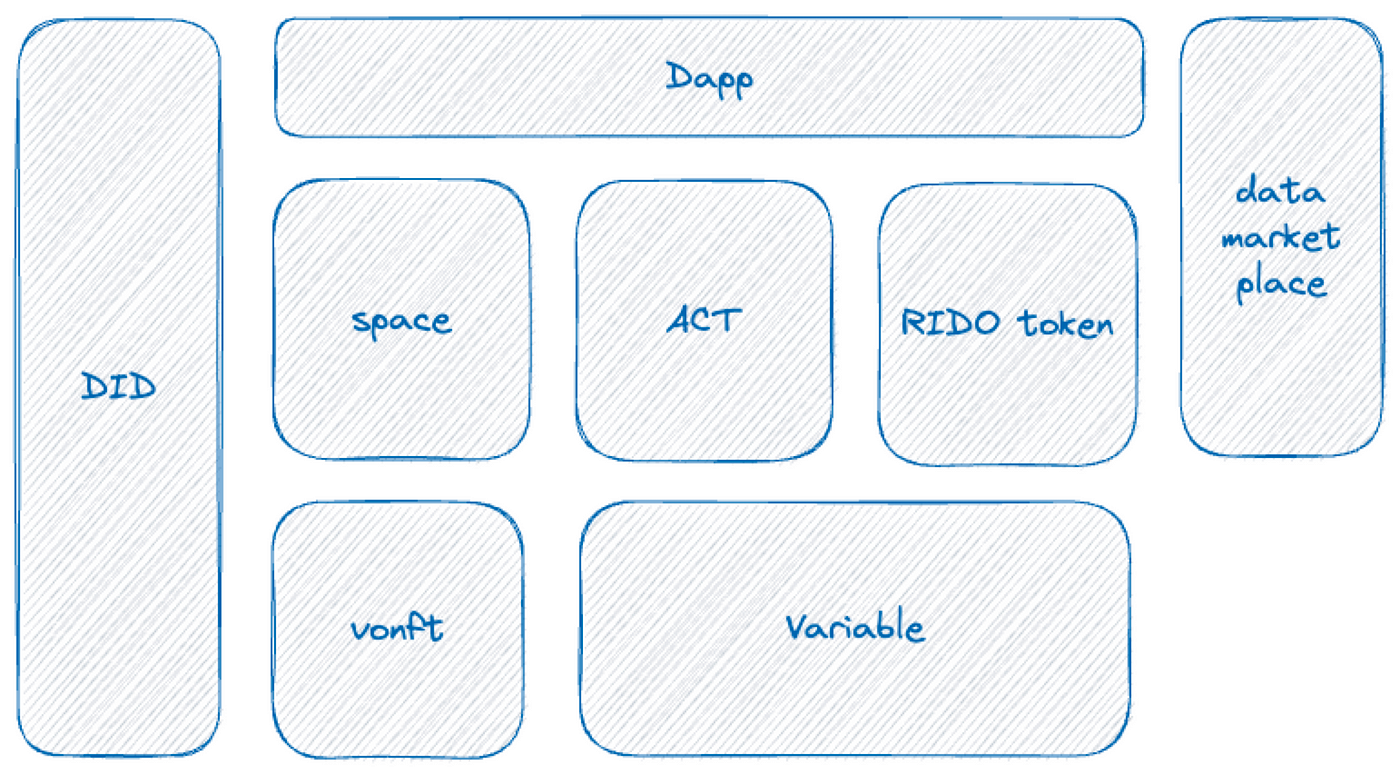
Variable: Data Definition
- Includes the structure of data;
- Rules for modifying data (VGF, variable generation function);
- Four access control methods: Users can set one or more of the following access control methods: 1) Public access: Users can set data to public status, allowing anyone to access it (e.g. blog). 2) Access control function (ACF): The data owner can define any logic that enables access to the data. (e.g. users holding BACY can access the data). 3) Access control token (ACT): Users who hold the data access control NFT can obtain data access control. 4) RIDO token access: Users can gain one-time access rights by spending RIDO.
VONFT: Data Ownership
- Each instance of a Variable is uniquely bound to a VONFT token that represents ownership of the Variable.
- VONFT can have two modes:1) SBT: VONFT is non-transferable. Building a reputation system based on valuable non-transferable data would be beneficial. 2) NFT: VONFT is transferable and ownership can be transferred by transferring the VONFT(reselling a game account).
DID: Abstract Account Implementation:
When a DID holds the VONFT corresponding to the data, it holds the ownership of the data. RIDO implements an abstract account through a proxy contract. This allows users to use any identity verification method, such as Metamask or Internet Identity. RIDO also supports session keys, which eliminates the need for secondary signatures within a certain period of time after one-time identity verification. This greatly improves the user experience, as non-session key implementations require wallet signatures for all operations.
2. System Architecture
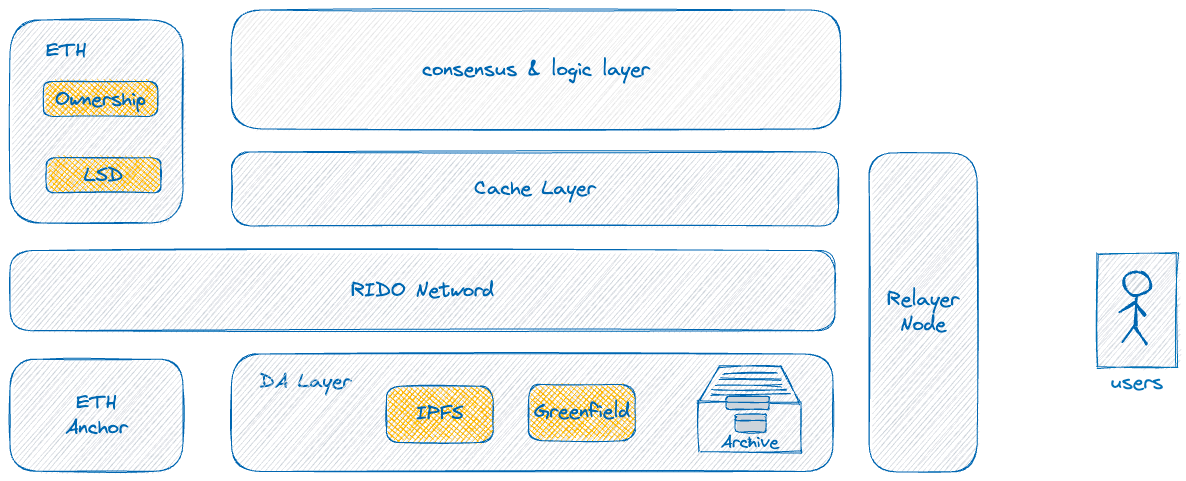
Consensus & Logic Layer & Cache Layer:
- The consensus & logic layer is responsible for executing both consensus and logic. All of the aforementioned logic modules are contained within this layer.
- Cache layer: This layer caches the state that is updated in the logic layer.
RIDO Network:
- Responsible for routing data in the cache layer to the DA layer.
- The RIDO network does not require consensus, as the system’s security is ensured by the consensus and logic layer.
- To ensure the security and running of the network, nodes in the RIDO network are elected through Ethereum’s LSD. Nodes that refuse to provide malicious services are punished.
DA Layer: More Stable, Cheaper Storage
- Users can choose to store their data in the DA layer for more stable and cost-effective storage. Currently, RIDO has chosen IPFS and Greenfield as its underlying storage, and in the future, RIDO will support more underlying storage options.
Relayer Node: Provides Data Indexing Services
- The primary function of the relayer node is to retrieve data from the DA layer and cache layer, reconstruct the data state, and build indexes on the data to provide services to users. The relayer node is permissionless, and any user can run their own relayer node and subscribe to the data they are interested in.
3. Workflow
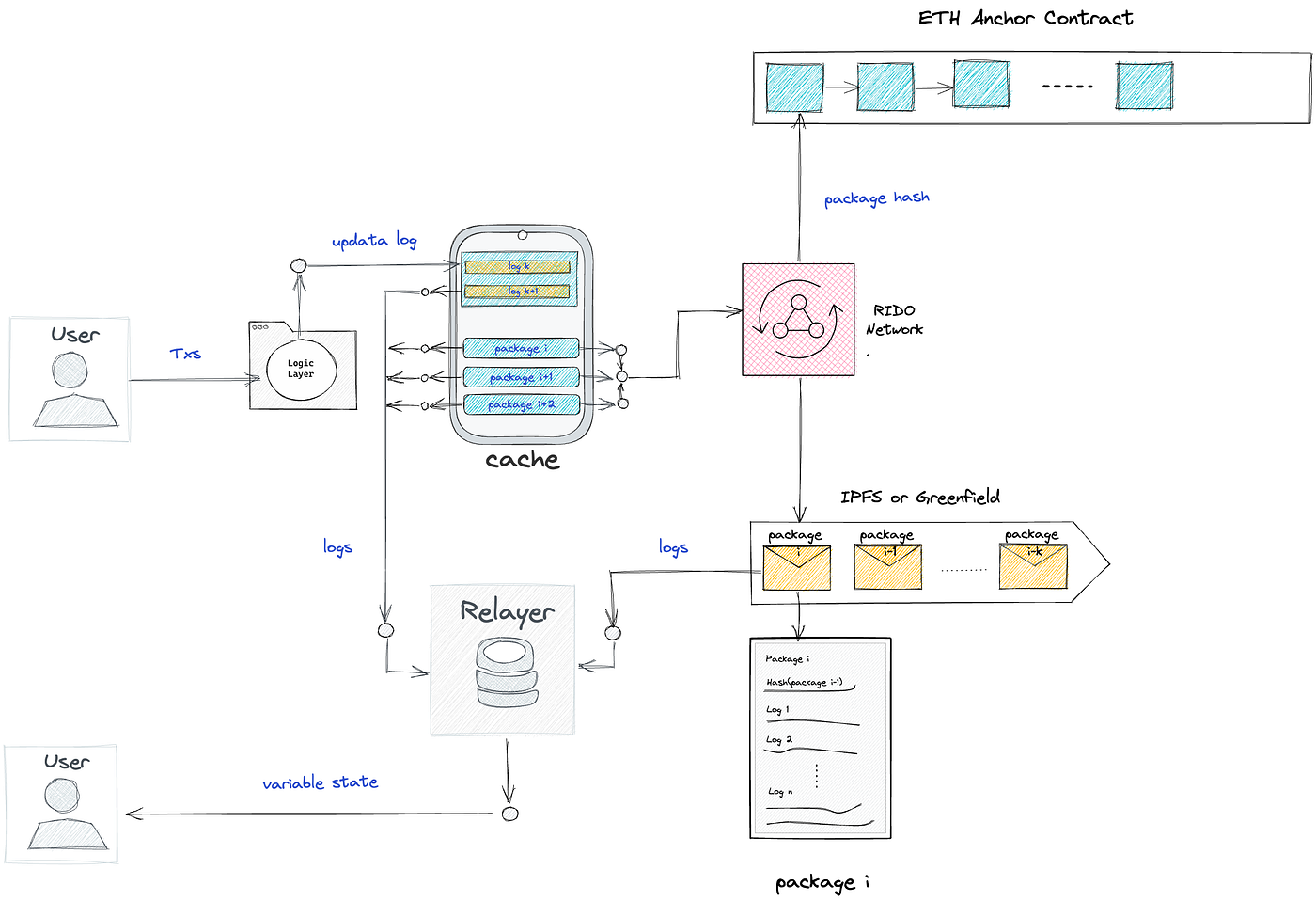
Figure 5 shows the workflow of RIDO:
- Users send transactions to relayer nodes.
2. Relayer nodes forward the transactions to the logic layer.
3. The logic layer checks the validity of the transaction, verifies whether the user has the right to modify data, modifies the data according to the defined rules, and caches the updated logs.
4. RIDO nodes store the updated data package in the DA layer.
5. The logic layer periodically checks whether the updated data package is stored in the DA layer based on the CID (computed locally in the logic layer) and clears the cached data that has already been stored.
6. RIDO nodes periodically update the hash values of the updated data package on ETH/Polygon/BSC.
7. Relayers retrieve logs from the DA layer and the logic layer, reconstruct the data state, and provide services to users.
III. Brainstorming Time:

Pretending to be serious for so long has exhausted me.
Finally, let’s be relaxed and try to brainstorm some applications and scenarios for RIDO.
Cross-Platform Data Sharing: Application Shared Data
Aside: “To be honest, this feature is a feature of web3, not unique to RIDO, so it seems familiar. So feel free to disregard it.”
- DID holds programmable storage space (Aside: “I can only think of examples such as identity authentication, Ethereum address verification, and Twitter account verification. Although most DIDs are capable of these functions, there may be other possibilities.”)
- Sharing content and relationships on social applications.(Aside: “While LENS is already available and I believe it is a good option, using RIDO may improve the interaction between different types of variables.”)
- In gaming, data sharing between different games and cross-platform linkage among different games is important. (Aside: “Implementing situations like “Justice League vs. Avengers,” “Sun Wukong vs. Ultraman.”)
In summary, it appears that RIDO can fulfill all of its current functions, but it is challenging to envision new ones. However, one possibility is to strengthen the interaction between data in RIDO, allowing for easy interaction between data that is defined within the system.
Data Trading Market (DataFi)
In the context of the data market, the value of data can be divided into two parts: the information that the data carries and the ownership of the data. We believe that both of these aspects have trading value.
- Data Ownership: The value of data ownership lies in the data itself rather than the information carried by the data. A common example is game accounts, where the value of the account is not in obtaining information such as level and experience, but rather in owning the level and experience. In simpler terms, it means that it doesn’t matter if I know an account is level 100, but it is very important if that level 100 account belongs to me.
- Information carried by data: This could refer to data trading in the traditional sense, such as knowledge payment and headhunters obtaining resumes. The information contained in RIDO data has clear generation conditions and usage scenarios, making it feasible to construct a data information trading market.
- Helping users realize monetization has been talked about for a long time, but it seems that no project has really taken off, and it has not even reached the step of verifying data correctness and value (which RIDO needs to solve). After some discussion, we came up with a feasible solution, which is to let the data user propose the demand, and the user will generate the data needed. A specific scenario is the search and recommendation feature on traditional internet platforms. In this case, the data user is primarily the application itself. For instance, on TikTok, users generate data that TikTok collects and analyzes for delivery.The same concept applies to RIDO, with the caveat that in this case, data ownership belongs to the user. The application must compensate the user for using their data, and the user can also sell their data to other project parties for their use.We want to emphasize that in order to help users monetize their data, it is likely that the user will need to generate data based on the demands of the data consumer.
2. Data Lego: Third parties can directly build verifiable high-level data on the chain based on existing data, and provide services to the public.
Dynamic NFT
Dynamic NFTs are very interesting. Just imagine if an NFT had a programmable storage space. Wouldn’t that make the NFT a piece of executable code? Combining several executable codes together results in a mini-program. These mini-programs can be combined using non-fungible tokens (NFTs), where each NFT has separate ownership and can be traded. Mini-programs can also be NFTs composed of multiple NFTs. While the possibilities are interesting, we are still exploring them.(Shareverse is a kind of exploration). (Aside: “Don’t ask me what specific applications there are, we are still coding, no, still exploring”)
Matrix (Aside: “Now, i am going to talk about science fiction”)
AI is currently developing rapidly, and the topic of “digital immortality” has once again come to the public’s attention(Aside: “Wasn’t this thing previously just science fiction? When did it enter the public eye?”). When discussing digital life, it’s impossible to avoid the topic of data ownership.If someone were to take your consciousness to conduct various strange experiments, it would be unacceptable both ethically and emotionally. (Aside: “recommend watching the movie ’Jung_E’ a science fiction film supported by Netfenix”. RIDO provides a possibility to solve this problem, and we can now use AI to make some preliminary attempts on RIDO:
- Using RIDO to store the memory of a personal AI in a long-term AI model.
- With AI, use personal data in RIDO to generate personal robots that can perform
- ####Automatic message reply
- ####Auxiliary governance (voting in Dao, agency)
Aside: “actually this article was completed with the help of GPT. Science fiction comes into reality, ai is amazing”
Reputation System
The last cool idea I thought of is a reputation system. (Aside: “Although I used to feel that building a reputation system on blockchain, a technology that achieves consensus without relying on trust, felt like it was contradictory, but anyway, let me try to talk about it”.)
I believe the reason why the reputation system on the blockchain cannot succeed is that most of the value of an account resides in its assets. When an account’s assets are transferred away, the account ceases to have value. However, believe that there is still a lot of data that is difficult to capitalize but has high value. For example, an account has 1 million fans. An account with 1 million fans is very valuable, but it is difficult to transfer these 1 million fans through capitalization. Therefore, the value of the 1 million fans is deposited on the account, and when the value deposited by an account has accumulated enough, a reputation system can be constructed based on the value of the account.”
(Aside: Okay, I can’t make anything up anymore.)
Come on: “This is the extent of my imagination, but our imagination is infinite. Therefore, any idea, any brainwave, can be annoying anytime, anywhere. Let’s not worry about whether it’s feasible, just consider whether it can bring a little bit of difference, even if it’s just a little bit, even if the person who brings about change is not us in the end.” — —From Rido Team


All Comments