

Australia’s financial regulator has urged young investors not to rely on social media influencers and artificial intelligence chatbots to make financial decisions, according to a study that also found that one in four “Gen Zs” invest in crypto.
The Australian Securities and Investments Commission (ASIC) posted the results of a survey on Sunday, finding that Gen Z has high levels of trust in “often unreliable sources,” which has contributed to riskier financial decisions.
“Moneysmart’s Gen Z study found that while Gen Z has a strong appetite for reputable and trustworthy financial content, many struggle to find it – and their search often leads them to sources designed for engagement rather than accuracy,” ASIC said.
ASIC took action against influencers over their financial social media content last year in June, issuing warning notices to 18 influencers “suspected of unlawfully promoting high-risk financial products and providing unlicensed financial advice.”
The latest survey, conducted between Nov. 28 and Dec. 10 last year with 1,127 respondents between 18 and 28, found that 63% of the group uses social media for financial information and guidance, while 18% use artificial intelligence (AI) platforms and 30% said they use YouTube specifically.
It also found that 56% of Gen Z say they “somewhat or completely trust” financial information on social media, with 52% saying the same of “finfluencers” — social media influencers primarily covering financial or investment niches who appear well-versed in finance.
AI, however, ranked as the most trusted source at 64%.
ASIC calls for caution on crypto influencers
The survey also showed that 23% of Gen Z now own crypto in Australia, with 29% of these trading based on social media and influencer content, prompting a warning that influencers may “set unrealistic expectations” about investment returns, market volatility, and the intricacies of long-term investing.
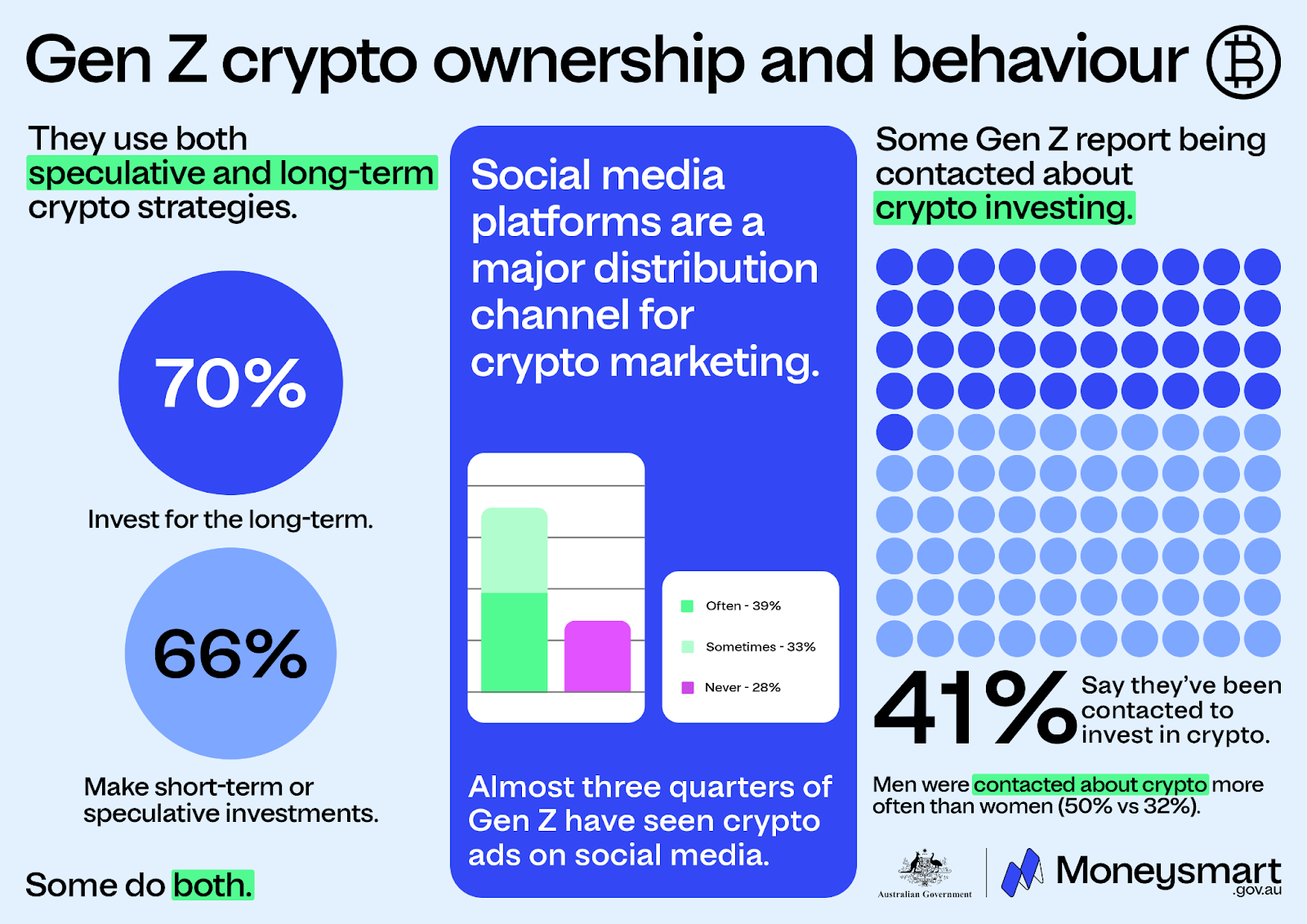
Speaking with the Australian Financial Review (AFR) on Sunday, ASIC commissioner Alan Kirkland said the regulator has been keeping an eye on marketing activity designed to drive people to make investments, noting some of them are scams.
“We’re conscious that there’s a lot of marketing activity on social media to encourage crypto investment, and our work has shown some that is actually encouraging people to invest in scams,” Kirkland said.
“It’s really important for people to be aware of those risks, because you don’t see that same volatility in other types of investments and often that volatility is driven by forces that it’s impossible for an individual sitting in Australia to understand,” he added.
Kirkland also flagged Australian superannuation funds — a $4.5 trillion market made of retirement funds — as an area in which unqualified influencers are offering advice.
“We see it most where people are lured in through social media ads and then encouraged to switch their super, because super is often people’s most valuable asset, and that’s why disreputable people often target it and why it can be so tragic if people are encouraged to put it into a risky investment,” he said.
ASIC has AI financial advice in its crosshairs
Kirkland also told the AFR that ASIC is “watching very closely” what types of financial information are being derived from AI tools. The commissioner warned that licenses are required for anything that gives out information representing concrete financial recommendations.
“It is clear under Australian law that if any entity is giving financial advice, they need to be licensed. So if an AI tool, whoever’s providing it, is actually making recommendations about individual financial products, taking into account individual circumstances, that would be personal advice, so it needs to be licensed,” he said.
ASIC’s concerns come amid a number of crypto exchanges that have already integrated AI bots into their services to offer personalized trading guidance or “trading partners”, including the likes of MEXC, KuCoin and Bitget.
“One of the most surprising findings from this research was the degree of trust young people are placing in AI platforms,” he said, adding:
“Depends very much on the nature of the questions you’re asking, how specific those questions are and the quality of the sources that AI is able to draw upon in order to serve us the results.”
AI financial information is not the only area ASIC is eyeing this year. In late January, the regulator warned that any crypto or AI firms exploiting licensing gray areas around payments in Australia will be one of its top priorities in 2026.


All Comments